
The Neural System Keeps the Rhythm
Human beings have a significant ability to maintain and moderate the respiratory rhythm to suit the demands of the body tissues, and this is done by the neural system.
Breathing is not a fixed clock. It quickens when you climb a flight of stairs and settles again when you sit down, and that adjustment is made for you, without a decision, by the brain.
The respiratory rhythm centre is a specialised centre present in the medulla region of the brain, and it is primarily responsible for this regulation.
The pneumotaxic centre is present in the pons region of the brain and can moderate the functions of the respiratory rhythm centre. Neural signals from this centre can reduce the duration of inspiration and thereby alter the respiratory rate.
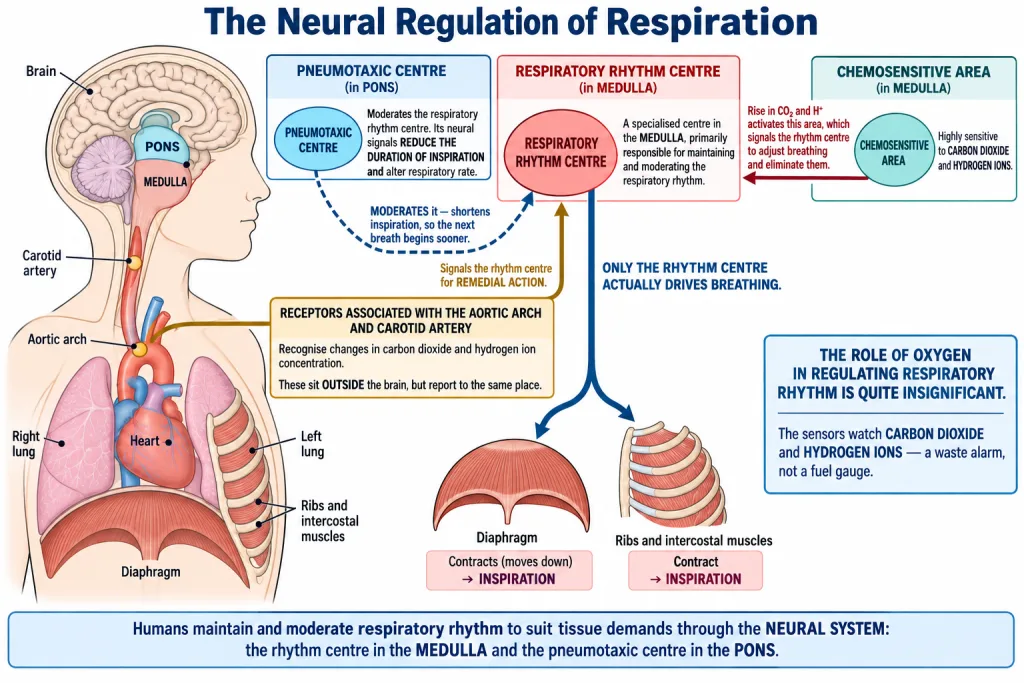
So the medulla sets the beat and the pons trims it. Shortening inspiration is the only action the chapter gives the pneumotaxic centre. It does not start breathing and it does not stop it - it cuts inspiration short, so the next breath begins sooner and the respiratory rate goes up.
[NEET Important] The rhythm centre is in the medulla; the pneumotaxic centre is in the pons. These two regions are swapped in option lists more often than anything else in this section, and "which region of the brain holds which centre" is a straight one-mark question. Learn each name locked to its region - rhythm in the medulla, pneumotaxic in the pons - and learn the pneumotaxic centre's single job: it reduces the duration of inspiration.
The Chemical Sensors - Carbon Dioxide and Hydrogen Ions
The centres in the brain need to be told what the blood is like before they can adjust anything, and the chapter names two sets of sensors that do the telling.
A chemosensitive area is situated adjacent to the rhythm centre, and it is highly sensitive to carbon dioxide and hydrogen ions. An increase in these substances activates this centre, which signals the rhythm centre to make the necessary adjustments so that these substances can be eliminated.
That is the whole loop in one sentence. A rise in and is detected, the rhythm centre is told, breathing is adjusted, and the excess is blown off at the alveoli.
Receptors associated with the aortic arch and the carotid artery also recognise changes in carbon dioxide and hydrogen ion concentration and send necessary signals to the rhythm centre for remedial actions.
Notice that these receptors sit out on the blood vessels, not in the brain - but they report to the same place, the rhythm centre.
The four structures, side by side
| Structure | Where it sits | What it does |
|---|---|---|
| Respiratory rhythm centre | the medulla region of the brain | primarily responsible for maintaining and moderating the respiratory rhythm |
| Pneumotaxic centre | the pons region of the brain | moderates the functions of the rhythm centre; its signals reduce the duration of inspiration and thereby alter the respiratory rate |
| Chemosensitive area | adjacent to the rhythm centre | highly sensitive to carbon dioxide and hydrogen ions; when they rise it signals the rhythm centre to make adjustments so these substances are eliminated |
| Receptors of the aortic arch and the carotid artery | on the aortic arch and the carotid artery | recognise changes in carbon dioxide and hydrogen ion concentration and send signals to the rhythm centre for remedial actions |
Read the "what it does" column as a direction of traffic. The chemosensitive area and the aortic and carotid receptors send information IN to the rhythm centre. The pneumotaxic centre modifies the rhythm centre. Only the rhythm centre actually drives the breathing.
[NEET Important] The chemosensitive area is sensitive to carbon dioxide and hydrogen ions - not to oxygen. And be exact about position: the chemosensitive area is adjacent to the rhythm centre, so it is in the medulla, while the aortic arch and carotid artery receptors are outside the brain altogether. A question that puts the chemosensitive area in the pons, or hands the aortic receptors to the pneumotaxic centre, is testing this table.
The Role of Oxygen Is Quite Insignificant
The role of oxygen in the regulation of respiratory rhythm is quite insignificant.
That one line is the most examined sentence in the whole section, and it is also the one students most often get backwards. It feels obvious that a shortage of oxygen should be what makes you breathe. The chapter says plainly that it is not. What the sensors watch is carbon dioxide and hydrogen ions.
- The chemosensitive area is highly sensitive to carbon dioxide and hydrogen ions.
- The aortic arch and carotid artery receptors recognise changes in carbon dioxide and hydrogen ion concentration.
- Neither is described as an oxygen sensor, and oxygen is given no regulatory job at all.
Think of it as a waste alarm rather than a fuel gauge. The body regulates breathing by watching what has to be thrown out, not by watching what is running low.
[NEET Important] "The role of oxygen in the regulation of respiratory rhythm is quite insignificant." Learn it in those words. The distractor you will be offered is an option saying that a fall in oxygen is the main stimulus for breathing - it is wrong, and carbon dioxide and hydrogen ions are the answer every time this is asked.
Quick Recap
- Human beings can maintain and moderate the respiratory rhythm to suit the demands of the body tissues, and this is done by the neural system.
- The respiratory rhythm centre is in the medulla region of the brain and is primarily responsible for this regulation.
- The pneumotaxic centre is in the pons region of the brain and can moderate the functions of the respiratory rhythm centre.
- Signals from the pneumotaxic centre reduce the duration of inspiration and thereby alter the respiratory rate.
- A chemosensitive area is situated adjacent to the rhythm centre and is highly sensitive to carbon dioxide and hydrogen ions.
- An increase in these substances activates the chemosensitive area, which signals the rhythm centre to make the necessary adjustments so that these substances can be eliminated.
- Receptors associated with the aortic arch and the carotid artery also recognise changes in carbon dioxide and hydrogen ion concentration and send necessary signals to the rhythm centre for remedial actions.
- The role of oxygen in the regulation of respiratory rhythm is quite insignificant.
- Direction of traffic: chemosensitive area and aortic or carotid receptors report IN to the rhythm centre; the pneumotaxic centre modifies the rhythm centre; the rhythm centre drives breathing.
Solved Examples
Question 1
Q. Which system carries out the regulation of the respiratory rhythm in human beings?
Answer. The neural system. Human beings have a significant ability to maintain and moderate the respiratory rhythm to suit the demands of the body tissues, and that ability is neural.
Question 2
Q. Name the centre primarily responsible for regulating respiration and say exactly where it lies.
Answer. The respiratory rhythm centre, a specialised centre present in the medulla region of the brain.
Question 3
Q. Where is the pneumotaxic centre, and what does it do?
Answer. It is present in the pons region of the brain, and it can moderate the functions of the respiratory rhythm centre.
Question 4
Q. What single effect do neural signals from the pneumotaxic centre have?
Answer. They reduce the duration of inspiration and thereby alter the respiratory rate. Shortening inspiration is the only action the chapter gives this centre - a shorter inspiration means the next breath starts sooner, so the rate rises.
Question 5
Q. Where is the chemosensitive area, and what is it sensitive to?
Answer. It is situated adjacent to the rhythm centre, and it is highly sensitive to carbon dioxide and hydrogen ions.
Question 6
Q. What happens when carbon dioxide and hydrogen ions rise in the blood?
Answer. The increase in these substances activates the chemosensitive area. That centre in turn signals the rhythm centre to make the necessary adjustments in the respiratory process, by which these substances can be eliminated.
Question 7
Q. Which receptors outside the brain take part in regulating respiration, and what do they do?
Answer. Receptors associated with the aortic arch and the carotid artery. They recognise changes in carbon dioxide and hydrogen ion concentration and send necessary signals to the rhythm centre for remedial actions.
Question 8
Q. How important is oxygen in the regulation of the respiratory rhythm?
Answer. The role of oxygen in the regulation of respiratory rhythm is quite insignificant. The sensors watch carbon dioxide and hydrogen ions, not oxygen.
Question 9
Q. How is respiration regulated? This is one of the chapter-end exercises.
Answer. Respiration is regulated by the neural system. Human beings have a significant ability to maintain and moderate the respiratory rhythm to suit the demands of the body tissues, and four structures share the work.
- The respiratory rhythm centre. This is a specialised centre present in the medulla region of the brain, and it is primarily responsible for this regulation. It is the centre that actually drives the rhythm of breathing.
- The pneumotaxic centre. This is present in the pons region of the brain and can moderate the functions of the respiratory rhythm centre. Neural signals from this centre can reduce the duration of inspiration and thereby alter the respiratory rate.
- The chemosensitive area. This is situated adjacent to the rhythm centre and is highly sensitive to carbon dioxide and hydrogen ions. An increase in these substances activates this centre, which in turn signals the rhythm centre to make the necessary adjustments in the respiratory process, so that these substances can be eliminated.
- Receptors associated with the aortic arch and the carotid artery. These also recognise changes in carbon dioxide and hydrogen ion concentration and send necessary signals to the rhythm centre for remedial actions.
And the closing point that carries a mark of its own: the role of oxygen in the regulation of respiratory rhythm is quite insignificant.
Question 10
Q. A student writes: "When the oxygen in my blood falls, my brain senses it and makes me breathe faster." Correct the statement.
Answer. The statement is wrong. The role of oxygen in the regulation of respiratory rhythm is quite insignificant. What is sensed is a rise in carbon dioxide and hydrogen ions - by the chemosensitive area next to the rhythm centre, and by the receptors on the aortic arch and the carotid artery. They signal the rhythm centre, which adjusts breathing so that these substances are eliminated.
Question 11
Q. Name the two regions of the brain involved in regulating respiration and the centre each one holds.
Answer. The medulla holds the respiratory rhythm centre. The pons holds the pneumotaxic centre. The chemosensitive area lies adjacent to the rhythm centre, so it too is in the medulla region.
Question 12
Q. You hold your breath for as long as you can. Why do you eventually have to breathe, and which sensor forces the issue?
Answer. Because carbon dioxide and hydrogen ions build up in the blood while you hold your breath. The chemosensitive area, which is highly sensitive to these substances, is activated and signals the rhythm centre to make the necessary adjustments so that they can be eliminated. The receptors on the aortic arch and the carotid artery send the same message. It is the rise in carbon dioxide, not the fall in oxygen, that ends the breath-hold.
Question 13
Q. Which structures send signals TO the rhythm centre, and which structure modifies it?
Answer. Sending signals in: the chemosensitive area, and the receptors of the aortic arch and the carotid artery - both report changes in carbon dioxide and hydrogen ion concentration. Modifying it: the pneumotaxic centre of the pons, whose signals reduce the duration of inspiration. Only the respiratory rhythm centre itself drives the breathing.