
Two Stages, One Pressure Gradient
Breathing involves two stages: inspiration, during which atmospheric air is drawn in, and expiration, by which the alveolar air is released out.
The movement of air into and out of the lungs is carried out by creating a pressure gradient between the lungs and the atmosphere. Air cannot choose where to go. It moves from the side of higher pressure to the side of lower pressure, and the entire mechanism of breathing is only the body arranging which of the two sides is higher.
The pressure inside the lungs has its own name - the intra-pulmonary pressure - and the two stages are defined against the atmosphere by that one value.
- Inspiration can occur if the pressure within the lungs - the intra-pulmonary pressure - is less than the atmospheric pressure, that is, there is a negative pressure in the lungs with respect to atmospheric pressure.
- Expiration takes place when the intra-pulmonary pressure is higher than the atmospheric pressure.
"Negative pressure" here does not mean less than nothing. It means less than the pressure of the air outside, and that is the sense in which the chapter uses the word.
The diaphragm and a specialised set of muscles - the external and internal intercostals between the ribs - help in the generation of such gradients. So there are two muscle groups in the machinery, the diaphragm below and the inter-costal muscles between the ribs, and neither of them is inside the lung.
[NEET Important] The direction of the inequality is the whole question. Intra-pulmonary pressure less than atmospheric gives inspiration; higher than atmospheric gives expiration. A very common distractor reverses this, or says air is "pumped" into the lungs. Nothing pumps air in - the lungs are made low-pressure and the atmosphere pushes air in.
Inspiration, Step by Step - and the Two Axes
Inspiration is an active process, and it happens in a fixed chain. Learn it as a ladder, because the exercise on this section asks for exactly this chain in order.
- Inspiration is initiated by the contraction of the diaphragm, which increases the volume of the thoracic chamber in the antero-posterior axis.
- The contraction of the external inter-costal muscles lifts up the ribs and the sternum, causing an increase in the volume of the thoracic chamber in the dorso-ventral axis.
- The overall increase in the thoracic volume causes a similar increase in the pulmonary volume.
- An increase in pulmonary volume decreases the intra-pulmonary pressure to less than the atmospheric pressure.
- This forces the air from outside to move into the lungs - that is inspiration.
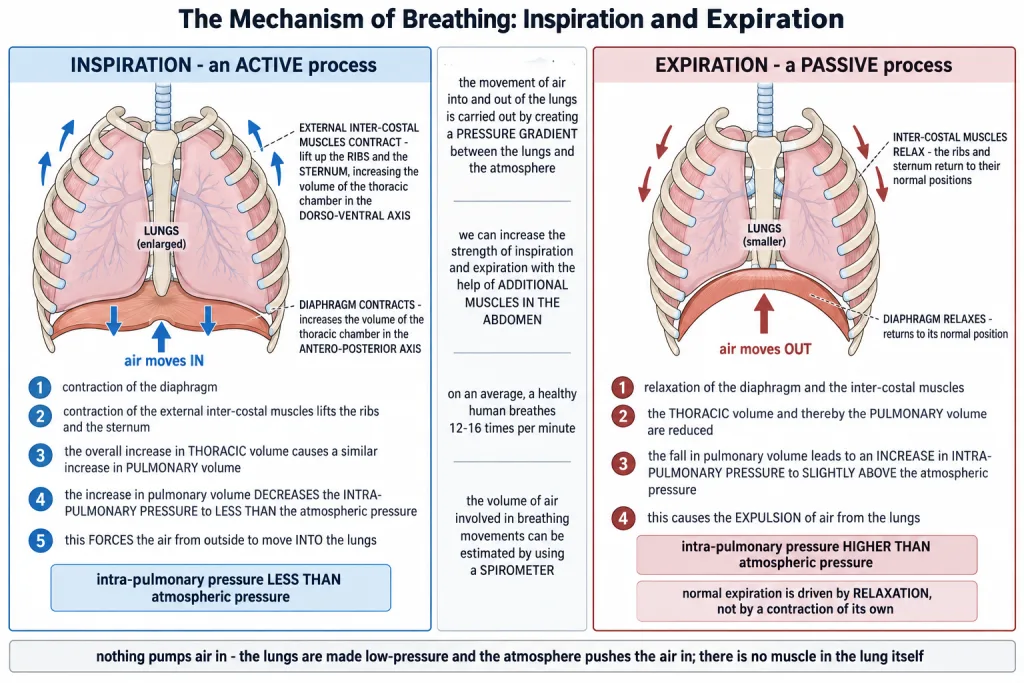
Two muscles, two axes, and the pairing is asked directly. Learn them as a labelled pair rather than as two separate sentences.
| Muscle that contracts | What it moves | Axis in which the thoracic volume increases |
|---|---|---|
| Diaphragm | the floor of the thoracic chamber, which flattens downwards | antero-posterior axis |
| External inter-costal muscles | the ribs and the sternum, which are lifted up | dorso-ventral axis |
Notice that steps 3 and 4 are where the thorax hands the job over to the lung. The muscles change the volume of the box; the lung follows the box because the thoracic chamber is air-tight; and only then does the pressure fall. There is no muscle in the lung itself.
[NEET Important] Swapping the two axes is the single commonest mistake in this section. Diaphragm goes with antero-posterior; external inter-costals go with dorso-ventral. Also note it is the external inter-costals that act during inspiration, not the internal ones, and that they lift both the ribs and the sternum, not the ribs alone.
Expiration Is a Relaxation, Not a Contraction
Expiration runs the same chain backwards, and it runs on relaxation.
- Relaxation of the diaphragm and the inter-costal muscles returns the diaphragm and sternum to their normal positions.
- This reduces the thoracic volume and thereby the pulmonary volume.
- The fall in pulmonary volume leads to an increase in intra-pulmonary pressure to slightly above the atmospheric pressure.
- This causes the expulsion of air from the lungs - that is expiration.
Say it plainly: normal expiration is a passive process. It is driven by the relaxation of the muscles that were contracted during inspiration and by the elastic recoil that follows, not by a contraction of its own. That is why quiet breathing costs the body work only on the way in.
But we are not limited to quiet breathing. We have the ability to increase the strength of inspiration and expiration with the help of additional muscles in the abdomen. When you blow out a candle or take the deepest breath you can, those abdominal muscles are what you are adding.
Two closing facts complete the mechanism.
- On an average, a healthy human breathes 12-16 times per minute.
- The volume of air involved in breathing movements can be estimated by using a spirometer, which helps in the clinical assessment of pulmonary functions.
[NEET Important] "Normal expiration is an active process" is a false statement that appears again and again. Normal expiration is passive. Keep 12-16 times per minute and spirometer ready as one-word answers - both are asked on their own, and the spirometer reading is the doorway into the next two sections on volumes and capacities.
Quick Recap
- Breathing involves two stages: inspiration, during which atmospheric air is drawn in, and expiration, by which the alveolar air is released out.
- The movement of air into and out of the lungs is carried out by creating a pressure gradient between the lungs and the atmosphere.
- Inspiration occurs if the intra-pulmonary pressure is less than the atmospheric pressure, that is, a negative pressure in the lungs with respect to atmospheric pressure.
- Expiration takes place when the intra-pulmonary pressure is higher than the atmospheric pressure.
- The diaphragm and a specialised set of muscles - the external and internal intercostals between the ribs - help generate these gradients.
- Inspiration: contraction of the diaphragm increases thoracic volume in the antero-posterior axis; contraction of the external inter-costal muscles lifts the ribs and the sternum, increasing thoracic volume in the dorso-ventral axis; thoracic volume up means pulmonary volume up; intra-pulmonary pressure falls below atmospheric; air is forced in from outside.
- Expiration: relaxation of the diaphragm and inter-costal muscles returns the diaphragm and sternum to their normal positions, thoracic and pulmonary volume fall, intra-pulmonary pressure rises slightly above atmospheric, air is expelled.
- Normal expiration is a passive process driven by relaxation, not by a contraction.
- We can increase the strength of inspiration and expiration with the help of additional muscles in the abdomen.
- On an average, a healthy human breathes 12-16 times per minute.
- A spirometer estimates the volume of air involved in breathing movements and helps in the clinical assessment of pulmonary functions.
Solved Examples
Question 1
Q. Name the two stages of breathing and say what each one does.
Answer. Inspiration, during which atmospheric air is drawn in, and expiration, by which the alveolar air is released out.
Question 2
Q. What actually makes air move into and out of the lungs?
Answer. A pressure gradient between the lungs and the atmosphere. The body changes the pressure inside the lungs, and air then moves on its own from the higher pressure to the lower pressure. Nothing pumps air into the lungs.
Question 3
Q. What is intra-pulmonary pressure, and what must it be for inspiration to occur?
Answer. Intra-pulmonary pressure is the pressure within the lungs. Inspiration can occur if it is less than the atmospheric pressure, that is, when there is a negative pressure in the lungs with respect to atmospheric pressure.
Question 4
Q. When does expiration take place?
Answer. When the intra-pulmonary pressure is higher than the atmospheric pressure. In normal breathing it rises to slightly above the atmospheric pressure, and air is pushed out.
Question 5
Q. Name the muscles that help generate the pressure gradients used in breathing.
Answer. The diaphragm, and a specialised set of muscles between the ribs - the external and internal intercostals. We can also add additional muscles in the abdomen to increase the strength of a breath.
Question 6
Q. Explain the process of inspiration under normal conditions. This is one of the chapter-end exercises.
Answer. Inspiration is the stage of breathing during which atmospheric air is drawn into the lungs, and it happens in the following order.
- Inspiration is initiated by the contraction of the diaphragm, which increases the volume of the thoracic chamber in the antero-posterior axis.
- The contraction of the external inter-costal muscles lifts up the ribs and the sternum, which increases the volume of the thoracic chamber in the dorso-ventral axis.
- The overall increase in the thoracic volume causes a similar increase in the pulmonary volume, because the thoracic chamber is air-tight and the lungs follow any change in its volume.
- The increase in pulmonary volume decreases the intra-pulmonary pressure to less than the atmospheric pressure - a negative pressure in the lungs with respect to the atmosphere.
- This pressure gradient forces the air from outside to move into the lungs, and that inward flow is inspiration.
Inspiration is an active process - both the diaphragm and the external inter-costal muscles have to contract for it to happen.
Question 7
Q. Which muscle increases the volume of the thoracic chamber in the antero-posterior axis, and which one in the dorso-ventral axis?
Answer. The diaphragm increases thoracic volume in the antero-posterior axis. The external inter-costal muscles, by lifting up the ribs and the sternum, increase it in the dorso-ventral axis. Keep the two joined in your memory - they are asked as a pair.
Question 8
Q. Describe expiration under normal conditions.
Answer. Relaxation of the diaphragm and the inter-costal muscles returns the diaphragm and sternum to their normal positions. This reduces the thoracic volume and thereby the pulmonary volume. The fall in pulmonary volume increases the intra-pulmonary pressure to slightly above the atmospheric pressure, and that causes the expulsion of air from the lungs.
Question 9
Q. Why is normal expiration called a passive process?
Answer. Because it is brought about by relaxation, not by a contraction. The muscles that were contracted for inspiration simply let go, the diaphragm and sternum return to their normal positions, and the chest falls back on its own. Only inspiration needs muscles to contract in quiet breathing.
Question 10
Q. How can we make a breath deeper or a blow-out stronger than normal?
Answer. We have the ability to increase the strength of inspiration and expiration with the help of additional muscles in the abdomen. Quiet breathing does not use them; forced breathing does.
Question 11
Q. How many times does a healthy human breathe in a minute, and what instrument is used to measure the air involved?
Answer. On an average, a healthy human breathes 12-16 times per minute. The volume of air involved in breathing movements can be estimated by using a spirometer, which helps in the clinical assessment of pulmonary functions.
Question 12
Q. A person's chest is held rigid by a tight plaster cast so that the ribs cannot be lifted. Explain what happens to breathing.
Answer. The dorso-ventral increase in thoracic volume is lost, because that increase comes from the external inter-costal muscles lifting the ribs and the sternum. The diaphragm can still contract and give the antero-posterior increase, so breathing continues but the fall in intra-pulmonary pressure is smaller and less air is drawn in with each breath. This is why such a person breathes shallowly and faster.
Question 13
Q. Arrange the following in the correct order for a normal inspiration: air moves into the lungs; contraction of the diaphragm; fall in intra-pulmonary pressure; increase in pulmonary volume; increase in thoracic volume.
Answer. Contraction of the diaphragm (with the external inter-costal muscles) leads to an increase in thoracic volume, then an increase in pulmonary volume, then a fall in intra-pulmonary pressure below atmospheric, and finally air moves into the lungs. Volume changes first and pressure follows - never the other way round.