
Three Disorders of the Respiratory System
The chapter names three disorders, and each one is defined by a single damaged structure and a single giveaway word. Learn them that way and the matching question answers itself.
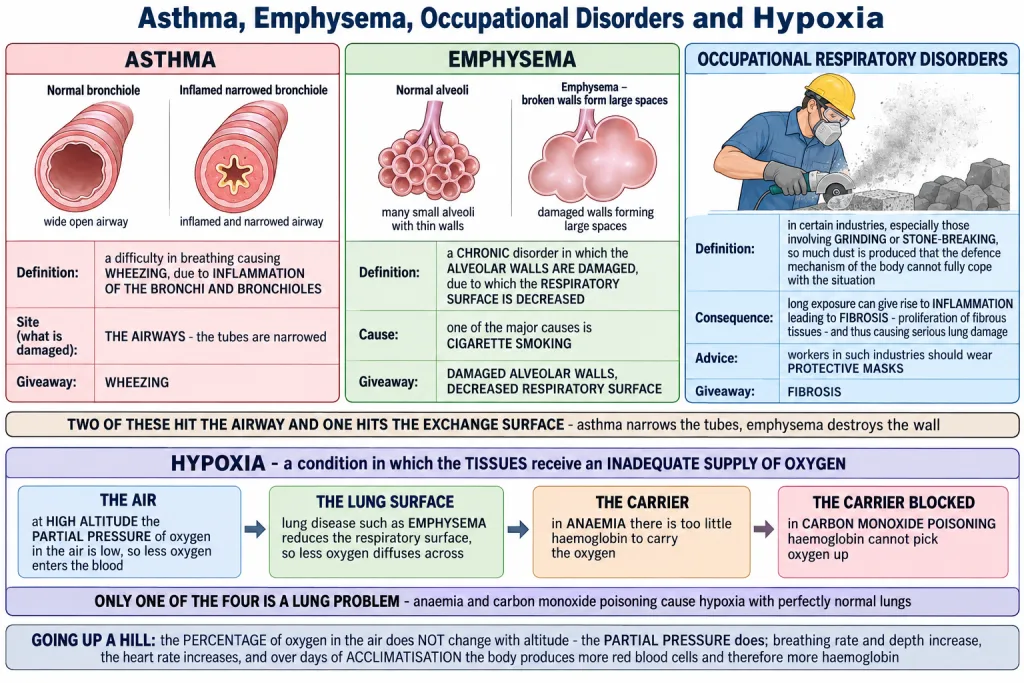
Asthma is a difficulty in breathing causing wheezing, due to inflammation of the bronchi and bronchioles.
Emphysema is a chronic disorder in which the alveolar walls are damaged, due to which the respiratory surface is decreased. One of the major causes is cigarette smoking.
Occupational respiratory disorders: in certain industries, especially those involving grinding or stone-breaking, so much dust is produced that the defence mechanism of the body cannot fully cope with the situation. Long exposure can give rise to inflammation leading to fibrosis - proliferation of fibrous tissues - and thus causing serious lung damage. Workers in such industries should wear protective masks.
| Disorder | What is damaged | The cause | The giveaway word |
|---|---|---|---|
| Asthma | the bronchi and bronchioles are inflamed | inflammation of the airways | wheezing |
| Emphysema | the alveolar walls are damaged, so the respiratory surface is decreased | cigarette smoking is one of the major causes | alveolar walls, decreased respiratory surface |
| Occupational respiratory disorders | serious lung damage from long dust exposure | dust in industries involving grinding or stone-breaking | fibrosis |
Two of these hit the airway and one hits the exchange surface, and that is the distinction the exam turns on. Asthma narrows the tubes - the air struggles to get through, which is why it wheezes. Emphysema destroys the alveolar walls - the tubes are open, but there is less surface left to diffuse across. A chronic smoker's breathlessness is emphysema, not asthma.
Emphysema is also described as chronic, which means it builds slowly and does not reverse. Asthma is not given that word.
[NEET Important] Three one-line definitions, asked as a matching set. Wheezing plus inflammation of bronchi and bronchioles is asthma. Damaged alveolar walls plus decreased respiratory surface, caused by cigarette smoking, is emphysema. Fibrosis - proliferation of fibrous tissues - from grinding and stone-breaking dust is the occupational disorder. The commonest trap swaps the site: an option that gives asthma damage to the alveolar walls, or gives emphysema the wheezing, is wrong.
Hypoxia - a Chapter-End Question Answered in Full
Two of the questions set at the end of this chapter are not answered anywhere in the printed chapter itself - one asks you to gather information about hypoxia, the other asks what happens to the respiratory process in a man going up a hill. They are worth knowing properly, because NEET asks them, and because they are the natural pay-off of everything you have learned about partial pressures. So here are the finished answers.
What hypoxia is
Hypoxia is a condition in which the tissues receive an inadequate supply of oxygen.
The definition is about the tissues, not about the lungs and not about the air. Anything that breaks the chain between the atmosphere and the cell can cause it, and the chain has several links, which is why the causes look so different from one another.
| Cause | Where the chain breaks |
|---|---|
| Going to a high altitude | the partial pressure of oxygen in the air is low, so less oxygen enters the blood |
| Lung disease such as emphysema | the respiratory surface is reduced, so less oxygen diffuses across |
| Anaemia | there is too little haemoglobin to carry the oxygen |
| Carbon monoxide poisoning | haemoglobin is blocked, so it cannot pick oxygen up |
Read the four causes as four different links in the same chain - the air, the lung surface, the carrier, and the carrier being blocked. That is all you need; the definition and this short list are the answer.
[NEET Important] Learn the definition in one line - "hypoxia is a condition in which the tissues receive an inadequate supply of oxygen" - and be able to give the four causes. The catch is that only one of them is a lung problem. Anaemia and carbon monoxide poisoning cause hypoxia with perfectly normal lungs, because the failure is in the carrier, not in the exchange surface.
What Happens to a Person Going Up a Hill
The trap first
The percentage of oxygen in the air does not change with altitude. The partial pressure does.
Air is about the same mixture at the top of a hill as at the bottom. What falls is the atmospheric pressure, and since the partial pressure of a gas is its share of the total pressure, a lower total pressure means a lower in the inspired air, even with the same percentage of oxygen. Any option that says the air "contains less oxygen by percentage" at altitude is the wrong one.
What follows from that
- Because in the inspired air is low, less oxygen diffuses into the blood at the alveoli, and the percentage saturation of haemoglobin falls.
- The tissues therefore receive an inadequate supply of oxygen - that is hypoxia.
The immediate responses
- The breathing rate and the depth of breathing both increase. This happens because the chemosensitive area and the receptors of the aortic arch and the carotid artery respond to the changed blood chemistry and signal the rhythm centre.
- The heart rate increases, so the blood that is carrying less oxygen per unit volume is delivered around the body faster.
- The person may feel breathlessness, headache, dizziness, nausea and fatigue - together, altitude sickness.
The slow response - acclimatisation
Over days of acclimatisation, the body produces more red blood cells and therefore more haemoglobin. With more haemoglobin, the blood can carry more oxygen even at the lower partial pressure, and the person begins to feel normal again. This is why climbers spend days at intermediate camps instead of going straight to the top.
[NEET Important] The question is set at the end of the chapter and the trap is the word "percentage". Say clearly that the percentage of oxygen in the air is unchanged and it is the partial pressure that falls. Then give the chain in order: a lower partial pressure of oxygen in the inspired air, less diffusion at the alveoli, lower haemoglobin saturation, hypoxia; then faster and deeper breathing and a faster heart rate; then more red blood cells over days of acclimatisation.
Quick Recap
- Asthma is a difficulty in breathing causing wheezing, due to inflammation of the bronchi and bronchioles.
- Emphysema is a chronic disorder in which the alveolar walls are damaged, due to which the respiratory surface is decreased.
- One of the major causes of emphysema is cigarette smoking.
- Occupational respiratory disorders: in industries involving grinding or stone-breaking, so much dust is produced that the defence mechanism of the body cannot fully cope with the situation.
- Long exposure can give rise to inflammation leading to fibrosis - proliferation of fibrous tissues - and thus causing serious lung damage.
- Workers in such industries should wear protective masks.
- Giveaway words: wheezing for asthma, damaged alveolar walls and decreased respiratory surface for emphysema, fibrosis for the occupational disorders.
- Hypoxia is a condition in which the tissues receive an inadequate supply of oxygen.
- Causes of hypoxia: high altitude, where the partial pressure of oxygen in the air is low; lung disease such as emphysema, where the respiratory surface is reduced; anaemia, where there is too little haemoglobin to carry the oxygen; and carbon monoxide poisoning, where haemoglobin is blocked.
- Going up a hill: the atmospheric pressure is lower, so the partial pressure of oxygen in the inspired air falls, even though the percentage of oxygen in the air is unchanged.
- Less oxygen diffuses into the blood at the alveoli and the percentage saturation of haemoglobin falls - hypoxia.
- Immediate responses: the breathing rate and depth increase, because the chemosensitive area and the aortic and carotid receptors respond to the changed blood chemistry; the heart rate increases; and there may be breathlessness, headache, dizziness, nausea and fatigue - altitude sickness.
- Over days of acclimatisation the body produces more red blood cells and therefore more haemoglobin, so the blood carries more oxygen at the lower partial pressure.
Solved Examples
Question 1
Q. What is asthma?
Answer. A difficulty in breathing causing wheezing, due to inflammation of the bronchi and bronchioles. The damage is in the airways, not in the alveoli.
Question 2
Q. What is emphysema, and what is one of its major causes?
Answer. A chronic disorder in which the alveolar walls are damaged, due to which the respiratory surface is decreased. One of the major causes is cigarette smoking.
Question 3
Q. Why does a person with emphysema become breathless even though the airways are open?
Answer. Because the alveolar walls are damaged and the respiratory surface is decreased. Diffusion depends on the area of the exchange surface, so with less surface left, less oxygen can pass into the blood however freely the air moves in and out.
Question 4
Q. What are occupational respiratory disorders, and which industries cause them?
Answer. They arise in certain industries, especially those involving grinding or stone-breaking, where so much dust is produced that the defence mechanism of the body cannot fully cope with the situation.
Question 5
Q. What does long exposure to industrial dust lead to?
Answer. Inflammation, leading to fibrosis - the proliferation of fibrous tissues - and thus causing serious lung damage.
Question 6
Q. What precaution should workers in grinding and stone-breaking industries take?
Answer. They should wear protective masks.
Question 7
Q. Give the one giveaway word for each of the three disorders.
Answer. Wheezing for asthma. Damaged alveolar walls and a decreased respiratory surface for emphysema. Fibrosis for the occupational respiratory disorders.
Question 8
Q. Have you heard about hypoxia? Try to gather information about it, and discuss with your friends. This is one of the chapter-end exercises.
Answer. Hypoxia is a condition in which the tissues receive an inadequate supply of oxygen. Notice that the definition is about the tissues - the failure can lie anywhere along the chain that runs from the air to the cell.
The main causes worth naming are these.
- Going to a high altitude, where the partial pressure of oxygen in the air is low, so less oxygen enters the blood.
- Lung disease such as emphysema, where the respiratory surface is reduced and less oxygen can diffuse across.
- Anaemia, where there is too little haemoglobin to carry the oxygen.
- Carbon monoxide poisoning, where haemoglobin is blocked and cannot pick oxygen up.
In anaemia and in carbon monoxide poisoning the lungs are working perfectly well - the failure is in the carrier - which is why hypoxia is defined by what the tissues receive rather than by what the lung does.
Question 9
Q. What happens to the respiratory process in a man going up a hill? This is one of the chapter-end exercises.
Answer. At high altitude the atmospheric pressure is lower, so the partial pressure of oxygen in the inspired air falls, even though the percentage of oxygen in the air is unchanged.
What follows from that:
- Less oxygen diffuses into the blood at the alveoli, and the percentage saturation of haemoglobin falls.
- The tissues therefore receive an inadequate supply of oxygen, which is hypoxia.
The immediate responses:
- The breathing rate and the depth of breathing increase, because the chemosensitive area and the receptors of the aortic arch and the carotid artery respond to the changed blood chemistry and signal the rhythm centre.
- The heart rate increases.
- The man may feel breathlessness, headache, dizziness, nausea and fatigue - altitude sickness.
Over days of acclimatisation:
- The body produces more red blood cells and therefore more haemoglobin, so the blood can carry more oxygen at the lower partial pressure, and the symptoms settle.
Question 10
Q. Does the percentage of oxygen in the air change as you climb a hill?
Answer. No. The percentage of oxygen in the air does not change with altitude - the partial pressure does. The atmospheric pressure falls, and since a gas's partial pressure is its share of the total pressure, the of the inspired air falls with it. That is the whole reason less oxygen gets into the blood.
Question 11
Q. What is acclimatisation, and what does the body actually change?
Answer. It is the adjustment the body makes over days at high altitude. The body produces more red blood cells and therefore more haemoglobin, so more oxygen can be carried even though the partial pressure of oxygen stays low.
Question 12
Q. Oxygen has a quite insignificant role in regulating respiration. Why then does a climber breathe faster at altitude?
Answer. Because it is not the low oxygen itself that is being sensed. The chemosensitive area and the receptors of the aortic arch and the carotid artery respond to the changed blood chemistry - to carbon dioxide and hydrogen ions - and signal the rhythm centre, which increases the rate and the depth of breathing. The regulation still runs on the same sensors it always did.
Question 13
Q. A patient has normal lungs, normal air and a normal breathing rate, but the tissues are still short of oxygen. Name two conditions that fit.
Answer. Anaemia, where there is too little haemoglobin to carry the oxygen, and carbon monoxide poisoning, where haemoglobin is blocked. Both are hypoxia, because hypoxia is defined as the tissues receiving an inadequate supply of oxygen - whatever the lungs are doing.