
Tidal Volume - What a Quiet Breath Moves
The spirometer reading from the previous section is where this whole topic begins. It records how much air moves with each breath, and the chapter divides that record into four respiratory volumes. The first of them is the one you are using right now, sitting still and reading.
Tidal Volume (TV): the volume of air inspired or expired during a normal respiration. It is approximately 500 mL.
"Normal" is the load-bearing word. Tidal volume is the quiet, effortless breath - no forcing in either direction.
The chapter then draws its own consequence from that figure, and it is worth reproducing exactly, because a chapter-end exercise turns on it. A healthy man can inspire or expire approximately 6000 to 8000 mL of air per minute. That figure comes straight out of the tidal volume and the breathing rate you already know: approximately 500 mL per breath at 12-16 breaths per minute.
[NEET Important] 500 mL is per breath; 6000 to 8000 mL is per minute. Questions swap the two, or attach "per minute" to 500 mL. Read the unit of time before you read the number.
The Volumes Force Adds, and the One Force Cannot Remove
A quiet breath is nowhere near the limit of the lungs. Three more volumes describe what forcing can add - and what it can never take away.
Inspiratory Reserve Volume (IRV): the additional volume of air a person can inspire by a forcible inspiration. This averages 2500 mL to 3000 mL.
Expiratory Reserve Volume (ERV): the additional volume of air a person can expire by a forcible expiration. This averages 1000 mL to 1100 mL.
Residual Volume (RV): the volume of air remaining in the lungs even after a forcible expiration. This averages 1100 mL to 1200 mL.
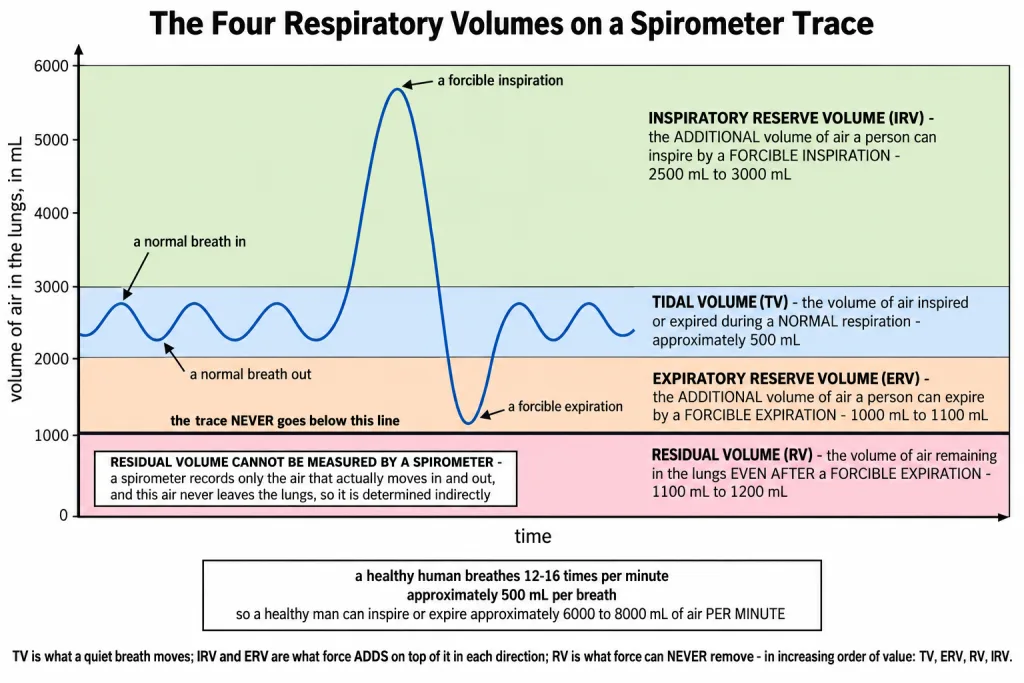
Here are all four together. Learn the table as a block - the value is asked as often as the definition.
| Respiratory volume | Abbreviation | Definition | Average value |
|---|---|---|---|
| Tidal Volume | TV | volume of air inspired or expired during a normal respiration | approximately 500 mL |
| Inspiratory Reserve Volume | IRV | additional volume of air a person can inspire by a forcible inspiration | 2500 mL to 3000 mL |
| Expiratory Reserve Volume | ERV | additional volume of air a person can expire by a forcible expiration | 1000 mL to 1100 mL |
| Residual Volume | RV | volume of air remaining in the lungs even after a forcible expiration | 1100 mL to 1200 mL |
Notice the word "additional" in the two reserve volumes. IRV and ERV are measured on top of a normal breath, not from zero. A person who has just breathed in normally can still pull in 2500 mL to 3000 mL more; a person who has just breathed out normally can still push out 1000 mL to 1100 mL more.
[NEET Important] IRV is by far the largest of the four volumes and ERV is the smallest. In increasing order of average value the four run TV, then ERV, then RV, then IRV. That ordering is a standard question and it is easy to get wrong because ERV and RV are so close - 1000 mL to 1100 mL against 1100 mL to 1200 mL.
Telling the Four Apart, and Why RV Is Special
Strip away the wording and there is only one idea holding the four volumes together.
TV is what a quiet breath moves; IRV and ERV are what force adds on top of it in each direction; RV is what force can never remove.
Read a question against that sentence and the answer usually falls out:
- "During a normal respiration" - that is TV.
- "Additional, by a forcible inspiration" - that is IRV.
- "Additional, by a forcible expiration" - that is ERV.
- "Remaining even after a forcible expiration" - that is RV.
And RV carries one further fact that the other three do not.
Residual volume cannot be measured by a spirometer. A spirometer records only the air that actually moves in and out of the lungs, and residual volume never leaves the lungs - it is the air that stays behind even at the end of the hardest possible breath out. It is therefore the one volume that has to be determined indirectly, and every capacity that includes RV inherits the same limitation.
That residual air is not wasted. It keeps the alveoli from collapsing between breaths and keeps gas exchange going even in the gap between one breath and the next.
[NEET Important] "Which respiratory volume cannot be measured by a spirometer?" has one answer: residual volume. The reason is examinable too - a spirometer measures only air that moves in and out, and RV never leaves the lungs. Do not confuse this with functional residual capacity, which also cannot be measured directly for exactly the same reason, because it contains RV.
Quick Recap
- Tidal Volume (TV): the volume of air inspired or expired during a normal respiration, approximately 500 mL.
- From that figure, a healthy man can inspire or expire approximately 6000 to 8000 mL of air per minute, since a healthy human breathes 12-16 times per minute.
- Inspiratory Reserve Volume (IRV): the additional volume of air a person can inspire by a forcible inspiration, averaging 2500 mL to 3000 mL.
- Expiratory Reserve Volume (ERV): the additional volume of air a person can expire by a forcible expiration, averaging 1000 mL to 1100 mL.
- Residual Volume (RV): the volume of air remaining in the lungs even after a forcible expiration, averaging 1100 mL to 1200 mL.
- The one idea: TV is what a quiet breath moves; IRV and ERV are what force adds on top of it in each direction; RV is what force can never remove.
- Residual volume cannot be measured by a spirometer, because a spirometer measures only the air that moves in and out and RV never leaves the lungs; it is determined indirectly.
- In increasing order of average value: TV, ERV, RV, IRV.
Solved Examples
Question 1
Q. Define tidal volume and give its value.
Answer. Tidal volume is the volume of air inspired or expired during a normal respiration. It is approximately 500 mL.
Question 2
Q. Distinguish between Inspiratory Reserve Volume and Expiratory Reserve Volume. This is one of the chapter-end exercises.
Answer.
| Point | Inspiratory Reserve Volume (IRV) | Expiratory Reserve Volume (ERV) |
|---|---|---|
| Definition | the additional volume of air a person can inspire by a forcible inspiration | the additional volume of air a person can expire by a forcible expiration |
| Direction of the effort | breathing in, over and above a normal inspiration | breathing out, over and above a normal expiration |
| Measured from | the end of a normal inspiration | the end of a normal expiration |
| Average value | 2500 mL to 3000 mL | 1000 mL to 1100 mL |
| Capacity it belongs to | Inspiratory Capacity, IC = TV + IRV | Expiratory Capacity, EC = TV + ERV |
Both are "extra" volumes added by force, but IRV is the extra you can take in and ERV the extra you can push out, and IRV is roughly two to three times larger than ERV.
Question 3
Q. What is Tidal Volume? Find out the Tidal volume (approximate value) for a healthy human in an hour. This is one of the chapter-end exercises.
Answer. Tidal volume is the volume of air inspired or expired during a normal respiration, and it is approximately 500 mL in a healthy human.
Now the arithmetic, step by step.
- Tidal volume is approximately 500 mL per breath, and a healthy human breathes 12-16 times per minute.
- Per minute: 500 x 12 = 6000 mL and 500 x 16 = 8000 mL, so a healthy man can inspire or expire approximately 6000 to 8000 mL of air per minute.
- Per hour: 6000 x 60 = 3,60,000 mL and 8000 x 60 = 4,80,000 mL.
So the tidal volume for a healthy human in an hour is about 3,60,000 mL to 4,80,000 mL, that is about 360 to 480 litres per hour.
Question 4
Q. Define inspiratory reserve volume and give its average value.
Answer. The additional volume of air a person can inspire by a forcible inspiration. It averages 2500 mL to 3000 mL. The word additional matters - it is measured on top of a normal inspiration, not from empty lungs.
Question 5
Q. Define expiratory reserve volume and give its average value.
Answer. The additional volume of air a person can expire by a forcible expiration. It averages 1000 mL to 1100 mL.
Question 6
Q. Define residual volume and give its average value.
Answer. The volume of air remaining in the lungs even after a forcible expiration. It averages 1100 mL to 1200 mL. The lungs are never completely emptied of air.
Question 7
Q. Which respiratory volume cannot be measured with a spirometer, and why?
Answer. Residual volume. A spirometer measures only the air that actually moves into and out of the lungs, and residual volume never leaves the lungs even at the end of the most forcible expiration. It therefore has to be determined indirectly, and so does any capacity that includes it.
Question 8
Q. Which of the four respiratory volumes is the largest, and which is the smallest?
Answer. The largest is the inspiratory reserve volume, 2500 mL to 3000 mL. The smallest is the expiratory reserve volume, 1000 mL to 1100 mL. In increasing order the four run TV, ERV, RV, IRV - and note that ERV and RV are very close, 1000 mL to 1100 mL against 1100 mL to 1200 mL.
Question 9
Q. A person breathes in normally, and then goes on breathing in as hard as possible. Name the two volumes involved.
Answer. The normal breath in is the tidal volume, approximately 500 mL. The extra air taken in after it is the inspiratory reserve volume, 2500 mL to 3000 mL. Together they make the inspiratory capacity.
Question 10
Q. Why can the lungs never be emptied completely, and what is the use of the air that stays behind?
Answer. Because of the residual volume, 1100 mL to 1200 mL, which remains in the lungs even after a forcible expiration. That air keeps the alveoli from collapsing between breaths and allows gas exchange to continue even in the pause between one breath and the next.
Question 11
Q. Name the volume described in each case: (i) moved during a normal respiration, (ii) additional air taken in by a forcible inspiration, (iii) additional air pushed out by a forcible expiration, (iv) air left after a forcible expiration.
Answer. (i) Tidal volume, TV, approximately 500 mL. (ii) Inspiratory reserve volume, IRV, 2500 mL to 3000 mL. (iii) Expiratory reserve volume, ERV, 1000 mL to 1100 mL. (iv) Residual volume, RV, 1100 mL to 1200 mL.
Question 12
Q. State the approximate volume of air a healthy man can inspire or expire in one minute, and show where the figure comes from.
Answer. Approximately 6000 to 8000 mL of air per minute. It comes from a tidal volume of approximately 500 mL multiplied by a breathing rate of 12-16 times per minute: 500 x 12 = 6000 mL and 500 x 16 = 8000 mL.
Question 13
Q. In one sentence, what separates the four respiratory volumes from one another?
Answer. TV is what a quiet breath moves; IRV and ERV are what force adds on top of it in each direction; and RV is what force can never remove. Match the wording of any question against that sentence and the volume names itself.