
The Passage, in Order
Air travels one fixed route from outside the body to the alveolus, and the order of the stations is worth learning as a chain, because a question will hand you the chain with one link moved.
External nostrils -> nasal chamber (through the nasal passage) -> pharynx -> larynx -> trachea -> primary bronchi -> secondary bronchi -> tertiary bronchi -> bronchioles -> terminal bronchioles -> alveoli.
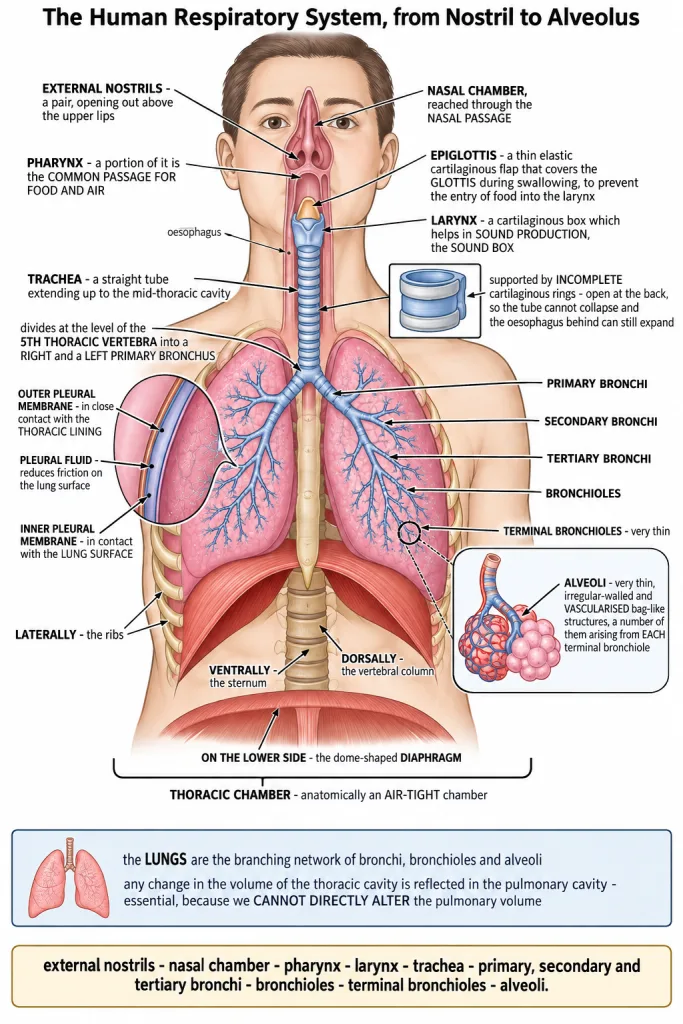
Now the details each station carries.
- We have a pair of external nostrils opening out above the upper lips, leading to a nasal chamber through the nasal passage.
- The nasal chamber opens into the pharynx, and a portion of the pharynx is the common passage for food and air.
- The pharynx opens through the larynx region into the trachea. The larynx is a cartilaginous box which helps in sound production, and is therefore called the sound box.
- During swallowing, the glottis can be covered by a thin elastic cartilaginous flap called the epiglottis, to prevent the entry of food into the larynx.
- The trachea is a straight tube extending up to the mid-thoracic cavity, and it divides at the level of the 5th thoracic vertebra into a right and a left primary bronchus.
- Each bronchus undergoes repeated divisions to form the secondary and tertiary bronchi and bronchioles, ending up in very thin terminal bronchioles.
- Each terminal bronchiole gives rise to a number of very thin, irregular-walled and vascularised bag-like structures called alveoli.
One structural fact runs across several of these stations. The trachea, the primary, secondary and tertiary bronchi, and the initial bronchioles are supported by incomplete cartilaginous rings. Incomplete is the examinable word - the rings are C-shaped, open at the back, which keeps the tube from collapsing while still letting the oesophagus behind it expand.
[NEET Important] Three numbers and one adjective from this block get asked directly. The trachea divides at the 5th thoracic vertebra. There is one pair of external nostrils. Cartilaginous rings are incomplete. And the larynx is the sound box, the epiglottis is the lid - swapping those two is the commonest error in the whole section.
The Lungs, the Pleura and the Thoracic Chamber
The branching network of bronchi, bronchioles and alveoli comprises the lungs. So the lung is not a bag - it is a tree of tubes ending in millions of sacs.
We have two lungs, which are covered by a double layered pleura, with pleural fluid between them. The pleural fluid reduces friction on the lung surface.
- The outer pleural membrane is in close contact with the thoracic lining.
- The inner pleural membrane is in contact with the lung surface.
The lungs are situated in the thoracic chamber, which is anatomically an air-tight chamber. Its walls are worth learning as four directions:
| Direction | What forms it |
|---|---|
| Dorsally | the vertebral column |
| Ventrally | the sternum |
| Laterally | the ribs |
| On the lower side | the dome-shaped diaphragm |
And here is why that anatomy matters. The arrangement of the lungs in the thorax is such that any change in the volume of the thoracic cavity will be reflected in the lung (pulmonary) cavity. Such an arrangement is essential for breathing, as we cannot directly alter the pulmonary volume.
Read that last clause twice. There is no muscle in the lung. The lung is moved by the box around it, which is why the diaphragm and the intercostal muscles are the muscles of breathing and why an air-tight thoracic chamber is not a detail but the whole mechanism.
[NEET Important] "Double layered pleura with pleural fluid in between, which reduces friction" is a one-mark sentence and it is asked in exactly those words. Know which membrane touches what: outer to the thoracic lining, inner to the lung surface.
The Conducting Part and the Exchange Part
The respiratory system is divided into two parts by function, and the boundary is exact.
| Part | Where it runs | What it does |
|---|---|---|
| Conducting part | from the external nostrils up to the terminal bronchioles | transports the atmospheric air to the alveoli, clears it of foreign particles, humidifies it, and brings the air to body temperature |
| Respiratory or exchange part | the alveoli and their ducts | the site of the actual diffusion of oxygen and carbon dioxide between blood and atmospheric air |
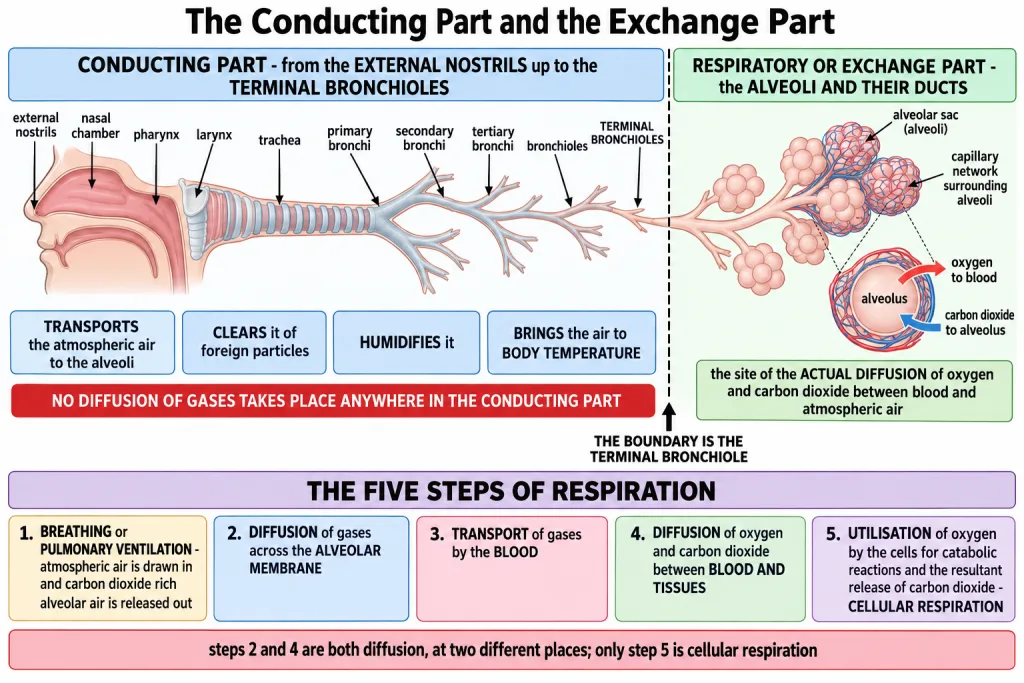
The conducting part does three jobs to the air besides moving it - cleaning, humidifying and warming - and all three are commonly asked together as a three-item list.
The boundary is the terminal bronchiole. Everything up to and including it conducts; the alveoli and alveolar ducts exchange. No diffusion of gases takes place anywhere in the conducting part.
The five steps of respiration
The chapter lists respiration as five steps, and the list is a favourite ordering question.
- Breathing or pulmonary ventilation, by which atmospheric air is drawn in and carbon dioxide rich alveolar air is released out.
- Diffusion of gases across the alveolar membrane.
- Transport of gases by the blood.
- Diffusion of oxygen and carbon dioxide between blood and tissues.
- Utilisation of oxygen by the cells for catabolic reactions and the resultant release of carbon dioxide - that is, cellular respiration.
[NEET Important] Steps 2 and 4 are both diffusion, at two different places - step 2 at the alveolar membrane, step 4 between blood and tissues - and an option list will offer you one where the answer is the other. Only step 5 is cellular respiration; the first four are all transport and exchange.
Quick Recap
- Route of air: external nostrils -> nasal chamber -> pharynx -> larynx -> trachea -> primary, secondary and tertiary bronchi -> bronchioles -> terminal bronchioles -> alveoli.
- A portion of the pharynx is the common passage for food and air.
- The larynx is a cartilaginous box that helps in sound production - the sound box.
- The epiglottis is a thin elastic cartilaginous flap that covers the glottis during swallowing to prevent food entering the larynx.
- The trachea divides at the level of the 5th thoracic vertebra into right and left primary bronchi.
- Trachea, primary, secondary and tertiary bronchi and initial bronchioles are supported by incomplete cartilaginous rings.
- Alveoli are very thin, irregular-walled and vascularised bag-like structures.
- The lungs are the branching network of bronchi, bronchioles and alveoli, covered by a double layered pleura with pleural fluid between, which reduces friction. Outer membrane to the thoracic lining, inner to the lung surface.
- The thoracic chamber is air-tight: vertebral column dorsally, sternum ventrally, ribs laterally, dome-shaped diaphragm below.
- Any change in thoracic volume is reflected in pulmonary volume, which is essential because we cannot directly alter the pulmonary volume.
- Conducting part: external nostrils to terminal bronchioles - transports, clears, humidifies and warms the air.
- Exchange part: alveoli and their ducts - the site of actual diffusion.
- Five steps of respiration: breathing, diffusion at the alveolar membrane, transport by blood, diffusion between blood and tissues, and utilisation by the cells.
Solved Examples
Question 1
Q. Trace the path of air from outside the body to an alveolus.
Answer. External nostrils -> nasal chamber (through the nasal passage) -> pharynx -> larynx -> trachea -> primary bronchi -> secondary bronchi -> tertiary bronchi -> bronchioles -> terminal bronchioles -> alveoli.
Question 2
Q. Which part of the respiratory tract is a common passage for food and air?
Answer. A portion of the pharynx. The nasal chamber opens into it, and the food passage crosses there.
Question 3
Q. Why is the larynx called the sound box?
Answer. Because it is a cartilaginous box which helps in sound production. That is the whole reason for the name.
Question 4
Q. What prevents food from entering the larynx during swallowing?
Answer. The epiglottis, a thin elastic cartilaginous flap that covers the glottis during swallowing.
Question 5
Q. At what level does the trachea divide, and into what?
Answer. At the level of the 5th thoracic vertebra, into a right and a left primary bronchus.
Question 6
Q. Which parts of the airway are supported by cartilaginous rings, and what is unusual about those rings?
Answer. The trachea, the primary, secondary and tertiary bronchi, and the initial bronchioles. The rings are incomplete - open on one side rather than closed circles.
Question 7
Q. Describe an alveolus in the chapter's own words.
Answer. A very thin, irregular-walled and vascularised bag-like structure, arising in numbers from each terminal bronchiole.
Question 8
Q. What exactly makes up a lung?
Answer. The branching network of bronchi, bronchioles and alveoli.
Question 9
Q. What is the pleura, and what does the pleural fluid do?
Answer. The double layered membrane covering each lung, with pleural fluid between the two layers. The fluid reduces friction on the lung surface. The outer pleural membrane is in close contact with the thoracic lining and the inner one with the lung surface.
Question 10
Q. Name the four boundaries of the thoracic chamber.
Answer. Dorsally the vertebral column, ventrally the sternum, laterally the ribs, and on the lower side the dome-shaped diaphragm. The chamber is anatomically air-tight.
Question 11
Q. Why does the anatomical arrangement of the lungs inside the thorax matter for breathing?
Answer. Because any change in the volume of the thoracic cavity is reflected in the pulmonary cavity. We cannot directly alter the pulmonary volume - there is no muscle in the lung itself - so the only way to move air is to change the size of the air-tight box around the lungs.
Question 12
Q. Where does the conducting part end and the exchange part begin?
Answer. The conducting part runs from the external nostrils up to the terminal bronchioles. The exchange part is the alveoli and their ducts. So the terminal bronchiole is the last conducting structure, and diffusion begins only beyond it.
Question 13
Q. What three things does the conducting part do to the air besides moving it?
Answer. It clears the air of foreign particles, humidifies it, and brings it to body temperature.
Question 14
Q. List the five steps of respiration.
Answer.
- Breathing or pulmonary ventilation - atmospheric air is drawn in and carbon dioxide rich alveolar air is released out.
- Diffusion of gases across the alveolar membrane.
- Transport of gases by the blood.
- Diffusion of oxygen and carbon dioxide between blood and tissues.
- Utilisation of oxygen by the cells for catabolic reactions and the resultant release of carbon dioxide - cellular respiration.