
A Capacity Is Only a Sum of Volumes
By adding up a few respiratory volumes described earlier, one can derive various pulmonary capacities, which can be used in clinical diagnosis.
That sentence is the whole idea, and it is worth saying even more plainly. Every capacity is a sum of volumes. There is nothing new to learn here - only which volumes go into which sum.
So if you know the four volumes cold - TV, IRV, ERV and RV - you already know all five capacities. What the exam actually tests is whether you can name the right combination, and the wording of each definition tells you which combination it wants.
Two words do almost all the work in these definitions.
- "Normal" - a normal inspiration or a normal expiration - means the tidal volume has already been used up, so the capacity is measured from the end of a quiet breath.
- "Forced" or "forcible" means a reserve volume has already been used up, so the capacity is measured from the extreme of a breath.
[NEET Important] Never memorise a capacity as a single number. Learn it as a formula. The printed volumes are ranges, so any total you memorise will disagree with the total in the next book you open, but IC = TV + IRV is true whatever numbers you feed it.
The Five Capacities
Each capacity below is given as the chapter gives it - a definition and a sum in the same breath.
Inspiratory Capacity (IC): the total volume of air a person can inspire after a normal expiration. This includes the tidal volume and the inspiratory reserve volume. IC = TV + IRV.
Expiratory Capacity (EC): the total volume of air a person can expire after a normal inspiration. This includes the tidal volume and the expiratory reserve volume. EC = TV + ERV.
Functional Residual Capacity (FRC): the volume of air that will remain in the lungs after a normal expiration. This includes ERV and RV. FRC = ERV + RV.
Vital Capacity (VC): the maximum volume of air a person can breathe in after a forced expiration - or equally, the maximum volume of air a person can breathe out after a forced inspiration. This includes ERV, TV and IRV. VC = ERV + TV + IRV.
Total Lung Capacity (TLC): the total volume of air accommodated in the lungs at the end of a forced inspiration. This includes RV, ERV, TV and IRV. TLC = RV + ERV + TV + IRV, that is TLC = VC + RV.
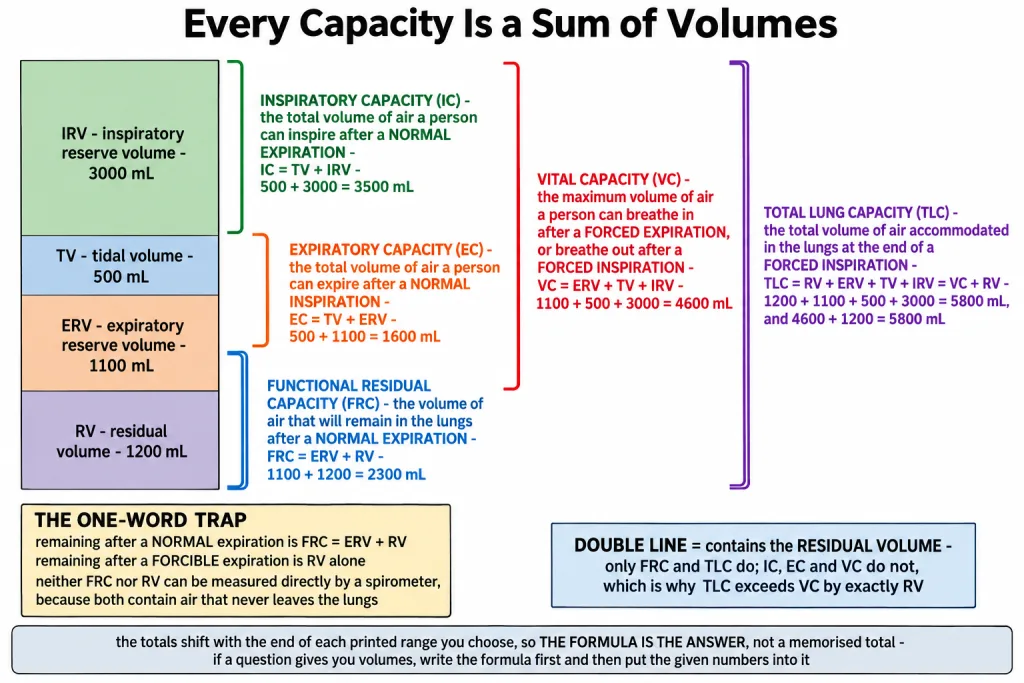
The whole set in one table. This table is the section.
| Capacity | Abbreviation | Definition | Formula |
|---|---|---|---|
| Inspiratory Capacity | IC | total volume of air a person can inspire after a normal expiration | IC = TV + IRV |
| Expiratory Capacity | EC | total volume of air a person can expire after a normal inspiration | EC = TV + ERV |
| Functional Residual Capacity | FRC | volume of air that will remain in the lungs after a normal expiration | FRC = ERV + RV |
| Vital Capacity | VC | maximum volume of air a person can breathe in after a forced expiration, or breathe out after a forced inspiration | VC = ERV + TV + IRV |
| Total Lung Capacity | TLC | total volume of air accommodated in the lungs at the end of a forced inspiration | TLC = RV + ERV + TV + IRV = VC + RV |
Two patterns are worth noticing before you leave the table.
- Only two capacities contain the residual volume: FRC and TLC. IC, EC and VC do not. That is why vital capacity is always smaller than total lung capacity, by exactly RV.
- Vital capacity is the largest volume a person can actually move in one breath, and total lung capacity is the largest volume the lungs can ever hold. The gap between them is air that can never be breathed out.
[NEET Important] VC = ERV + TV + IRV and TLC = VC + RV are the two most-asked formulae in the chapter. Watch the trap in the vital capacity definition: it is measured after a forced expiration, not a normal one, and it can be stated in either direction - breathe in after a forced expiration, or breathe out after a forced inspiration - and both statements describe the same value.
Putting Real Numbers In
Formulae become memorable once you have pushed numbers through them once. Take the mid-range values from the printed ranges:
TV = 500 mL, IRV = 3000 mL, ERV = 1100 mL, RV = 1200 mL.
| Capacity | Formula | Arithmetic | Value |
|---|---|---|---|
| Inspiratory Capacity | IC = TV + IRV | 500 + 3000 | 3500 mL |
| Expiratory Capacity | EC = TV + ERV | 500 + 1100 | 1600 mL |
| Functional Residual Capacity | FRC = ERV + RV | 1100 + 1200 | 2300 mL |
| Vital Capacity | VC = ERV + TV + IRV | 1100 + 500 + 3000 | 4600 mL |
| Total Lung Capacity | TLC = RV + ERV + TV + IRV | 1200 + 1100 + 500 + 3000 | 5800 mL |
Check the shortcut on the last row: TLC = VC + RV = 4600 + 1200 = 5800 mL. The two routes agree, as they must.
Now the warning that goes with the table. These totals depend entirely on which end of each printed range you choose. Take IRV as 2500 mL and ERV as 1000 mL instead, and vital capacity comes out as 1000 + 500 + 2500 = 4000 mL rather than 4600 mL. Neither answer is wrong. The formula is the answer, not a memorised total.
[NEET Important] If a numerical question gives you volumes, use them - do not substitute the values you memorised. The examiner supplies the numbers precisely to see whether you know the combination. Write the formula first, then put the given numbers into it.
The One Word That Changes the Answer
This is the single biggest trap in the whole chapter, and it is worth its own heading.
"The volume of air remaining in the lungs after a NORMAL expiration" is the Functional Residual Capacity, FRC = ERV + RV.
"The volume of air remaining in the lungs after a FORCIBLE expiration" is the Residual Volume, RV.
One word - normal against forcible - changes the answer from a capacity to a volume.
The reason is easy once you see it. After a normal expiration you have only let out the tidal volume; the expiratory reserve volume is still sitting in your lungs, on top of the residual volume. Push out that reserve as well, with a forcible expiration, and only the residual volume is left.
Using the printed ranges, FRC = ERV + RV runs from 1000 + 1100 = 2100 mL to 1100 + 1200 = 2300 mL, while RV alone is 1100 mL to 1200 mL - roughly half as much.
[NEET Important] Remaining after a NORMAL expiration is FRC; remaining after a FORCIBLE expiration is RV. A chapter-end exercise asks for "the volume of air remaining in the lungs after a normal breathing" and the answer is FRC, not residual volume. Read the adjective before the word "expiration" every single time - it is the only thing separating the two answers. Both FRC and RV also share one property: neither can be measured directly by a spirometer, because both contain air that never leaves the lungs.
Quick Recap
- By adding up a few respiratory volumes, one can derive various pulmonary capacities, which can be used in clinical diagnosis. Every capacity is a sum of volumes.
- Inspiratory Capacity (IC): total volume of air a person can inspire after a normal expiration. IC = TV + IRV.
- Expiratory Capacity (EC): total volume of air a person can expire after a normal inspiration. EC = TV + ERV.
- Functional Residual Capacity (FRC): volume of air that will remain in the lungs after a normal expiration. FRC = ERV + RV.
- Vital Capacity (VC): the maximum volume of air a person can breathe in after a forced expiration, or breathe out after a forced inspiration. VC = ERV + TV + IRV.
- Total Lung Capacity (TLC): total volume of air accommodated in the lungs at the end of a forced inspiration. TLC = RV + ERV + TV + IRV, that is VC + RV.
- Worked set using TV 500, IRV 3000, ERV 1100 and RV 1200 mL: IC 3500 mL, EC 1600 mL, FRC 2300 mL, VC 4600 mL, TLC 5800 mL.
- The totals shift with the end of the range you choose, so the formula is the answer, not a memorised total.
- Only FRC and TLC contain the residual volume; IC, EC and VC do not. TLC exceeds VC by exactly RV.
- The trap: remaining after a NORMAL expiration is FRC; remaining after a FORCIBLE expiration is RV.
Solved Examples
Question 1
Q. Define vital capacity. What is its significance? This is one of the chapter-end exercises.
Answer. Vital capacity is the maximum volume of air a person can breathe in after a forced expiration. It can be stated the other way round with the same meaning - the maximum volume of air a person can breathe out after a forced inspiration. It includes ERV, TV and IRV, so VC = ERV + TV + IRV.
Its significance:
- It is the largest volume of air a person can actually move in a single breath, so it measures how much of the lung is usable and working.
- It is used in the clinical assessment of pulmonary function, being one of the values a spirometer gives directly.
- It falls in restrictive lung disease, where the lungs cannot expand fully, and in obstructive lung disease, where air cannot be moved out freely, so a fall in vital capacity is an early warning sign.
- It is higher in athletes and in people living at low altitude, and lower in the untrained, which is why it is used to compare respiratory fitness.
Question 2
Q. State the volume of air remaining in the lungs after a normal expiration. This is one of the chapter-end exercises.
Answer. It is the Functional Residual Capacity (FRC), and FRC = ERV + RV. Using the printed ranges, ERV is 1000 mL to 1100 mL and RV is 1100 mL to 1200 mL, so FRC is roughly 2100 mL to 2300 mL.
The answer is NOT the residual volume. Residual volume is what remains after a forcible expiration, 1100 mL to 1200 mL. After a normal expiration only the tidal volume has been let out, so the expiratory reserve volume is still in the lungs on top of the residual volume - and the sum of those two is the functional residual capacity.
Question 3
Q. Distinguish between Inspiratory capacity and Expiratory capacity. This is one of the chapter-end exercises.
Answer.
| Point | Inspiratory Capacity (IC) | Expiratory Capacity (EC) |
|---|---|---|
| Definition | the total volume of air a person can inspire after a normal expiration | the total volume of air a person can expire after a normal inspiration |
| Formula | IC = TV + IRV | EC = TV + ERV |
| Measured from | the end of a normal expiration | the end of a normal inspiration |
| Direction | breathing in | breathing out |
| Approximate value | about 3000 mL to 3500 mL | about 1500 mL to 1600 mL |
Both contain the tidal volume; they differ in which reserve volume is added to it and in which direction the air moves.
Question 4
Q. Distinguish between Vital capacity and Total lung capacity. This is one of the chapter-end exercises.
Answer.
| Point | Vital Capacity (VC) | Total Lung Capacity (TLC) |
|---|---|---|
| Definition | the maximum volume of air a person can breathe in after a forced expiration, or breathe out after a forced inspiration | the total volume of air accommodated in the lungs at the end of a forced inspiration |
| Formula | VC = ERV + TV + IRV | TLC = RV + ERV + TV + IRV, that is VC + RV |
| Residual volume | not included | included |
| Can it be measured directly by a spirometer | yes | no, because it contains the residual volume |
| Approximate value | about 4000 mL to 4600 mL | about 5200 mL to 5800 mL |
Total lung capacity is larger than vital capacity by exactly the residual volume, which is the air that can never be breathed out.
Question 5
Q. What is a pulmonary capacity, and how is it obtained?
Answer. By adding up a few respiratory volumes, one can derive various pulmonary capacities, which can be used in clinical diagnosis. Every capacity is simply a sum of two or more of the four respiratory volumes - there is no new measurement involved.
Question 6
Q. Define inspiratory capacity and give its formula.
Answer. The total volume of air a person can inspire after a normal expiration. It includes the tidal volume and the inspiratory reserve volume: IC = TV + IRV.
Question 7
Q. Define expiratory capacity and give its formula.
Answer. The total volume of air a person can expire after a normal inspiration. It includes the tidal volume and the expiratory reserve volume: EC = TV + ERV.
Question 8
Q. Define functional residual capacity and give its formula.
Answer. The volume of air that will remain in the lungs after a normal expiration. It includes the expiratory reserve volume and the residual volume: FRC = ERV + RV.
Question 9
Q. Define total lung capacity in two ways.
Answer. The total volume of air accommodated in the lungs at the end of a forced inspiration. As a sum it is TLC = RV + ERV + TV + IRV, and the same thing written shorter is TLC = vital capacity + residual volume.
Question 10
Q. Take TV = 500 mL, IRV = 3000 mL, ERV = 1100 mL and RV = 1200 mL. Calculate IC, EC, FRC, VC and TLC.
Answer.
- IC = TV + IRV = 500 + 3000 = 3500 mL
- EC = TV + ERV = 500 + 1100 = 1600 mL
- FRC = ERV + RV = 1100 + 1200 = 2300 mL
- VC = ERV + TV + IRV = 1100 + 500 + 3000 = 4600 mL
- TLC = RV + ERV + TV + IRV = 1200 + 1100 + 500 + 3000 = 5800 mL, which also checks out as TLC = VC + RV = 4600 + 1200 = 5800 mL.
Question 11
Q. Two textbooks give vital capacity as 4000 mL and as 4600 mL. Are both correct?
Answer. Yes. The respiratory volumes are printed as ranges, so IRV can be taken as 2500 mL or as 3000 mL and ERV as 1000 mL or 1100 mL. Using the low end, VC = 1000 + 500 + 2500 = 4000 mL; using the high end, VC = 1100 + 500 + 3000 = 4600 mL. The formula is the answer, not a memorised total - always write VC = ERV + TV + IRV and put the given numbers into it.
Question 12
Q. Which capacities include the residual volume?
Answer. Only two: Functional Residual Capacity, FRC = ERV + RV, and Total Lung Capacity, TLC = RV + ERV + TV + IRV. IC, EC and VC do not include it, and that is exactly why TLC is larger than VC by the residual volume.
Question 13
Q. Why can total lung capacity not be measured directly with a spirometer?
Answer. Because it includes the residual volume, and a spirometer measures only the air that actually moves in and out of the lungs. Residual volume never leaves the lungs, so TLC and FRC both have to be determined indirectly, while TV, IRV, ERV, IC, EC and VC can be read straight off a spirometer.
Question 14
Q. A doctor finds that a patient's vital capacity has fallen well below normal. What does that tell her?
Answer. That the largest volume of air the patient can move in one breath has shrunk, so less of the lung is usable and working. Vital capacity is used in the clinical assessment of pulmonary function, and it falls in both restrictive lung disease, where the lungs cannot expand fully, and obstructive lung disease, where air cannot be moved out freely. It is a signal to investigate further, not a diagnosis on its own.