
Reabsorption - Nearly 99 Per Cent Comes Back
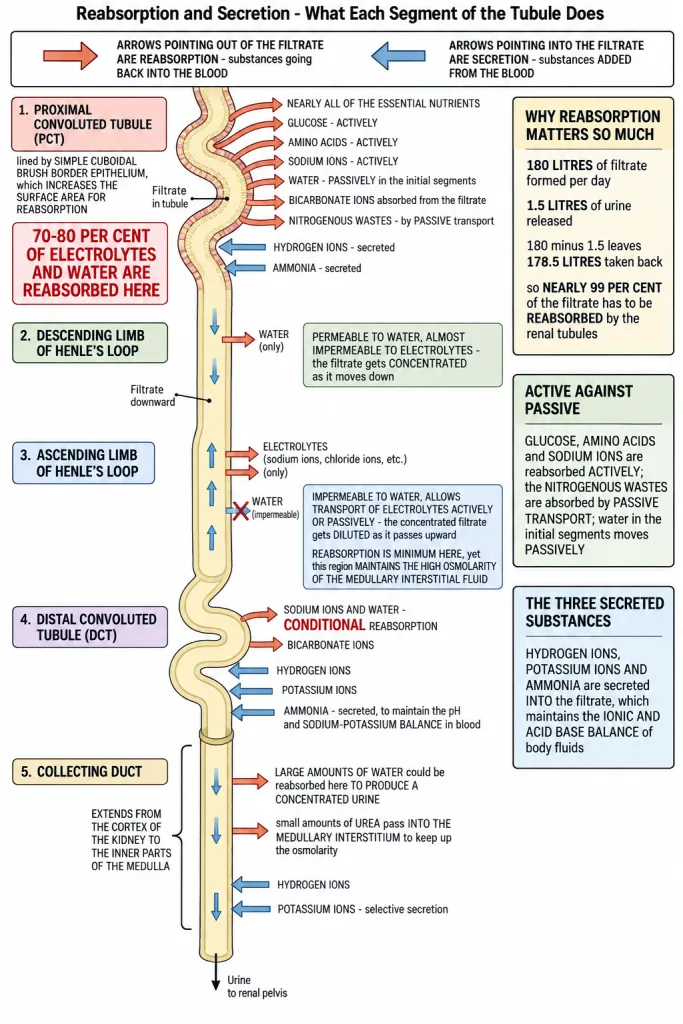
A comparison of the volume of filtrate formed per day (180 litres) with the urine released (1.5 litres) shows that nearly 99 PER CENT of the filtrate has to be reabsorbed by the renal tubules. This process is called REABSORPTION.
Do the arithmetic once and the figure sticks. 180 litres go in, 1.5 litres come out, so 178.5 out of 180 litres comes back. 178.5 divided by 180 is about 99 per cent. The kidney is far more a recovery organ than a disposal organ - it throws away barely one part in a hundred of what it filters.
The tubular epithelial cells in different segments of the nephron perform this either by ACTIVE or PASSIVE mechanisms.
| Substance | How it is reabsorbed |
|---|---|
| Glucose | ACTIVELY |
| Amino acids | ACTIVELY |
| ACTIVELY | |
| Nitrogenous wastes | by PASSIVE transport |
| Water, in the initial segments of the nephron | PASSIVELY |
Read the pattern rather than the list. The things the body wants back - glucose, amino acids, sodium ions - are pulled back actively, at a cost of energy. The things it is trying to get rid of, the nitrogenous wastes, drift back passively, and only as much as follows the concentrations. Water in the initial segments also moves passively.
[NEET Important] The commonest wrong option here is "urea is actively reabsorbed". It is not - the nitrogenous wastes are absorbed by passive transport. Glucose, amino acids and sodium ions are the active ones. Learn the two groups as opposites and the question answers itself.
Tubular Secretion - the Other Direction
During urine formation the tubular cells SECRETE substances like , and ammonia INTO the filtrate.
Tubular secretion is an important step in urine formation, as it helps in the maintenance of the ionic and acid base balance of body fluids.
Make the direction explicit, because that is the standard swap.
| Process | Direction | What moves |
|---|---|---|
| REABSORPTION | OUT of the filtrate, back into the blood | glucose, amino acids, , water, nitrogenous wastes |
| SECRETION | INTO the filtrate, out of the blood | , and ammonia |
Reabsorption takes things OUT of the filtrate. Secretion puts things IN. An option list will offer you "secretion of glucose" or "reabsorption of hydrogen ions" and both are wrong on direction alone, before you even reach the substance.
And notice why secretion exists at all. Filtration is unselective - it takes everything except the proteins. Secretion is the kidney's chance to add exactly what needs to go, which is how the ionic and acid base balance of body fluids is finally set.
[NEET Important] Three substances are named as secreted - hydrogen ions, potassium ions and ammonia. They come back segment by segment through the rest of this section, and the reason given every time is the maintenance of pH and ionic balance.
Segment by Segment - What Each Part of the Tubule Does
This grid is the single most examined object in the chapter. Learn it as a table, in order down the tubule.
| Segment | What it does |
|---|---|
| Proximal Convoluted Tubule (PCT) | lined by simple cuboidal BRUSH BORDER epithelium, which increases the surface area for reabsorption; nearly all of the essential nutrients, and 70-80 PER CENT of electrolytes and water, are reabsorbed here; maintains pH and ionic balance by selective secretion of hydrogen ions and ammonia into the filtrate and by absorption of from it |
| Henle's Loop | reabsorption is MINIMUM in its ascending limb; this region plays a significant role in the maintenance of high osmolarity of the medullary interstitial fluid |
| Distal Convoluted Tubule (DCT) | CONDITIONAL reabsorption of and water; also capable of reabsorption of and selective secretion of hydrogen and potassium ions and ammonia, to maintain the pH and sodium-potassium balance in blood |
| Collecting Duct | extends from the CORTEX of the kidney to the INNER PARTS OF THE MEDULLA; large amounts of water could be reabsorbed here to produce a concentrated urine; allows the passage of small amounts of UREA into the medullary interstitium to keep up the osmolarity; maintains pH and ionic balance by selective secretion of hydrogen and potassium ions |
The two limbs of Henle's loop deserve a table of their own. Swapping them is the commonest error in the chapter.
| Limb | Permeable to water? | Permeable to electrolytes? | What happens to the filtrate |
|---|---|---|---|
| DESCENDING limb | YES - permeable to water | NO - almost impermeable to electrolytes | the filtrate gets CONCENTRATED as it moves down |
| ASCENDING limb | NO - impermeable to water | YES - allows transport of electrolytes actively or passively | the concentrated filtrate gets DILUTED as it passes upward, due to the passage of electrolytes into the medullary fluid |
Say the pairing out loud in one line: the descending limb loses water, the ascending limb loses salt. Water leaving on the way down concentrates what is left; electrolytes leaving on the way up dilutes what is left. And the electrolytes that leave the ascending limb are exactly what keeps the medullary interstitial fluid at a high osmolarity, which is why reabsorption is minimum in the ascending limb and yet the region matters so much.
One word in the DCT row is examinable on its own. CONDITIONAL reabsorption means the amount of sodium and water taken back is not fixed - it depends on the body's needs at the time, and is placed under hormonal control. If the body is short of water, more is reabsorbed; if there is plenty, less is. The PCT reabsorbs regardless; the DCT reabsorbs on condition.
[NEET Important] Three lines from this grid are asked more than the rest. The PCT reabsorbs nearly all the essential nutrients and 70-80 per cent of electrolytes and water. The descending limb is permeable to water and almost impermeable to electrolytes, while the ascending limb is the exact reverse. The collecting duct runs from the cortex to the inner parts of the medulla and passes small amounts of urea into the medullary interstitium. Only the collecting duct is credited with urea passage; do not give that job to Henle's loop.
Quick Recap
- 180 litres of filtrate per day against 1.5 litres of urine means nearly 99 per cent of the filtrate has to be reabsorbed by the renal tubules; this is REABSORPTION. 178.5 out of 180 litres comes back.
- The tubular epithelial cells in different segments perform reabsorption either by active or passive mechanisms.
- Glucose, amino acids and sodium ions are reabsorbed ACTIVELY; the nitrogenous wastes are absorbed by PASSIVE transport; water is reabsorbed PASSIVELY in the initial segments of the nephron.
- TUBULAR SECRETION: the tubular cells secrete hydrogen ions, potassium ions and ammonia INTO the filtrate.
- Tubular secretion helps in the maintenance of the ionic and acid base balance of body fluids.
- Reabsorption takes things OUT of the filtrate; secretion puts things IN.
- PCT - lined by simple cuboidal brush border epithelium, which increases the surface area for reabsorption; nearly all the essential nutrients and 70-80 per cent of electrolytes and water are reabsorbed here; maintains pH and ionic balance by selective secretion of hydrogen ions and ammonia into the filtrate and absorption of bicarbonate ions from it.
- Henle's loop - reabsorption is minimum in the ascending limb, but the region maintains the high osmolarity of the medullary interstitial fluid.
- Descending limb - permeable to water, almost impermeable to electrolytes; the filtrate is concentrated as it moves down.
- Ascending limb - impermeable to water, allows transport of electrolytes actively or passively; the concentrated filtrate gets diluted as it passes upward, due to the passage of electrolytes into the medullary fluid.
- DCT - conditional reabsorption of sodium ions and water; also reabsorbs bicarbonate ions and selectively secretes hydrogen and potassium ions and ammonia, to maintain the pH and sodium-potassium balance in blood.
- Collecting duct - extends from the cortex to the inner parts of the medulla; large amounts of water could be reabsorbed here to produce a concentrated urine; passes small amounts of urea into the medullary interstitium to keep up the osmolarity; secretes hydrogen and potassium ions for pH and ionic balance.
Solved Examples
Question 1
Q. What is reabsorption, and how much of the filtrate is reabsorbed?
Answer. Reabsorption is the process by which the renal tubules take back most of the filtrate. A comparison of the volume of filtrate formed per day, 180 litres, with the urine released, 1.5 litres, shows that nearly 99 per cent of the filtrate has to be reabsorbed by the renal tubules.
Question 2
Q. Show the arithmetic behind the figure of nearly 99 per cent.
Answer. 180 litres of filtrate is formed per day and only 1.5 litres of urine is released. So 180 minus 1.5, that is 178.5 litres, is taken back. 178.5 out of 180 is about 99 per cent. The kidney discards barely one part in a hundred of what it filters.
Question 3
Q. Which substances are reabsorbed actively, and which passively?
Answer. Glucose, amino acids and sodium ions are reabsorbed ACTIVELY. The nitrogenous wastes are absorbed by PASSIVE transport. Reabsorption of water also occurs passively in the initial segments of the nephron.
Question 4
Q. What is tubular secretion, and which substances are secreted?
Answer. During urine formation the tubular cells secrete substances into the filtrate. The ones named are hydrogen ions, potassium ions and ammonia.
Question 5
Q. Why is tubular secretion an important step in urine formation?
Answer. Because it helps in the maintenance of the ionic and acid base balance of body fluids. Filtration is unselective - it lets through everything except the proteins - so secretion is the kidney's chance to add exactly what needs to leave.
Question 6
Q. State the difference in direction between reabsorption and secretion.
Answer. Reabsorption takes substances OUT of the filtrate and returns them to the blood. Secretion puts substances INTO the filtrate from the blood. So glucose is reabsorbed, never secreted, and hydrogen ions are secreted, not reabsorbed.
Question 7
Q. Describe the lining of the proximal convoluted tubule and say what it achieves.
Answer. The PCT is lined by simple cuboidal brush border epithelium, and the brush border increases the surface area for reabsorption. Nearly all of the essential nutrients, and 70-80 per cent of electrolytes and water, are reabsorbed by this segment.
Question 8
Q. How does the PCT help maintain the pH and ionic balance of body fluids?
Answer. By the selective secretion of hydrogen ions and ammonia into the filtrate, and by the absorption of from it. Both directions are used at once - something acidic is pushed out into the filtrate while bicarbonate is pulled back into the blood.
Question 9
Q. State whether true or false, with a reason: "Henle's loop plays an important role in concentrating the urine." This is one of the chapter-end exercises.
Answer. TRUE.
The reason lies in the two limbs and in what they do to the medulla around them.
- The descending limb is permeable to water but almost impermeable to electrolytes. Water leaves, so this concentrates the filtrate as it moves down.
- The ascending limb is impermeable to water but allows transport of electrolytes actively or passively. So as the concentrated filtrate passes upward it gets diluted, due to the passage of electrolytes into the medullary fluid.
- Reabsorption is minimum in the ascending limb, and yet this region plays a significant role in the maintenance of high osmolarity of the medullary interstitial fluid - precisely because the electrolytes it loses are what make the medulla concentrated.
That high medullary osmolarity is what allows large amounts of water to be reabsorbed from the collecting duct to produce a concentrated urine. So Henle's loop concentrates the urine indirectly, by preparing the medulla the collecting duct passes through.
Question 10
Q. State whether true or false, with a reason: "Glucose is actively reabsorbed in the proximal convoluted tubule." This is one of the chapter-end exercises.
Answer. TRUE.
Glucose is among the substances reabsorbed ACTIVELY. The chapter names them together - substances like glucose, amino acids and sodium ions in the filtrate are reabsorbed actively, whereas the nitrogenous wastes are absorbed by passive transport.
And the proximal convoluted tubule is the right address for it. Nearly all of the essential nutrients are reabsorbed by this segment, along with 70-80 per cent of electrolytes and water, helped by the simple cuboidal brush border epithelium that increases the surface area for reabsorption. Glucose is an essential nutrient, so it is taken back here, and it is taken back actively.
Question 11
Q. Fill in the gaps: "Ascending limb of Henle's loop is to water whereas the descending limb is to it." This is one of the chapter-end exercises.
Answer. The gaps are impermeable and permeable.
The completed sentence reads: "Ascending limb of Henle's loop is IMPERMEABLE to water whereas the descending limb is PERMEABLE to it."
What each permeability does to the filtrate:
- The descending limb is permeable to water but almost impermeable to electrolytes. Water moves out into the medulla, so this concentrates the filtrate as it moves down.
- The ascending limb is impermeable to water but allows transport of electrolytes actively or passively. No water can leave, but electrolytes do, so as the concentrated filtrate passes upward it gets diluted, due to the passage of electrolytes into the medullary fluid.
Keep the order of the sentence in mind - it names the ASCENDING limb first, so the first blank is impermeable. Reading it the other way round is the commonest slip in this chapter.
Question 12
Q. Where is reabsorption minimum, and why does that region still matter?
Answer. Reabsorption is minimum in the ascending limb of Henle's loop. However, this region plays a significant role in the maintenance of high osmolarity of the medullary interstitial fluid, because the electrolytes that pass out of it into the medullary fluid are what keep the medulla concentrated.
Question 13
Q. What is meant by conditional reabsorption, and where does it take place?
Answer. Conditional reabsorption of sodium ions and water takes place in the distal convoluted tubule. Conditional means the amount taken back is not fixed - it depends on the body's needs at the time, and is placed under hormonal control. If the body is short of water, more is reabsorbed; if there is plenty, less is. The PCT reabsorbs regardless; the DCT reabsorbs on condition.
Question 14
Q. List the other jobs of the distal convoluted tubule.
Answer. The DCT is also capable of reabsorption of , and of the selective secretion of hydrogen and potassium ions and ammonia, in order to maintain the pH and sodium-potassium balance in blood.
Question 15
Q. Describe the collecting duct - how far it runs and what it does.
Answer. This long duct extends from the CORTEX of the kidney to the INNER PARTS OF THE MEDULLA. Along that run it does three things.
- Large amounts of water could be reabsorbed from this region to produce a concentrated urine.
- It allows the passage of small amounts of urea into the medullary interstitium, to keep up the osmolarity.
- It plays a role in the maintenance of pH and ionic balance of blood by the selective secretion of hydrogen and potassium ions.
Only the collecting duct is credited with passing urea into the medullary interstitium - that job does not belong to Henle's loop.