
Three Regulators, and the ADH Route
The functioning of the kidneys is efficiently monitored and regulated by HORMONAL FEEDBACK MECHANISMS involving the HYPOTHALAMUS, the JGA and, to a certain extent, the HEART. Learn those three sources together, because the list itself is asked directly - hypothalamus, JGA, heart.
Start with the water route, which runs through the hypothalamus.
OSMORECEPTORS in the body are activated by changes in blood volume, body fluid volume and ionic concentration. All three triggers are named, and all three appear in options.
An excessive loss of fluid can activate these receptors, which stimulate the hypothalamus to release ANTIDIURETIC HORMONE (ADH), or VASOPRESSIN, from the NEUROHYPOPHYSIS. Note the two names for one hormone and the address it is released from - ADH is also called vasopressin, and it comes out of the neurohypophysis.
ADH facilitates water reabsorption from the latter parts of the tubule, thereby preventing DIURESIS. Diuresis simply means passing a lot of dilute urine; ADH stops that from happening, so less water is lost and the urine that leaves is more concentrated.
An increase in body fluid volume can switch off the osmoreceptors and suppress ADH release, to complete the feedback. That switching off is what makes it a feedback mechanism rather than a one-way push.
ADH can also affect kidney function by its CONSTRICTORY effects on blood vessels, which causes an increase in blood pressure; an increase in blood pressure can increase the glomerular blood flow and thereby the GFR. So ADH has two separate actions - water reabsorption in the tubule, and constriction of blood vessels that raises blood pressure and the GFR.
[NEET Important] ADH conserves water - it does not eliminate it. The commonest wrong statement in this whole chapter is that ADH makes the urine hypotonic. ADH facilitates water REABSORPTION from the latter parts of the tubule and prevents diuresis, so the urine becomes more concentrated, that is hypertonic.
The Renin-Angiotensin Mechanism
The JGA plays a complex regulatory role, and its sequence is the most examined thing in the section. Learn it as an ordered chain, because options are built by swapping two neighbouring steps.
Step 1. A fall in glomerular blood flow, glomerular blood pressure or GFR can activate the JG cells to release RENIN. Any one of those three falls will do it, and the cells that respond are the JG cells of the juxta glomerular apparatus.
Step 2. Renin converts ANGIOTENSINOGEN in blood to ANGIOTENSIN I and further to ANGIOTENSIN II. The starting material is angiotensinogen, already present in the blood; angiotensin I comes before angiotensin II.
Step 3. Angiotensin II, being a powerful VASOCONSTRICTOR, increases the glomerular blood pressure and thereby the GFR. This is the direct correction - the fall that started the chain is undone.
Step 4. Angiotensin II also activates the ADRENAL CORTEX to release ALDOSTERONE.
Step 5. Aldosterone causes reabsorption of sodium ions and water from the distal parts of the tubule, which also leads to an increase in blood pressure and GFR. In symbols the ion reabsorbed is , and it comes back along with water, from the distal parts of the tubule.
This complex mechanism is generally known as the RENIN-ANGIOTENSIN MECHANISM.
Read the chain once as a single sentence: a fall in GFR wakes the JG cells, which release renin, which turns angiotensinogen into angiotensin I and then angiotensin II, which constricts vessels to raise the glomerular blood pressure and the GFR and also tells the adrenal cortex to send out aldosterone, which pulls back sodium and water from the distal tubule and raises the blood pressure and GFR again.
[NEET Important] Two hormones, two different sources. Renin comes from the JG cells of the kidney; aldosterone comes from the adrenal cortex. Options routinely swap them. Also remember that renin acts on angiotensinogen, not on angiotensin I, and that angiotensin II - not angiotensin I - is the powerful vasoconstrictor.
The ANF Route, and the Three Routes Side by Side
The heart has a say as well. An increase in blood flow to the ATRIA of the heart can cause the release of ATRIAL NATRIURETIC FACTOR (ANF). ANF can cause VASODILATION - dilation of blood vessels - and thereby DECREASE the blood pressure. The ANF mechanism therefore acts as a CHECK on the renin-angiotensin mechanism.
That last line is the point of the whole paragraph. Renin-angiotensin pushes the blood pressure up; ANF pulls it back down. One is the brake on the other.
| Route | What triggers it | Where the hormone comes from | What it does | Net effect |
|---|---|---|---|---|
| ADH, or vasopressin | osmoreceptors activated by changes in blood volume, body fluid volume and ionic concentration - typically an excessive loss of fluid | the hypothalamus stimulates release from the NEUROHYPOPHYSIS | facilitates water reabsorption from the latter parts of the tubule, preventing diuresis; also constricts blood vessels | conserves water; raises blood pressure and so the GFR |
| Renin-angiotensin | a fall in glomerular blood flow, glomerular blood pressure or GFR | RENIN from the JG cells; ALDOSTERONE from the ADRENAL CORTEX | angiotensin II is a powerful vasoconstrictor; aldosterone reabsorbs sodium ions and water from the distal parts of the tubule | RAISES blood pressure and the GFR |
| ANF | an increase in blood flow to the ATRIA of the heart | the ATRIA of the heart | vasodilation, that is dilation of blood vessels | DECREASES blood pressure - a check on the renin-angiotensin mechanism |
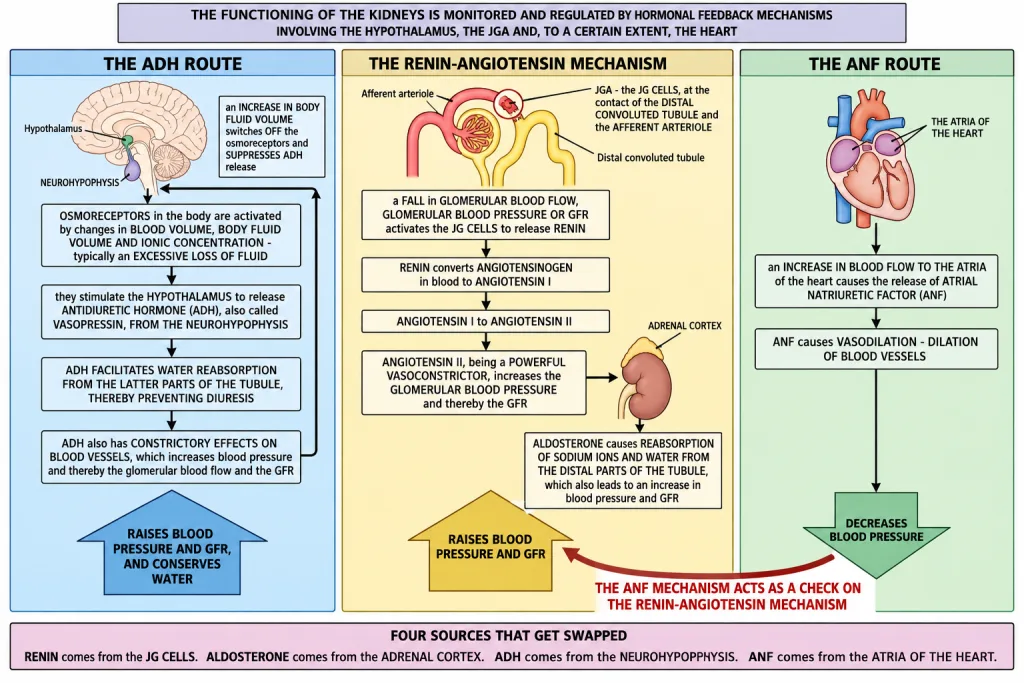
[NEET Important] Four sources get swapped in every option list. Renin comes from the JG cells, aldosterone from the adrenal cortex, ADH from the neurohypophysis and ANF from the atria of the heart. And keep the directions straight: renin-angiotensin raises blood pressure while ANF lowers it.
Quick Recap
- The functioning of the kidneys is efficiently monitored and regulated by hormonal feedback mechanisms involving the hypothalamus, the JGA and, to a certain extent, the heart.
- Osmoreceptors in the body are activated by changes in blood volume, body fluid volume and ionic concentration.
- An excessive loss of fluid activates these receptors, which stimulate the hypothalamus to release antidiuretic hormone (ADH), or vasopressin, from the neurohypophysis.
- ADH facilitates water reabsorption from the latter parts of the tubule, thereby preventing diuresis.
- An increase in body fluid volume can switch off the osmoreceptors and suppress ADH release, to complete the feedback.
- ADH also has constrictory effects on blood vessels, which increases blood pressure; an increase in blood pressure can increase the glomerular blood flow and thereby the GFR.
- A fall in glomerular blood flow, glomerular blood pressure or GFR activates the JG cells to release renin.
- Renin converts angiotensinogen in blood to angiotensin I and further to angiotensin II.
- Angiotensin II, being a powerful vasoconstrictor, increases the glomerular blood pressure and thereby the GFR.
- Angiotensin II also activates the adrenal cortex to release aldosterone.
- Aldosterone causes reabsorption of sodium ions and water from the distal parts of the tubule, which also leads to an increase in blood pressure and GFR.
- This complex mechanism is generally known as the renin-angiotensin mechanism.
- An increase in blood flow to the atria of the heart can cause the release of atrial natriuretic factor (ANF).
- ANF causes vasodilation, that is dilation of blood vessels, and thereby decreases the blood pressure.
- The ANF mechanism acts as a check on the renin-angiotensin mechanism.
- Sources to keep apart: renin from the JG cells, aldosterone from the adrenal cortex, ADH from the neurohypophysis, ANF from the atria of the heart.
Solved Examples
Question 1
Q. Which three sources take part in the hormonal regulation of kidney function?
Answer. The hypothalamus, the JGA and, to a certain extent, the heart. The functioning of the kidneys is efficiently monitored and regulated by hormonal feedback mechanisms involving these three.
Question 2
Q. What activates the osmoreceptors of the body?
Answer. Changes in blood volume, body fluid volume and ionic concentration. In practice, an excessive loss of fluid from the body activates them.
Question 3
Q. Where is ADH released from, and what else is it called?
Answer. From the neurohypophysis, after the osmoreceptors stimulate the hypothalamus to release it. ADH is the antidiuretic hormone, also called vasopressin.
Question 4
Q. State whether the following is true or false, and correct it if it is false: "ADH helps in water elimination, making the urine hypotonic." This is one of the chapter-end exercises.
Answer. FALSE.
ADH does the opposite of what the statement says. ADH facilitates water REABSORPTION from the latter parts of the tubule, thereby preventing diuresis.
So less water is lost from the body, not more, and the urine that finally leaves becomes more concentrated, that is hypertonic - not hypotonic.
The corrected statement is: ADH helps in water reabsorption from the latter parts of the tubule, preventing diuresis and making the urine hypertonic.
Question 5
Q. How is the ADH feedback switched off?
Answer. An increase in body fluid volume can switch off the osmoreceptors and suppress ADH release, which completes the feedback. Once the body has enough fluid, the signal to conserve water is withdrawn.
Question 6
Q. Besides acting on the tubule, how else does ADH affect kidney function?
Answer. By its constrictory effects on blood vessels. This causes an increase in blood pressure, and an increase in blood pressure can increase the glomerular blood flow and thereby the GFR.
Question 7
Q. What is the significance of the juxta glomerular apparatus (JGA) in kidney function? This is one of the chapter-end exercises.
Answer. The JGA is the kidney's own sensor and switch for regulating its filtration rate.
What it is. A sensitive region formed by cellular modifications in the distal convoluted tubule and the afferent arteriole at the point where they touch each other.
What it senses. A fall in glomerular blood flow, glomerular blood pressure or GFR.
What it does about it. The JG cells release renin, which sets off the renin-angiotensin mechanism - renin converts angiotensinogen in blood to angiotensin I and further to angiotensin II; angiotensin II, being a powerful vasoconstrictor, increases the glomerular blood pressure and thereby the GFR; and angiotensin II also activates the adrenal cortex to release aldosterone, which causes reabsorption of sodium ions and water from the distal parts of the tubule, again raising blood pressure and GFR.
Why it matters. The GFR is restored to normal without waiting for any outside instruction. That makes the JGA the kidney's own autoregulatory sensor and switch - it notices the fall and starts the correction itself.
Question 8
Q. What starts the renin-angiotensin mechanism, and which cells respond?
Answer. A fall in glomerular blood flow, glomerular blood pressure or GFR. The JG cells respond by releasing renin.
Question 9
Q. Write the renin-angiotensin chain in order.
Answer. Renin converts angiotensinogen in blood to angiotensin I, and further to angiotensin II. Angiotensin II, being a powerful vasoconstrictor, increases the glomerular blood pressure and thereby the GFR, and it also activates the adrenal cortex to release aldosterone. Aldosterone causes reabsorption of sodium ions and water from the distal parts of the tubule, which also leads to an increase in blood pressure and GFR.
Question 10
Q. Where does aldosterone come from and what does it do?
Answer. From the adrenal cortex, which angiotensin II activates. Aldosterone causes reabsorption of sodium ions and water from the distal parts of the tubule, and this leads to an increase in blood pressure and GFR.
Question 11
Q. Fill in the gap: "Reabsorption of water from distal parts of the tubules is facilitated by hormone _." This is one of the chapter-end exercises.
Answer. The answer is ADH, the antidiuretic hormone.
The complete sentence reads: "Reabsorption of water from distal parts of the tubules is facilitated by hormone ADH."
ADH, also called vasopressin, is released from the neurohypophysis when the osmoreceptors stimulate the hypothalamus, and it facilitates water reabsorption from the latter parts of the tubule, thereby preventing diuresis.
One thing worth noting. Aldosterone also causes reabsorption of sodium ions and water from the distal parts of the tubule, so both hormones act on that part of the nephron - but the hormone the sentence names, the one whose job is water reabsorption itself, is ADH.
Question 12
Q. What triggers the release of ANF, and from where does it come?
Answer. An increase in blood flow to the atria of the heart. The atria then release atrial natriuretic factor (ANF).
Question 13
Q. What does ANF do, and how does it relate to the renin-angiotensin mechanism?
Answer. ANF causes vasodilation - dilation of blood vessels - and thereby decreases the blood pressure. Since the renin-angiotensin mechanism raises the blood pressure, the ANF mechanism acts as a check on it.
Question 14
Q. Match each hormone with the place it is released from: renin, aldosterone, ADH, ANF.
Answer. Renin - the JG cells. Aldosterone - the adrenal cortex. ADH - the neurohypophysis. ANF - the atria of the heart.
Question 15
Q. A person has lost a lot of fluid through sweating. Trace what the body does.
Answer. The fall in body fluid volume activates the osmoreceptors, which stimulate the hypothalamus to release ADH from the neurohypophysis. ADH facilitates water reabsorption from the latter parts of the tubule, preventing diuresis, so little water is lost and the urine is concentrated. ADH also constricts blood vessels, raising blood pressure and so the glomerular blood flow and GFR. When the body fluid volume rises again, the osmoreceptors are switched off and ADH release is suppressed, completing the feedback.