
Four Disorders at a Glance
When the kidney stops doing its job, the failure shows up in the blood first. The chapter names four things that go wrong, and each one has a giveaway word that identifies it in an option list.
| Disorder | What it is | The giveaway word |
|---|---|---|
| Uremia | malfunctioning of the kidneys leads to the accumulation of UREA IN BLOOD - highly harmful, and may lead to kidney failure | UREA IN BLOOD |
| Renal calculi | stone, or insoluble mass of crystallised salts such as oxalates, formed within the kidney | STONE, OXALATES |
| Glomerulonephritis | inflammation of the glomeruli of the kidney | INFLAMMATION of the glomeruli |
| Acute renal failure | kidney failure, for which KIDNEY TRANSPLANTATION is the ultimate method of correction | TRANSPLANTATION |
Read the endings and the disorders separate themselves. -emia is in the blood, so uremia is urea in the BLOOD. -uria is in the urine, so glycosuria and ketonuria are glucose and ketone bodies in the URINE. -itis is inflammation, so glomerulonephritis is inflammation of the glomeruli. Calculus is simply the Latin for a small stone.
[NEET Important] Uremia is urea in the BLOOD, not in the urine. Urea in the urine is normal - 25-30 g of it leaves every day. It is urea piling up in the blood that is the disorder, and the chapter warns it may lead to kidney failure.
Haemodialysis, Step by Step
In such patients urea can be removed by a process called HAEMODIALYSIS. The chapter describes the machine in a fixed order, and that order is what gets asked.
1. Blood is taken out of an ARTERY. The blood drained from a convenient ARTERY is pumped into a dialysing unit called an ARTIFICIAL KIDNEY.
2. An anticoagulant is added on the way in. The blood is pumped into the unit after adding an ANTICOAGULANT LIKE HEPARIN, so that it does not clot inside the machine.
3. Inside the unit. The unit contains a coiled CELLOPHANE TUBE surrounded by a fluid, the DIALYSING FLUID, having the same composition as that of plasma EXCEPT THE NITROGENOUS WASTES.
4. How the clearing happens. The porous cellophane membrane of the tube allows the passage of molecules based on CONCENTRATION GRADIENT. As nitrogenous wastes are absent in the dialysing fluid, these substances freely move out, thereby clearing the blood.
5. Blood goes back through a VEIN. The cleared blood is pumped back to the body through a VEIN after adding ANTI-HEPARIN to it, which undoes the heparin so that normal clotting is restored.
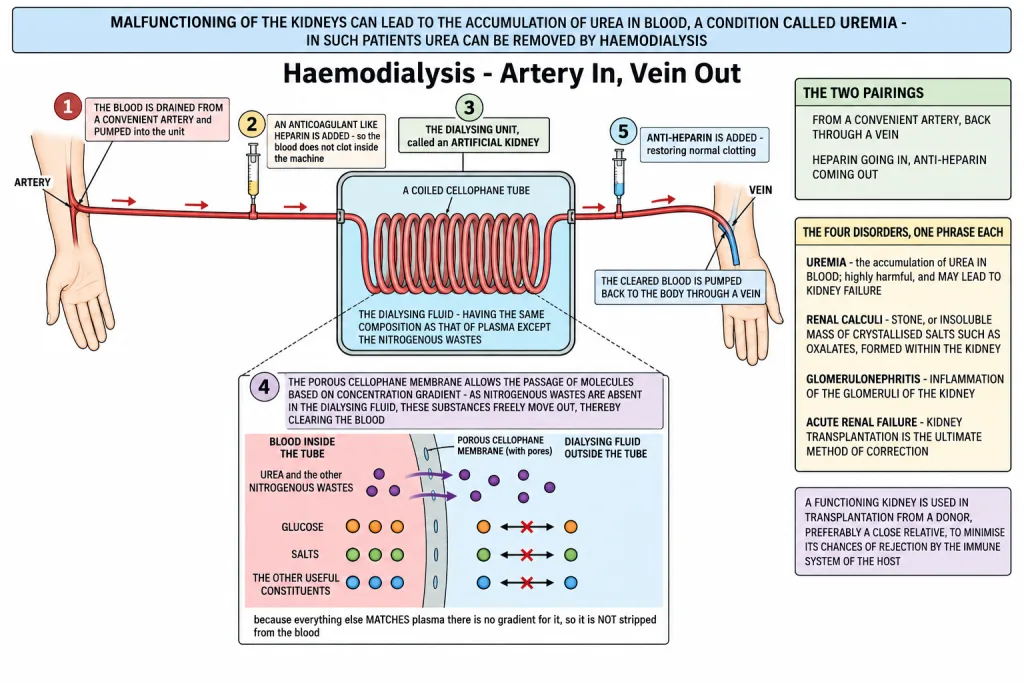
Two pairings hold this whole passage together, and both are asked directly.
| Going in | Coming out |
|---|---|
| from a convenient ARTERY | back through a VEIN |
| HEPARIN added - an anticoagulant | ANTI-HEPARIN added - restores clotting |
The design of the dialysing fluid is the clever part. It matches plasma in everything except the nitrogenous wastes. Because the wastes are missing on the outside, there is a steep concentration gradient for them and they move out. Because everything else matches, glucose, salts and the other useful constituents have no gradient to move down and are not stripped from the blood.
[NEET Important] Artery in, vein out; heparin in, anti-heparin out. Reversing either pair is the standard wrong option. And the membrane is CELLOPHANE, working by concentration gradient, not by active transport.
Transplantation, Calculi and Glomerulonephritis
KIDNEY TRANSPLANTATION is the ultimate method in the correction of acute renal failures. Dialysis keeps a uremic patient alive; a transplant is the actual correction.
A functioning kidney is used in transplantation from a donor, preferably a CLOSE RELATIVE, to minimise its chances of REJECTION by the immune system of the host.
Read that reason properly. The relative is not preferred for convenience. A close relative's tissues are genetically more similar, so the host's immune system is less likely to reject the transplanted kidney. Rejection by the immune system of the host is the exact phrase a question wants.
Two more disorders complete the list.
- RENAL CALCULI: stone, or insoluble mass of crystallised salts such as oxalates, formed WITHIN THE KIDNEY.
- GLOMERULONEPHRITIS: inflammation of the GLOMERULI of the kidney.
Both are named for exactly what they are. A calculus is a stone; the salts named are oxalates. Glomerulo- points at the glomeruli and -nephritis at inflammation.
[NEET Important] Match the four disorders to their one defining phrase and you have this section. Uremia - urea in blood. Renal calculi - stone of crystallised salts such as oxalates in the kidney. Glomerulonephritis - inflammation of the glomeruli. Acute renal failure - corrected ultimately by kidney transplantation. Definitions are swapped between the four in matching questions.
Quick Recap
- UREMIA - malfunctioning of the kidneys can lead to the accumulation of UREA IN BLOOD, which is highly harmful and may lead to kidney failure.
- In such patients urea can be removed by a process called HAEMODIALYSIS.
- The blood drained from a convenient ARTERY is pumped into a dialysing unit called an ARTIFICIAL KIDNEY, after adding an ANTICOAGULANT LIKE HEPARIN.
- The unit contains a coiled CELLOPHANE TUBE surrounded by a fluid, the DIALYSING FLUID, having the same composition as that of plasma EXCEPT THE NITROGENOUS WASTES.
- The porous cellophane membrane allows the passage of molecules based on CONCENTRATION GRADIENT.
- As nitrogenous wastes are absent in the dialysing fluid, these substances freely move out, thereby clearing the blood.
- The cleared blood is pumped back to the body through a VEIN after adding ANTI-HEPARIN to it.
- KIDNEY TRANSPLANTATION is the ultimate method in the correction of acute renal failures.
- A functioning kidney is used in transplantation from a donor, preferably a CLOSE RELATIVE, to minimise its chances of REJECTION by the immune system of the host.
- RENAL CALCULI - stone, or insoluble mass of crystallised salts such as oxalates, formed within the kidney.
- GLOMERULONEPHRITIS - inflammation of the glomeruli of the kidney.
Solved Examples
Question 1
Q. What is uremia?
Answer. Malfunctioning of the kidneys can lead to the accumulation of UREA IN BLOOD, a condition called uremia. Note the site - urea in the BLOOD, not in the urine.
Question 2
Q. Why is uremia dangerous?
Answer. Because it is highly harmful and may lead to kidney failure. The kidney's failure to clear urea makes the blood toxic, which damages the kidney further.
Question 3
Q. How can urea be removed from a uremic patient?
Answer. By a process called HAEMODIALYSIS.
Question 4
Q. Describe haemodialysis in order.
Answer.
- The blood drained from a convenient ARTERY is pumped into a dialysing unit called an ARTIFICIAL KIDNEY, after adding an ANTICOAGULANT LIKE HEPARIN.
- The unit contains a coiled CELLOPHANE TUBE surrounded by a fluid, the DIALYSING FLUID, having the same composition as that of plasma EXCEPT THE NITROGENOUS WASTES.
- The porous cellophane membrane of the tube allows the passage of molecules based on CONCENTRATION GRADIENT.
- As nitrogenous wastes are absent in the dialysing fluid, these substances freely move out, thereby clearing the blood.
- The cleared blood is pumped back to the body through a VEIN after adding ANTI-HEPARIN to it.
Question 5
Q. From which vessel is the blood drawn for dialysis, and through which is it returned?
Answer. Drawn from a convenient ARTERY; returned through a VEIN. Artery in, vein out - reversing this is the commonest error.
Question 6
Q. Why is heparin added before dialysis, and why is anti-heparin added afterwards?
Answer. Heparin is an ANTICOAGULANT, added so that the blood does not clot inside the dialysing unit. Anti-heparin is added to the cleared blood before it is pumped back so that the effect of the heparin is cancelled and normal clotting is restored in the body.
Question 7
Q. What does the dialysing unit contain?
Answer. A coiled CELLOPHANE TUBE surrounded by a fluid called the DIALYSING FLUID. The unit itself is called an ARTIFICIAL KIDNEY.
Question 8
Q. What is the composition of the dialysing fluid?
Answer. The same composition as that of plasma, EXCEPT THE NITROGENOUS WASTES.
Question 9
Q. Fill in the gap: "Dialysis fluid contain all the constituents as in plasma except _." This is one of the chapter-end exercises.
Answer. Dialysis fluid contains all the constituents as in plasma except THE NITROGENOUS WASTES.
Why it is made that way.
- The porous cellophane membrane of the tube allows the passage of molecules based on CONCENTRATION GRADIENT.
- Because the nitrogenous wastes are absent from the dialysing fluid, there is a steep concentration gradient across the membrane, so these substances freely move out of the blood, thereby clearing it.
- If the fluid contained the wastes as well, there would be no gradient, so nothing would move out and the blood would not be cleared - the machine would be useless.
- And because everything else matches plasma exactly, the useful constituents have no gradient to move down, so glucose, salts and the other essentials do not leak away while the wastes are being removed.
In one line: the wastes are left out so they will move out, and everything else is matched so it will stay in.
Question 10
Q. On what basis does the cellophane membrane let molecules pass?
Answer. On concentration gradient. The porous cellophane membrane of the tube allows the passage of molecules based on concentration gradient - it is not active transport, and no energy is spent pulling the wastes out.
Question 11
Q. What is the ultimate method in the correction of acute renal failure?
Answer. KIDNEY TRANSPLANTATION. A functioning kidney is used in transplantation from a donor.
Question 12
Q. Why is a close relative preferred as a kidney donor?
Answer. To minimise the chances of REJECTION by the immune system of the host. A close relative is genetically more similar, so the recipient's immune system is less likely to treat the new kidney as foreign.
Question 13
Q. What are renal calculi?
Answer. Stone, or insoluble mass of crystallised salts such as oxalates, formed within the kidney.
Question 14
Q. What is glomerulonephritis?
Answer. Inflammation of the glomeruli of the kidney. The name says it - glomerulo- for the glomeruli and -nephritis for inflammation of the kidney.