
The Kidneys Are Not the Only Excretory Organs
Other than the kidneys, the LUNGS, LIVER and SKIN also help in the elimination of excretory wastes. The chapter adds one more route almost as an aside - small amounts of nitrogenous wastes can be eliminated through SALIVA too.
This section is one grid, and the chapter-end exercise asks for exactly this grid. Learn each organ with what it eliminates and by what route.
| Organ | What it eliminates | By what route |
|---|---|---|
| Lungs | large amounts of carbon dioxide - approximately 200 mL per minute - and also significant quantities of water every day | expired air |
| Liver - the LARGEST GLAND in our body | bilirubin, biliverdin, cholesterol, degraded steroid hormones, vitamins and drugs | BILE; most of these substances ultimately pass out along with the digestive wastes |
| Skin - sweat glands | sodium chloride, small amounts of urea, lactic acid and so on | SWEAT, a watery fluid |
| Skin - sebaceous glands | sterols, hydrocarbons and waxes | SEBUM, which provides a protective oily covering for the skin |
| Salivary glands | small amounts of nitrogenous wastes | SALIVA |
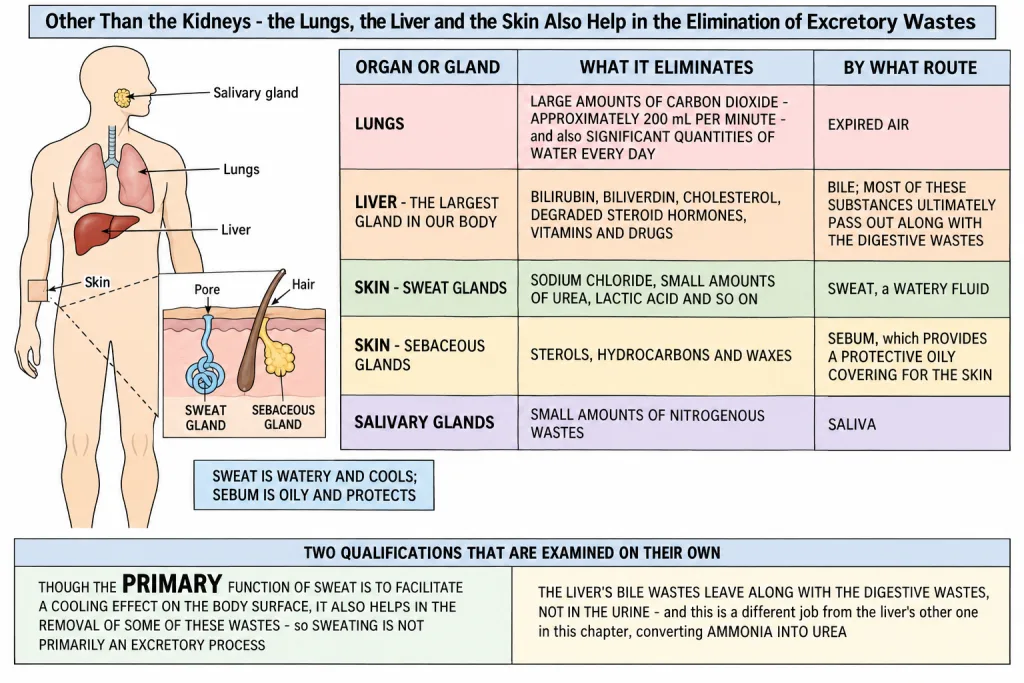
[NEET Important] The named substances are the marks. Bilirubin and biliverdin belong to the LIVER and leave in bile. Sterols, hydrocarbons and waxes belong to the SEBACEOUS glands and leave in sebum. Sodium chloride, urea and lactic acid belong to the SWEAT glands. A matching question moves one list under the wrong gland and waits.
Lungs and Liver
The lungs. Our lungs remove large amounts of carbon dioxide - approximately 200 mL per minute - and also significant quantities of water every day.
Two things leave through the lungs, not one. Most students remember the and forget the water, but the chapter names both in the same sentence. The number is 200 mL of carbon dioxide per minute - do not confuse it with 125 mL per minute, which is the glomerular filtration rate.
The liver. The liver is the LARGEST GLAND in our body, and it excretes by secreting BILE.
Bile contains substances like BILIRUBIN, BILIVERDIN, CHOLESTEROL, DEGRADED STEROID HORMONES, VITAMINS AND DRUGS.
And note where they end up. Most of these substances ultimately pass out along with the digestive wastes, that is, in the faeces, not in the urine. The liver hands its wastes to the gut, and the gut carries them out.
Keep the liver's two roles in this chapter apart. Earlier the chapter said ammonia is converted into urea in the LIVER, and that urea then goes to the kidneys in the blood. Here the liver is doing something different - secreting bile with bilirubin, biliverdin, cholesterol, degraded steroid hormones, vitamins and drugs, which leave with the digestive wastes.
[NEET Important] Bilirubin and biliverdin are bile pigments and are the liver's signature answer. If an option list offers them under lungs, sweat or sebum, that option is wrong. And remember the liver's bile wastes leave with the FAECES, not the urine.
The Skin - Sweat, Sebum and One Careful Word
The SWEAT and SEBACEOUS glands in the skin can eliminate certain substances through their secretions. Two glands, two secretions, two lists.
Sweat glands. Sweat produced by the sweat glands is a watery fluid containing sodium chloride (), small amounts of urea, lactic acid and so on.
Now the careful word. Though the PRIMARY function of sweat is to facilitate a COOLING EFFECT on the body surface, it also helps in the removal of some of these wastes.
"Primary" is examinable. Sweating is NOT primarily an excretory process - it is primarily a cooling process that removes a little waste as a side effect. A question that asks for the primary function of sweat wants cooling of the body surface, and the tempting wrong answer is excretion of urea.
Sebaceous glands. Sebaceous glands eliminate certain substances like STEROLS, HYDROCARBONS and WAXES through SEBUM. This secretion provides a protective oily covering for the skin.
So the skin's two glands are opposite in purpose as well as in content. Sweat is watery and cools; sebum is oily and protects. Both carry away a few wastes while doing their real job.
And one extra route. Small amounts of nitrogenous wastes can be eliminated through SALIVA too.
[NEET Important] The distinction most often tested from this page is sweat against sebum. Sweat - watery, sodium chloride, urea, lactic acid, primary function COOLING. Sebum - oily, sterols, hydrocarbons, waxes, primary function a PROTECTIVE OILY COVERING. Swapping the two lists is the standard trap.
Quick Recap
- Other than the kidneys, the LUNGS, LIVER and SKIN also help in the elimination of excretory wastes.
- LUNGS - remove large amounts of carbon dioxide, approximately 200 mL per minute, and also significant quantities of water every day.
- LIVER - the LARGEST GLAND in our body; it secretes BILE containing BILIRUBIN, BILIVERDIN, CHOLESTEROL, DEGRADED STEROID HORMONES, VITAMINS AND DRUGS.
- Most of these bile substances ultimately pass out along with the digestive wastes.
- SKIN - the SWEAT and SEBACEOUS glands can eliminate certain substances through their secretions.
- Sweat is a watery fluid containing sodium chloride, small amounts of urea, lactic acid and so on.
- The PRIMARY function of sweat is to facilitate a COOLING EFFECT on the body surface; it also helps in the removal of some of these wastes, so sweating is not primarily an excretory process.
- Sebaceous glands eliminate STEROLS, HYDROCARBONS and WAXES through SEBUM.
- Sebum provides a protective oily covering for the skin.
- Small amounts of nitrogenous wastes can be eliminated through SALIVA too.
Solved Examples
Question 1
Q. Other than the kidneys, which organs help in the elimination of excretory wastes?
Answer. The LUNGS, the LIVER and the SKIN. The chapter also notes that small amounts of nitrogenous wastes can be eliminated through saliva.
Question 2
Q. How much carbon dioxide do the lungs remove, and what figure does the chapter give?
Answer. Large amounts - approximately 200 mL per minute.
Question 3
Q. Apart from carbon dioxide, what else do the lungs remove?
Answer. Significant quantities of water, every day. Both leave in the expired air, and the chapter names them in the same sentence.
Question 4
Q. Which is the largest gland in our body, and how does it take part in excretion?
Answer. The LIVER. It takes part in excretion by secreting BILE, which carries wastes out of the body.
Question 5
Q. Name the substances the liver eliminates in bile.
Answer. BILIRUBIN, BILIVERDIN, CHOLESTEROL, DEGRADED STEROID HORMONES, VITAMINS AND DRUGS.
Question 6
Q. What finally happens to the substances secreted in bile?
Answer. Most of these substances ultimately pass out along with the digestive wastes - that is, with the faeces, not in the urine.
Question 7
Q. Which two kinds of gland in the skin eliminate substances, and through what?
Answer. The SWEAT glands, through SWEAT, and the SEBACEOUS glands, through SEBUM. The sweat and sebaceous glands in the skin can eliminate certain substances through their secretions.
Question 8
Q. What does sweat contain?
Answer. Sweat is a watery fluid containing sodium chloride, small amounts of urea, lactic acid and so on.
Question 9
Q. What is the primary function of sweat?
Answer. To facilitate a COOLING EFFECT on the body surface. It also helps in the removal of some wastes, but that is secondary.
Question 10
Q. Is sweating an excretory process? Answer carefully.
Answer. It helps in excretion, but it is not primarily an excretory process. Though the primary function of sweat is to facilitate a cooling effect on the body surface, it also helps in the removal of some of the wastes - sodium chloride, small amounts of urea and lactic acid. The word "primary" is what a question turns on: sweat cools first and excretes incidentally.
Question 11
Q. What do sebaceous glands eliminate, and through what secretion?
Answer. STEROLS, HYDROCARBONS and WAXES, eliminated through SEBUM.
Question 12
Q. What does sebum do for the skin?
Answer. It provides a protective oily covering for the skin. That is its real job; the elimination of sterols, hydrocarbons and waxes comes along with it.
Question 13
Q. Name a secretion, other than sweat and sebum, that can carry small amounts of nitrogenous waste out of the body.
Answer. SALIVA. Small amounts of nitrogenous wastes could be eliminated through saliva too.
Question 14
Q. Describe the role of liver, lungs and skin in excretion. This is one of the chapter-end exercises.
Answer. Other than the kidneys, the lungs, liver and skin also help in the elimination of excretory wastes.
LIVER. The liver is the largest gland in our body. It secretes BILE, and the bile contains BILIRUBIN, BILIVERDIN, CHOLESTEROL, DEGRADED STEROID HORMONES, VITAMINS AND DRUGS. Most of these substances ultimately pass out along with the digestive wastes. The liver is also the organ in which ammonia is converted into urea, which the blood then carries to the kidneys.
LUNGS. Our lungs remove large amounts of carbon dioxide - approximately 200 mL per minute - and also significant quantities of water every day, both in the expired air.
SKIN. The sweat and sebaceous glands in the skin can eliminate certain substances through their secretions.
- Sweat glands produce sweat, a watery fluid containing sodium chloride, small amounts of urea, lactic acid and so on. Though the primary function of sweat is to facilitate a cooling effect on the body surface, it also helps in the removal of some of these wastes.
- Sebaceous glands eliminate certain substances like sterols, hydrocarbons and waxes through sebum, and this secretion provides a protective oily covering for the skin.
| Organ | What it eliminates | Route |
|---|---|---|
| Liver | bilirubin, biliverdin, cholesterol, degraded steroid hormones, vitamins, drugs | bile, then out with the digestive wastes |
| Lungs | carbon dioxide, about 200 mL per minute, and water | expired air |
| Skin | sodium chloride, urea, lactic acid; sterols, hydrocarbons, waxes | sweat; sebum |