
What the Body Has to Get Rid Of
Animals accumulate ammonia, urea, uric acid, carbon dioxide, water and ions like , , , phosphate and sulphate - either by metabolic activities or by other means like excess ingestion. These substances have to be removed totally or partially.
Read the two sources of waste, because a question can turn on either. Some of it the body makes; some of it the body simply took in more of than it needed.
Ammonia, urea and uric acid are the major forms of nitrogenous wastes excreted by animals, and the whole first half of this chapter follows from one property they differ in.
And the chapter's other standing idea is osmoregulation. Osmoregulation is the regulation of the water and ionic content of the body fluids - keeping the concentration of the body's fluids steady, whatever the animal drinks, eats or loses. Excretion and osmoregulation are done by the same organs at the same time, which is why the chapter keeps naming both together.
[NEET Important] Carbon dioxide and water are excretory products too. A question asking which of four substances is not an excretory product is usually testing whether you think excretion means only nitrogen.
Three Wastes, Three Patterns
The three nitrogenous wastes differ in toxicity and in how much water it costs to get rid of them, and those two properties run in opposite directions.
| Waste | Toxicity | Water needed to excrete it |
|---|---|---|
| Ammonia | the MOST toxic | a large amount |
| Urea | intermediate - less toxic | moderate |
| Uric acid | the LEAST toxic | a minimum loss of water |
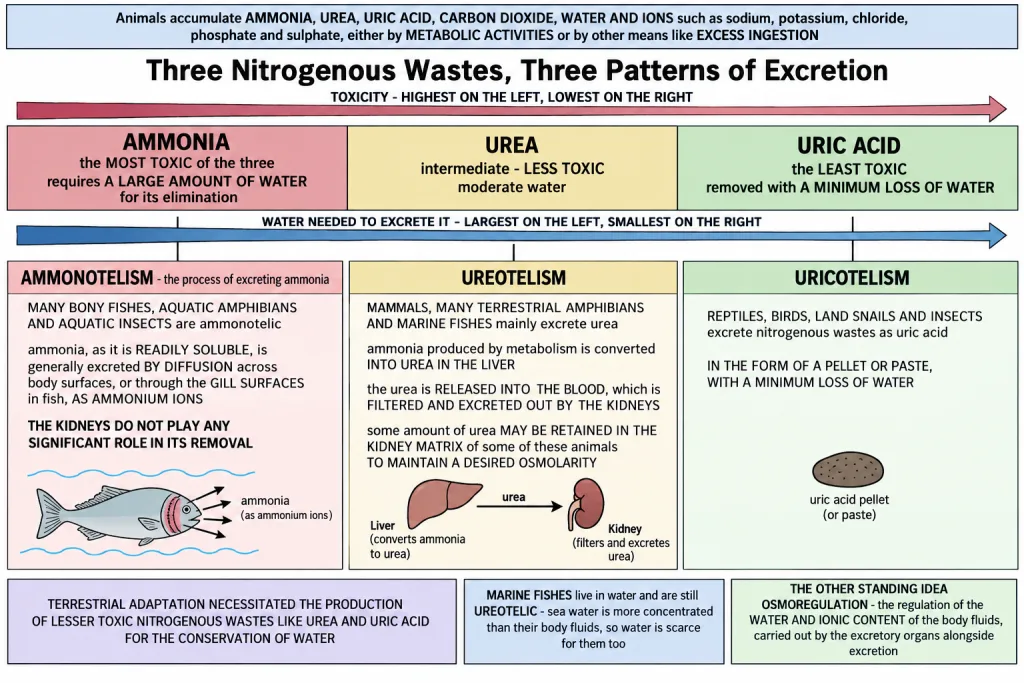
Each waste names a pattern of excretion, and each pattern names its animals.
- AMMONOTELISM - the process of excreting ammonia.
- Many bony fishes, aquatic amphibians and aquatic insects are ammonotelic.
- Ammonia, as it is readily soluble, is generally excreted by DIFFUSION across body surfaces or through gill surfaces in fish, as ammonium ions.
- The kidneys do not play any significant role in its removal. That negative is asked directly.
2. UREOTELISM. Terrestrial adaptation necessitated the production of lesser toxic nitrogenous wastes like urea and uric acid for conservation of water.
- Mammals, many terrestrial amphibians and marine fishes mainly excrete urea.
- Ammonia produced by metabolism is converted into urea IN THE LIVER of these animals and released into the blood, which is filtered and excreted out by the kidneys.
- Some amount of urea may be retained in the kidney matrix of some of these animals to maintain a desired osmolarity.
3. URICOTELISM.
- Reptiles, birds, land snails and insects excrete nitrogenous wastes as uric acid, in the form of a pellet or paste, with a minimum loss of water.
Note where the marine fishes sit. They live in water but are ureotelic, not ammonotelic - because sea water is saltier than their body fluids, so water is scarce for them too.
[NEET Important] Toxicity and water cost move together: most toxic needs most water. So ammonia suits an animal surrounded by water and uric acid suits an animal that cannot spare any. Every "which animal excretes what" question is answered from that one line rather than from a memorised list.
Why Land Animals Cannot Be Ammonotelic
This is one of the chapter's set questions, and it has a clean three-step answer.
Step 1 - ammonia is the most toxic of the three wastes. It cannot be allowed to build up in the body even briefly.
Step 2 - getting rid of it therefore needs a large amount of water, because it has to be flushed out in a very dilute solution before it can do harm.
Step 3 - a terrestrial animal cannot spare that water. An aquatic animal is surrounded by it and can simply let ammonia diffuse away across the body or gill surface; a land animal would dehydrate itself.
So terrestrial adaptation necessitated the production of lesser toxic nitrogenous wastes - urea and uric acid - for the conservation of water. Urea costs moderate water; uric acid, being the least toxic, goes out as a semi-solid pellet or paste with a minimum loss of water.
[NEET Important] The reason is water conservation, not toxicity alone. An answer that says only "ammonia is toxic" misses the mark - ammonia is toxic AND expensive in water, and it is the water that makes it impossible on land.
Quick Recap
- Animals accumulate ammonia, urea, uric acid, carbon dioxide, water and ions such as sodium, potassium, chloride, phosphate and sulphate, by metabolic activity or by excess ingestion.
- Ammonia, urea and uric acid are the major nitrogenous wastes.
- Ammonia is the most toxic and needs a large amount of water; uric acid is the least toxic and needs a minimum loss of water.
- Ammonotelism - many bony fishes, aquatic amphibians and aquatic insects; ammonia is readily soluble and is excreted by diffusion across body or gill surfaces as ammonium ions; the kidneys play no significant role.
- Ureotelism - mammals, many terrestrial amphibians and marine fishes; ammonia is converted into urea in the LIVER, released into the blood and excreted by the kidneys; some urea may be retained in the kidney matrix to maintain a desired osmolarity.
- Uricotelism - reptiles, birds, land snails and insects; uric acid leaves as a pellet or paste with minimum water loss.
- Terrestrial adaptation necessitated less toxic wastes for the conservation of water.
- Osmoregulation is the regulation of the water and ionic content of the body fluids, and the excretory organs do it alongside excretion.
Solved Examples
Question 1
Q. Name the substances animals accumulate and have to eliminate.
Answer. Ammonia, urea, uric acid, carbon dioxide, water and ions such as sodium, potassium, chloride, phosphate and sulphate. They accumulate either by metabolic activities or by other means like excess ingestion.
Question 2
Q. Name the three major nitrogenous wastes and rank them by toxicity.
Answer. Ammonia, urea and uric acid. Ammonia is the most toxic and uric acid is the least toxic, with urea in between.
Question 3
Q. How does water cost track toxicity for the three wastes?
Answer. They move together. Ammonia, the most toxic, requires a large amount of water for its elimination, while uric acid, being the least toxic, can be removed with a minimum loss of water.
Question 4
Q. What is ammonotelism, and which animals are ammonotelic?
Answer. Ammonotelism is the process of excreting ammonia. Many bony fishes, aquatic amphibians and aquatic insects are ammonotelic.
Question 5
Q. How is ammonia actually removed from an ammonotelic animal?
Answer. Ammonia is readily soluble, so it is generally excreted by diffusion across body surfaces, or through the gill surfaces in fish, as ammonium ions. The kidneys do not play any significant role in its removal.
Question 6
Q. Where is urea made in a ureotelic animal, and what happens to it next?
Answer. Ammonia produced by metabolism is converted into urea in the LIVER. It is then released into the blood, which is filtered and excreted out by the kidneys.
Question 7
Q. Which animals are ureotelic?
Answer. Mammals, many terrestrial amphibians and marine fishes.
Question 8
Q. Why may some urea be retained in the kidney matrix of a ureotelic animal?
Answer. To maintain a desired osmolarity. The retained urea helps hold the concentration of the kidney's interior high, which the chapter returns to when it explains how concentrated urine is made.
Question 9
Q. Which animals are uricotelic, and in what form does the waste leave?
Answer. Reptiles, birds, land snails and insects. Uric acid leaves in the form of a pellet or paste, with a minimum loss of water.
Question 10
Q. What is meant by the term osmoregulation? This is one of the chapter-end exercises.
Answer. Osmoregulation is the regulation of the water content and the ionic concentration of the body fluids, so that the osmotic concentration of those fluids is kept steady whatever the animal drinks, eats or loses.
It matters because cells only work within a narrow range of concentration - too dilute and water floods in, too concentrated and water is drawn out. In animals the same organs usually do both jobs at once, excreting wastes and adjusting how much water and salt leaves with them, which is why protonephridia are described as primarily osmoregulatory and why the kidney's work is described in terms of both waste removal and fluid balance.
Question 11
Q. Terrestrial animals are generally either ureotelic or uricotelic, not ammonotelic. Why? This is one of the chapter-end exercises.
Answer. Because ammonia is the most toxic of the three wastes and requires a large amount of water for its elimination, and a land animal cannot spare that water.
- An aquatic animal can afford ammonotelism - it is surrounded by water and can let ammonia diffuse away across the body surface or the gills, since ammonia is readily soluble.
- On land there is no such supply. Flushing out ammonia in a large volume of dilute fluid would dehydrate the animal.
- So terrestrial adaptation necessitated the production of lesser toxic nitrogenous wastes like urea and uric acid, for the conservation of water. Urea needs only moderate water, and uric acid, the least toxic, goes out as a pellet or paste with a minimum loss of water.
Question 12
Q. Marine fishes live surrounded by water, yet they are ureotelic and not ammonotelic. Why does that make sense?
Answer. Because sea water is more concentrated than their body fluids, so they are constantly losing water to their surroundings and are effectively short of it. Being ureotelic lets them excrete nitrogen without spending the large volume of water ammonia would need. Living in water is not the same as having water to spare.
Question 13
Q. Which excretory product is not nitrogenous but is still eliminated in large quantity?
Answer. Carbon dioxide, along with water and ions. The chapter lists all of these as substances that accumulate and must be removed, and carbon dioxide is dealt with by the lungs rather than the kidneys.