
Four Structures, Four Groups
A survey of the animal kingdom presents a variety of excretory structures. In most of the invertebrates these structures are simple tubular forms, whereas vertebrates have complex tubular organs called kidneys.
This whole section is one matching table, and NEET asks it as one.
| Structure | Which animals | What it does |
|---|---|---|
| Protonephridia, also called flame cells | Platyhelminthes (flatworms, for example Planaria), rotifers, some annelids, and the cephalochordate Amphioxus | primarily ionic and fluid volume regulation, that is OSMOREGULATION |
| Nephridia | earthworms and other annelids | remove nitrogenous wastes AND maintain fluid and ionic balance |
| Malpighian tubules | most insects, including cockroaches | removal of nitrogenous wastes AND osmoregulation |
| Antennal glands, also called green glands | crustaceans like prawns | the excretory function |
| Kidneys | vertebrates | complex tubular organs - the rest of this chapter |
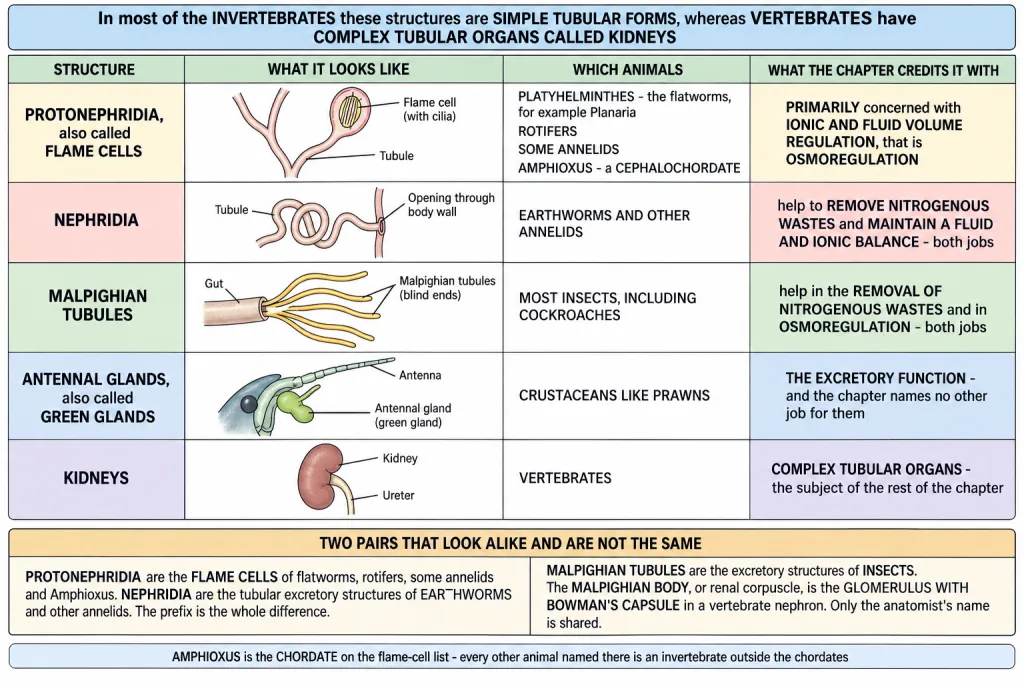
[NEET Important] Only ONE of these is described as primarily osmoregulatory. Protonephridia are primarily concerned with ionic and fluid volume regulation - waste removal is not their headline job. Nephridia and Malpighian tubules do both jobs, and the chapter says so of each in turn. That distinction is the most examined line in the section.
The Two Names That Trip Students
Two pairs of words in that table look alike and mean different things.
Protonephridia and nephridia are not the same structure. Protonephridia are the flame cells of flatworms, rotifers, some annelids and Amphioxus; nephridia are the tubular excretory structures of earthworms and other annelids. The prefix is the whole difference, and an option list will offer you both.
Malpighian tubules and the Malpighian body are not the same thing either, and they are not even in the same animal.
- Malpighian tubules are the excretory structures of insects, including the cockroach.
- The Malpighian body, which the chapter names a few pages later, is the glomerulus together with Bowman's capsule in the human nephron - also called the renal corpuscle.
Both are named after the same anatomist, and that is the only thing they have in common. A question naming "Malpighian" without saying tubule or body is testing whether you noticed.
One more worth fixing now. Amphioxus is a chordate - a cephalochordate - and it is the answer whenever a question asks for a chordate animal with flame cells. Every other animal on the flame-cell list is an invertebrate outside the chordates.
[NEET Important] Learn the four structures with their animals in one direction and then test yourself in the other. NEET asks both ways: "the excretory structure of a prawn is …" and "green glands are found in …".
Quick Recap
- Most invertebrates have simple tubular excretory structures; vertebrates have complex tubular organs called kidneys.
- Protonephridia or flame cells - in Platyhelminthes such as Planaria, rotifers, some annelids and the cephalochordate Amphioxus - are primarily concerned with ionic and fluid volume regulation, that is osmoregulation.
- Nephridia - the tubular excretory structures of earthworms and other annelids - remove nitrogenous wastes and maintain a fluid and ionic balance.
- Malpighian tubules - of most insects, including cockroaches - remove nitrogenous wastes and carry out osmoregulation.
- Antennal glands or green glands perform the excretory function in crustaceans like prawns.
- Protonephridia are not nephridia, and Malpighian tubules are not the Malpighian body.
- Amphioxus is the chordate on the flame-cell list.
Solved Examples
Question 1
Q. How do the excretory structures of invertebrates and vertebrates differ in general?
Answer. In most invertebrates they are simple tubular forms, while vertebrates have complex tubular organs called kidneys.
Question 2
Q. What are protonephridia also called, and in which animals are they found?
Answer. Flame cells. They are found in Platyhelminthes - the flatworms, for example Planaria - in rotifers, in some annelids, and in the cephalochordate Amphioxus.
Question 3
Q. What are protonephridia primarily concerned with?
Answer. Ionic and fluid volume regulation - that is, osmoregulation. Waste removal is not their headline function.
Question 4
Q. Name a chordate animal having flame cells as excretory structures. This is one of the chapter-end exercises.
Answer. Amphioxus, a cephalochordate.
It is the only chordate on the flame-cell list - the others, the flatworms such as Planaria, the rotifers and some annelids, are all invertebrates outside the chordates. In Amphioxus the protonephridia are primarily concerned with ionic and fluid volume regulation, that is osmoregulation.
Question 5
Q. What are nephridia, and what do they do?
Answer. The tubular excretory structures of earthworms and other annelids. They help to remove nitrogenous wastes and maintain a fluid and ionic balance.
Question 6
Q. Name the excretory structures of a cockroach and say what they do.
Answer. Malpighian tubules, found in most insects including cockroaches. They help in the removal of nitrogenous wastes and in osmoregulation.
Question 7
Q. What performs the excretory function in a prawn?
Answer. Antennal glands, also called green glands. They are found in crustaceans.
Question 8
Q. Distinguish between protonephridia and nephridia.
Answer. Protonephridia are the flame cells of flatworms, rotifers, some annelids and Amphioxus, and are primarily osmoregulatory. Nephridia are the tubular excretory structures of earthworms and other annelids, and they remove nitrogenous wastes as well as maintaining fluid and ionic balance. Some annelids appear on both lists - the names are not interchangeable.
Question 9
Q. A question mentions a "Malpighian" structure. What two different things could be meant?
Answer. Malpighian tubules are the excretory structures of insects. The Malpighian body, or renal corpuscle, is the glomerulus together with Bowman's capsule in the vertebrate nephron. They are in different animals and do different things - only the anatomist's name is shared.
Question 10
Q. Which of the four invertebrate structures is described as doing only the excretory function, without osmoregulation being named?
Answer. The antennal or green glands of crustaceans. The chapter says they perform the excretory function and stops there, whereas nephridia and Malpighian tubules are each credited with waste removal and fluid or ionic balance, and protonephridia with osmoregulation above all.
Question 11
Q. Arrange these animals with their excretory structures: Planaria, earthworm, cockroach, prawn.
Answer. Planaria - protonephridia or flame cells. Earthworm - nephridia. Cockroach - Malpighian tubules. Prawn - antennal or green glands.
Question 12
Q. Why would a freshwater flatworm need a structure that is primarily osmoregulatory?
Answer. Because fresh water is far more dilute than its body fluids, so water is constantly entering the animal. Its main problem is not getting rid of nitrogen - the body surface can handle that by diffusion - but pumping out the excess water and holding on to its ions, which is exactly what ionic and fluid volume regulation means.