
Two Streams Running Opposite Ways
Mammals have the ability to produce a concentrated urine. The HENLE'S LOOP and the VASA RECTA play a significant role in this. Everything in this section follows from the shape of those two structures - both are hairpins, and in a hairpin the fluid coming down runs right beside the fluid going up.
The flow of filtrate in the two limbs of Henle's loop is in OPPOSITE DIRECTIONS and thus forms a COUNTER CURRENT. The filtrate goes down the descending limb into the medulla and then back up the ascending limb towards the cortex, so the two streams pass each other at every level.
The flow of blood through the two limbs of vasa recta is also in a counter current pattern. The vasa recta is the hairpin-shaped blood vessel that runs alongside the loop, and its blood does exactly the same thing - down one limb, up the other.
| Hairpin | What flows in it | Direction of flow |
|---|---|---|
| Henle's loop | filtrate | descending limb downwards, ascending limb upwards - OPPOSITE directions, a counter current |
| Vasa recta | blood | also a counter current pattern |
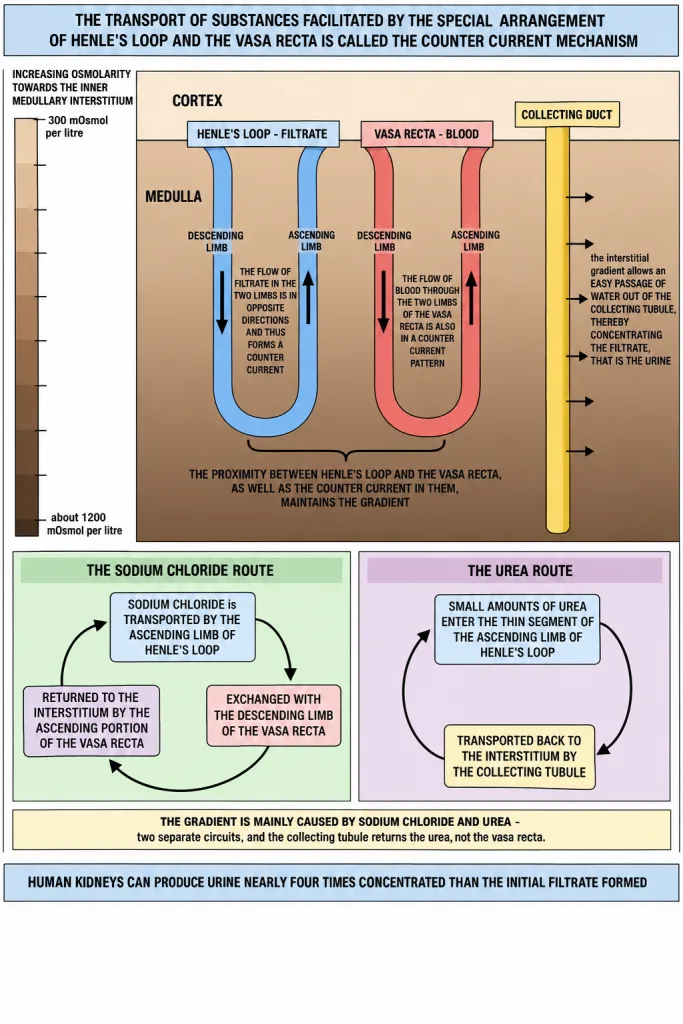
The proximity between Henle's loop and the vasa recta, as well as the counter current in them, helps in maintaining an increasing osmolarity towards the inner medullary interstitium - from 300 mOsmol per litre in the CORTEX to about 1200 mOsmol per litre in the INNER MEDULLA. Read that sentence twice: proximity AND counter current together, and the gradient increases as you go deeper, from the cortex down to the inner medulla.
[NEET Important] Two structures, not one. A question asking which structures make concentrated urine possible wants Henle's loop AND the vasa recta, and the reason is their proximity plus the counter current in both. Naming only the loop loses the mark.
What Builds the Gradient - Sodium Chloride and Urea
This gradient is mainly caused by SODIUM CHLORIDE and UREA. Neither one simply leaks into the medulla and stays there - each is carried round a small circuit, and NEET asks which substance moves where.
1. The sodium chloride route. Sodium chloride is transported by the ASCENDING LIMB of Henle's loop, which is exchanged with the DESCENDING LIMB of the vasa recta. Sodium chloride is returned to the interstitium by the ASCENDING PORTION of the vasa recta.
So leaves the ascending limb of the loop, is handed to the descending limb of the vasa recta, and is put back into the interstitium by the ascending portion of the vasa recta. It goes round in a circle instead of being washed away.
2. The urea route. Small amounts of UREA enter the THIN SEGMENT OF THE ASCENDING LIMB of Henle's loop, which is transported back to the interstitium by the COLLECTING TUBULE.
So urea enters at the thin segment of the ascending limb and is returned by the collecting tubule - a different vessel from the one that returns the salt.
| Substance | Where it leaves or enters | What returns it to the interstitium |
|---|---|---|
| Sodium chloride | transported by the ASCENDING LIMB of Henle's loop; exchanged with the DESCENDING LIMB of the vasa recta | the ASCENDING PORTION of the vasa recta |
| Urea | small amounts enter the THIN SEGMENT OF THE ASCENDING LIMB of Henle's loop | the COLLECTING TUBULE |
The transport of substances facilitated by the special arrangement of Henle's loop and the vasa recta is called the COUNTER CURRENT MECHANISM.
[NEET Important] Four addresses get swapped in options. Sodium chloride is transported by the ASCENDING limb, not the descending one; it is exchanged with the DESCENDING limb of the vasa recta and returned by the ASCENDING portion of the vasa recta; and urea comes back through the COLLECTING TUBULE, not through the vasa recta. Learn the two routes as two separate circuits.
Why a Counter Current Works At All
This mechanism helps to maintain a concentration gradient in the medullary interstitium. The presence of such an interstitial gradient helps in an easy passage of water from the collecting tubule, thereby concentrating the filtrate, that is the urine.
But why should two streams running opposite ways build such a steep gradient in the first place? The answer is simple arithmetic, and it is worth holding on to.
Because the two streams run past each other in opposite directions, a small difference maintained at every level adds up along the length of the loop into a very large difference between the top and the bottom. At any one point the ascending limb only has to make the interstitium around it slightly saltier than the fluid inside it - a small, easy step. But the fluid moving down the descending limb, and the blood moving down the vasa recta, carry that slightly higher concentration a little deeper, where the next small step is added on top of it. Step after small step, stacked down the length of the hairpin, the total becomes enormous - 300 mOsmol per litre at the top in the cortex and about 1200 mOsmol per litre at the bottom in the inner medulla.
The counter current is also what holds the gradient in place. A straight blood vessel running through the medulla would simply wash the salt and urea away and flatten everything out. The vasa recta, being a hairpin, carries them down one limb and brings them back up the other, so the medulla keeps what it has built.
And that is what all of it is for. The collecting duct passes through this very interstitium on its way out. With the surroundings so concentrated, water moves out of the collecting duct easily, leaving the urine behind in a small, strong volume.
Human kidneys can produce urine nearly FOUR TIMES concentrated than the initial filtrate formed.
[NEET Important] The gradient is a means, not an end. Its purpose is the easy passage of water out of the collecting tubule, which concentrates the urine up to nearly four times the initial filtrate. A question asking what the medullary gradient is for is answered with water leaving the collecting duct, not with salt reabsorption.
Quick Recap
- Mammals can produce a concentrated urine; Henle's loop and the vasa recta play a significant role in this.
- The flow of filtrate in the two limbs of Henle's loop is in opposite directions and thus forms a counter current.
- The flow of blood through the two limbs of the vasa recta is also in a counter current pattern.
- The proximity between Henle's loop and the vasa recta, and the counter current in them, help maintain an increasing osmolarity towards the inner medullary interstitium.
- The osmolarity rises from 300 mOsmol per litre in the cortex to about 1200 mOsmol per litre in the inner medulla.
- This gradient is mainly caused by sodium chloride and urea.
- Sodium chloride is transported by the ascending limb of Henle's loop, exchanged with the descending limb of the vasa recta, and returned to the interstitium by the ascending portion of the vasa recta.
- Small amounts of urea enter the thin segment of the ascending limb of Henle's loop and are transported back to the interstitium by the collecting tubule.
- The transport of substances facilitated by the special arrangement of Henle's loop and the vasa recta is called the counter current mechanism.
- The mechanism maintains a concentration gradient in the medullary interstitium.
- The interstitial gradient allows an easy passage of water from the collecting tubule, thereby concentrating the filtrate, that is the urine.
- A counter current works because the two streams run past each other in opposite directions, so a small difference maintained at every level adds up along the length of the loop into a very large difference between top and bottom.
- Human kidneys can produce urine nearly four times concentrated than the initial filtrate formed.
Solved Examples
Question 1
Q. Which two structures let a mammal produce a concentrated urine?
Answer. Henle's loop and the vasa recta. Mammals have the ability to produce a concentrated urine, and these two play a significant role in it.
Question 2
Q. In what direction does the filtrate flow in the two limbs of Henle's loop?
Answer. In opposite directions. The filtrate goes down the descending limb and back up the ascending limb, and this opposite flow forms a counter current.
Question 3
Q. What is special about the flow of blood in the vasa recta?
Answer. The flow of blood through the two limbs of the vasa recta is also in a counter current pattern - down one limb and up the other, alongside the loop.
Question 4
Q. What exactly maintains the increasing osmolarity towards the inner medullary interstitium?
Answer. The proximity between Henle's loop and the vasa recta, as well as the counter current in them. Both parts of that answer are needed - being close together AND running opposite ways.
Question 5
Q. Give the osmolarity of the cortex and of the inner medulla.
Answer. 300 mOsmol per litre in the cortex and about 1200 mOsmol per litre in the inner medulla. The osmolarity increases as you go deeper, towards the inner medullary interstitium.
Question 6
Q. What causes this gradient?
Answer. It is mainly caused by sodium chloride and urea.
Question 7
Q. Trace the route of sodium chloride in the counter current mechanism.
Answer. Sodium chloride is transported by the ascending limb of Henle's loop. It is then exchanged with the descending limb of the vasa recta, and finally returned to the interstitium by the ascending portion of the vasa recta. It travels round a circuit instead of being carried away.
Question 8
Q. Trace the route of urea in the counter current mechanism.
Answer. Small amounts of urea enter the thin segment of the ascending limb of Henle's loop, and this urea is transported back to the interstitium by the collecting tubule.
Question 9
Q. Which limb of Henle's loop transports sodium chloride, and which structure returns it to the interstitium?
Answer. The ascending limb of Henle's loop transports the sodium chloride, and the ascending portion of the vasa recta returns it to the interstitium. In between, it is exchanged with the descending limb of the vasa recta.
Question 10
Q. What is the counter current mechanism?
Answer. The transport of substances facilitated by the special arrangement of Henle's loop and the vasa recta. That special arrangement is their proximity and the counter current flow in both of them.
Question 11
Q. Give a brief account of the counter current mechanism. This is one of the chapter-end exercises.
Answer. The counter current mechanism is the transport of substances made possible by the special arrangement of Henle's loop and the vasa recta, and it is what lets a mammal produce a concentrated urine.
1. Two counter currents. The flow of filtrate in the two limbs of Henle's loop is in opposite directions and thus forms a counter current, and the flow of blood through the two limbs of the vasa recta is also in a counter current pattern.
2. Proximity plus counter current. The proximity between Henle's loop and the vasa recta, as well as the counter current in them, helps in maintaining an increasing osmolarity towards the inner medullary interstitium - from 300 mOsmol per litre in the cortex to about 1200 mOsmol per litre in the inner medulla.
3. What causes the gradient. It is mainly caused by sodium chloride and urea, each carried round its own circuit:
- Sodium chloride is transported by the ascending limb of Henle's loop, which is exchanged with the descending limb of the vasa recta, and sodium chloride is returned to the interstitium by the ascending portion of the vasa recta.
- Small amounts of urea enter the thin segment of the ascending limb of Henle's loop, which is transported back to the interstitium by the collecting tubule.
4. What the gradient is for. This mechanism helps to maintain a concentration gradient in the medullary interstitium, and the presence of such an interstitial gradient helps in an easy passage of water from the collecting tubule, thereby concentrating the filtrate, that is the urine. Human kidneys can produce urine nearly four times concentrated than the initial filtrate formed.
Question 12
Q. Why does running two streams in opposite directions build such a steep gradient?
Answer. Because a small difference maintained at every level adds up along the length of the loop. At any single point the ascending limb only has to make the interstitium slightly saltier than the fluid inside it, which is easy. But the descending stream carries that slightly higher concentration deeper, where the next small step is added on top of it. Stacked step by step down the hairpin, the small differences become a very large difference between the top and the bottom - 300 mOsmol per litre in the cortex against about 1200 mOsmol per litre in the inner medulla.
Question 13
Q. What would happen if a straight blood vessel, rather than a hairpin, ran through the medulla?
Answer. It would wash the sodium chloride and urea away and flatten the gradient. The vasa recta, being a hairpin with a counter current flow, carries them down one limb and brings them back up the other, so the medulla keeps the concentration it has built.
Question 14
Q. How does the medullary gradient actually concentrate the urine?
Answer. The collecting duct passes through that concentrated interstitium on its way out. The presence of the interstitial gradient helps in an easy passage of water from the collecting tubule, so water moves out and the filtrate left behind becomes concentrated urine.
Question 15
Q. How concentrated can human urine become compared with the initial filtrate?
Answer. Nearly four times concentrated than the initial filtrate formed.