
Storing Urine Until You Decide
Urine formed by the nephrons is ultimately carried to the URINARY BLADDER, where it is stored till a VOLUNTARY signal is given by the central nervous system (CNS). That last clause is the whole reason this section exists - the kidney never stops making urine, but the body does not release it continuously.
The release itself is a reflex, and it runs in a fixed order.
Step 1 - the signal is initiated by the STRETCHING of the urinary bladder as it gets filled with urine. The trigger is mechanical, not chemical. Nothing here is measuring urea or salt.
Step 2 - in response, the STRETCH RECEPTORS on the walls of the bladder send signals to the CNS. Name the receptor and name where it sits: stretch receptors, on the walls of the bladder.
Step 3 - the CNS passes on motor messages to bring about two things at once:
- the CONTRACTION of the smooth muscles of the bladder, and
- the SIMULTANEOUS RELAXATION of the urethral sphincter.
Step 4 - the two together cause the release of urine. The word simultaneous is doing real work. A bladder that squeezes against a shut sphincter releases nothing.
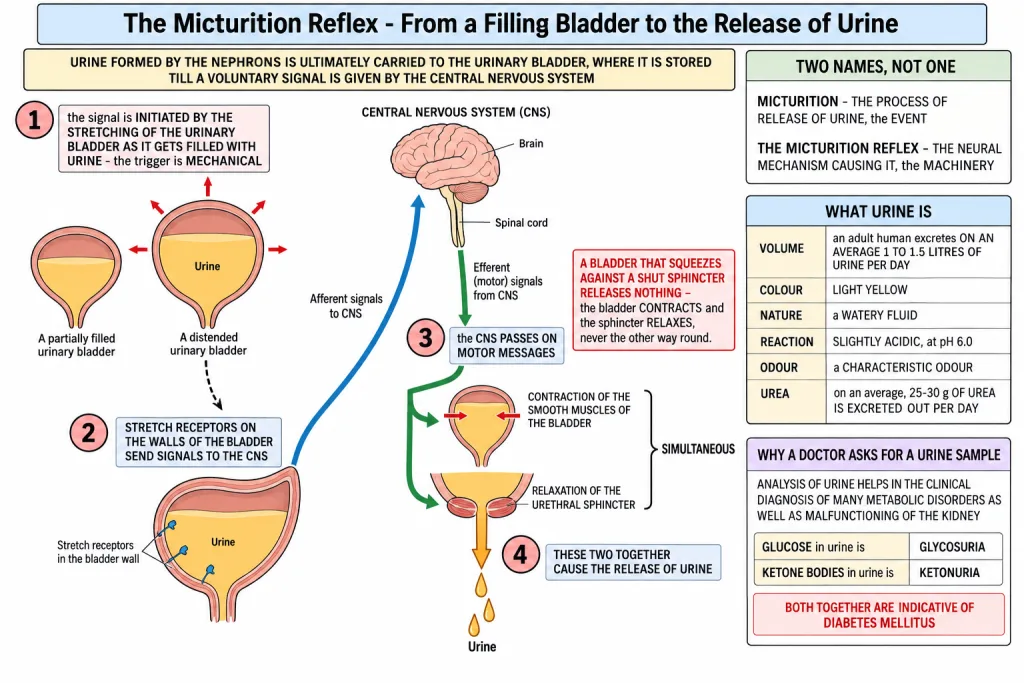
Two names come out of this, and they are not the same name.
- The process of release of urine is called MICTURITION.
- The neural mechanism causing it is called the MICTURITION REFLEX.
Micturition is the event; the micturition reflex is the machinery behind it. An option list will give you both and expect you to pick the one the stem actually asked for.
[NEET Important] Sequence questions are the standard form here. The order is filling and stretching, then the stretch receptors, then the CNS, then contraction of bladder muscle with relaxation of the sphincter, then release. The favourite distractor swaps the two muscle events - it offers relaxation of the bladder with contraction of the sphincter. The bladder CONTRACTS and the sphincter RELAXES.
What Urine Actually Is
The chapter gives urine a short list of measured properties, and every one of them has been asked as a one-mark question. Learn the numbers as printed, ranges included.
| Property | Value as the chapter gives it |
|---|---|
| Volume per day | an adult human excretes on an average 1 to 1.5 litres of urine per day |
| Colour | light yellow |
| Physical nature | a watery fluid |
| Reaction | slightly ACIDIC, at pH 6.0 |
| Odour | a characteristic odour |
| Urea excreted | on an average, 25-30 g of urea is excreted out per day |
Read the two numbers together and do not let them collide. 1 to 1.5 litres is the volume of urine per day. 25-30 g is the mass of urea in it per day. They belong to the same sentence in the chapter and to opposite ends of the same question.
And urine is slightly ACIDIC, not alkaline. pH 6.0 is just below neutral. Blood sits a little above neutral, urine a little below - a question that offers pH 7.4 is offering you blood's value.
[NEET Important] Three figures carry this section: 1 to 1.5 litres per day, pH 6.0, and 25-30 g of urea per day. The distractors are drawn from elsewhere in this same chapter - 180 litres is the daily filtrate, 125 mL per minute is the glomerular filtration rate, 120-170 g is the weight of a kidney. Match the number to its unit and its per-what before you pick.
Why a Doctor Asks for a Urine Sample
Various conditions can affect the characteristics of urine. Because urine is made by filtering blood and then editing the filtrate, what appears in urine reports on what was in the blood and on how well the tubules did their editing.
So analysis of urine helps in the clinical diagnosis of many metabolic disorders as well as malfunctioning of the kidney. Note that the chapter claims both - metabolic disorders of the body at large, and malfunctioning of the kidney itself.
The worked example the chapter gives is a metabolic one.
- The presence of glucose in urine is called GLYCOSURIA.
- The presence of ketone bodies in urine is called KETONURIA.
- Both together are indicative of DIABETES MELLITUS.
Take the two words apart and they stop being confusable. Glyco- is sugar, keto- is ketone bodies, and -uria means "in the urine". The same ending turns up again in uremia, but that one is urea in the BLOOD, not in the urine - a different disorder in a later section.
[NEET Important] Glycosuria is glucose, ketonuria is ketone bodies, and diabetes mellitus is the condition both point to. A question may name only one of them and still expect diabetes mellitus as the answer.
Quick Recap
- Urine formed by the nephrons is ultimately carried to the URINARY BLADDER, where it is stored till a VOLUNTARY signal is given by the central nervous system (CNS).
- The signal is initiated by the STRETCHING of the urinary bladder as it gets filled with urine.
- In response, the STRETCH RECEPTORS on the walls of the bladder send signals to the CNS.
- The CNS passes on motor messages to initiate the CONTRACTION of the smooth muscles of the bladder and the SIMULTANEOUS RELAXATION of the urethral sphincter, causing the release of urine.
- The process of release of urine is called MICTURITION; the neural mechanism causing it is called the MICTURITION REFLEX.
- An adult human excretes on an average 1 to 1.5 litres of urine per day.
- Urine is a LIGHT YELLOW coloured WATERY fluid, SLIGHTLY ACIDIC at pH 6.0, with a characteristic odour.
- On an average, 25-30 g of urea is excreted out per day.
- Various conditions can affect the characteristics of urine.
- Analysis of urine helps in the clinical diagnosis of many metabolic disorders as well as malfunctioning of the kidney.
- Presence of glucose (GLYCOSURIA) and ketone bodies (KETONURIA) in urine are indicative of DIABETES MELLITUS.
Solved Examples
Question 1
Q. Where is the urine made by the nephrons stored, and for how long?
Answer. Urine formed by the nephrons is ultimately carried to the URINARY BLADDER, where it is stored till a VOLUNTARY signal is given by the central nervous system (CNS).
Question 2
Q. What initiates the signal that begins micturition?
Answer. The STRETCHING of the urinary bladder as it gets filled with urine. The trigger is mechanical - the wall being stretched - not a change in the chemistry of the urine.
Question 3
Q. Name the receptors involved in micturition and say exactly where they lie.
Answer. The STRETCH RECEPTORS, which lie on the walls of the urinary bladder. When the bladder fills and stretches, they send signals to the CNS.
Question 4
Q. What two muscular events does the CNS order, and why must they happen together?
Answer. The CNS passes on motor messages to initiate the CONTRACTION of the smooth muscles of the bladder and the SIMULTANEOUS RELAXATION of the urethral sphincter.
They must happen together because a bladder squeezing against a closed sphincter would release nothing. Contraction pushes, relaxation opens the way, and only both at once cause the release of urine.
Question 5
Q. Distinguish between micturition and the micturition reflex.
Answer. Micturition is the process of release of urine - the event itself. The micturition reflex is the neural mechanism causing it - the stretch receptors, the CNS and the motor messages that produce the event. One is what happens; the other is how it is brought about.
Question 6
Q. Explain micturition. This is one of the chapter-end exercises.
Answer. Micturition is the process of release of urine, and the neural mechanism causing it is called the micturition reflex. It runs in this order.
- Urine formed by the nephrons is ultimately carried to the URINARY BLADDER, where it is stored till a VOLUNTARY signal is given by the central nervous system (CNS).
- The signal is initiated by the STRETCHING of the urinary bladder as it gets filled with urine.
- In response, the STRETCH RECEPTORS on the walls of the bladder send signals to the CNS.
- The CNS passes on motor messages to initiate the CONTRACTION of the smooth muscles of the bladder and the SIMULTANEOUS RELAXATION of the urethral sphincter.
- These two together cause the release of urine.
In short: the bladder fills and stretches, stretch receptors report to the CNS, the CNS orders the bladder to contract and the urethral sphincter to relax at the same moment, and urine is released.
Question 7
Q. "Micturition is carried out by a reflex." State whether this is true or false and justify your answer. This is one of the chapter-end exercises.
Answer. TRUE.
The neural mechanism causing micturition is called the MICTURITION REFLEX. Stretch receptors on the walls of the bladder register the stretching of the bladder as it fills, send signals to the CNS, and the CNS returns motor messages that contract the smooth muscles of the bladder and simultaneously relax the urethral sphincter, releasing the urine. That is a reflex arc - receptor, centre, effector.
But add the qualification the chapter itself carries. Urine is stored in the bladder till a VOLUNTARY signal is given by the CNS, so in an adult the reflex is under voluntary control - it can be held back or permitted. It is a reflex, and a reflex the CNS is allowed to overrule.
Question 8
Q. How much urine does an adult human pass in a day?
Answer. An adult human excretes on an average 1 to 1.5 litres of urine per day.
Question 9
Q. Describe the physical properties of normal urine.
Answer. It is a LIGHT YELLOW coloured WATERY fluid which is SLIGHTLY ACIDIC, at pH 6.0, and has a characteristic odour.
Note the reaction carefully - urine is slightly acidic, not alkaline. pH 6.0 is a little below neutral.
Question 10
Q. Fill in the gap: "A healthy adult human excretes (on an average) _ gm of urea/day." This is one of the chapter-end exercises.
Answer. A healthy adult human excretes (on an average) 25-30 gm of urea per day.
Keep this figure beside the other two the chapter gives for urine, because questions mix them up on purpose.
| Quantity | Value |
|---|---|
| Urine passed per day | 1 to 1.5 litres |
| Urea excreted per day | 25-30 g |
| pH of urine | 6.0, that is slightly acidic |
One is a volume of fluid, one is a mass of a solute, and one is a reaction. 1 to 1.5 litres of urine carries 25-30 g of urea, and that urine sits at pH 6.0.
Question 11
Q. What is glycosuria, and what does it point to?
Answer. Glycosuria is the presence of glucose in urine. Along with ketone bodies in urine, it is indicative of DIABETES MELLITUS.
Question 12
Q. What is ketonuria?
Answer. The presence of ketone bodies in urine. Presence of glucose (glycosuria) and ketone bodies (ketonuria) in urine are indicative of diabetes mellitus.
Question 13
Q. Why is analysis of urine clinically useful?
Answer. Because various conditions can affect the characteristics of urine, so analysis of urine helps in the clinical diagnosis of many metabolic disorders as well as malfunctioning of the kidney. Urine is blood that has been filtered and then edited by the tubules, so it reports both on what was circulating and on how well the kidney did the editing.
Question 14
Q. A patient's urine sample shows both glucose and ketone bodies. Name each finding and say what the pair suggests.
Answer. Glucose in urine is glycosuria; ketone bodies in urine is ketonuria. Together they are indicative of DIABETES MELLITUS.
Do not confuse either with uremia, which is urea in the BLOOD and points to malfunctioning of the kidneys, not to a sugar disorder.