
Three Processes, and the First of Them
Urine formation involves THREE main processes - GLOMERULAR FILTRATION, REABSORPTION and SECRETION - that take place in different parts of the nephron.
Learn the three as a set before you learn any one of them. This section is the first of the three, glomerular filtration. The next section takes the other two, reabsorption and secretion.
| Process | Where in the nephron | What happens |
|---|---|---|
| Glomerular filtration | the glomerulus | blood is filtered into Bowman's capsule |
| Reabsorption | the renal tubules | most of the filtrate is taken back |
| Secretion | the tubular cells | substances are added into the filtrate |
The first step in urine formation is the filtration of blood, which is carried out by the glomerulus, and is called glomerular filtration.
On an average, 1100-1200 mL of blood is filtered by the kidneys per minute, which constitutes roughly ONE-FIFTH of the blood pumped out by each ventricle of the heart in a minute.
That one-fifth is a link back to the previous chapter. Cardiac output is about 5 litres per minute, and one-fifth of 5 litres is about 1000 to 1200 mL - which is exactly the 1100-1200 mL per minute the kidneys take. So the two chapters agree, and a question can be set from either end.
[NEET Important] Do not mix up the two big volumes of this section. 1100-1200 mL per minute is the BLOOD filtered, while 125 mL per minute is the FILTRATE formed. The blood figure is a volume going in; the filtrate figure is a volume coming out. Options lists put both numbers side by side on purpose.
The Filtration Barrier - Three Layers
The glomerular capillary blood pressure causes filtration of blood through 3 layers. The count is asked, and so is the order, so learn them from the blood outward.
- The ENDOTHELIUM of the glomerular blood vessels - the innermost layer, the wall of the capillary itself.
- A BASEMENT MEMBRANE between these two layers - the middle layer.
- The EPITHELIUM of Bowman's capsule - the outermost layer, the wall of the capsule.
The source names them as the endothelium of glomerular blood vessels, the epithelium of Bowman's capsule and a basement membrane between these two layers. Either way, the basement membrane lies between the other two and there are exactly three.
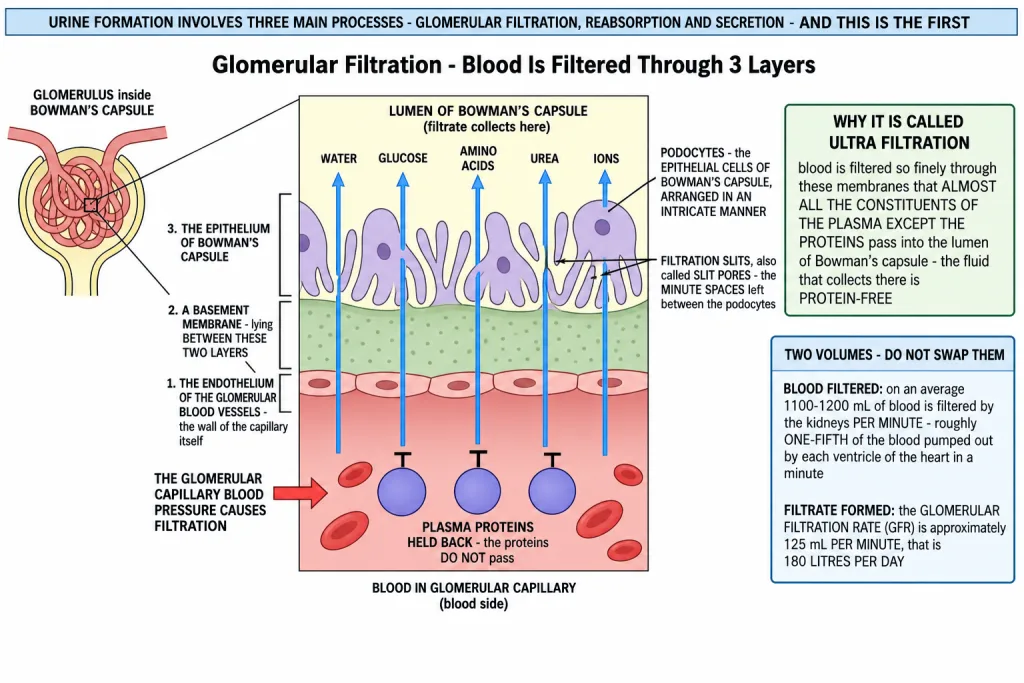
The epithelial cells of Bowman's capsule, called PODOCYTES, are arranged in an intricate manner so as to leave some minute spaces called FILTRATION SLITS or SLIT PORES.
- Podocytes are the cells.
- Filtration slits, also called slit pores, are the minute spaces left between them.
Blood is filtered so finely through these membranes that almost all the constituents of the plasma EXCEPT THE PROTEINS pass into the lumen of Bowman's capsule. Therefore it is considered a process of ULTRA FILTRATION.
That is the whole reason for the name. Ordinary filtration holds back large particles; here the sieve is fine enough to hold back the plasma proteins while letting glucose, amino acids, urea, water and ions through. The fluid that enters Bowman's capsule is therefore protein-free.
[NEET Important] The word ultra filtration is earned by ONE fact - the proteins stay behind. An option saying the filtrate is free of glucose, or free of urea, is wrong; glucose and urea both pass into the capsule and are dealt with later down the tubule. Only the proteins are held back at this stage.
The GFR and How the Kidney Regulates It
The amount of the filtrate formed by the kidneys per minute is called the GLOMERULAR FILTRATION RATE (GFR).
GFR in a healthy individual is approximately 125 mL per minute, that is 180 litres per day.
The two values are the same fact in two units. 125 mL per minute multiplied by 1440 minutes in a day is 180000 mL, which is 180 litres. Both numbers are asked, so carry both.
The kidneys have built-in mechanisms for the regulation of GFR. One such efficient mechanism is carried out by the JUXTA GLOMERULAR APPARATUS (JGA).
JGA is a special sensitive region formed by cellular modifications in the DISTAL CONVOLUTED TUBULE and the AFFERENT ARTERIOLE at the location of their contact.
- Two structures make it - the distal convoluted tubule and the afferent arteriole.
- It sits where those two touch.
- It is a sensitive region - it senses, and then it acts.
A fall in GFR can activate the JG cells to release RENIN, which can stimulate the glomerular blood flow and thereby bring the GFR back to normal.
Read that as a loop. GFR falls, the JG cells notice, renin is released, glomerular blood flow is stimulated, GFR comes back to normal. The kidney has corrected its own filtration rate without waiting for a signal from outside, which is why this is called autoregulation.
[NEET Important] Two swaps are set here again and again. The JGA is made from the DISTAL convoluted tubule and the AFFERENT arteriole - not the proximal tubule, not the efferent arteriole. And renin comes from the JG cells of the kidney, while aldosterone comes from the adrenal cortex. Keep the source of each straight.
Quick Recap
- Urine formation involves three main processes - glomerular filtration, reabsorption and secretion - taking place in different parts of the nephron.
- The first step is the filtration of blood, carried out by the glomerulus, and is called glomerular filtration.
- 1100-1200 mL of blood is filtered by the kidneys per minute, roughly one-fifth of the blood pumped out by each ventricle of the heart in a minute - and cardiac output is about 5 litres per minute, so the two figures agree.
- The glomerular capillary blood pressure causes the filtration.
- Filtration happens through 3 layers - the endothelium of the glomerular blood vessels, the epithelium of Bowman's capsule, and a basement membrane between these two layers.
- The epithelial cells of Bowman's capsule are called podocytes, arranged so as to leave minute spaces called filtration slits or slit pores.
- Almost all the constituents of plasma except the proteins pass into the lumen of Bowman's capsule, so the process is called ultra filtration.
- GFR is the amount of filtrate formed by the kidneys per minute.
- GFR in a healthy individual is approximately 125 mL per minute, that is 180 litres per day.
- The kidneys have built-in mechanisms for the regulation of GFR, one efficient one being the juxta glomerular apparatus (JGA).
- The JGA is a special sensitive region formed by cellular modifications in the distal convoluted tubule and the afferent arteriole at the location of their contact.
- A fall in GFR activates the JG cells to release renin, which stimulates the glomerular blood flow and brings the GFR back to normal.
Solved Examples
Question 1
Q. Name the three main processes involved in urine formation.
Answer. Glomerular filtration, reabsorption and secretion. They take place in different parts of the nephron.
Question 2
Q. Which is the first step in urine formation, and which part of the nephron carries it out?
Answer. The filtration of blood. It is carried out by the glomerulus and is called glomerular filtration.
Question 3
Q. How much blood is filtered by the kidneys per minute, and what fraction of the heart's output is that?
Answer. On an average 1100-1200 mL of blood is filtered per minute. That is roughly one-fifth of the blood pumped out by each ventricle of the heart in a minute. Since cardiac output is about 5 litres per minute, one-fifth of it comes to about 1100-1200 mL, which is why the two chapters agree.
Question 4
Q. What force actually drives filtration at the glomerulus?
Answer. The glomerular capillary blood pressure. It causes filtration of blood through the 3 layers of the barrier.
Question 5
Q. Name the three layers through which blood is filtered.
Answer. The endothelium of the glomerular blood vessels, the epithelium of Bowman's capsule, and a basement membrane between these two layers. There are exactly three, and the basement membrane lies between the other two.
Question 6
Q. What are podocytes, and what do they leave between them?
Answer. Podocytes are the epithelial cells of Bowman's capsule. They are arranged in an intricate manner so as to leave some minute spaces called filtration slits, or slit pores.
Question 7
Q. Why is glomerular filtration described as ultra filtration?
Answer. Because blood is filtered so finely through these membranes that almost all the constituents of the plasma except the proteins pass into the lumen of Bowman's capsule. The sieve is fine enough to hold back the plasma proteins while letting water, glucose, amino acids, urea and ions through, so the process is considered a process of ultra filtration.
Question 8
Q. Define Glomerular Filtration Rate (GFR). This is one of the chapter-end exercises.
Answer. Glomerular filtration rate is the amount of the filtrate formed by the kidneys per minute.
In a healthy individual GFR is approximately 125 mL per minute, that is 180 litres per day.
Note carefully what is being measured. GFR counts the FILTRATE that enters Bowman's capsule, not the blood that arrives at the glomerulus. The blood figure is a different one - 1100-1200 mL of blood is filtered by the kidneys per minute - and the two must not be swapped.
Question 9
Q. Explain the autoregulatory mechanism of GFR. This is one of the chapter-end exercises.
Answer. The kidneys have built-in mechanisms for the regulation of glomerular filtration rate, and one efficient mechanism is carried out by the juxta glomerular apparatus (JGA).
What the JGA is. It is a special sensitive region formed by cellular modifications in the distal convoluted tubule and the afferent arteriole at the location of their contact. So two structures form it - the distal convoluted tubule and the afferent arteriole - and it lies exactly where they touch.
What it senses. A fall in GFR.
What it then does. A fall in GFR activates the JG cells to release renin. Renin stimulates the glomerular blood flow, and thereby brings the GFR back to normal.
Why it is called autoregulation. Because the kidney corrects its own filtration rate without waiting for a signal from outside - no nerve and no hormone from another organ is needed to start it. The organ senses the fall and fixes it itself.
Question 10
Q. State whether true or false, with a reason: "Protein-free fluid is filtered from blood plasma into the Bowman's capsule." This is one of the chapter-end exercises.
Answer. TRUE.
The reason is the description of glomerular filtration itself. Blood is filtered so finely through the three membranes that almost all the constituents of the plasma EXCEPT THE PROTEINS pass into the lumen of Bowman's capsule. The proteins are held back, so the fluid that collects in Bowman's capsule is protein-free.
That single fact is why the process is called ultra filtration rather than ordinary filtration. Water, glucose, amino acids, urea and ions all get through; the plasma proteins do not.
Question 11
Q. What is the JGA and where exactly is it formed?
Answer. The juxta glomerular apparatus is a special sensitive region formed by cellular modifications in the distal convoluted tubule and the afferent arteriole, at the location of their contact. It is one of the kidney's built-in mechanisms for regulating GFR.
Question 12
Q. What does renin do, and what makes the JG cells release it?
Answer. A fall in GFR activates the JG cells to release renin. Renin stimulates the glomerular blood flow and thereby brings the GFR back to normal. Renin comes from the JG cells of the kidney - not from the adrenal cortex, which is the source of aldosterone.
Question 13
Q. A patient's urine is found to contain albumin, a plasma protein. Which step has gone wrong?
Answer. The filtration barrier at the glomerulus has failed. Normally almost all the constituents of the plasma except the proteins pass into Bowman's capsule, because the three layers - endothelium, basement membrane and the podocyte epithelium with its filtration slits - hold the proteins back. If protein appears in the urine, that fine sieve is leaking, and the process is no longer a true ultra filtration.
Question 14
Q. Show that a GFR of 125 mL per minute works out to 180 litres per day.
Answer. There are 1440 minutes in a day. 125 mL per minute times 1440 minutes gives 180000 mL, and 180000 mL is 180 litres. So 125 mL per minute and 180 litres per day are the same GFR written in two units, and both should be quoted when the value is asked.