
Same Syllabus. A Different Exam.
The Important Questions and Answers section worked this chapter the way a written paper does - describe the nephron, explain the counter current, account for the regulation. NEET does not ask you to explain anything here. It names one segment, one number or one hormone, gives four options, and you have about half a minute.
The marking is +4 for a correct answer and -1 for a wrong one. In a written answer, saying "one limb of Henle's loop is permeable to water" still earns something. Here, naming the ascending limb where the answer is the descending limb is worth -1, which is five marks behind someone who skipped it.
This chapter is recall built on one long tube. Almost every question is answered by knowing which segment does what, which hormone comes from where, or which number belongs to which stage. There is nothing to derive except one division.
Where students lose marks is the two limbs and the four hormones. Both get their own block below.
The Four Shapes This Chapter Is Asked In
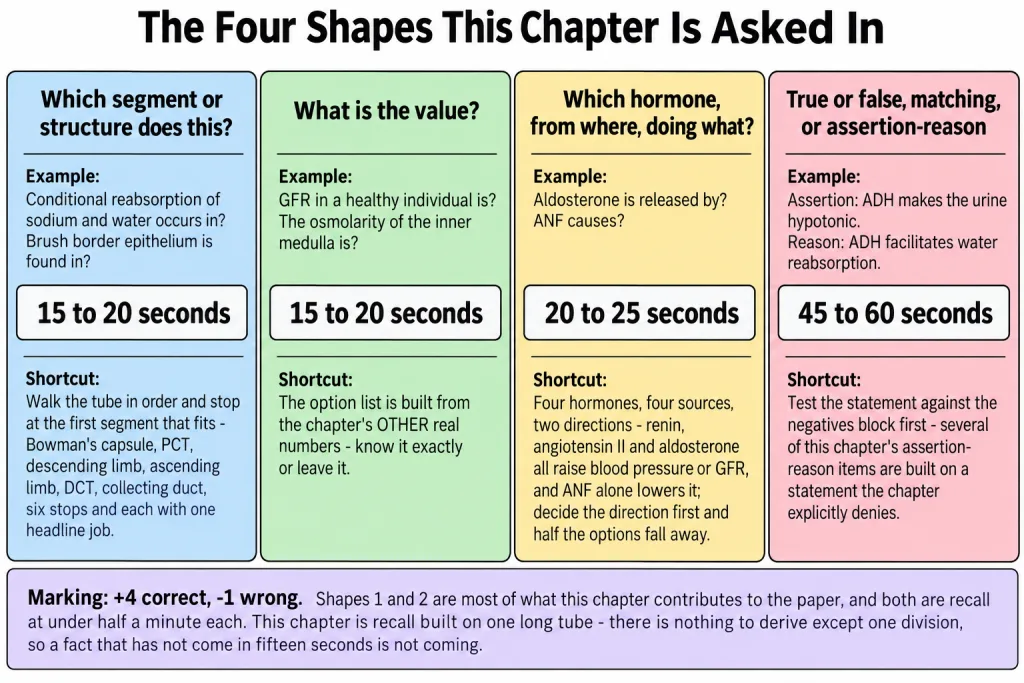
Shape 1 - Which segment or structure does this? "Conditional reabsorption of sodium and water occurs in?" "Brush border epithelium is found in?" Budget 15 to 20 seconds. The shortcut: walk the tube in order and stop at the first segment that fits. Bowman's capsule, PCT, descending limb, ascending limb, DCT, collecting duct - six stops, and each has one headline job.
Shape 2 - What is the value? "GFR in a healthy individual is?" "The osmolarity of the inner medulla is?" Budget 15 to 20 seconds. The shortcut: the option list is built from the chapter's OTHER real numbers. Know it exactly or leave it.
Shape 3 - Which hormone, from where, doing what? "Aldosterone is released by?" "ANF causes?" Budget 20 to 25 seconds. The shortcut: four hormones, four sources, two directions. Renin, angiotensin II and aldosterone all raise blood pressure or GFR; ANF alone lowers it. Decide the direction first and half the options fall away.
Shape 4 - True or false, matching, or assertion-reason. "Assertion: ADH makes the urine hypotonic. Reason: ADH facilitates water reabsorption." Budget 45 to 60 seconds. The shortcut: test the statement against the negatives block first. Several of this chapter's assertion-reason items are built on a statement the chapter explicitly denies.
[NEET Important] Shapes 1 and 2 are most of what this chapter contributes, and both are recall at under half a minute. The chapter-end exercises themselves are half true-or-false, matching and fill-in-the-gaps, which is unusually close to the NEET format - work them and you have already practised the exam.
Every Number in the Chapter
Learn these as a block, because the wrong options are drawn from this same block.
The kidney
- Length 10-12 cm, width 5-7 cm, thickness 2-3 cm, average weight 120-170 g.
- Sited between the last thoracic and the third lumbar vertebra.
- Nearly one million nephrons per kidney.
Filtration
- 1100-1200 mL of blood filtered per minute, which is roughly one-fifth of the blood pumped out by each ventricle per minute - and since cardiac output is about 5 litres per minute, one-fifth of it is exactly that figure.
- Filtration through 3 layers: the endothelium of the glomerular blood vessels, the epithelium of Bowman's capsule, and the basement membrane between them.
- GFR is approximately 125 mL per minute, that is 180 litres per day.
Reabsorption and concentration
- 180 litres of filtrate against 1.5 litres of urine means nearly 99 per cent is reabsorbed.
- The PCT reabsorbs nearly all the essential nutrients and 70-80 per cent of electrolytes and water.
- Osmolarity runs from 300 mOsmol per litre in the cortex to about 1200 mOsmol per litre in the inner medulla, a gradient mainly caused by sodium chloride and urea.
- Human kidneys can concentrate urine nearly four times the initial filtrate.
Urine and the other organs
- 1 to 1.5 litres of urine per day, light yellow, slightly acidic at pH 6.0.
- 25-30 g of urea excreted per day.
- The lungs remove approximately 200 mL of carbon dioxide per minute.
[NEET Important] Two numbers in this chapter are the same number in different clothes: 125 mL per minute and 180 litres per day. Multiply 125 by 60 minutes and by 24 hours and you get 180,000 mL. If you know one, you can rebuild the other - which makes them the cheapest pair of marks in the chapter.
One Structure, One Line
Every Shape 1 and Shape 3 question is one row of this table.
| Structure | Its one line |
|---|---|
| Protonephridia (flame cells) | flatworms, rotifers, some annelids, Amphioxus; primarily osmoregulation |
| Nephridia | earthworms and other annelids |
| Malpighian tubules | insects, including the cockroach |
| Antennal or green glands | crustaceans like prawns |
| Hilum | the notch where ureter, blood vessels and nerves enter |
| Renal pelvis | broad funnel shaped space with calyces |
| Medullary pyramids | conical masses of medulla projecting into the calyces |
| Columns of Bertini | cortex extending between the pyramids |
| Glomerulus | tuft of capillaries from the afferent arteriole |
| Bowman's capsule | double walled cup enclosing the glomerulus |
| Malpighian body / renal corpuscle | glomerulus + Bowman's capsule |
| Podocytes | epithelial cells of Bowman's capsule leaving filtration slits |
| PCT | brush border; nearly all nutrients and 70-80 per cent of electrolytes and water |
| Descending limb of Henle | permeable to water, almost impermeable to electrolytes - concentrates the filtrate |
| Ascending limb of Henle | impermeable to water, transports electrolytes - dilutes the filtrate |
| DCT | conditional reabsorption of sodium and water |
| Collecting duct | cortex to inner medulla; lets urea into the interstitium |
| Peritubular capillaries | network from the efferent arteriole around the tubule |
| Vasa recta | U shaped, parallel to Henle's loop; absent or highly reduced in cortical nephrons |
| Cortical nephron | short loop, barely enters the medulla; the majority |
| Juxta medullary nephron | long loop running deep into the medulla |
| JGA | cellular modifications where the DCT and the afferent arteriole touch |
| Renin | from the JG cells |
| Angiotensin II | powerful vasoconstrictor; raises glomerular blood pressure and GFR |
| Aldosterone | from the adrenal cortex; reabsorbs sodium and water at the distal parts |
| ADH / vasopressin | from the neurohypophysis; reabsorbs water, prevents diuresis |
| ANF | from the atria of the heart; vasodilation, lowers blood pressure |
| Glycosuria | glucose in urine |
| Ketonuria | ketone bodies in urine |
| Uremia | urea accumulating in the blood |
| Renal calculi | stone of crystallised salts such as oxalates |
| Glomerulonephritis | inflammation of the glomeruli |
[NEET Important] The four hormones sort into two directions. Renin, angiotensin II and aldosterone push blood pressure and GFR UP. ANF pulls blood pressure DOWN, and the chapter says it acts as a check on the renin-angiotensin mechanism. Decide the direction the question wants before you read the options.
The Negatives, and the Pairs That Get Swapped
The negatives
- The kidneys play NO significant role in removing ammonia from an ammonotelic animal - it diffuses out across the body or gill surface.
- Proteins do NOT pass into Bowman's capsule. Almost every other plasma constituent does, which is why it is called ultra filtration.
- Vasa recta is ABSENT or highly reduced in cortical nephrons.
- Reabsorption is MINIMUM in the ascending limb of Henle's loop - its job there is maintaining medullary osmolarity, not reabsorbing.
- ADH does NOT cause water elimination. It prevents diuresis by reabsorbing water, so the urine becomes more concentrated, not less.
- The dialysing fluid has the same composition as plasma EXCEPT the nitrogenous wastes - that absence is the whole point, because it creates the gradient.
- Sweating is NOT primarily an excretory process. Its primary function is a cooling effect; waste removal comes along with it.
- Protonephridia are NOT primarily waste-removers - they are primarily concerned with ionic and fluid volume regulation.
The pairs
| If the question says | The answer is | The trap option is |
|---|---|---|
| permeable to water, impermeable to electrolytes | descending limb of Henle's loop | the ascending limb, which is the exact reverse |
| conditional reabsorption | DCT | the PCT, whose reabsorption is not conditional |
| brush border epithelium | PCT | the DCT or the collecting duct |
| released by the JG cells | renin | aldosterone, which comes from the adrenal cortex |
| released from the neurohypophysis | ADH | ANF, which comes from the atria of the heart |
| lowers blood pressure | ANF | angiotensin II, which raises it |
| short loop, little vasa recta | cortical nephron | the juxta medullary nephron, which is the opposite on both counts |
| flame cells | protonephridia | nephridia, which are the earthworm's |
| excretory structure of an insect | Malpighian tubules | the Malpighian body, which is part of a vertebrate nephron |
| added before the blood enters the dialyser | heparin | anti-heparin, which is added before the blood goes back |
| glucose in the urine | glycosuria | ketonuria, which is ketone bodies |
[NEET Important] When a stem describes a permeability, write down which limb it must be before you look at the options. The descending limb loses water; the ascending limb loses salt. Everything else about the counter current follows from those two lines.
Solved Examples at NEET Pace
Each item names the shortcut it uses, because the shortcut is the thing worth carrying into the exam hall.
Question 1
Q. What is the GFR of a healthy individual?
Answer. Approximately 125 mL per minute, that is 180 litres per day. Shortcut: the two figures are the same number. 125 times 60 times 24 is 180,000 mL - so knowing either one rebuilds the other.
Question 2
Q. Which limb of Henle's loop is impermeable to water?
Answer. The ascending limb. Shortcut: descending loses water, ascending loses salt. The descending limb is permeable to water and almost impermeable to electrolytes; the ascending is the exact reverse.
Question 3
Q. Conditional reabsorption of sodium and water happens where?
Answer. The distal convoluted tubule. Shortcut: "conditional" belongs to the DCT and nowhere else - it means the amount depends on the body's needs, under hormonal control.
Question 4
Q. Which segment has a brush border, and what does it reabsorb?
Answer. The PCT, lined by simple cuboidal brush border epithelium that increases the surface area for reabsorption. It takes back nearly all the essential nutrients and 70-80 per cent of electrolytes and water. Shortcut: brush border always means PCT.
Question 5
Q. Name the three layers blood is filtered through at the glomerulus.
Answer. The endothelium of the glomerular blood vessels, the epithelium of Bowman's capsule, and the basement membrane between the two. Shortcut: two cell layers with a membrane sandwiched between them - and the count, three, is asked as often as the names.
Question 6
Q. Why is glomerular filtration called ultra filtration?
Answer. Because almost all the constituents of plasma EXCEPT the proteins pass into the lumen of Bowman's capsule - the filter is fine enough to hold back protein and nothing else. Shortcut: if a question offers "protein-free filtrate", it is true.
Question 7
Q. Where is the JGA, and what does it release?
Answer. At the point of contact between the distal convoluted tubule and the afferent arteriole, formed by cellular modifications in both. The JG cells release renin when GFR falls. Shortcut: the JGA is where the tubule doubles back and touches its own incoming arteriole - one structure, two tissues.
Question 8
Q. Put the renin-angiotensin sequence in order.
Answer. Fall in GFR -> JG cells release renin -> renin converts angiotensinogen to angiotensin I -> angiotensin I to angiotensin II -> angiotensin II is a vasoconstrictor, raising glomerular blood pressure and GFR -> angiotensin II also activates the adrenal cortex to release aldosterone -> aldosterone reabsorbs sodium and water at the distal parts. Shortcut: it is a straight chain with one branch at angiotensin II.
Question 9
Q. ANF does what, and where does it come from?
Answer. From the atria of the heart, released when blood flow to the atria increases; it causes vasodilation and thereby decreases blood pressure, acting as a check on the renin-angiotensin mechanism. Shortcut: ANF is the only one of the four hormones that pulls in the opposite direction.
Question 10
Q. The medullary osmolarity runs from what to what, and what causes the gradient?
Answer. From 300 mOsmol per litre in the cortex to about 1200 mOsmol per litre in the inner medulla, mainly caused by sodium chloride and urea. Shortcut: 300 to 1200 is exactly four times - the same four as "urine four times concentrated".
Question 11
Q. Which vessel runs parallel to Henle's loop, and in which nephrons is it missing?
Answer. The vasa recta, a U shaped minute vessel of the peritubular network. It is absent or highly reduced in cortical nephrons. Shortcut: long loop and vasa recta go together - juxta medullary nephrons have both, cortical nephrons have neither in full.
Question 12
Q. A statement claims ADH makes the urine hypotonic. Is it right?
Answer. No. ADH facilitates water reabsorption from the latter parts of the tubule, preventing diuresis - so less water leaves and the urine is more concentrated. Shortcut: the name says it. Anti-diuretic means against urine flow.
Question 13
Q. What is absent from the dialysing fluid, and why does that matter?
Answer. The nitrogenous wastes. Everything else matches plasma. Because they are absent, a concentration gradient exists across the porous cellophane membrane, so the wastes move out of the blood. Shortcut: the gradient is the whole machine - matching plasma everywhere else is what stops the useful constituents leaking away.
Question 14
Q. Which excretory structure is described as primarily osmoregulatory?
Answer. Protonephridia, the flame cells of flatworms, rotifers, some annelids and Amphioxus. Shortcut: only one of the four invertebrate structures gets the word "primarily", and it is attached to ionic and fluid volume regulation, not to waste removal.
A Drill Before You Move On
Decide each one before you read the verdict. Aim for 20 to 25 seconds per question.
- GFR is approximately 180 mL per minute. - False. 125 mL per minute; 180 is the litres per day.
- The PCT reabsorbs 70-80 per cent of electrolytes and water. - True.
- The descending limb of Henle's loop is impermeable to water. - False. It is permeable to water and almost impermeable to electrolytes.
- Vasa recta is well developed in cortical nephrons. - False. Absent or highly reduced.
- Renin is released by the adrenal cortex. - False. By the JG cells. The adrenal cortex releases aldosterone.
- ANF acts as a check on the renin-angiotensin mechanism. - True.
- Ammonia is excreted mainly by the kidneys in ammonotelic animals. - False. The kidneys play no significant role; it diffuses out across body or gill surfaces.
- Uric acid requires the least water for elimination. - True, because it is the least toxic.
- The inner medulla reaches about 1200 mOsmol per litre. - True, against 300 in the cortex.
- Sweat's primary function is excretion. - False. Its primary function is a cooling effect on the body surface.
- Amphioxus has flame cells. - True, and it is the chordate on that list.
- A healthy adult excretes about 25-30 g of urea per day. - True.