
How to Use This Section
You have finished the theory. Sections 1 to 8 took you from Dobereiner's triads to the acidic and basic oxides, and each carried its own dozen worked questions. This section is different: it is one long problem set — 36 fully worked questions arranged from the simplest to the hardest — and it deliberately covers every in-text worked problem and every end-of-chapter exercise that Boards, JEE Main and NEET keep recycling, plus a handful of the "identify the element from its numbers" puzzles that competitive papers love.
This chapter carries almost no arithmetic, so students assume it is easy and then lose marks on reasoning. A typical wrong answer says "oxygen has a higher ionization enthalpy than nitrogen because it is further right" — the general trend applied where the anomaly rules. Another puts bigger than because sodium is a bigger atom. The cure is to work enough questions that the exceptions become as familiar as the rules. So work these.
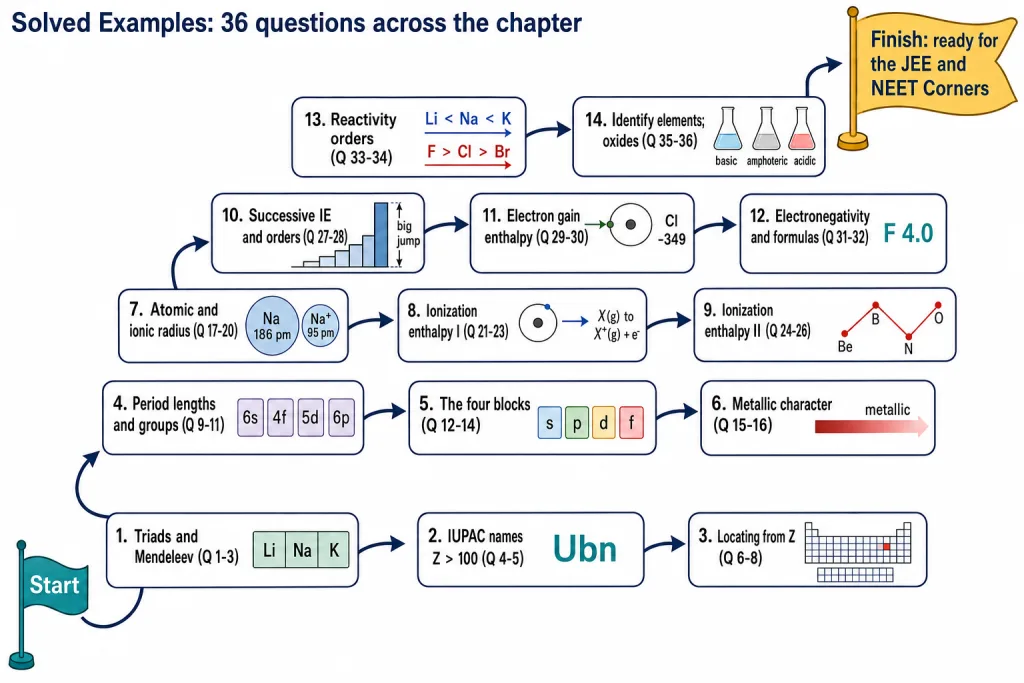
The working method
- Cover the answer. Attempt the question first, on paper, with a pen. Reading a solution feels like learning and is not.
- Compare your reasoning, not just your final line. In this chapter the marks are in the "because". If your order was right but your reason was "it is further right", you would have lost marks on the anomaly questions.
- Read the Watch out line. Most questions end with one. That is the transferable part; the numbers and the particular examples are disposable.
The data used throughout
Key Point: Atomic radii (pm): Li 152, Be 111, B 88, C 77, N 74, O 66, F 64; Na 186, Mg 160, Al 143, Si 117, P 110, S 104, Cl 99; K 231, Rb 244, Cs 262; Br 114, I 133, At 140. Ionic radii: 95 pm, 136 pm. First ionization enthalpies (): Na 496, Mg 737, Al 577, Si 786; B 801, Ga 579, In 558, Tl 589. Electron gain enthalpies (): O , S ; F , Cl , Br , I ; He , Ne . Pauling electronegativities: Li 1.0, Be 1.5, B 2.0, C 2.5, N 3.0, O 3.5, F 4.0; Na 0.9, Mg 1.2, Al 1.5, Si 1.8, P 2.1, S 2.5, Cl 3.0; Br 2.8, I 2.5, At 2.2. These are the values your textbook uses, and the ones an examiner expects.
The six errors that cost the most marks in this chapter
| Error | Where it bites | The fix |
|---|---|---|
| Applying the "increases across a period" rule to Be/B and N/O | Questions 24, 28 | Half-filled and fully-filled subshells are extra stable; is held tighter than |
| Ordering isoelectronic ions by the size of the parent atom | Questions 18, 20 | Same electrons, so more protons means smaller |
| Saying fluorine has the most negative electron gain enthalpy | Questions 29, 30 | Chlorine does; fluorine's tiny shell repels the incoming electron |
| Counting the group number of a p-block element as just the electrons | Questions 8, 13 | Group (number of electrons) |
| Forgetting that the electrons fill before | Questions 8, 13 | Period highest occupied, whatever the or electrons say |
| Treating electron gain enthalpy and electronegativity as the same thing | Question 30 | One is a measurable energy of an isolated atom; the other is a dimensionless tendency inside a bond |
Solved Examples
Question 1: Dobereiner's triads and the basic theme of the periodic table
(a) Using the atomic weights Li 7, Na 23, K 39; Ca 40, Sr 88, Ba 137; and Cl 35.5, Br 80, I 127, show that each set forms a Dobereiner triad. (b) What is the basic theme of organisation in the periodic table?
Answer: (a) The whole idea of a triad is simple. Take three elements that behave alike, and the atomic weight of the middle one comes out roughly as the average of the other two. Its properties sit in between too. So all I have to do is average the two ends and see if I land on the middle one.
| Triad | Average of the outer two | Actual middle value | Verdict |
|---|---|---|---|
| Li, Na, K | Na | exact | |
| Ca, Sr, Ba | Sr | very close | |
| Cl, Br, I | Br | very close |
All three work, so each set is a triad. The rule only fitted a handful of such groups, which is why chemists wrote it off as coincidence at the time. Still, it was the first sign that elements come in families with a number pattern behind them.
(b) The basic theme is to put elements with similar properties in the same vertical column. In the modern table they go in order of increasing atomic number, and similar outer electronic configurations keep coming back at regular intervals. That way I can study a family of elements together instead of over a hundred elements one by one, and even guess the properties of an element nobody has studied yet.
Ans: (a) Averages 23, 88.5 and 81.25 against actual 23, 88 and 80, so all three are triads. (b) Elements with similar properties (similar outer electronic configuration) are grouped in the same column, arranged by atomic number, so their chemistry can be studied and predicted family by family.
Watch out: Dobereiner in one line is "middle equals the mean of the ends". For the basic theme, one sentence is enough: similar properties in the same column, atomic number as the ordering rule.
Question 2: What Mendeleev used, and how the modern law differs
(a) Which important property did Mendeleev use to classify the elements in his periodic table, and did he stick to it? (b) What is the basic difference in approach between Mendeleev's Periodic Law and the Modern Periodic Law?
Answer: (a) Mendeleev arranged the elements in order of increasing atomic weight. He also leaned heavily on the formulas and properties of their compounds, mainly the oxides and hydrides, to decide which elements belonged in the same family.
He didn't stick to it strictly. Whenever the weight order dropped an element into the wrong family, he trusted the chemistry instead. Iodine has a lower atomic weight than tellurium, but he put iodine after tellurium so that it sat with fluorine, chlorine and bromine. He also left gaps for elements he believed hadn't been found yet (eka-aluminium and eka-silicon) rather than jam the next known element into the wrong slot.
(b) Mendeleev's law says the properties of elements are a periodic function of their atomic weights. The Modern Periodic Law says they are a periodic function of their atomic numbers. The switch happened after Moseley (1913) showed that a plot of of the characteristic X-rays against gives a straight line, while a plot against atomic mass doesn't. So atomic number is the more fundamental property. Once the table is based on atomic number, an element's position is fixed by its electronic configuration, and the awkward pairs like Te/I fall into place with no exception needed.
Ans: (a) Atomic weight, backed by the properties of compounds; no, he broke the order (Te before I) and left gaps to keep similar elements together. (b) Mendeleev: periodic function of atomic weight; Modern: periodic function of atomic number, which really comes from electronic configuration.
Watch out: "Weight versus number" is the two-word answer, but I always add why the change was made (Moseley's X-ray work) and one example where the old order failed (tellurium and iodine).
Question 3: Mendeleev's predictions for eka-aluminium and eka-silicon
Mendeleev predicted that eka-aluminium would have atomic weight 68, density , a low melting point, an oxide and a chloride ; and that eka-silicon would have atomic weight 72, density , a high melting point, an oxide and a chloride . (a) Name the two elements and compare his predictions with the values found. (b) Explain, from the periodic table, how he could predict the formulas of the oxides and chlorides.
Answer: (a) The gap under aluminium turned out to be gallium (Ga), and the gap under silicon turned out to be germanium (Ge). Putting his numbers next to the real ones:
| Property | Eka-aluminium (predicted) | Gallium (found) | Eka-silicon (predicted) | Germanium (found) |
|---|---|---|---|---|
| Atomic weight | 68 | 70 | 72 | 72.6 |
| Density / | 5.9 | 5.94 | 5.5 | 5.36 |
| Melting point / K | Low | 302.93 | High | 1231 |
| Oxide | ||||
| Chloride |
Every prediction came close, and the formulas were spot on. This is what made his table famous.
(b) Elements in the same column form the same type of compounds. Aluminium forms and , so the element below it (valence 3) has to form and . Silicon forms and , so the element below it (valence 4) has to form and . For the atomic weight he just took roughly the midpoint of the neighbours above and below in the column, the same averaging trick as in Dobereiner's triads.
Ans: (a) Gallium and germanium; predicted 68 / 5.9 / / against found 70 / 5.94 / / , and 72 / 5.5 / / against 72.6 / 5.36 / / . (b) Same column, same valence, same formula type.
Watch out: "Eka" is Sanskrit for "one", so eka-aluminium is the element one place below aluminium. The oxide formulas and come straight from the group valence, nothing more.
Question 4: IUPAC names and symbols for elements beyond 100
(a) Write the IUPAC name and symbol for the elements with atomic number 120, 119 and 121. (b) Do the same for and . (c) Decode the temporary symbols Uus and Uub: give the atomic number, the systematic name and the official name and symbol of each.
Answer: First I need the digit roots: 0 nil, 1 un, 2 bi, 3 tri, 4 quad, 5 pent, 6 hex, 7 sept, 8 oct, 9 enn. I write the roots for the digits in order, stick "ium" on the end, and the symbol is just the first letter of each root. One spelling thing I keep in mind: the final "i" of "bi" or "tri" merges with "ium", so 112 is ununbium, not "ununbiium".
(a) Building them digit by digit:
| Digits | Roots | Name | Symbol | |
|---|---|---|---|---|
| 120 | 1, 2, 0 | un + bi + nil | unbinilium | Ubn |
| 119 | 1, 1, 9 | un + un + enn | ununennium | Uue |
| 121 | 1, 2, 1 | un + bi + un | unbiunium | Ubu |
(b) Same method:
| Digits | Roots | Name | Symbol | |
|---|---|---|---|---|
| 126 | 1, 2, 6 | un + bi + hex | unbihexium | Ubh |
| 132 | 1, 3, 2 | un + tri + bi | untribium | Utb |
(c) Going backwards, I read the symbol one letter at a time. U un , u un , s sept . So Uus is , ununseptium, which is now officially tennessine, Ts. For Uub, U , u , b bi , so it is , ununbium, officially copernicium, Cn.
Ans: (a) 120 unbinilium Ubn; 119 ununennium Uue; 121 unbiunium Ubu. (b) 126 unbihexium Ubh; 132 untribium Utb. (c) Uus , ununseptium, tennessine (Ts); Uub , ununbium, copernicium (Cn).
Watch out: The roots for 0 and 9 (nil and enn) are the ones I tend to forget. 109 is unnilennium (Une) and 110 is ununnilium (Uun).
Question 5: Which elements honour a laboratory and a scientist?
Which element do you think would have been named by (i) the Lawrence Berkeley Laboratory and (ii) Seaborg's group? Also state the atomic number and the temporary systematic name of each.
Answer: (i) The element named for this laboratory (and for Ernest Lawrence, who founded it) is lawrencium, Lr, . Its systematic name is unniltrium, Unt. The lab's home town and state also got elements, berkelium (Bk, ) and californium (Cf, ), but those are below 100 and never needed a systematic name.
(ii) Glenn Seaborg's work, starting with plutonium in 1940, produced the transuranium elements from 94 to 102 and is the reason the actinoids sit below the lanthanoids. Element 106 is seaborgium, Sg, named after him. Its systematic name is unnilhexium, Unh.
The reason temporary names exist at all goes back to element 104. It was claimed by both American and Soviet groups, who called it rutherfordium and kurchatovium. To avoid that kind of fight, IUPAC gives every new element a temporary name made purely from its atomic number until the discovery is confirmed and an official name is voted in.
Ans: (i) Lawrencium, Lr, (unniltrium, Unt). (ii) Seaborgium, Sg, (unnilhexium, Unh).
Watch out: Permanent names honour a place or a person; temporary names honour only the digits. Seaborgium (106) is the standard example of an element named after a scientist who was still alive, and Seaborg's Nobel Prize year is 1951.
Question 6: Locating Z = 114 and finding Z from a position
(a) In terms of period and group, where would you locate the element with ? (b) Write the atomic number of the element present in the third period and seventeenth group of the periodic table.
Answer: (a) For a big like this I don't fill from scratch. I jump to the last noble gas and count from there. The noble gas that ends period 6 is radon, . Period 7 then fills (2 electrons: Fr, Ra), then (14 electrons: the actinoids Th to Lr), then (10 electrons: Rf to Cn) and only then . That brings me to . So has two electrons in : .
Now I read the position off the configuration. The highest occupied is 7, so it is in period 7. The last electron went into , so it is p-block, and with it has four valence electrons, so the group is . That's the carbon family, directly below lead. This is flerovium (Fl).
(b) This time I work forwards. Period 3 starts at sodium () with . Group 17 is the halogens, , seven electrons in the valence shell and one short of a noble gas. The period 3 halogen is , which is electrons. That's chlorine, .
Ans: (a) Period 7, group 14 (flerovium). (b) , chlorine.
Watch out: For any large , jump to the last noble gas and count , , , in that order. Period 7 runs , , , ; closes and (oganesson) closes .
Question 7: The undiscovered-when-written elements Z = 117 and Z = 120
In which family or group would you place the elements with and ? Give the electronic configuration in each case.
Answer: For , I use what I worked out in Question 6: is , and fills from 113 to 118. Element 117 is the fifth one into , so it is . Seven valence electrons, one short of a full shell, is the signature of a halogen. So it goes in group 17, period 7. (This is tennessine, Ts.)
For , element 118 closes and is the noble gas oganesson (Og), which the systematic scheme calls Uuo. The next two electrons have to open a new shell. So 119 is , an alkali metal, and 120 is , written in the temporary notation. Two electrons in the outermost subshell means the alkaline earth metals, group 2, and since the highest is 8, it would start an eighth period.
The nice part is that the configuration tells me the chemistry before anyone has even made the element. 117 should form a ion and an -type compound like the other halogens; 120 should form a ion and an oxide like barium or radium.
Ans: : group 17 (halogens), . : group 2 (alkaline earth metals), , i.e. .
Watch out: is always a halogen, and with no or filling is always group 2. 118 is the last element of period 7, so 119 and 120 start period 8, not 7.
Question 8: Period and group of Z = 24, 33, 53 and 88
Find the period, group and block of the elements with atomic numbers 24, 33, 53 and 88 by writing their outer electronic configurations.
Answer: The three rules I use every time: period highest principal quantum number occupied. For the s-block, group number of electrons. For the p-block, group (electrons in and ). For the d-block, group electrons in plus .
: takes care of 18, and the remaining 6 go into and . I'd normally write , but the half-filled is more stable, so that's the real configuration (chromium). Highest , so period 4. It is d-block, and the group is .
: , and I check: 18 + 10 + 2 + 3 . Period 4, p-block, group . This is arsenic, a metalloid in the nitrogen family.
: , check: 36 + 10 + 2 + 5 . Period 5, p-block, group . Iodine.
: , check: 86 + 2 . Period 7, s-block, group 2. Radium.
| Outer configuration | Period | Block | Group | Element | |
|---|---|---|---|---|---|
| 24 | 4 | d | 6 | Cr | |
| 33 | 4 | p | 15 | As | |
| 53 | 5 | p | 17 | I | |
| 88 | 7 | s | 2 | Ra |
Ans: 24: period 4, group 6, d-block (Cr). 33: period 4, group 15, p-block (As). 53: period 5, group 17, p-block (I). 88: period 7, group 2, s-block (Ra).
Watch out: Period from the biggest , group from the count of outer electrons, block from the last subshell filled. For chromium the group is 6 either way, whether I write or the naive , because it's the total of electrons that counts.
Question 9: Why the fifth period has 18 elements
How would you justify the presence of 18 elements in the fifth period of the periodic table?
Answer: The period number is the of the outer shell, so for period 5 I start with . But I can't just count all the subshells, because not all of them fill in this period. Going by the energy order, the orbitals that get filled between krypton and xenon are , then , then : . The and come much later, in periods 6 and 7.
Now I count orbitals. has 1, has 5, has 3. That's 9 orbitals in total.
Each orbital takes 2 electrons, so electrons get added across this period. Every extra electron is a new element, so period 5 has 18 elements, from rubidium (, ) to xenon (, ).
Ans: Period 5 fills (1 orbital), (5) and (3): 9 orbitals, 18 electrons, so 18 elements.
Watch out: Number of elements in a period is just (orbitals filled in that period). Write the filling order in the answer, that line is what actually justifies the count.
Question 10: Why the sixth period should have 32 elements
On the basis of quantum numbers, justify that the sixth period of the periodic table should have 32 elements.
Answer: For period 6 the outer shell is . The orbitals that fill between xenon () and radon () are, in order of energy, , , and .
I get the orbital count from the quantum numbers. Each subshell has orbitals. For , , so 1 orbital. For , , so 7 orbitals. For , , so 5. For , , so 3. Total orbitals.
Each orbital holds two electrons with opposite spin (), so electrons, which means 32 elements, from caesium () to radon (). The 14 of them that fill (cerium to lutetium) are the lanthanoids, and they get pulled out into a separate panel so the table doesn't become too wide.
Quick check: . Period 7 works the same way (, , , ) and also has 32 elements, francium (87) to oganesson (118).
Ans: (1) (7) (5) (3) orbitals elements.
Watch out: The period lengths 2, 8, 8, 18, 18, 32, 32 are just (1), (1 + 3), (1 + 3), (1 + 5 + 3), (1 + 5 + 3), (1 + 7 + 5 + 3), (1 + 7 + 5 + 3). The orbitals belong to and the orbitals to , but the period is still named after the and shell being filled.
Question 11: Why groups share properties, and what the period number means
(a) Why do elements in the same group have similar physical and chemical properties? (b) In the modern periodic table, the period indicates the value of: (i) atomic number (ii) atomic mass (iii) principal quantum number (iv) azimuthal quantum number. (c) Anything that influences the valence electrons will affect the chemistry of the element. Which one of these does not affect the valence shell: (i) valence principal quantum number (ii) nuclear charge (iii) nuclear mass (iv) number of core electrons?
Answer: (a) Chemistry is decided almost entirely by the outermost electrons, how many there are and how they're arranged. Elements in one group have the same number of electrons in the same type of outer orbital. Every alkali metal is (Li , Na , K , Rb , Cs , Fr ), every halogen is . Since they lose or gain electrons the same way, they form the same kinds of compounds (, for the alkali metals) and show the same physical trends. The properties aren't identical, size and ionization enthalpy change smoothly down the group, but the pattern is the same.
(b) A new period starts each time electrons begin entering a new principal shell. So the period number is the principal quantum number of the valence shell, option (iii). Atomic number and mass keep increasing along a period, so they can't be what the period "indicates", and is what the block tells you, not the period.
(c) The valence electrons feel the nuclear charge , sit further out when is larger, and get shielded by the core electrons. All three change the chemistry. The nuclear mass, option (iii), changes nothing about the electrostatics the electrons feel. That's exactly why isotopes of an element have the same chemistry.
Ans: (a) Same number and arrangement of valence electrons (e.g. for group 1). (b) (iii) principal quantum number. (c) (iii) nuclear mass.
Watch out: Period gives , block gives , group gives the count of outer electrons. Nuclear mass is a distractor in any "what affects the valence shell" question, electrons respond to charge, not mass.
Question 12: General outer configurations of the four blocks
Write the general outer electronic configuration of s-, p-, d- and f-block elements, and name the groups each block covers.
Answer: A block is named after the subshell that gets the last electron. So the general configuration is really just saying how many electrons that subshell can take across the block. I put all four in one table.
| Block | Outer configuration | Groups | Members |
|---|---|---|---|
| s | 1 and 2 | Alkali and alkaline earth metals (plus H and He by configuration) | |
| p | 13 to 18 | Boron to noble-gas families | |
| d | 3 to 12 | Transition elements | |
| f | Separate panels | Lanthanoids (Ce to Lu) and actinoids (Th to Lr) |
The notation needs a careful read. In the d-block the electrons sit in the shell below the outer one, , and the is there to allow exceptions like palladium, . In the f-block the electrons are two shells in, . That's why the lanthanoids are so alike: the electron being added is buried deep inside and barely changes the outside of the atom.
Two odd ones. Helium is , which is an s-block configuration, but it sits in group 18 because a full shell makes it behave as a noble gas. Hydrogen, , is placed separately at the top because it can act like group 1 (lose an electron) or like group 17 (gain one).
Ans: s: (groups 1, 2); p: (groups 13 to 18); d: (groups 3 to 12); f: (lanthanoids and actinoids).
Watch out: The superscript range in each formula is the number of columns in that block: 2, 6, 10 and 14. Don't drop the from the f-block formula, some lanthanoids (gadolinium, for one) have a electron and some have none.
Question 13: Position from an outer configuration
Assign the position (period, group and block) of the element having outer electronic configuration (i) for , (ii) for and (iii) for .
Answer: (i) . The last electron went into , so p-block. The highest is 3, so period 3. Six valence electrons, and for the p-block I add 10, so group . The full configuration has 16 electrons, so it's sulphur.
(ii) . Last electron in , so d-block. Highest is 4, so period 4. For a d-block element the group is plus electrons, . Total electrons , which is titanium.
(iii) . Last electron in , so f-block, a lanthanoid. Highest is 6, so period 6. All the lanthanoids go with group 3 in the separate panel. Electron count , which is gadolinium. The half-filled is why it keeps one electron in instead of pushing it into .
| Configuration | Period | Group | Block | Element |
|---|---|---|---|---|
| 3 | 16 | p | S | |
| 4 | 4 | d | Ti | |
| 6 | 3 (lanthanoid panel) | f | Gd |
Ans: (i) Period 3, group 16, p-block (S). (ii) Period 4, group 4, d-block (Ti). (iii) Period 6, group 3, f-block lanthanoid (Gd).
Watch out: Letter of the last-filled subshell gives the block, largest gives the period, electron count gives the group. For d-block add the and electrons ( for Ti); for p-block add 10 to the valence count.
Question 14: Which statement about the blocks is incorrect?
Which of the following statements related to the modern periodic table is incorrect? (a) The p-block has 6 columns, because a maximum of 6 electrons can occupy all the orbitals in a p-subshell. (b) The d-block has 8 columns, because a maximum of 8 electrons can occupy all the orbitals in a d-subshell. (c) Each block contains a number of columns equal to the number of electrons that can occupy that subshell. (d) The block indicates the value of the azimuthal quantum number for the last subshell that received electrons in building up the configuration.
Answer: I check each statement against the orbital count. A subshell with quantum number has orbitals and holds electrons: holds 2, holds 6, holds 10, holds 14.
(a) Three orbitals, 6 electrons, 6 columns (groups 13 to 18). Correct.
(b) Five orbitals hold 10 electrons, and the d-block has 10 columns (groups 3 to 12). The statement says 8 for both, so this one is wrong.
(c) s: 2 columns, p: 6, d: 10, f: 14. The width of each block matches the capacity of its subshell. Correct.
(d) s-block means , p-block , d-block , f-block for the last electron added. Correct.
Ans: (b), the d-block has 10 columns because a d-subshell holds 10 electrons.
Watch out: Block width : 2, 6, 10, 14. If a statement says 8 for anything about orbitals it's wrong; 8 is the octet, not a subshell capacity.
Question 15: Ordering elements by metallic character
(a) Considering atomic number and position in the periodic table, arrange Si, Be, Mg, Na and P in increasing order of metallic character. (b) Considering the elements B, Al, Mg and K, which is the correct order of metallic character: (i) B > Al > Mg > K (ii) Al > Mg > B > K (iii) Mg > Al > K > B (iv) K > Mg > Al > B?
Answer: Metallic character is just how easily an atom gives up its outer electrons. Two rules I use: it decreases across a period from left to right (the nucleus pulls harder on electrons in the same shell), and it increases down a group (the outer electron is further away and better shielded, so it leaves more easily).
(a) Na (group 1), Mg (group 2), Si (group 14) and P (group 15) are all in period 3, so across the row it's Na > Mg > Si > P. Be is group 2 like Mg but one period up, so Be is less metallic than Mg. Be is still a metal, while Si is a metalloid and P a non-metal, so Be sits above both of those. Increasing order: P < Si < Be < Mg < Na.
(b) K is group 1, period 4, so it's the most metallic of the lot. Mg (group 2) and Al (group 13) are both period 3, and Mg is to the left, so Mg > Al. B is above Al in group 13 and is a non-metal, so it's the least metallic. Order: K > Mg > Al > B, option (iv).
Ans: (a) P < Si < Be < Mg < Na. (b) (iv) K > Mg > Al > B.
Watch out: Bottom-left is the most metallic corner of the table, top-right the least. When two elements are in different periods and different groups, go by the diagonal: the one further down and further left wins.
Question 16: Non-metallic character and the metal/non-metal contrast
(a) Considering the elements B, C, N, F and Si, the correct order of their non-metallic character is: (i) B > C > Si > N > F (ii) Si > C > B > N > F (iii) F > N > C > B > Si (iv) F > N > C > Si > B. (b) What are the major differences between metals and non-metals?
Answer: (a) This is the metallic rule flipped. Non-metallic character increases across a period and decreases down a group. B, C, N and F are all in period 2, so F > N > C > B. Si is below C in group 14, so it's less non-metallic than C. The only real question is whether Si goes above or below B. Boron has the higher electronegativity (B 2.0 against Si 1.8) and is a harder, more non-metallic solid, while silicon is a metalloid. So B > Si. Order: F > N > C > B > Si, option (iii).
(b) I find it easiest to put the contrast in a table.
| Property | Metals | Non-metals |
|---|---|---|
| Position | Left and centre of the table; more than 78% of all elements | Top right-hand side |
| State at room temperature | Solids (mercury is a liquid; gallium and caesium melt near 303 K and 302 K) | Solids or gases; bromine is a liquid |
| Melting and boiling points | Usually high | Usually low (boron and carbon are exceptions) |
| Conduction of heat and electricity | Good conductors | Poor conductors |
| Mechanical | Malleable (can be hammered into sheets) and ductile (drawn into wires) | Most solids are brittle |
| Chemistry | Low ionization enthalpy, lose electrons to form cations, basic oxides | High electronegativity, gain electrons to form anions, acidic oxides |
On the border between the two, silicon, germanium, arsenic, antimony and tellurium sit along the zig-zag line and show a bit of both. Those are the metalloids.
Ans: (a) (iii) F > N > C > B > Si. (b) Metals: left side, solids, good conductors, malleable and ductile, lose electrons, basic oxides. Non-metals: top right, poor conductors, brittle solids or gases, gain electrons, acidic oxides.
Watch out: Non-metallic character follows electronegativity. The B versus Si comparison is where this order goes wrong for most people, boron is more non-metallic than silicon even though it has the smaller atomic number.
Question 17: What atomic and ionic radius really mean, and how radius varies
(a) What do atomic radius and ionic radius really mean to you? (b) The bond length in is 198 pm and the C-C bond length in diamond is 154 pm. Find the covalent radii of chlorine and carbon. The distance between neighbouring copper atoms in solid copper is 256 pm; what is the metallic radius of copper? (c) How does atomic radius vary in a period and in a group? Explain the variation.
Answer: (a) The question says "really" because an atom doesn't have a hard edge. The electron cloud just fades out, so I can't measure the radius of one atom sitting alone. What I can measure is the distance between two nuclei in a bond or in a crystal, and half of that is what we call the radius. For a non-metal, the covalent radius is half the distance between two identical atoms joined by a single covalent bond. For a metal, the metallic radius is half the distance between two neighbouring atoms in the metal crystal. The ionic radius is the share of the cation-anion distance in an ionic crystal that gets assigned to each ion. All three are "effective" sizes measured in the combined state, in picometres.
(b) I just halve each distance. These match the tabulated values (Cl 99 pm, C 77 pm), so the numbers make sense.
(c) Across a period the radius decreases: Li 152, Be 111, B 88, C 77, N 74, O 66, F 64 pm. Each step adds one proton and one electron, but the new electron goes into the same shell, where it hardly shields the others. The outer electrons feel a bigger effective nuclear charge, get pulled in, and the atom shrinks.
Down a group the radius increases: Li 152, Na 186, K 231, Rb 244, Cs 262 pm; F 64, Cl 99, Br 114, I 133, At 140 pm. Each step adds a whole new shell, so the outer electrons sit further out, and the extra filled inner shells shield them from the nucleus. The bigger wins over the bigger nuclear charge.
One thing I keep in mind: noble-gas radii are van der Waals radii, since there are no bonds to halve. They're much larger and shouldn't be compared with covalent radii.
Ans: (a) Half the internuclear distance in a bond (covalent), in a metal crystal (metallic), or the ion's share in an ionic crystal (ionic); measured sizes, not the size of an isolated atom. (b) Cl 99 pm, C 77 pm, Cu 128 pm. (c) Decreases across a period (same shell, more pull); increases down a group (new shell, more shielding).
Watch out: The whole calculation is bond length divided by 2. The 198 pm and 256 pm examples are the standard way to define covalent and metallic radius, so they're worth quoting.
Question 18: Largest and smallest among Mg, Mg, Al, Al, and why ions differ from atoms
(a) Which of the species Mg, , Al, will have the largest and the smallest size? (b) Explain why cations are smaller and anions larger in radius than their parent atoms. Describe what happens to the radius of an atom as it (i) gains an electron (ii) loses an electron.
Answer: (a) I need three comparisons. Mg (160 pm) and Al (143 pm) are neighbours in period 3, so Mg is the bigger atom. Any cation is smaller than its parent atom, so < Mg and < Al. Then and are isoelectronic (10 electrons each), and has 13 protons pulling on them against magnesium's 12, so is the smaller one. Largest is Mg, smallest is .
(b) When an atom loses an electron, the cation has fewer electrons but the same nuclear charge. Often the whole outer shell is gone (Na is ; is ). The electrons left behind are held more tightly, because each one now gets a bigger share of the nuclear pull and there's less electron-electron repulsion. So the ion shrinks: Na 186 pm, 95 pm. The higher the positive charge, the smaller the ion.
When an atom gains an electron, the anion has more electrons and the same nuclear charge. The extra electron adds repulsion in the outer shell and lowers the effective nuclear charge each electron feels, so the cloud spreads out: F 64 pm, 136 pm. The higher the negative charge, the bigger the ion.
Ans: (a) Largest Mg, smallest . (b) Cation: fewer electrons, same nuclear charge, tighter hold, smaller (Na 186 to 95 pm). Anion: more electrons, more repulsion, lower effective nuclear charge, larger (F 64 to 136 pm).
Watch out: Same nucleus, different number of electrons. Fewer electrons means smaller, more means bigger. The pairs 186/95 pm and 64/136 pm are the numbers worth remembering.
Question 19: Naming isoelectronic species
What do you understand by isoelectronic species? Name a species that will be isoelectronic with each of the following: (i) (ii) Ar (iii) (iv) .
Answer: Isoelectronic species are atoms or ions that have the same number of electrons. They can be different elements with different charges; only the electron count has to match.
First I count the electrons in each one. : . Ar: 18. : . : .
Then I look for neighbours with the same count. For 10 electrons: Ne, , , , , . For 18: , , , , . For 36: Kr, , , .
| Species | Electrons | Isoelectronic partners |
|---|---|---|
| 10 | Ne, , , | |
| Ar | 18 | , , , |
| 10 | Ne, , , | |
| 36 | Kr, , |
Ans: Species with the same number of electrons. (i) Ne or (ii) or (iii) Ne or (iv) Kr or .
Watch out: Electrons charge. Then I look at the nearest noble gas and the ions on either side of it. Anything with 10 electrons belongs to the "neon family" , which is the set in the next question.
Question 20: Ordering an isoelectronic series by size
(a) Consider the species , , , , and . What is common in them? Arrange them in order of increasing ionic radius. (b) The size of the isoelectronic species , Ne and is affected by: (i) nuclear charge (ii) valence principal quantum number (iii) electron-electron interaction in the outer orbitals (iv) none of these, because their size is the same.
Answer: (a) I count electrons: ; ; 10; 10; 10; 10. All six have 10 electrons in the configuration , so they're isoelectronic.
The only thing that differs is the nuclear charge: N 7, O 8, F 9, Na 11, Mg 12, Al 13 protons. The same 10 electrons are being pulled by more and more protons, so the cloud gets tighter as goes up. Larger nuclear charge, smaller ion.
So the order is . The anions are the big ones (fewer protons than electrons) and the highly charged cations are the small ones.
(b) , Ne and all have 10 electrons in the same outer shell with the same electron-electron interactions, so (ii) and (iii) can't separate them. Their sizes are clearly different ( 136 pm is far bigger than 95 pm), so (iv) is wrong. What actually differs is the number of protons: 9, 10, 11. The answer is (i) nuclear charge.
Ans: (a) All have 10 electrons; . (b) (i) nuclear charge.
Watch out: In an isoelectronic series, size runs opposite to atomic number. If I remember "most negative anion biggest, most positive cation smallest", I can't get the order wrong.
Question 21: The words in the definition, and isotopes
(a) What is the significance of the terms "isolated gaseous atom" and "ground state" while defining ionization enthalpy and electron gain enthalpy? (b) Would you expect the first ionization enthalpies of two isotopes of the same element to be the same or different? Justify.
Answer: (a) Ionization enthalpy is the energy needed to pull one electron off one atom, . If the atom were in a solid or a liquid, it would be surrounded by neighbours that attract or repel its electrons, so the energy would include those interactions and would change from sample to sample. An isolated atom in the gas phase feels no neighbours, so the value belongs to the atom alone and can be compared fairly from one element to another. The same reasoning applies to electron gain enthalpy, .
"Ground state" matters because an atom in an excited state already has its electron in a higher orbital. Less energy would be needed to remove it, and the number would depend on which excited state I happened to pick. Fixing the ground state, the lowest-energy arrangement, gives one unique value per element. Both conditions are there for the same reason: to compare, I need a common starting point.
(b) Isotopes differ only in the number of neutrons. The nuclear charge and the electronic configuration, the two things that decide how tightly the outer electron is held, are identical. So the first ionization enthalpies are the same. There's a tiny difference from the slightly different nuclear mass, but that's far below anything I'd need to mention.
Ans: (a) "Isolated gaseous" removes the influence of neighbouring atoms; "ground state" fixes the electron in its lowest orbital. Both make the value unique and comparable. (b) Same, since isotopes have the same nuclear charge and electronic configuration.
Watch out: Every word in the definition is there to make the number reproducible. In a short answer I mention both terms and the reason "for comparison purposes".
Question 22: Ionization enthalpy of atomic hydrogen in J mol
The energy of an electron in the ground state of the hydrogen atom is J. Calculate the ionization enthalpy of atomic hydrogen in .
Answer: To ionize the atom, the electron has to be lifted from its ground state (, energy J) up to , where its energy is zero. So the energy needed per atom is the difference:
The question wants it per mole, and one mole has atoms:
Quick check: that's about 1312 , or 13.6 eV per atom, which is the familiar hydrogen ionization energy. So the number is right.
Ans: (about 1312 ).
Watch out: The electron's energy is negative but the ionization enthalpy is positive. I also have to remember the question asks for J per mole, not per atom, so I mustn't forget to multiply by .
Question 23: Predicting aluminium's ionization enthalpy from its neighbours
The first ionization enthalpies of the third-period elements Na, Mg and Si are 496, 737 and 786 respectively. Predict whether the first ionization enthalpy of Al will be closer to 575 or 760 , and justify.
Answer: My first instinct would be that Al sits between Mg (737) and Si (786), so a smooth trend puts it near 760. That's wrong.
I have to look at which electron is being removed. Mg is , so the electron comes from a filled subshell. Al is , so the electron comes from . A electron is on average further from the nucleus than a electron of the same shell (it penetrates less), and it's shielded not only by the neon core but also by the two electrons. So it's held less tightly and comes off more easily.
That means the value for Al should be lower than Mg's, so it has to be closer to 575 . The measured value is 577.
The same thing happens one period up: boron (801) is lower than beryllium (899), for exactly the same versus reason.
Ans: Closer to 575 . The electron of Al is well shielded by the pair and is easier to remove than a electron of Mg.
Watch out: The first p electron of a period is always easier to remove than the last s electron before it. With Na 496, Mg 737, Al 577, Si 786, the order is Na < Al < Mg < Si, not the smooth one.
Question 24: The second-period order Li < B < Be < C < O < N < F < Ne
Among the second-period elements the actual first ionization enthalpies are in the order Li < B < Be < C < O < N < F < Ne. Explain why (i) Be has a higher than B, and (ii) O has a lower than N and F.
Answer: The general trend first. Across the period the nuclear charge goes up by one at each step, while the added electron enters the same shell and shields poorly. So the outer electrons get pulled in harder and generally rises from Li to Ne. Two pairs break the smooth rise.
(i) Be (899) is above B (801). Be is , so the electron I remove is a electron. B is , so the electron I remove is a electron. A electron spends more time close to the nucleus (better penetration) and is held more tightly than a electron. On top of that, boron's electron is shielded by the pair. So even though boron has one more proton, its outer electron is easier to remove, and Be > B.
(ii) O (1314) is below N (1402). N is . By Hund's rule the three electrons sit one in each orbital, all unpaired, which is an especially stable half-filled arrangement. O is , so the fourth electron has to pair up in an orbital that already has one. Two electrons in the same orbital repel each other, so that paired electron is easier to remove. That gives O < N.
For O < F: F is , with one more proton than oxygen and the same kind of paired electron, so the higher nuclear charge simply wins and F (1681) > O.
Ans: (i) Be loses a electron; B loses a less tightly held, better shielded electron. (ii) N has a stable half-filled with all electrons unpaired; O has to lose a paired electron that suffers extra repulsion, so O < N; F has a higher nuclear charge, so O < F.
Watch out: Two anomalies, two reasons: "s versus p" for Be/B and "half-filled versus paired" for N/O. The same pairs show up again in period 3 (Mg > Al, P > S).
Question 25: The sodium-magnesium puzzle, and why IE falls down a group
(a) The first ionization enthalpy of sodium is lower than that of magnesium, but its second ionization enthalpy is higher than that of magnesium. Explain. (b) What are the various factors due to which the ionization enthalpy of main-group elements tends to decrease down a group?
Answer: (a) For the first electron: Na is and Mg is . Mg has one more proton pulling on electrons in the same subshell, and its atom is smaller, so the first electron is harder to remove from Mg. : Na 496 < Mg 737 .
For the second electron, things flip. Once one electron is gone, is , a neon core with a full, very stable octet. The second electron has to come out of the shell, which is closer to the nucleus and poorly shielded. is , so its second electron is still an outer electron, only a bit harder to remove than sodium's first was because of the positive charge. So : Na (4562) Mg (1451).
(b) Down a group, three things change together. (i) Atomic size increases: the outermost electron is in a shell of higher , further from the nucleus, so it feels a weaker pull. (ii) The number of inner filled shells increases, so the shielding of the outer electron from the nucleus increases. (iii) The nuclear charge also increases, but its effect is outweighed by the increase in distance and shielding. Net result: the outer electron is held less tightly and decreases, e.g. Li 520, Na 496, K 419, Rb 403, Cs 374 .
Ans: (a) First: Mg has the higher nuclear charge for the same shell. Second: has a stable neon configuration and the electron must come from the inner shell, while still has an easy electron. (b) Larger size (higher ) and more shielding by inner shells; these beat the rise in nuclear charge.
Watch out: Breaking into a noble-gas core costs a huge jump in ionization enthalpy. "Na has a higher second IE than Mg" is true, "Na has a higher first IE than Mg" is false, so I read carefully which ionization the question means.
Question 26: The group 13 irregularity
The first ionization enthalpies (in ) of the group 13 elements are B 801, Al 577, Ga 579, In 558, Tl 589. How would you explain this deviation from the general trend?
Answer: Down a group, normally keeps falling: bigger atom, more shielding. B to Al does fall sharply (801 to 577). But then it rises slightly at Ga (579), falls at In (558), and rises again at Tl (589).
Ga versus Al: between Al and Ga the ten electrons of the first transition series have been added. electrons are poor at shielding. They're diffuse and don't sit between the nucleus and the outer electron very effectively. So the electron of gallium feels a bigger effective nuclear charge than expected, gallium ends up no larger than aluminium, and its is slightly higher than aluminium's instead of lower.
In versus Ga: Ga to In adds only a normal set. The atom grows, shielding increases, and falls a little as expected (579 to 558).
Tl versus In: between In and Tl both the lanthanoids and the series get added. The electrons shield even more poorly than electrons, so the electron of thallium feels a much higher effective nuclear charge, and rises again to 589.
Ans: The poor shielding by the newly filled (before Ga) and (before Tl) electrons raises the effective nuclear charge on the outer electron, so Ga is slightly above Al and Tl is above In instead of below.
Watch out: Whenever a filled or set is inserted before an element, I expect the "should decrease" trend to stall or reverse. The group 13 order is B > Tl > Ga > Al > In, and the same -shielding idea explains why Ga (135 pm) is no bigger than Al (143 pm).
Question 27: Successive ionization enthalpies — reading the big jump
(a) Which one of the following statements is incorrect in relation to ionization enthalpy? (i) Ionization enthalpy increases for each successive electron. (ii) The greatest increase in ionization enthalpy is experienced on removal of an electron from the core noble-gas configuration. (iii) The end of valence electrons is marked by a big jump in ionization enthalpy. (iv) Removal of an electron from orbitals bearing a lower value is easier than from orbitals having a higher value. (b) The successive ionization enthalpies of two elements X and Y (in ) are: X: 738, 1451, 7733; Y: 577, 1817, 2745, 11577. Identify the group and valence of each, and suggest what X and Y are if both belong to period 3.
Answer: (a) I go through the four one by one. (i) is true — every electron I pull out leaves behind a more positive ion, and the rest are held tighter. (ii) is true — once the valence electrons are gone, the next one has to come out of the filled noble-gas core, which sits much closer in and is hardly shielded, so that is the biggest jump. (iii) is the same idea from the other side; the jump tells me where the valence shell ends. (iv) is the wrong one. Lower means closer to the nucleus, so that electron is harder to remove, not easier. So the answer is (iv).
(b) I look for the jump. For X, 738 to 1451 is about double, which is normal. But 1451 to 7733 is more than five times. So X gives up two electrons easily and the third comes from the core. Two valence electrons means group 2, valence 2. In period 3 that is magnesium.
For Y, 577 to 1817 to 2745 climbs steadily, so those three are all outer electrons. Then 2745 to 11577 is about a four-fold jump. Three valence electrons means group 13, valence 3. In period 3 that is aluminium.
| Element | Jump after | Group | ||||
|---|---|---|---|---|---|---|
| X (Mg) | 738 | 1451 | 7733 | — | 2nd electron | 2 |
| Y (Al) | 577 | 1817 | 2745 | 11577 | 3rd electron | 13 |
Ans: (a) (iv). (b) X: group 2, valence 2, magnesium; Y: group 13, valence 3, aluminium.
Watch out: I count the electrons removed before the big jump — that number is the valence, and for s- and p-block elements it gives the group. A ratio of about 4 or more between consecutive values is the jump; normal steps are only about 1.5 to 2 times.
Question 28: Ordering sets by first ionization enthalpy
Arrange in increasing order of first ionization enthalpy and give the reason for each order: (a) Na, Mg, Al, Si (b) B, C, N, O (c) Li, Na, K, Rb (d) F, Ne, Na.
Answer: (a) These are all period 3, so the general trend is up from left to right, but I have to check the s/p anomaly. The values are Na 496, Al 577, Mg 737, Si 786. Al sits below Mg because its electron comes out more easily than magnesium's (same reason as in Question 23). Order: Na < Al < Mg < Si.
(b) Period 2, and here the half-filled anomaly shows up. B 801, C 1086, O 1314, N 1402. O falls below N because its fourth electron is paired up and gets pushed by its partner (Question 24). Order: B < C < O < N.
(c) Going down group 1, each step adds a whole shell and more shielding, so the outer electron is held less and less tightly: Li 520 > Na 496 > K 419 > Rb 403. Order: Rb < K < Na < Li.
(d) This one crosses a period boundary. F (1681) has seven electrons in a tightly held shell. Ne (2081) completes that shell and has the highest nuclear charge in the period, so it is the maximum. Na (496) then starts a brand new shell far out, with a full neon core shielding it, so it drops right down. Order: Na < F < Ne.
Ans: (a) Na < Al < Mg < Si. (b) B < C < O < N. (c) Rb < K < Na < Li. (d) Na < F < Ne.
Watch out: I apply the trend first, then check for the two anomalies (s/p and half-filled), and remember that a new period always begins with a sharp drop. Noble gases are the peaks and alkali metals the troughs on the versus graph.
Question 29: Comparing electron gain enthalpies
(a) Which of P, S, Cl and F will have the most negative electron gain enthalpy, and which the least negative? Explain. (b) Which of each pair would have a more negative electron gain enthalpy: (i) O or F (ii) F or Cl?
Answer: Two rules and one exception. Electron gain enthalpy gets more negative across a period, because the atom is smaller and the nucleus pulls the incoming electron harder. It gets less negative down a group, because the new electron lands further from the nucleus. The exception is the tiny atoms O and F. Their subshell is so crowded that the incoming electron gets repelled by the electrons already there, so their values end up less negative than S and Cl below them.
(a) P, S and Cl are all period 3, so going across the row Cl is most negative and P least. F is above Cl, and by the exception F () is less negative than Cl (). So chlorine is the most negative and phosphorus the least. P also has a stable half-filled , so it doesn't want an extra electron much anyway.
(b)(i) O and F are in the same period. F is smaller, has a higher nuclear charge and needs only one electron to reach the neon configuration, so F () is more negative than O ().
(b)(ii) This is the exception. Cl () is more negative than F (). Fluorine's orbitals are so compact that the new electron feels strong repulsion; chlorine's orbitals have more room, so the repulsion is much smaller.
| Element | / |
|---|---|
| O | |
| S | |
| F | |
| Cl | |
| Br | |
| I |
Ans: (a) Most negative Cl, least negative P. (b)(i) F (ii) Cl.
Watch out: It's chlorine, not fluorine, that has the most negative electron gain enthalpy of all elements, and S beats O the same way. Halogen order by magnitude: Cl > F > Br > I; chalcogens: S > Se > Te > O.
Question 30: The second electron gain enthalpy of oxygen, and enthalpy versus electronegativity
(a) Would you expect the second electron gain enthalpy of O to be positive, more negative or less negative than the first? Justify. (b) What is the basic difference between the terms electron gain enthalpy and electronegativity? (c) Why are the electron gain enthalpies of the noble gases positive?
Answer: (a) The first electron goes in easily: , . The neutral atom attracts it and energy comes out.
The second one is a different story: . Now I am pushing a negative electron onto an ion that is already negative. That repulsion has to be overcome, so energy has to go in. The second electron gain enthalpy is positive, about . still exists in solids only because the lattice energy of the crystal more than pays back this cost.
(b) Electron gain enthalpy is an actual energy I can measure, in , for one isolated gaseous atom taking in one electron. It has a definite value and a sign. Electronegativity is just a number on an arbitrary scale, no units, that tells me how strongly an atom inside a bond pulls the shared pair towards itself. I can't measure it directly, and it changes with the atom's surroundings — the partner atom, the oxidation state.
(c) A noble gas already has a full shell. Any extra electron has to go into the next principal shell, far from the nucleus and heavily shielded, which is an unstable arrangement. So energy has to be supplied and comes out positive: He , Ne , Ar , Kr , Xe , Rn .
Ans: (a) Positive — the second electron is repelled by the negative ion. (b) Electron gain enthalpy is a measurable energy for an isolated atom gaining an electron; electronegativity is a unitless, bond-dependent tendency to attract shared electrons. (c) The electron has to enter a new, higher shell.
Watch out: First electron gain is exothermic for most non-metals, but the second is always endothermic. When I write the difference in (b), the key phrase is "isolated atom" for electron gain enthalpy versus "atom in a molecule" for electronegativity.
Question 31: Electronegativity — is it a constant? Orders and bond polarity
(a) How would you react to the statement that the electronegativity of N on the Pauling scale is 3.0 in all nitrogen compounds? (b) Arrange in increasing order of electronegativity: (i) Si, P, S, Cl (ii) F, Cl, Br, I (iii) B, Al, Mg, Na. (c) Using Pauling values, which bond is most polar: C-F, N-F or O-F? And which is more polar, Si-Cl or P-Cl?
Answer: (a) I don't agree with it. Electronegativity is how strongly an atom pulls shared electrons towards itself in a particular bond, and that pull depends on the atom's situation — its oxidation state, what it is bonded to, its hybridisation. The nitrogen in (oxidation state ) and the nitrogen in (oxidation state ) don't attract electrons equally; the more positive the atom, the harder it pulls. The 3.0 is a representative average that Pauling assigned, handy for comparing elements, but it isn't the same in every compound. So the statement is not correct.
(b)(i) Across period 3 electronegativity rises with effective nuclear charge: Si 1.8 < P 2.1 < S 2.5 < Cl 3.0. (ii) Down group 17 the atom gets bigger and its grip on bonding electrons weakens: I 2.5 < Br 2.8 < Cl 3.0 < F 4.0. (iii) Na 0.9, Mg 1.2 and Al 1.5 are period 3 and rise to the right; B (2.0) sits above Al in group 13 and is higher still. Order: Na 0.9 < Mg 1.2 < Al 1.5 < B 2.0.
(c) The bigger the electronegativity difference, the more polar the bond. C-F: . N-F: . O-F: . So C-F is the most polar. Si-Cl: ; P-Cl: . So Si-Cl is more polar than P-Cl.
Ans: (a) Disagree — electronegativity changes with oxidation state and bonding partner; 3.0 is an average. (b)(i) Si < P < S < Cl (ii) I < Br < Cl < F (iii) Na < Mg < Al < B. (c) C-F most polar; Si-Cl more polar than P-Cl.
Watch out: Bigger electronegativity difference means a more polar bond and more ionic character. Whenever a question claims electronegativity is a fixed property of an element, the answer is no — it depends on the bond.
Question 32: Predicting formulas of binary compounds
(a) Using the periodic table, predict the formulas of compounds formed by (i) silicon and bromine (ii) aluminium and sulphur. (b) Predict the formulas of the stable binary compounds formed by (i) lithium and oxygen (ii) magnesium and nitrogen (iii) aluminium and iodine (iv) silicon and oxygen (v) phosphorus and fluorine (vi) element 71 and fluorine.
Answer: First I get the valence from the group. Groups 1, 2, 13, 14 have valence 1, 2, 3, 4 — just the number of outer electrons. Groups 15, 16, 17 towards hydrogen or metals have valence (outer electrons) ; towards more electronegative atoms group 15 also shows 5. Then I criss-cross the valences so the total balances.
(a)(i) Si (group 14) has valence 4, Br (group 17) has valence 1: . (ii) Al (group 13) has valence 3, S (group 16) has valence 2, so I need 2 Al and 3 S: .
(b) Same method for each pair.
| Pair | Valences | Formula |
|---|---|---|
| Li (1), O (2) | 1 and 2 | |
| Mg (2), N (3) | 2 and 3 | |
| Al (3), I (1) | 3 and 1 | |
| Si (4), O (2) | 4 and 2 | |
| P (3 or 5), F (1) | 3 and 1, or 5 and 1 | and |
| Element 71 (3), F (1) | 3 and 1 |
For element 71 I count out the configuration: , which is lutetium, the last lanthanoid. Lanthanoids show the state, so valence 3 and the formula is .
Ans: (a) , . (b) , , , , or , .
Watch out: Valence from the group number, then criss-cross. For phosphorus with fluorine I write both and , and say that fluorine, being so electronegative, brings out phosphorus's valence of 5.
Question 33: Reading the periodic table, and oxidation state versus covalency
(a) Use the periodic table to identify (i) an element with five electrons in the outer subshell (ii) an element that would tend to lose two electrons (iii) an element that would tend to gain two electrons (iv) the group having a metal, a non-metal, a liquid and a gas at room temperature. (b) Are the oxidation state and the covalency of Al in the same?
Answer:
(a)(i) The outer subshell of a p-block atom is . Five electrons in it means , which is a halogen. Fluorine () or chlorine () both work.
(ii) An atom that wants to lose two electrons has on the outside, so group 2. Magnesium or calcium, which form and to get a noble-gas core.
(iii) An atom that wants to gain two is two short of an octet, , so group 16. Oxygen or sulphur, forming and .
(iv) I go down group 17. Fluorine and chlorine are gases, bromine is a liquid, iodine is a solid non-metal, and astatine at the bottom is metallic in character. So group 17.
(b) First the oxidation state. Water is neutral, chloride is , and the whole ion carries . So , giving . Al is in the state.
Covalency is a different thing. It just counts bonds. Al makes one bond to Cl and five bonds to the oxygen atoms of the five water molecules, six bonds in all. So the covalency is 6. They're not the same: oxidation state , covalency 6. Aluminium can do this because it is in period 3 and has nine valence orbitals (, , ), so it can take more than four electron pairs. Boron in period 2 only has four valence orbitals and never goes past covalency 4, which is why we get but .
Ans: (a)(i) F or Cl (ii) Mg or Ca (iii) O or S (iv) group 17. (b) No, oxidation state , covalency 6.
Watch out: Oxidation state counts charge, covalency counts bonds. Second-period atoms stop at covalency 4 because they only have and ; third-period atoms can reach 6.
Question 34: Reactivity orders in group 1 and group 17, and oxidizing power
(a) The increasing order of reactivity among group 1 elements is Li < Na < K < Rb < Cs, whereas that among group 17 elements is F > Cl > Br > I. Explain. (b) Considering the elements F, Cl, O and N, the correct order of their chemical reactivity in terms of oxidizing property is: (i) F > Cl > O > N (ii) F > O > Cl > N (iii) Cl > F > O > N (iv) O > F > N > Cl.
Answer:
(a) A metal reacts by losing electrons. For an alkali metal, reactivity is really about how easily the single electron comes off, which is the ionization enthalpy. Going down the group the atom gets bigger and the outer electron is shielded better, so drops (Li 520, Na 496, K 419, Rb 403, Cs 374 ) and reactivity goes up: Li < Na < K < Rb < Cs.
A non-metal reacts by gaining electrons. For a halogen the question is how hard it pulls an electron in, which is its electron gain enthalpy and electronegativity. Down the group the atom is bigger, the incoming electron sits further from the nucleus, and the pull gets weaker (electronegativity F 4.0, Cl 3.0, Br 2.8, I 2.5). So reactivity goes down: F > Cl > Br > I. Fluorine still comes out most reactive even though chlorine has the slightly more negative electron gain enthalpy, because the F-F bond is weak and the tiny ion is stabilised a lot by hydration and lattice energy.
(b) Oxidizing power means how well an element grabs electrons, and that follows electronegativity. The values are F 4.0, O 3.5, Cl 3.0, N 3.0. Fluorine is the strongest oxidizer. Chlorine beats oxygen even with the lower electronegativity, because it needs only one electron to finish its octet and forms easily, while oxygen needs two. Nitrogen sits as the very stable molecule and needs three electrons, so it is the weakest. Order: F > Cl > O > N, option (i).
Ans: (a) Metals get more reactive down the group as ionization enthalpy falls; halogens get less reactive down the group as the pull on an incoming electron weakens. (b) (i) F > Cl > O > N.
Watch out: Metals get more reactive going down, non-metals going up. In the oxidizing order F > Cl > O > N, chlorine sitting ahead of oxygen is the bit I keep getting wrong, so I just memorise it.
Question 35: Identifying elements from ionization and electron gain enthalpies
The first () and second () ionization enthalpies and the electron gain enthalpy (), all in , of six elements are:
| Element | |||
|---|---|---|---|
| I | 520 | 7300 | |
| II | 419 | 3051 | |
| III | 1681 | 3374 | |
| IV | 1008 | 1846 | |
| V | 2372 | 5251 | |
| VI | 738 | 1451 |
Which of these is likely to be (a) the least reactive element (b) the most reactive metal (c) the most reactive non-metal (d) the least reactive non-metal (e) the metal that forms a stable binary halide (f) the metal that forms a predominantly covalent halide ?
Answer:
Before touching the parts, I read the pattern in each row. A low with a huge jump to means one valence electron, so group 1. A moderate with only a modest rise means two valence electrons, group 2. A very high with a strongly negative is a halogen. A very high with a positive is a noble gas.
(a) V has the highest (2372) and a positive electron gain enthalpy (). It won't lose electrons and won't take them either. That's a noble gas, and these are actually helium's numbers.
(b) The lowest is II at 419, and the jump to 3051 is the group-1 signature. It gives up its electron most easily, so it is the most reactive metal (potassium's values).
(c) III has a very high (1681) and the most negative (). Those are fluorine's values, the most reactive non-metal.
(d) IV is still a non-metal, its of is large, but its (1008) is lower. A heavier halogen, so iodine.
(e) For I need a metal with two valence electrons. That's VI, where 738 rises only to 1451 (magnesium). It forms .
(f) For a covalent I want a group-1 metal, and I (jump from 520 to 7300) qualifies, but it has the higher first ionization enthalpy of the two group-1 candidates. That's lithium. Being the smallest alkali metal with a high charge-to-size ratio, its halides like LiCl have noticeable covalent character.
Ans: (a) V (b) II (c) III (d) IV (e) VI (f) I.
Watch out: Two numbers give the group (where's the jump?), one number gives metal or non-metal (how negative is ?). A positive means noble gas, and of two group-1 metals the one with the higher is lithium, the one with covalent halides.
Question 36: Classifying oxides and their reactions with water
(a) Show by a chemical reaction with water that is a basic oxide and is an acidic oxide. (b) Classify , , , , and as basic, amphoteric, neutral or acidic, and write the reaction with water where one occurs.
Answer:
The rule I use: across a period, the oxide of the element on the far left is the most basic and the one on the far right is the most acidic, with the middle ones amphoteric or neutral. Basic oxides give a base with water, acidic oxides give an acid, amphoteric oxides react with both acids and bases, and neutral oxides do neither.
(a) These are the two ends of period 3.
(b) I place each oxide by where its element sits.
| Oxide | Element's position | Nature | With water |
|---|---|---|---|
| Group 1 | Basic | ||
| Group 2 | Basic | (sparingly) | |
| Group 13, centre | Amphoteric | Insoluble; and | |
| Group 14, centre | Neutral | No acidic or basic reaction | |
| Group 15, right | Acidic | ||
| Group 16, right | Acidic |
I double-check the equation because it's the easy one to get wrong. Left side: 4 P, 10 O, plus 6 water gives 12 H and 16 O in total. Right side: has 12 H, 4 P, 16 O. Balanced.
Why it works this way: metals on the left have low ionization enthalpies and form ionic oxides with in them, which takes protons from water to make . Non-metals on the right form covalent oxides whose central atom is electronegative and pulls electrons out of the O-H bonds of water, releasing . Aluminium is in between. It's electropositive enough to dissolve in acid, but its oxide is covalent enough to dissolve in strong base too.
Ans: (a) (basic); (acidic). (b) Basic: , ; amphoteric: ; neutral: ; acidic: (), ().
Watch out: Left basic, right acidic, middle amphoteric or neutral. The neutral ones to remember are CO, NO and ; the amphoteric pair is and ; and with water gives perchloric acid .