
How Big Is an Atom? The Problem of Measuring Something Without an Edge
Elements in the same column behave alike, and elements across a row change steadily, because their physical properties change steadily. The first of those properties is size.
Atomic size is awkward for two reasons.
- Atoms are tiny. A typical atom has a radius of about , that is m, or 120 pm.
- Atoms have no edge. The electron cloud has no sharp boundary; the probability of finding an electron just fades away with distance.
Key Point: There is no practical way to measure the size of a single, isolated atom. What we can measure is the distance between two atoms that are bonded or packed together — and half of that distance is a sensible "radius".
Covalent radius — for non-metals
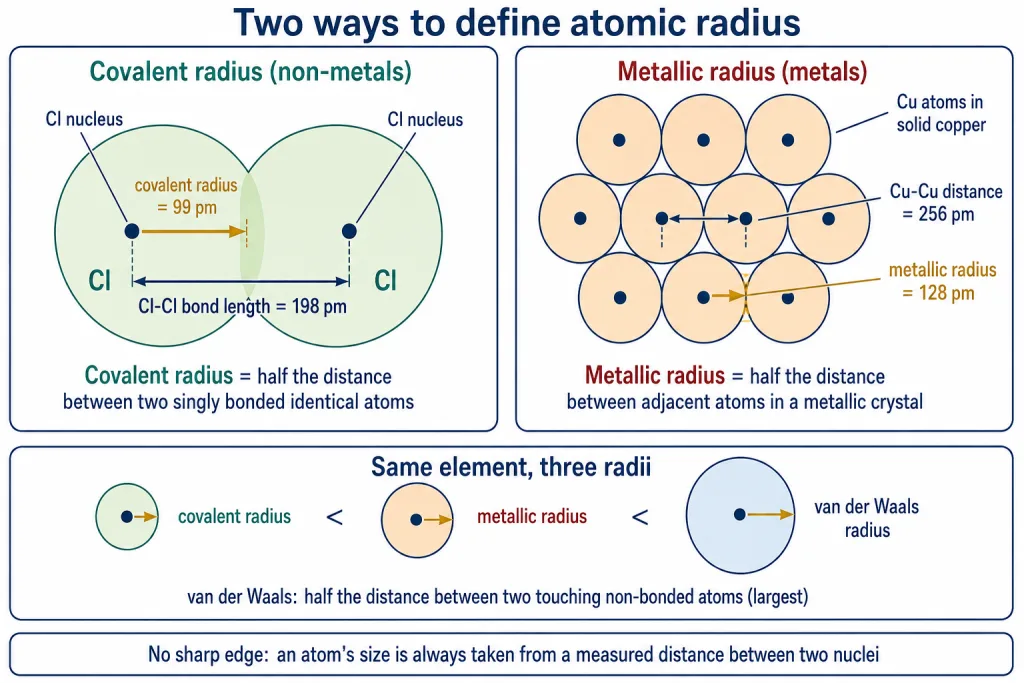
For a non-metal that forms a diatomic molecule, measure the distance between the two nuclei joined by a single bond. Half that distance is the covalent radius.
- In the Cl-Cl bond length is 198 pm.
- Half of it, 99 pm, is the covalent radius of chlorine.
The same works for any single-bonded pair of identical atoms: Br-Br, C-C, H-H. Covalent radii are roughly additive, so adding two of them estimates an unknown bond length.
Metallic radius — for metals
Metals form a giant crystal in which each atom touches its neighbours. So we measure the distance between the centres of two adjacent atoms in the solid and halve it. That is the metallic radius.
- In solid copper, adjacent Cu atoms are 256 pm apart.
- Half of it, 128 pm, is the metallic radius of copper.
"Atomic radius" — one name for both
Atomic radius covers both: the covalent radius for a non-metal, the metallic radius for a metal. Either way the number comes from a measured internuclear distance, obtained by X-ray diffraction and other spectroscopic methods on crystals and molecules.
Key Point (Definition): Covalent radius = half the internuclear distance between two identical atoms joined by a single covalent bond. Metallic radius = half the internuclear distance between two adjacent atoms in a metallic crystal. Both are called atomic radius in this chapter.
[JEE Main] A third radius is the van der Waals radius: half the distance between the nuclei of two non-bonded atoms of neighbouring molecules (or two noble-gas atoms) that are just touching. Non-bonded atoms only touch and never overlap, so this is always the largest of the three. For the same element,
Covalent bonding pulls two atoms close enough for their electron clouds to overlap, so the covalent radius is smallest; a metallic lattice holds atoms slightly less tightly; van der Waals contact is loosest. For chlorine the covalent radius is 99 pm but the van der Waals radius is about 180 pm.
Trend 1: Atomic Radius Decreases Across a Period
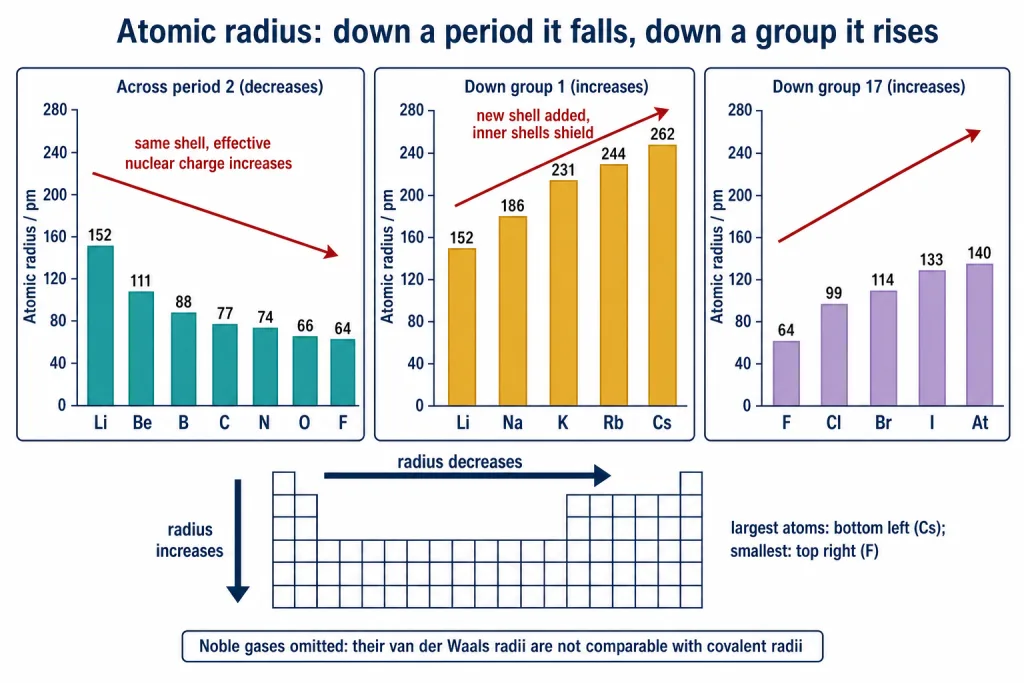
These are the atomic radii for the second and third periods.
| Period 2 | Li | Be | B | C | N | O | F |
|---|---|---|---|---|---|---|---|
| Atomic radius / pm | 152 | 111 | 88 | 77 | 74 | 66 | 64 |
| Period 3 | Na | Mg | Al | Si | P | S | Cl |
|---|---|---|---|---|---|---|---|
| Atomic radius / pm | 186 | 160 | 143 | 117 | 110 | 104 | 99 |
Read either row left to right and the atoms get smaller. Lithium is more than twice the size of fluorine; sodium nearly twice the size of chlorine. The drop is steep at the start of the period (Li to Be loses 41 pm, Na to Mg loses 26 pm) and gentler at the end (N to O loses 8 pm, S to Cl loses 5 pm), but it is a drop all the way.
Why? Same shell, stronger pull
From Li to F:
- What stays the same: the outermost electrons are in the same shell — for the whole second period, for the whole third. No new layer is added.
- What changes: each step right adds one proton to the nucleus and one electron to the same valence shell. Electrons in the same shell shield one another poorly, so the extra proton is felt almost fully by every outer electron.
So the effective nuclear charge — the pull the outer electrons actually feel once the inner electrons have partly cancelled the nucleus — rises steadily from left to right, squeezing the same shell inward.
Key Point: Across a period the valence electrons stay in the same shell while the effective nuclear charge increases with atomic number. The electrons are pulled in more strongly, so atomic radius decreases across a period.
Why the drop is steep at first, then gentle
Lithium's single 2s electron is shielded almost completely by the two 1s electrons, so it is far out, loosely held, and the atom is large. One extra proton makes a big fractional difference to that small effective charge — hence the big drop from Li to Be. By N, O and F the effective nuclear charge is already high, one more proton changes it little, and the radius shrinks by only a few picometres per step.
The decrease across a period is large in the s- and p-blocks and much smaller in the d-block, where the added electrons go into an inner subshell and partly shield the outer electrons. That is why the transition metals in one row are all roughly the same size, and it has a knock-on effect at the end of this section (gallium versus aluminium).
[Board] The two-line answer to "why does atomic radius decrease across a period?" is: (i) the outer electrons occupy the same shell; (ii) the effective nuclear charge increases with atomic number, so the electrons are attracted more strongly and the atom shrinks. Both halves are needed for full marks.
Trend 2: Atomic Radius Increases Down a Group
Now travel vertically — the alkali metals and the halogens.
| Group 1 | Atomic radius / pm | Group 17 | Atomic radius / pm |
|---|---|---|---|
| Li | 152 | F | 64 |
| Na | 186 | Cl | 99 |
| K | 231 | Br | 114 |
| Rb | 244 | I | 133 |
| Cs | 262 | At | 140 |
Both columns climb steadily with atomic number. Caesium at 262 pm is the largest atom you will normally meet; francium would be larger still.
Why? A new shell every step, and the inner shells shield
Two things happen at each step down, and they pull the same way.
- A new shell is added. The valence electron sits in for Li, for Na, for K, for Rb, for Cs, and a higher means an electron on average farther from the nucleus.
- The inner shells shield. The nucleus gains many protons going down (Li has 3, Cs has 55), but those are matched by extra inner electrons that screen the valence electron very effectively. Caesium's valence electron feels an effective nuclear charge not much bigger than lithium's, while sitting in a much larger orbit.
Key Point: Down a group the principal quantum number of the valence shell increases and the filled inner shells shield the outer electrons from the nucleus. The outer electrons are farther away and held only a little more strongly, so atomic radius increases down a group.
Putting the two trends together
| Direction | What changes | Effect on radius |
|---|---|---|
| Left to right across a period | Same shell; effective nuclear charge rises | Decreases |
| Top to bottom down a group | New shell added; inner shells shield | Increases |
The largest atoms sit at the bottom left (Cs, Fr) and the smallest at the top right (F, and helium if you count it). For two atoms sharing neither period nor group, the group effect (more shells) is normally bigger, so an element lower in the table is usually larger even if farther right. K (231 pm) beats Na (186 pm), while Br (114 pm), in K's period, is much smaller than both.
The noble gases are left out — deliberately
Helium, neon, argon and the rest are monoatomic. They form no bonds, so there is no Cl-Cl type distance to halve for a covalent radius, and no metallic lattice either. The only measurable radius for a noble gas is the distance between two touching but unbonded atoms in the solid — a van der Waals radius, always much bigger than the covalent radii of neighbouring elements: neon's is about 160 pm against fluorine's 64 pm.
Those large numbers in the period table would look like a sudden jump at the end of every period and wreck the trend. The jump is not real; it is an apples-and-oranges comparison. Noble-gas radii should be compared with the van der Waals radii of other elements, not with their covalent radii, which is why they are left out of the across-the-period tables.
[NEET] "Which element has the largest atomic radius in the second period?" The intended answer is lithium, not neon, because the noble-gas radius is a non-bonded (van der Waals) radius and is not compared with the covalent radii of the other elements. But if a question explicitly says "van der Waals radius" or "including noble gases", the noble gas is the largest in its period. Read the wording.
Ionic Radius: What Happens to Size When an Atom Gains or Loses Electrons
Metals lose electrons and become cations; non-metals gain electrons and become anions. Each change alters the size, and you must be able to predict the direction.
How ionic radii are measured
In an ionic crystal such as NaCl the ions are packed in contact, and X-ray diffraction gives the distance from a centre to a neighbouring centre. That distance is the sum of the two ionic radii; dividing it between the ions is a matter of convention, which is why books quote slightly different values. Ionic radii follow the same periodic trends as atomic radii — smaller across a period, larger down a group.
Cations are smaller than their parent atoms
| Species | Electrons | Protons | Radius / pm |
|---|---|---|---|
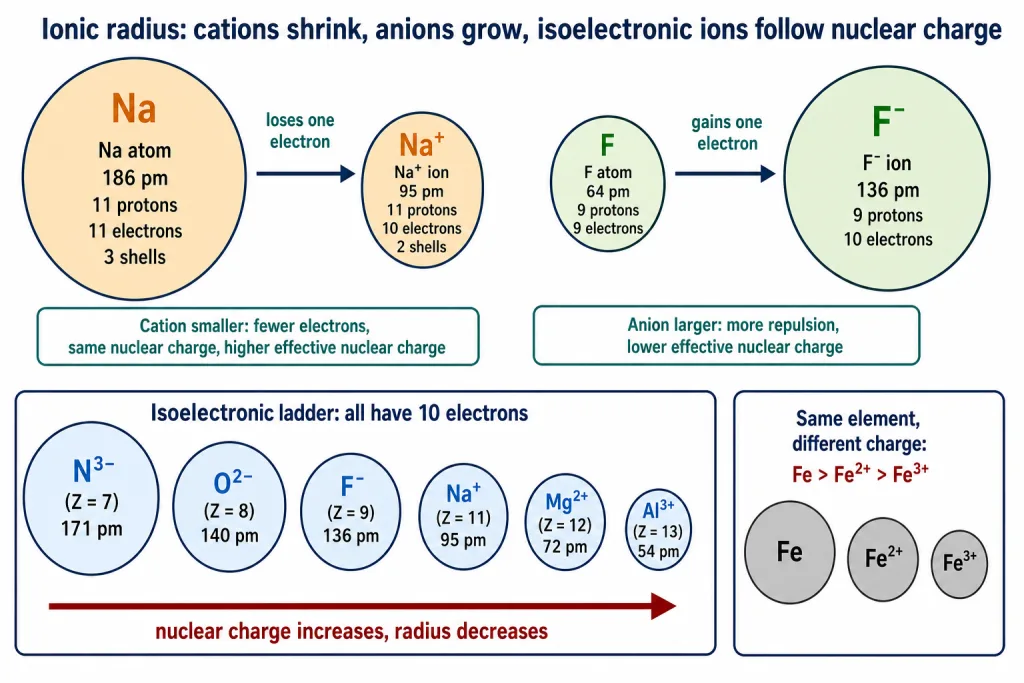
| Na | 11 | 11 | 186 |
| 10 | 11 | 95 |
Sodium loses its lone 3s electron and shrinks to about half its size, for two reasons. First, the whole outer shell disappears: that electron was alone in the shell, so the outermost occupied shell becomes . Second, 11 protons now hold only 10 electrons, so there is less electron-electron repulsion and a higher effective nuclear charge per electron, drawing the cloud inward.
Key Point: A cation is smaller than its parent atom because it has fewer electrons while its nuclear charge remains the same; the surviving electrons are pulled in more tightly (and often a whole shell has been removed).
Anions are larger than their parent atoms
| Species | Electrons | Protons | Radius / pm |
|---|---|---|---|
| F | 9 | 9 | 64 |
| 10 | 9 | 136 |
Fluorine gains one electron into its 2p subshell and more than doubles in radius. No new shell is added; the increase comes purely from the electrons. Ten electrons repel one another more than nine did, so the cloud spreads out, and nine protons now hold ten electrons, so each feels a smaller share of the nuclear pull. The added electron also shields the others a little.
Key Point: An anion is larger than its parent atom because adding electrons increases electron-electron repulsion and lowers the effective nuclear charge; the electron cloud expands.
The rule in one line, and the two extensions
For any element: .
More positive charge, smaller ion. Of two cations of the same element, the more highly charged is smaller, having lost more electrons to the same nucleus:
Iron's metallic radius is about 126 pm; is roughly 76 pm and roughly 64 pm.
More negative charge, larger ion. In reverse: , because the extra electrons' mutual repulsion outweighs the unchanged nuclear pull.
Ratios make the point numerically: , while at about 54 pm against Al's 143 pm gives roughly . The higher the charge and the more shells stripped away, the smaller the ratio.
[Board] Asked why a cation is smaller or an anion larger, give both halves: the change in the number of electrons (same nuclear charge, more or less repulsion) and the resulting change in effective nuclear charge. Mentioning the lost shell for cations earns extra credit.
Isoelectronic Species: Same Electrons, Different Nucleus
Look at these four ions.
| Species | Protons () | Electrons | Radius / pm |
|---|---|---|---|
| 8 | 10 | 140 | |
| 9 | 10 | 136 | |
| 11 | 10 | 95 | |
| 12 | 10 | 72 |
All four have 10 electrons and the configuration — the neon configuration. Species with the same number of electrons are called isoelectronic.
Key Point (Definition): Isoelectronic species are atoms or ions that have the same number of electrons (and the same electronic configuration). Examples: , , Ne, , and all have 10 electrons.
Their sizes differ because the nucleus differs. The 10 electrons of are held by 8 protons; the same 10 in are held by 12, so that cloud is pulled in tighter.
Key Point: Among isoelectronic species, the one with the larger nuclear charge (more protons) has the smaller radius; the one with the largest negative charge (fewest protons) is the largest.
Lined up by atomic number, the radius falls as rises.
(Neon slots in between and on this argument, though its measured radius is a non-bonded one.)
A note on the numbers
Tables quote slightly different ionic radii — as 95 pm here and 102 pm in a later table on the second-period anomaly; 72 pm; 76 pm; 31 pm. The differences come from the convention for splitting the cation-anion distance and from the coordination number in the crystal. In exams, quote the value the question gives and rely on the trend for ordering.
The problem everyone should be able to do
Which of Mg, , Al, is the largest and which the smallest?
- Across a period radius decreases: Mg (160 pm) Al (143 pm).
- A cation is smaller than its parent atom: , .
- Among isoelectronic species higher nuclear charge means smaller: () and () both have 10 electrons, so is smaller.
Largest Mg, smallest , full order .
Finding isoelectronic partners
Count the electrons, then find a neighbour with the same count.
| Given | Electrons | Some isoelectronic partners |
|---|---|---|
| 10 | , , Ne, , , | |
| Ar | 18 | , , , |
| 10 | , , , Ne, , | |
| 36 | , Kr, , |
Electrons , so has and has .
[NEET] "The size of the isoelectronic species , Ne and is affected by" — the answer is nuclear charge . Not (it is 2 for all three), not electron-electron interactions (the electron count is identical), and not "none". Nuclear charge is the only thing that differs.
The Ordering Toolkit and the Gallium Surprise
Almost every exam question on size is a ranking. Apply these rules in order until one settles the comparison.
| Step | Rule | Example |
|---|---|---|
| 1 | Compare number of shells (period). More shells, larger. | K (4 shells) Na (3 shells) |
| 2 | Same shells? Compare nuclear charge. Higher , smaller (across a period; and for isoelectronic species). | Na Cl; |
| 3 | Same element? Compare charge. More negative, larger; more positive, smaller. | |
| 4 | Mixed atoms and ions? Convert to electron counts and shells, then use 1 and 2. | (3 shells, ) Na (3 shells, ) |
Two consequences students often get backwards:
- A cation can be smaller than a neutral atom from an earlier period. has three shells and 19 protons, Na three shells and 11; the tighter grip wins, so (about 138 pm) Na (186 pm).
- An anion can be larger than a neutral atom from a later period. (about 181 pm) beats Ga (135 pm), As (121 pm) and Br (114 pm), all a period lower, and is not far short of Ca (about 197 pm).
A worked mini-ranking
Order Na, , K, by size. K has four shells, Na three, and each cation one shell fewer than its parent. So K is largest, then Na (3 shells, ), then (3 shells, ), then (2 shells):
The shell count, not the label "cation" or "atom", did the sorting.
Why gallium is not bigger than aluminium
Down group 13 you would expect B Al Ga In Tl. The actual covalent radii are B 88, Al 143, Ga 135, In 167, Tl 170 pm — gallium, one period below aluminium, is slightly smaller.
Between Al and Ga sit the ten 3d transition elements (Sc to Zn), so gallium has ten 3d electrons aluminium lacks. Those are inner electrons, but diffuse ones that shield the outer 4s and 4p electrons poorly, while the nucleus has gained ten protons across the 3d row. Poor shielding plus ten more protons means gallium's outer electrons feel a much higher effective nuclear charge than "one period lower" suggests, enough to cancel the gain from the new shell.
Key Point: The filling of the 3d subshell before Ga, and the poor shielding of those 3d electrons, raises the effective nuclear charge on gallium's outer electrons so much that its radius is about the same as, in fact slightly less than, aluminium's. This is sometimes called the d-block contraction (or scandide contraction).
[JEE Main] The same idea explains why the first ionization enthalpy of Ga (579 kJ/mol) is slightly higher than Al's (577 kJ/mol) instead of lower — that comes in the next section. A related effect, the lanthanoid contraction, makes the 4d and 5d elements of each group almost the same size (Zr and Hf, for example).
Before you move on
Check that you can do these four things without looking back.
- Define covalent and metallic radius from Cl-Cl (198 pm) and Cu-Cu (256 pm).
- Explain both atomic-radius trends: "same shell + rising effective nuclear charge" across a period, "new shell + shielding" down a group.
- Explain why (95 pm) is smaller than Na (186 pm) and (136 pm) larger than F (64 pm).
- Order any isoelectronic set by nuclear charge, the highest being the smallest.
Solved Examples
Question 1: What atomic radius and ionic radius really mean
What do the terms atomic radius and ionic radius really mean to you?
Answer: An atom has no sharp edge, so I cannot measure one isolated atom. Any radius has to come from a distance between two atoms that I can measure.
Atomic radius is half the distance between the nuclei of two neighbouring atoms of the same element. For a non-metal I use two atoms joined by a single covalent bond, giving the covalent radius: Cl-Cl is 198 pm, so chlorine's radius is 99 pm. For a metal I use two adjacent atoms in the metallic crystal, giving the metallic radius: Cu-Cu is 256 pm, so copper's is 128 pm. "Atomic radius" means whichever applies.
Ionic radius is the size of a cation or an anion. I take the cation-to-anion centre distance in an ionic crystal by X-ray diffraction, then share it between the two ions so each gets its own radius.
A cation is always smaller than its parent atom and an anion always larger, and ionic radii follow the same period and group trends as atomic radii.
Ans: Atomic radius is half the internuclear distance between two bonded (covalent radius) or adjacent (metallic radius) atoms of an element; ionic radius is the effective size of an ion, obtained from cation-anion distances in a crystal.
Watch out: Every radius here is half a measured distance between two centres, never one atom measured on its own.
Question 2: Covalent radius from bond length, and predicting a bond length
(a) The Br-Br bond length in is 228 pm and the C-C bond length in diamond is 154 pm. Find the covalent radii of bromine and carbon. (b) Using the covalent radius of chlorine (99 pm), estimate the C-Cl bond length in .
Answer: The covalent radius is half the single-bond distance between two identical atoms. For bromine
and for carbon, from the C-C single bond,
Both match the tabulated radii (Br 114 pm, C 77 pm).
For (b), covalent radii are roughly additive, so a bond between two different atoms is about the sum of their radii.
The measured C-Cl bond length is about 177 pm, so the estimate is close. Small differences come from the electronegativity difference, which shortens polar bonds slightly.
Ans: pm, pm, and the C-Cl bond length is about 176 pm.
Watch out: Halve a homonuclear bond length to get a covalent radius; add two covalent radii to predict a heteronuclear bond length.
Question 3: How atomic radius varies in a period and in a group
How does atomic radius vary in a period and in a group? How do you explain the variation?
Answer: In a period the atomic radius decreases left to right. Second period: Li 152, Be 111, B 88, C 77, N 74, O 66, F 64 pm. Third period: Na 186 pm down to Cl 99 pm.
The outer electrons all sit in the same shell ( for Li to F), and each step adds one proton and one electron to that shell. Electrons in the same shell hardly shield one another, so the effective nuclear charge rises steadily, the outer electrons are pulled in harder, and the atom shrinks.
In a group the atomic radius increases top to bottom. Group 1: Li 152, Na 186, K 231, Rb 244, Cs 262 pm. Group 17: F 64, Cl 99, Br 114, I 133, At 140 pm.
Here each step adds a whole new shell, raising the valence electron's principal quantum number, so the outer electrons are farther out. The extra protons are matched by extra inner electrons that shield very well, so the pull does not grow enough to cancel the larger shell.
Ans: Radius decreases across a period (same shell, rising effective nuclear charge) and increases down a group (new shell, inner-shell shielding).
Watch out: Both halves of each explanation are needed — "same shell, more pull" across, "new shell, well shielded" down.
Question 4: What happens to the radius when an atom gains or loses an electron
Describe the theory associated with the radius of an atom as it (a) gains an electron, (b) loses an electron. Illustrate with iron, which forms and .
Answer: (a) Gaining an electron makes the atom grow. The nucleus is unchanged, but there is one more electron in the outer shell, so the electrons repel one another more and the nuclear pull is shared among more of them, giving each a smaller effective nuclear charge. The cloud spreads out. Fluorine (64 pm) becomes fluoride (136 pm); oxygen (66 pm) becomes oxide (140 pm).
(b) Losing an electron makes the atom shrink. The nucleus is again unchanged, but with fewer electrons there is less mutual repulsion and a larger share of the pull for each remaining electron, so the cloud is drawn in. Often the whole outer shell is emptied, removing a layer entirely. Sodium (186 pm) becomes (95 pm).
For iron, the more electrons lost, the harder the same nucleus grips those left. Fe (about 126 pm) gives (about 76 pm) and (about 64 pm).
In general, anion atom cation; among ions of the same element, higher positive charge means a smaller ion and higher negative charge a larger one.
Ans: Gaining electrons increases repulsion and lowers effective nuclear charge, so the radius increases; losing electrons does the opposite — the more electrons lost, the smaller the ion, as in .
Watch out: The nucleus never changes when an ion forms; only the electron count does, and that alone decides the direction of the size change.
Question 5: Why cations are smaller and anions larger than their parent atoms
Explain why cations are smaller and anions larger in radii than their parent atoms.
Answer: A cation has fewer electrons than the parent atom but the same number of protons. Fewer electrons means less electron-electron repulsion and a higher effective nuclear charge on each remaining electron, so the cloud is pulled inward. Often the outermost shell is lost altogether: Na is with three shells, is with two, and the size drops from 186 pm to 95 pm.
An anion has more electrons but the same number of protons. More electrons means more repulsion and a lower effective nuclear charge per electron, so the cloud expands. No new shell is needed: F (, 64 pm) becomes (, 136 pm).
One picture covers both. A fixed number of protons holds a crowd of electrons: fewer electrons, each held tighter, compact crowd; more electrons, each held loosely, spread-out crowd.
Ans: A cation is smaller because it has fewer electrons for the same nuclear charge (higher effective nuclear charge, less repulsion, often one shell fewer); an anion is larger because it has more electrons for the same nuclear charge (lower effective nuclear charge, more repulsion).
Watch out: The phrase that earns the marks is "same nuclear charge, different number of electrons".
Question 6: Ordering sodium, potassium and their cations
Arrange Na, , K and in order of increasing size, with reasons.
Answer: First I count shells. K is — four. Na is — three. is — three. is — two.
More shells means larger, so K is the largest (231 pm) and the smallest (95 pm).
Na and both have three shells, so I compare nuclear charge. Na has 11 protons pulling on 11 electrons; has 19 pulling on 18. The ion's electrons are held far more tightly, so (about 138 pm) is smaller than Na (186 pm).
Ans: Increasing size: .
Watch out: A cation can be smaller than a neutral atom from an earlier period — count shells first, then compare nuclear charge.
Question 7: Naming isoelectronic partners
What do you understand by isoelectronic species? Name a species that will be isoelectronic with each of the following: (i) , (ii) Ar, (iii) , (iv) .
Answer: Isoelectronic species are atoms or ions with the same number of electrons, and therefore the same electronic configuration. Their sizes differ only because their nuclear charges differ. I count electrons in each case and look for a match.
(i) : . Ne, , , , , .
(ii) Ar: 18. (17 + 1), (16 + 2), (19 - 1), (20 - 2).
(iii) : . Ne, , , , .
(iv) : . Kr, (35 + 1), (38 - 2), (34 + 2).
Ans: (i) Ne or ; (ii) or ; (iii) Ne or ; (iv) Kr or — any species with the same electron count is acceptable.
Watch out: Electrons charge. Find the nearest noble gas with that electron count, then step one or two places left (anions) or right (cations).
Question 8: Ordering a six-member isoelectronic set
Consider the species , , , , and . (a) What is common to them? (b) Arrange them in order of increasing ionic radius.
Answer: For (a) I count electrons: ; ; ; ; ; . All six give 10 electrons with the configuration , so they are isoelectronic with neon.
For (b), only the nuclear charge differs: runs 7, 8, 9, 11, 12, 13. The same ten electrons are held by more protons as rises, so the ion gets smaller. The largest is (7 protons on 10 electrons), the smallest (13 protons on 10 electrons).
Approximate radii: 54, 72, 95, 136, 140, 171 pm.
Ans: (a) All have 10 electrons — they are isoelectronic. (b) .
Watch out: Write the atomic numbers under the symbols and reverse the order — highest is smallest.
Question 9: Largest and smallest among Mg, magnesium ion, Al and aluminium ion
Which of the species Mg, , Al, has the largest size and which the smallest?
Answer: The neutral atoms first. Mg and Al are both in period 3 and radius decreases across a period, so Mg (160 pm) is larger than Al (143 pm).
Next each cation against its parent. A cation is smaller than its parent atom, so and . Both ions have lost the entire third shell and are left with .
Then the two cations against each other. They are isoelectronic with 10 electrons each, and has 13 protons holding them against magnesium's 12, so is smaller (about 54 pm versus 72 pm).
Full order: .
Ans: Largest: Mg. Smallest: .
Watch out: Three rules settle any mixed set of neighbouring atoms and ions — across the period, cation smaller than atom, isoelectronic by .
Question 10: Placing a neutral atom, its anion, a noble gas and a cation in order
Arrange Cl, , Ar and in order of decreasing size, and explain your reasoning.
Answer: First the isoelectronic trio. (), Ar (18) and () all have 18 electrons, configuration . Among isoelectronic species higher nuclear charge means smaller, so
Now the neutral chlorine atom. Cl has 17 electrons in three shells and a covalent radius of 99 pm, so it is smaller than (about 181 pm), an anion always being larger than its parent atom. It is also smaller than (about 138 pm): both have three shells, but the atom's small covalent radius reflects the overlap of a bonded pair while the ion's radius is measured in a crystal.
One caution about argon. Its only measurable radius is a van der Waals (non-bonded) radius, about 188 pm, which on the bare numbers would put it above . An exam that mixes a noble gas into an isoelectronic set wants the isoelectronic argument, nuclear charge, so the order above is the expected answer. If a question instead compares a noble gas's radius with covalent radii of other elements, say the comparison is not like-for-like.
Ans: (isoelectronic trio ordered by nuclear charge; the neutral chlorine atom, with its small covalent radius, is the smallest).
Watch out: A noble gas inside an isoelectronic set is just the 18-electron (or 10-electron) species, so rank it by — and mention the van der Waals caveat if the question invites discussion.
Question 11: What decides the size of fluoride, neon and sodium ion
The size of the isoelectronic species , Ne and is affected by (a) nuclear charge () (b) valence principal quantum number () (c) electron-electron interaction in the outer orbitals (d) none of the factors because their size is the same.
Answer: All three have 10 electrons in . The valence principal quantum number is 2 for each, so (b) cannot distinguish them, and the electron-electron interactions among ten electrons in the same configuration are identical, so (c) cannot either. The sizes are clearly not equal — is about 136 pm and about 95 pm — so (d) is wrong.
Only the number of protons differs: 9, 10 and 11. That one differing quantity must set the size: more protons, tighter hold, smaller species. So .
Ans: (a) nuclear charge ().
Watch out: For isoelectronic species everything about the electrons is the same, so only the nucleus can explain the size difference.
Question 12: Why gallium is no bigger than aluminium
The atomic radius of aluminium is 143 pm and that of gallium, immediately below it in group 13, is 135 pm. Radius normally increases down a group. Why does it not do so here?
Answer: I expect Ga to be clearly larger: its valence electrons are in while Al's are in , a whole extra shell.
What is different is the ten 3d elements, Sc to Zn, lying between Al () and Ga (). Gallium's configuration is , so it carries ten 3d electrons aluminium does not have. Those are inner electrons, but spread out, and they shield the outer 4s and 4p electrons poorly. Meanwhile the nucleus has gained ten protons across the 3d row. Poor shielding plus ten extra protons means Ga's outer electrons feel a much higher effective nuclear charge than a simple "one row down" comparison predicts.
That stronger pull contracts the shell enough to cancel the expected increase, so Ga ends up about the size of Al — in fact slightly smaller (135 pm against 143 pm). This is the d-block contraction.
Ans: The ten poorly shielding 3d electrons in gallium, together with the ten extra protons, raise the effective nuclear charge on its outer electrons so much that its radius shrinks to about aluminium's size.
Watch out: When a p-block element follows the first d-block row (Ga, Ge, As), expect it to be a little smaller and harder to ionize than the group trend predicts.