
Adding an Electron: Electron Gain Enthalpy
Ionization enthalpy asked what it costs to pull an electron out. Turned around, the same question asks what happens energetically when an electron is pushed in. This property can have either sign, and it hides a surprise in the second period.
Key Point (Definition): When an electron is added to a neutral gaseous atom X to convert it into a negative ion, the enthalpy change accompanying the process is called the electron gain enthalpy, : It measures the ease with which an atom adds an electron to form an anion.
The atom must be gaseous and isolated, so neighbours do not interfere, and the product is a gaseous anion. Being an enthalpy change, follows the usual thermodynamic sign convention:
- Energy released on adding the electron: exothermic, negative.
- Energy supplied to force the electron in: endothermic, positive.
Both cases occur. For most elements the nucleus attracts the incoming electron more strongly than the electrons already present repel it, so energy is released. For a few — the noble gases especially — there is no comfortable place for it, and it must be forced in.
Why halogens release the most energy
Group 17 atoms are , one electron short of a filled shell. Adding one gives the anion the stable noble-gas configuration . The atom is small, the effective nuclear charge felt by the incoming electron is high, and the reward is a closed shell. Halogens therefore have the most negative values of all: chlorine kJ/mol, fluorine kJ/mol.
Why noble gases resist
A noble gas already has the closed configuration. The extra electron cannot enter the filled valence shell; it must go into the next higher principal quantum level (), far from the nucleus, well shielded, giving a very unstable arrangement. Energy has to be supplied, so noble-gas values are large and positive: He , Ne , Ar kJ/mol.
Key Point: Electron gain enthalpies have large negative values toward the upper right of the periodic table, just before the noble gases. The noble gases themselves have positive values.
[Board] "Why is the electron gain enthalpy of noble gases positive?" — the electron must enter the next higher shell, giving a very unstable configuration, so energy is needed.
Ionization enthalpy and electron gain enthalpy side by side
| Property | Process | Sign | Typical values |
|---|---|---|---|
| Ionization enthalpy | Always positive (energy always needed) | Na 496, Cl 1251 kJ/mol | |
| Electron gain enthalpy | Negative for most, positive for some | Cl , Ne kJ/mol |
Removing an electron always costs work, since it is pulled away from a positive nucleus. Adding one can go either way.
The Data: Electron Gain Enthalpies of Main-Group Elements
Learn the shape of each column rather than every number, but memorise the halogen values and the O/S pair.
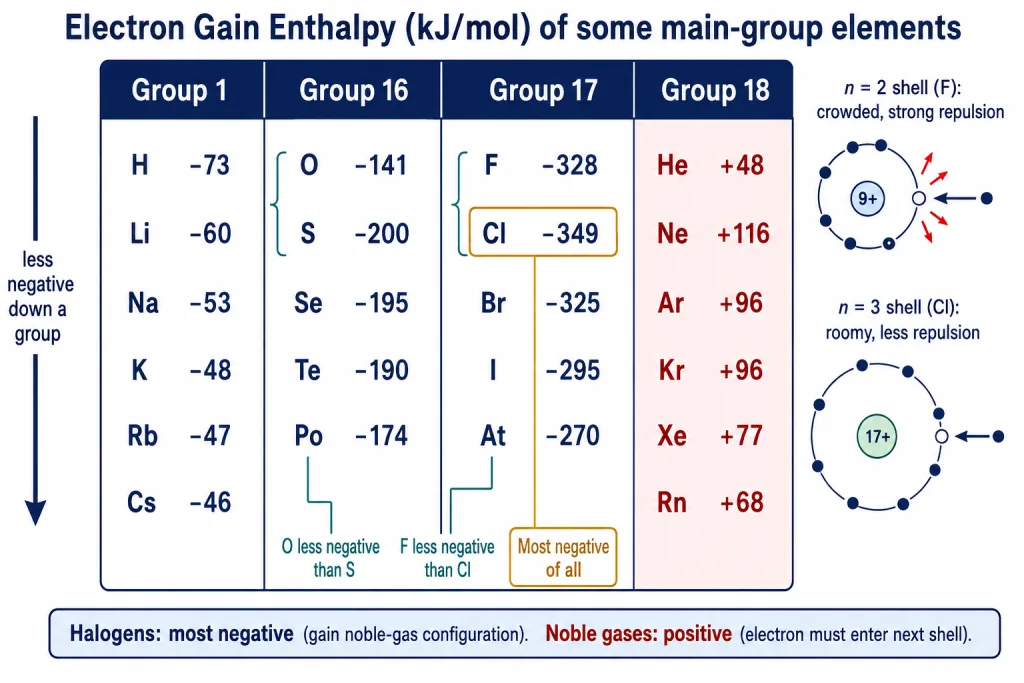
Electron gain enthalpies (kJ/mol)
| Group 1 | Group 16 | Group 17 | Group 18 | ||||
|---|---|---|---|---|---|---|---|
| H | He | ||||||
| Li | O | F | Ne | ||||
| Na | S | Cl | Ar | ||||
| K | Se | Br | Kr | ||||
| Rb | Te | I | Xe | ||||
| Cs | Po | At | Rn |
Group 1. Even alkali metals release a little energy on gaining an electron ( gives a filled s subshell). The values are small and become slightly less negative down the group: Li , Na , K , Rb , Cs kJ/mol. Hydrogen () is at kJ/mol.
Group 16. Oxygen at kJ/mol is less negative than sulfur at kJ/mol. From sulfur down the expected pattern returns: S , Se , Te , Po kJ/mol — less negative as the atom grows.
Group 17. Fluorine at kJ/mol is less negative than chlorine at kJ/mol. From chlorine down: Cl , Br , I , At kJ/mol. The most negative value in the whole table belongs to chlorine, not fluorine.
Group 18. All positive: He , Ne , Ar , Kr , Xe , Rn kJ/mol. Neon is the most endothermic; the values shrink down the group as the empty level comes closer in energy.
Key Point: Most negative overall: Cl ( kJ/mol). Order in group 17: (in magnitude). Order in group 16: (in magnitude). Most positive: Ne ( kJ/mol).
[JEE/NEET] "Most negative electron gain enthalpy" and "highest electron gain enthalpy" are opposite requests. Highest (most positive) in a set containing a noble gas is the noble gas.
Why it is called "less systematic"
The variation of electron gain enthalpy across the table is less systematic than that of ionization enthalpy. Ionization enthalpy depends mainly on how tightly the existing outermost electron is held. Electron gain enthalpy depends on what the incoming electron finds: how much room there is, how strongly the electrons already in that subshell repel it, and whether the new configuration is a stable half-filled or filled one.
That last factor produces values a plain left-to-right rule cannot predict. Nitrogen (, half-filled) has a value near zero — the added electron would have to pair up in a stable half-filled subshell, with no net gain. Beryllium and magnesium (, filled) are similar: the new electron would have to start the higher-energy p subshell. Standard tables omit those columns because they break the simple pattern; exams do not.
Explaining the Trends — and the Second-Period Surprise
How strongly an atom attracts an extra electron depends on the two things that governed atomic radius and ionization enthalpy: the effective nuclear charge at the outer edge of the atom, and how far that edge is from the nucleus.
Across a period: more negative
From left to right, rises and the atom shrinks, so the incoming electron lands closer to a more strongly charged nucleus. As a general rule, electron gain enthalpy becomes more negative with increasing atomic number across a period. In the third period the values run from Na and grow more negative through Si, P and S () to Cl ( kJ/mol), with two bumps: the pause at Mg (, filled) and the smaller-than-expected value at P (, half-filled).
Down a group: less negative
Down a group a new shell is added each time, so the atom gets bigger, the extra electron sits farther out and better shielded, and the attraction weakens. Electron gain enthalpy generally becomes less negative down a group. In the table: Cl , Br , I , At ; S , Se , Te , Po ; Li down to Cs kJ/mol.
The surprise: O and F are less negative than S and Cl
By the down-the-group rule, oxygen should be more negative than sulfur and fluorine more negative than chlorine. The measured values say otherwise:
| Pair | Expected (size rule) | Actual (kJ/mol) |
|---|---|---|
| O vs S | O more negative | O , S — S is more negative |
| F vs Cl | F more negative | F , Cl — Cl is more negative |
Oxygen and fluorine are second-period elements, so the incoming electron goes into the shell, which is very small and already holds six (O) or seven (F) electrons in a tiny volume. The added electron suffers significant repulsion from them, cancelling a good part of the nuclear attraction. In sulfur and chlorine the electron enters the shell, a much larger region of space where the existing electrons are more spread out and the repulsion is far smaller. So S and Cl release more energy than O and F.
Key Point: The electron gain enthalpy of O or F is less negative than that of S or Cl because the added electron enters the small level and suffers strong repulsion from the electrons already present; in the larger level of S or Cl the repulsion is much less.
This does not make fluorine a weak attractor: it still has the second most negative value in the table and is the most electronegative element. The anomaly is only about the comparison with the element directly below.
[JEE Main] The anomaly stops after the second row. From the third period down, each shell is roomy enough that size wins again, so S > Se > Te and Cl > Br > I follow the normal trend.
Worked case: P, S, Cl, F
Which of P, S, Cl and F has the most negative electron gain enthalpy, and which the least negative?
- Across the third period the value becomes more negative from P to S to Cl, so Cl is the most negative of those three.
- Between F and Cl, the repulsion argument makes Cl more negative. So chlorine is the most negative overall.
- Phosphorus has the half-filled configuration; adding an electron would force pairing, so phosphorus is the least negative.
Electron affinity: the sign-convention footnote
Many books use electron affinity , the negative of the enthalpy change for :
Energy released on adding an electron makes the electron affinity positive — contrary to the thermodynamic convention — and energy supplied makes it negative. Chlorine has electron affinity kJ/mol and electron gain enthalpy kJ/mol. Strictly, electron affinity is defined at absolute zero; at other temperatures , a correction of about 6 kJ/mol at room temperature that you can ignore unless asked.
[Board] A question saying "electron affinity" with positive numbers for halogens uses the old convention. "Highest electron affinity" then means "most negative electron gain enthalpy" — chlorine in both languages.
Electronegativity: a Property of an Atom in a Bond
Ionization enthalpy and electron gain enthalpy both describe an isolated gaseous atom. Most atoms are bonded and sharing electrons, and for those the question becomes how strongly the atom pulls the shared electrons towards itself. That pull is electronegativity.
Key Point (Definition): A qualitative measure of the ability of an atom in a chemical compound to attract shared electrons to itself is called electronegativity.
Three things separate it from everything else in this chapter.
- It is qualitative. Unlike ionization enthalpy and electron gain enthalpy, electronegativity is not a measurable quantity. No experiment reads out "3.0" for chlorine. What we have are numerical scales built from measurable things (bond energies, ionization enthalpies, atomic radii) and adjusted so the numbers rank atoms sensibly.
- It is about an atom in a compound, not a free atom.
- It is about shared electrons — electrons in a covalent bond — not an electron fully removed or fully added.
The Pauling scale
Several scales exist — Pauling, Mulliken-Jaffe, Allred-Rochow — but Pauling's is used almost universally. Linus Pauling, in 1922, arbitrarily assigned the value 4.0 to fluorine, the element considered best at attracting electrons, and fixed the rest relative to it. So 4.0 is a chosen reference point, not a measured number, and there are no units.
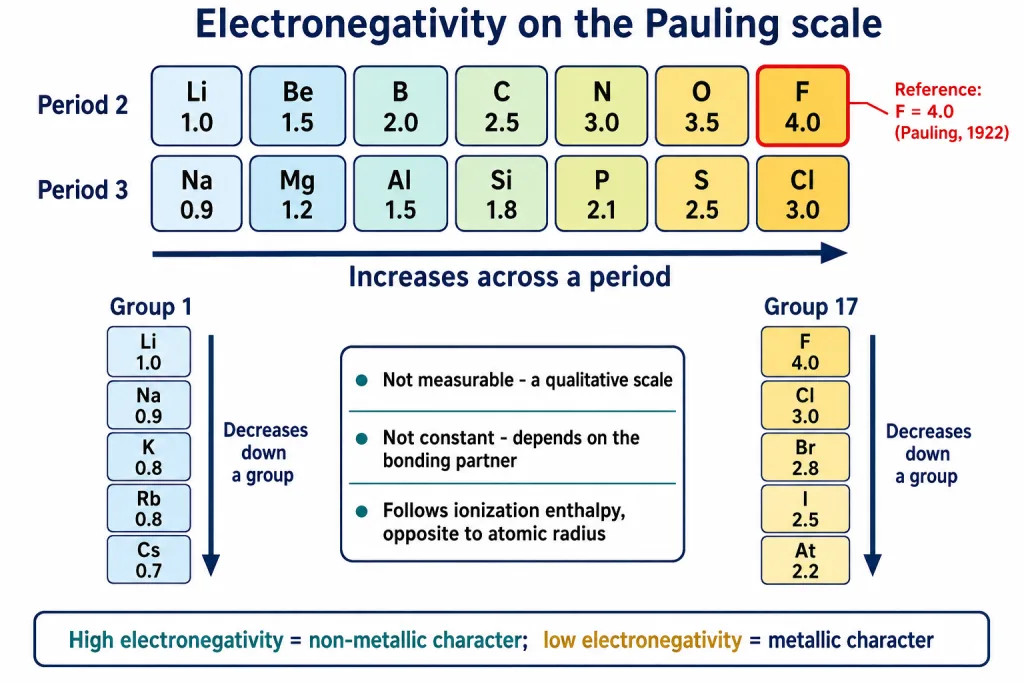
Electronegativity across periods (Pauling scale)
| Period 2 | Li | Be | B | C | N | O | F |
|---|---|---|---|---|---|---|---|
| Electronegativity | 1.0 | 1.5 | 2.0 | 2.5 | 3.0 | 3.5 | 4.0 |
| Period 3 | Na | Mg | Al | Si | P | S | Cl |
|---|---|---|---|---|---|---|---|
| Electronegativity | 0.9 | 1.2 | 1.5 | 1.8 | 2.1 | 2.5 | 3.0 |
Electronegativity down groups (Pauling scale)
| Group 1 | Electronegativity | Group 17 | Electronegativity |
|---|---|---|---|
| Li | 1.0 | F | 4.0 |
| Na | 0.9 | Cl | 3.0 |
| K | 0.8 | Br | 2.8 |
| Rb | 0.8 | I | 2.5 |
| Cs | 0.7 | At | 2.2 |
Numbers worth carrying in your head: F 4.0, O 3.5, N and Cl 3.0, C and S 2.5, H 2.1 (same as P), Na 0.9, Cs 0.7. The second-period row climbs in steps of 0.5 from Li to F.
It is not a constant
Key Point: The electronegativity of any given element is not constant; it varies depending on the element to which it is bound, and on its oxidation state and hybridisation.
The tabulated number is an average, useful for comparison. Nitrogen in and nitrogen in do not pull on shared electrons identically. "The electronegativity of N is 3.0 in all nitrogen compounds" is therefore not correct; 3.0 is the Pauling value for a typical bond, not a fixed property in every environment.
Even unmeasurable, electronegativity predicts the nature of the force holding a pair of atoms together — nearly non-polar for similar values (C-H), polar covalent for a moderate difference (H-Cl, O-H), essentially ionic for a large one (Na-Cl).
[NEET] Definition trap: "ability of an isolated atom to attract electrons" describes electron gain enthalpy. "Ability of an atom in a molecule to attract shared electrons" is electronegativity.
Trends in Electronegativity and What They Tell Us
Electronegativity follows the most regular trend of all the properties in this chapter. There are no O/F or Be/B anomalies to remember.
Across a period and down a group
Key Point: Electronegativity generally increases across a period from left to right (Li 1.0 to F 4.0) and decreases down a group (F 4.0 to At 2.2). The trend is the same as that of ionization enthalpy and opposite to that of atomic radius.
The link to atomic radius
Atomic radii decrease across a period and increase down a group, and that is the whole explanation.
- Across a period, the atom shrinks and rises, so the nucleus sits closer to the bonding region and pulls harder on the shared electrons: Li (152 pm, 1.0) to F (64 pm, 4.0).
- Down a group, the atom grows and the valence shell is better shielded, so the nucleus is farther from the shared electrons and pulls less: F (64 pm, 4.0) to I (133 pm, 2.5) to At (140 pm, 2.2).
The link to ionization enthalpy
An atom that holds its own electrons tightly (high ionization enthalpy) also pulls strongly on shared electrons, so the two rise and fall together. The Mulliken scale defines electronegativity as the average of ionization enthalpy and the magnitude of electron gain enthalpy, and is sometimes called an "absolute" electronegativity. Fluorine, with high ionization enthalpy and a very negative electron gain enthalpy, tops either scale.
| Element | Atomic radius (pm) | First (kJ/mol) | Electronegativity |
|---|---|---|---|
| Na | 186 | 496 | 0.9 |
| Mg | 160 | 737 | 1.2 |
| Al | 143 | 577 | 1.5 |
| Si | 117 | 786 | 1.8 |
| Cl | 99 | 1251 | 3.0 |
The radius falls, the ionization enthalpy broadly rises (with the Al dip), and electronegativity climbs steadily — being a smoothed comparative scale, it does not register the Al dip.
Electronegativity and metallic / non-metallic character
Non-metals tend to gain electrons; metals tend to lose them. Electronegativity is therefore directly related to non-metallic character and inversely related to metallic character.
- The increase across a period comes with an increase in non-metallic (decrease in metallic) properties — from the metal sodium to the non-metal chlorine.
- The decrease down a group comes with a decrease in non-metallic (increase in metallic) character — in group 14, C (non-metal, 2.5) gives way to Si and Ge (metalloids), then Sn and Pb (metals).
Key Point: Most electronegative element: F (4.0), top right. Least electronegative: Cs (0.7), bottom left (francium is radioactive and rarely quoted). The most electronegative elements are the strongest non-metals; the least electronegative are the most reactive metals.
[JEE Main] For a set mixing periods and groups, place each element on a mental grid: the pull increases towards the top right (F). Among P, S, Br and I: S is right of P, Br sits below Cl and Cl > S, and I is below Br. Order: Br (2.8) > S (2.5) > I (2.5, marginally lower in more precise tables) > P (2.1).
Electron Gain Enthalpy versus Electronegativity, and the Four Trends Together
Both terms are about "attracting electrons", so they get mixed up. They are not the same thing.
The basic difference
| Electron gain enthalpy | Electronegativity | |
|---|---|---|
| Refers to | An isolated gaseous atom | An atom in a chemical compound (in a bond) |
| What it describes | Tendency of the atom to gain one extra electron and form an anion | Tendency of the atom to attract shared (bonding) electrons towards itself |
| Measurable? | Yes — an enthalpy change, measured in kJ/mol | No — a qualitative property; the scales (Pauling, Mulliken-Jaffe, Allred-Rochow) are constructed, unitless |
| Constant for an element? | Yes — a fixed property of the gaseous atom | No — varies with bonding partner, oxidation state and hybridisation |
| Sign | Can be negative or positive | Always a positive number on the scale |
| Extreme values | Most negative: Cl ( kJ/mol) | Highest: F (4.0) |
Chlorine has the most negative electron gain enthalpy, but fluorine is the most electronegative element. Were the two the same property, one element would top both lists.
Second electron gain enthalpy
Adding a second electron to oxygen: the first step releases energy ( kJ/mol). The second, , adds an electron to an already negative ion, which repels it; that repulsion must be overcome by supplying energy. So the second electron gain enthalpy of oxygen is positive (endothermic), about kJ/mol, and this holds for every element. still exists in oxides because the lattice energy released when it packs with cations more than pays for the endothermic step.
Key Point: First may be negative or positive; second is always positive, because an electron is being forced into an anion that already repels it.
The four trends on one picture
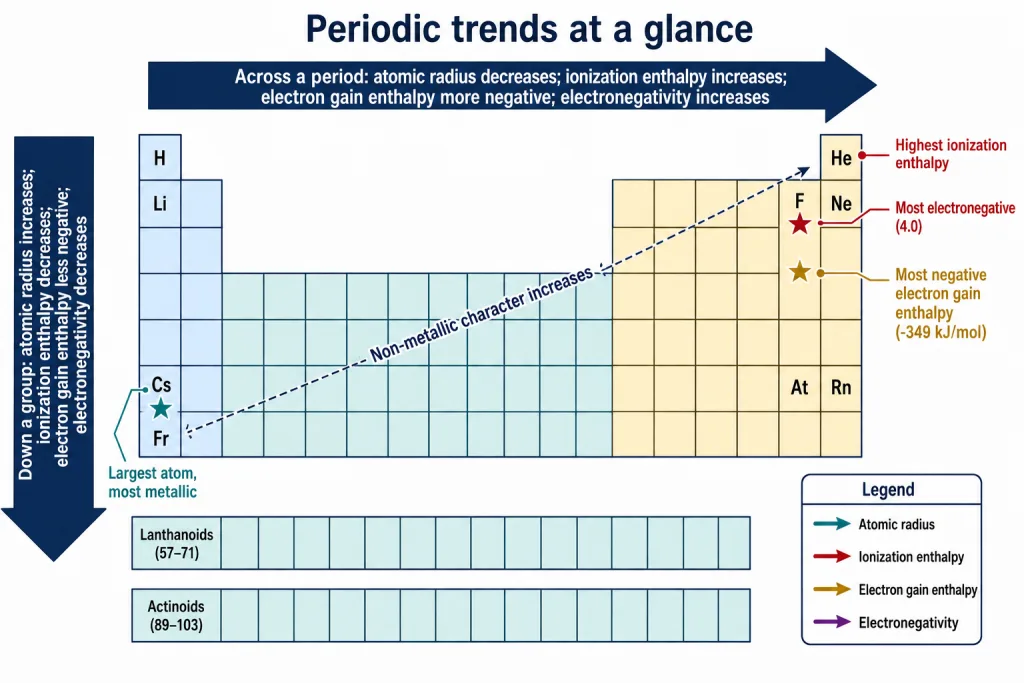
| Property | Across a period (left to right) | Down a group (top to bottom) | Where it peaks |
|---|---|---|---|
| Atomic radius | Decreases | Increases | Bottom left (Cs, Fr) |
| Ionization enthalpy | Increases | Decreases | Top right (He, then Ne, F) |
| Electron gain enthalpy | Becomes more negative | Becomes less negative | Upper right, before the noble gases (Cl most negative) |
| Electronegativity | Increases | Decreases | Top right (F = 4.0) |
Every arrow follows from two facts: effective nuclear charge rises across a period and a new shell is added down a group. Radius points one way; the three attraction properties point the other. Metallic character runs with radius towards the bottom left, non-metallic character with electronegativity towards the top right.
Exceptions to keep on a separate list
| Property | Exceptions you must know | Reason |
|---|---|---|
| Ionization enthalpy | B < Be; O < N (and Al < Mg, S < P) | 2p vs 2s penetration; pairing in a half-filled subshell |
| Electron gain enthalpy | O less negative than S; F less negative than Cl; N and noble gases positive or near zero | Small shell repulsion; half-filled and filled subshells |
| Electronegativity | None at Board level | Smoothed, comparative scale |
| Atomic radius | Noble-gas radii (van der Waals) not compared with covalent radii | Different kind of radius |
[Board] "Regular trend without exception" — electronegativity. "May be positive or negative" — electron gain enthalpy. "Not a measurable quantity" — electronegativity again.
Solved Examples
Question 1: Ordering the halogens by electron gain enthalpy
Arrange F, Cl, Br and I in order of increasingly negative electron gain enthalpy, and state which one has the most negative value. Give the reason for any departure from the group trend.
Answer:
I start with the group trend. Down a group the atom gets bigger and the incoming electron sits farther out and better shielded, so the value becomes less negative: Cl , Br , I kJ/mol.
Fluorine is the exception. By size alone it should be the most negative, but its incoming electron enters the tiny shell, already holding seven electrons in a small volume. That repulsion cancels part of the attraction, so fluorine releases less energy than chlorine: F kJ/mol.
Least negative to most negative: I () < Br () < F () < Cl ().
Ans: (increasingly negative). Chlorine is the most negative; fluorine is out of place because of electron-electron repulsion in its small subshell.
Watch out: The order alone is not enough — the repulsion reason carries the marks.
Question 2: Ordering the chalcogens O, S, Se
Arrange O, S and Se in order of decreasing (i.e. less and less negative) electron gain enthalpy and explain.
Answer:
The values are O , S , Se kJ/mol.
S against Se is the normal group trend: Se is bigger, so its incoming electron is held less tightly and S is more negative.
O against S is the anomaly. Oxygen's extra electron enters the small shell and is strongly repelled by the six electrons already there, so oxygen releases much less energy than sulfur — less than selenium too.
By magnitude: S () > Se () > O ().
Ans: More negative to less negative, . Oxygen is the least negative because of repulsion in its small 2p subshell.
Watch out: In group 16 the anomaly is bigger than in group 17 — O sits below Se and Te as well, since Te ( kJ/mol) is still more negative than O.
Question 3: N, O and F — and the near-zero value of nitrogen
Arrange N, O and F in order of increasingly negative electron gain enthalpy. Why is the value for nitrogen close to zero (slightly positive in most tables)?
Answer:
Across period 2, rises and the atom shrinks, so the value should become more negative: N < O < F. That is the order — N (about 0 or slightly positive), O , F kJ/mol.
Nitrogen breaks the smooth rise. It is , so the 2p subshell is exactly half-filled, one electron in each of the three orbitals with parallel spins. A half-filled subshell is extra stable (symmetry and exchange energy), and an added electron would have to pair up, losing that stability and suffering pairing repulsion. Nuclear attraction and electron repulsion almost cancel, so essentially no energy is released.
Carbon makes the contrast: at it has a genuinely negative value (about kJ/mol), because adding an electron gives it the stable half-filled arrangement. Carbon is more willing than nitrogen, though nitrogen is to its right.
Ans: (increasingly negative). Nitrogen's value is nearly zero because its stable half-filled subshell has no appetite for a fourth p electron.
Watch out: Two extra-stable configurations resist electron gain — half-filled (: N, P) and completely filled (: Be, Mg; : noble gases). A set containing one of these has it as the least negative (or positive) member.
Question 4: Why noble gases have positive electron gain enthalpies
The electron gain enthalpy of neon is kJ/mol and that of chlorine is kJ/mol. Explain the opposite signs. Why is neon's value larger than argon's ( kJ/mol)?
Answer:
Chlorine is . There is room for one more electron in the 3p subshell, and filling it gives the stable closed shell of argon. The electron is taken in close to a high- nucleus, so a lot of energy is released — negative sign.
Neon is , with the shell already full. The extra electron must go into the level, far from the nucleus, heavily shielded by the ten inner electrons, giving a very unstable arrangement. Energy has to be supplied — positive sign.
Neon against argon: argon's extra electron goes into , neon's into . Both lie outside a closed shell, but neon is much smaller and its filled shell very compact, so the incoming electron feels more repulsion relative to attraction. The values fall down the group — Ne , Ar , Kr , Xe , Rn kJ/mol — as the next empty level comes relatively closer in energy.
Ans: Chlorine gains an electron to complete a stable octet (energy released, negative). Neon already has one, so the extra electron enters the next higher shell (energy absorbed, positive). Neon's value exceeds argon's because its compact core repels the incoming electron more.
Watch out: "Next higher principal quantum level, very unstable configuration" is the phrase the answer needs.
Question 5: Converting between electron affinity and electron gain enthalpy
(a) A reference book lists the electron affinity of bromine as kJ/mol and that of helium as kJ/mol. Write the corresponding electron gain enthalpies and state whether each process is exothermic or endothermic. (b) An exam question says "the electron affinity of X is 200 kJ/mol; is the process exothermic?" Which convention should you assume?
Answer:
The relation is , ignoring the small correction. Energy released on gaining an electron counts as a positive electron affinity, opposite to the thermodynamic sign.
Bromine: kJ/mol gives kJ/mol — negative, so exothermic, energy released in .
Helium: kJ/mol gives kJ/mol — positive, so endothermic, energy needed to make .
In (b), a positive "electron affinity" for a typical non-metal is the older convention: energy released, exothermic, kJ/mol. Had it said "electron gain enthalpy kJ/mol", that would be endothermic. The word used decides the sign.
Ans: Br: kJ/mol, exothermic. He: kJ/mol, endothermic. In (b) assume the electron-affinity convention, so the process is exothermic.
Watch out: "High electron affinity" and "very negative electron gain enthalpy" both mean the atom readily gains an electron — same physics, opposite signs.
Question 6: Most negative and least negative in a mixed set
From the set P, S, Cl, F pick the element with the most negative electron gain enthalpy and the one with the least negative. Then do the same for the set Na, Mg, Al, Si.
Answer:
Set 1, across the third period: the value becomes more negative from P to S to Cl as rises and the atom shrinks. Phosphorus also has a half-filled subshell resisting an extra electron, so P is the least negative of those three.
Set 1, F against Cl: same group, but fluorine's incoming electron enters the small subshell and is strongly repelled, so Cl ( kJ/mol) is more negative than F ( kJ/mol). Most negative Cl, least negative P.
Set 2: Na () releases a little energy ( kJ/mol) as the added electron completes the 3s pair. Mg () has a filled s subshell, so the new electron must start the higher-energy 3p subshell — a positive or near-zero value, the least negative. Al () and Si () accept electrons more readily, and Si, further right with higher , is the most negative (about kJ/mol).
Ans: Set 1: most negative Cl, least negative P. Set 2: most negative Si, least negative Mg.
Watch out: Scan a set for a filled or half-filled subshell (the least negative candidate) and for a second-period element that may lose to the one below it, before applying the left-to-right rule.
Question 7: Ordering by electronegativity
Arrange the following in order of increasing electronegativity: (a) C, N, O, F; (b) F, Cl, Br, I; (c) Si, P, Cl, Br, K. Use Pauling values where helpful.
Answer:
Set (a) is one period, and electronegativity rises across a period as the atom shrinks and grows: C 2.5 < N 3.0 < O 3.5 < F 4.0.
Set (b) is one group, and it falls down a group as the atom grows and shielding increases: I 2.5 < Br 2.8 < Cl 3.0 < F 4.0.
Set (c) is mixed, so I place each element on the grid. K, at the far left of period 4, is 0.8 — lowest by far. Si 1.8, P 2.1 and Cl 3.0 run across period 3. Br sits below Cl, so lower than Cl but at 2.8 still above P and Si. That gives K 0.8 < Si 1.8 < P 2.1 < Br 2.8 < Cl 3.0.
Ans: (a) ; (b) ; (c) .
Watch out: Mixed sets turn on remembering that a heavier halogen (Br 2.8) still beats most third-period elements.
Question 8: Predicting the direction of bond polarity
Using Pauling electronegativities, decide which atom carries the partial negative charge () in each bond, and rank the bonds in order of increasing polarity: H-Cl, C-H, N-H, O-H, H-F. (H = 2.1, C = 2.5, N = 3.0, O = 3.5, F = 4.0, Cl = 3.0.)
Answer:
The shared electrons shift towards the more electronegative atom, which becomes , leaving the other . The larger the difference, the more polar the bond.
Differences: C-H (C is ); N-H (N is ); H-Cl (Cl is ); O-H (O is ); H-F (F is ).
Ranking: C-H (0.4) < N-H = H-Cl (0.9) < O-H (1.4) < H-F (1.9). C-H is almost non-polar, which is why hydrocarbons are non-polar. H-F is the most polar common covalent bond, and that polarity is behind hydrogen bonding in HF.
Ans: on C, N, Cl, O and F respectively; polarity increases as C-H < N-H = H-Cl < O-H < H-F.
Watch out: Rough guide — a difference below 0.5 is essentially non-polar, 0.5 to about 1.7 is polar covalent, above about 1.7 leans ionic.
Question 9: Which element is most metallic?
The Pauling electronegativities of four elements are: P 2.1, Q 0.8, R 1.5, S 3.0. (a) Which is the most metallic and which the most non-metallic? (b) Which two are most likely to form an ionic compound together, and what would its formula type be if Q is in group 1 and S in group 17?
Answer:
Electronegativity is directly related to non-metallic character and inversely to metallic character: a metal gives electrons away easily and pulls weakly on shared electrons.
So the most metallic is Q, lowest at 0.8 — typical of an alkali metal such as K or Rb. The most non-metallic is S at 3.0, typical of Cl or N.
The biggest gap is between Q and S: . A difference that large means the bonding electrons essentially transfer from Q to S. With Q in group 1 (forming ) and S in group 17 (forming ), the formula is QS, the type of KCl.
Ans: (a) Most metallic: Q; most non-metallic: S. (b) Q and S form an ionic compound of formula type QS (like KCl).
Question 10: Oxygen versus fluorine, and fluorine versus chlorine
Which of each pair has the more negative electron gain enthalpy: (i) O or F, (ii) F or Cl? Explain both answers briefly.
Answer:
O and F lie in the same period. Across a period the value becomes more negative because increases and the atom gets smaller, pulling the incoming electron closer. Fluorine also gains a noble-gas configuration () on accepting one electron, while oxygen reaches only . So F is more negative: F versus O kJ/mol.
F and Cl lie in the same group, where normally the smaller upper element would be more negative. But fluorine's added electron enters the small shell, strongly repelled by the seven electrons already crowded there, while chlorine's enters the roomier shell with much less repulsion. So Cl is more negative: Cl versus F kJ/mol.
Ans: (i) F; (ii) Cl.
Watch out: Fluorine wins against its period neighbour but loses to its group neighbour. Keep the two reasons separate.
Question 11: The second electron gain enthalpy of oxygen
Would you expect the second electron gain enthalpy of oxygen to be positive, more negative or less negative than the first? Justify.
Answer:
First step: . A neutral atom attracts the electron and energy is released, kJ/mol.
Second step: . The electron is now added to a species already carrying a negative charge. Like charges repel, so pushes it away and work must be done to force it in.
Energy has to be supplied, so the second electron gain enthalpy is positive, roughly kJ/mol. It is not merely less negative — it changes sign.
Oxides still exist because in a solid like MgO the huge lattice enthalpy released when and pack together more than compensates for it.
Ans: The second electron gain enthalpy of oxygen is positive (endothermic), because the second electron must be added against the repulsion of the already negative ion.
Watch out: Every second electron gain enthalpy is positive, for every element.
Question 12: Electron gain enthalpy versus electronegativity; is N always 3.0?
(a) State the basic difference between electron gain enthalpy and electronegativity. (b) How would you react to the statement "the electronegativity of nitrogen on the Pauling scale is 3.0 in all nitrogen compounds"?
Answer:
Electron gain enthalpy is the enthalpy change when an isolated gaseous atom accepts an electron to become a gaseous anion. It belongs to the free atom, it is measurable, and it has definite units (kJ/mol) and a definite sign.
Electronegativity is the ability of an atom in a compound to attract the shared electrons of a bond towards itself. It belongs to a bonded atom, is not measurable directly, is expressed on an arbitrary unitless scale, and changes with the atom's environment. Chlorine has the most negative electron gain enthalpy, but fluorine is the most electronegative element — different properties.
For (b), the statement is not acceptable. Electronegativity is not a constant; it depends on the atom bonded to, the oxidation state and the hybridisation. The value 3.0 is a representative Pauling value, not a fixed number applying to N in , , alike. Nitrogen bonded to fluorine has its electron density pulled away and behaves as if more electronegative than nitrogen bonded to hydrogen.
Ans: (a) Electron gain enthalpy concerns an isolated gaseous atom gaining an electron (measurable, kJ/mol); electronegativity concerns a bonded atom attracting shared electrons (not measurable, unitless, bond-dependent). (b) The statement is wrong; electronegativity varies with the bonding partner and the state of the atom, so N is not fixed at 3.0 in all its compounds.
Watch out: "Isolated atom + one electron" versus "bonded atom + shared electrons" is the contrast being tested.