
Mendeleev Was Right for a Reason He Could Not Know
When Mendeleev built his table in 1869, nobody knew what an atom was made of. The electron was found only in 1897 and the nucleus in 1911. He ordered elements by the only handle he had — atomic mass — and trusted chemical behaviour wherever the masses disagreed. That is why iodine came after tellurium even though iodine is lighter, and why he left gaps for elements nobody had seen.
He was right, but why he was right stayed a mystery for over forty years, and the answer came from physics.
Moseley and the X-ray fingerprint of an element
In 1913 the English physicist Henry Moseley bombarded metal targets with high-speed electrons and studied the characteristic X-rays each metal gave off. Every element has its own fingerprint of sharp lines at particular frequencies.
Take the frequency of a particular line and plot against the element's atomic number : the points fall on a perfectly straight line. Plot the same against atomic mass and the points wobble off the line.
where is a small constant. The relation is often written , with and constants for a given X-ray line.
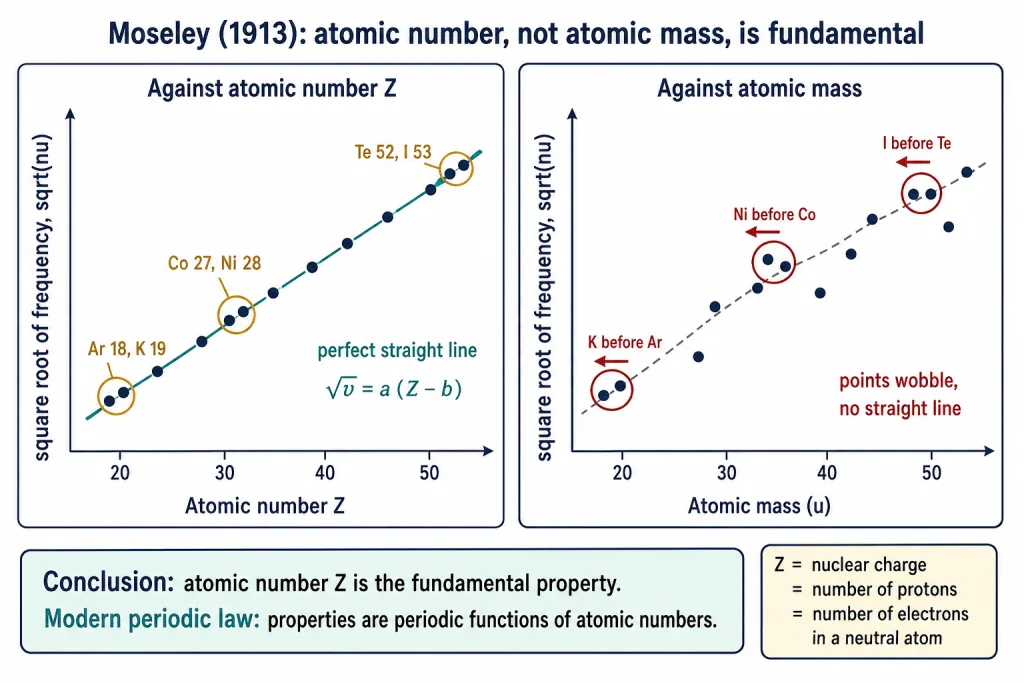
Key Point: Moseley (1913) showed that of the characteristic X-rays of an element varies linearly with its atomic number, not with its atomic mass. So the atomic number is a more fundamental property of an element than its atomic mass.
What Moseley's line really told us
Atomic mass depends on how many neutrons the atoms carry and on the natural isotope mixture. Atomic number is the charge on the nucleus — the proton count — and that is what holds the electrons and produces the X-rays. The straight line said that the quantity changing by exactly one unit from element to element is . Atomic mass only grows roughly with , which is why Mendeleev's mass-ordering worked as well as it did.
The plot also settled the pairs Mendeleev had swapped by hand:
| Pair | Atomic masses (u) | Order by mass | Order by | |
|---|---|---|---|---|
| Ar, K | 39.95, 39.10 | K before Ar | 18, 19 | Ar before K |
| Co, Ni | 58.93, 58.69 | Ni before Co | 27, 28 | Co before Ni |
| Te, I | 127.60, 126.90 | I before Te | 52, 53 | Te before I |
Every "wrong-way" pair is in the right order once is used. The chemistry was never wrong; the mass was the wrong label.
[Board] For "What was Moseley's contribution to the periodic table?" say three things — (i) he plotted of characteristic X-rays against and got a straight line, (ii) no such line appears against atomic mass, (iii) so atomic number, not atomic mass, is the fundamental property, which turned Mendeleev's law into the modern periodic law. The plot is of , not of and not of wavelength.
The Modern Periodic Law
Once atomic number replaced atomic mass, Mendeleev's law needed only a one-word repair.
Key Point (Definition): Modern Periodic Law: The physical and chemical properties of the elements are periodic functions of their atomic numbers.
Mendeleev's version said "periodic function of their atomic weights". Same structure, one variable changed. Learn the modern wording exactly.
Why atomic number is the right variable
The atomic number equals the nuclear charge (the proton count) and, in a neutral atom, the number of electrons. Electrons do the chemistry, so ordering by orders by how many electrons the atom has to arrange, and it is that arrangement in shells and subshells which repeats.
Sodium behaves like lithium because both end in , not because their masses are related. Chlorine behaves like fluorine because both end in . As climbs, the outer configuration cycles through and starts again, and properties cycle with it.
Key Point: The periodic law is essentially a consequence of the periodic variation in electronic configurations of the elements. Electronic configuration determines both the physical and the chemical properties of an element and its compounds.
Every trend later in the chapter — size, ionization enthalpy, electronegativity, valence — comes back to the electron arrangement, and that comes back to .
94 natural elements, and the rest are made
The periodic law revealed important analogies among the 94 naturally occurring elements. The count is 94 rather than 92 because two elements beyond uranium — neptunium (Np, Z = 93) and plutonium (Pu, Z = 94) — occur in tiny traces in pitchblende, an ore of uranium, alongside actinium and protactinium. Everything beyond plutonium is artificial, made a few atoms at a time in accelerators and reactors.
| Category | Elements | Note |
|---|---|---|
| Naturally occurring | to (H to Pu) | Np and Pu occur in pitchblende in trace amounts |
| Artificially produced | onwards | Short-lived, made in laboratories |
| Discovered and named so far | up to (Og) | All official names announced by IUPAC |
The law stimulated renewed interest in inorganic chemistry, and the search for new elements continues — which is why a naming system for elements beyond 100 became necessary.
Mendeleev's law versus the modern law
| Aspect | Mendeleev's periodic law (1869) | Modern periodic law (after 1913) |
|---|---|---|
| Basis of arrangement | Atomic weight (mass) | Atomic number |
| Statement | Properties are a periodic function of atomic weights | Properties are periodic functions of atomic numbers |
| Position of Ar/K, Co/Ni, Te/I | Anomalous — had to be swapped by hand | Natural — correct by |
| Isotopes | Would need separate places (different masses) | Same , same place |
| Underlying reason | Unknown at the time | Periodic repetition of electronic configuration |
[NEET] For "the basic difference between Mendeleev's law and the modern periodic law": Mendeleev used atomic mass; the modern law uses atomic number, which is more fundamental because it equals the nuclear charge and fixes the electronic configuration.
The Long Form of the Periodic Table: Periods and Groups
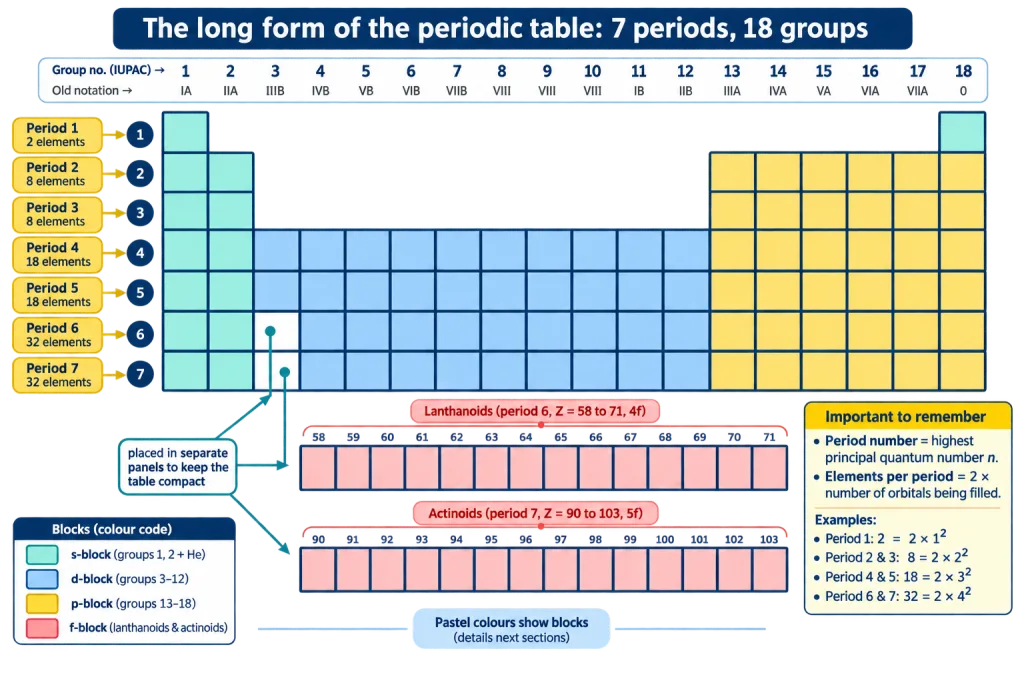
Many shapes of periodic table have been drawn — spirals, cylinders, tables built around valence or around configuration. The one used everywhere today is the long form, and it is the most convenient because an element's electronic configuration can be read straight off its position.
Periods — the horizontal rows
The horizontal rows are periods; Mendeleev called them series. Across a period the atomic number rises by one at each step and one more electron is added to the same outer shell.
Key Point (Definition): A period is a horizontal row of the periodic table. There are seven periods, and the period number equals the highest principal quantum number of the elements in that period.
Sodium (, highest ) is in period 3. Krypton (, highest ) is in period 4 even though its 3d subshell is being filled.
Groups — the vertical columns
The vertical columns are groups, and a group is often called a family — the alkali metals, the halogens, the noble gases. Elements share a column because they have similar outer electronic configurations, which is why their chemistry is similar.
Key Point (Definition): A group or family is a vertical column of the periodic table. Its members have the same number and same distribution of electrons in their outermost orbitals, and so show similar chemical properties.
Eighteen groups, numbered 1 to 18
The old labels used Roman numerals with letters: IA, IIA, IIIB, IVB … VIIB, then VIII (a triple column), then IB, IIB, IIIA … VIIA, and 0 for the noble gases. American and European books disagreed on which columns were "A" and which "B". In 1984 the International Union of Pure and Applied Chemistry (IUPAC) recommended numbering the groups 1 to 18 from left to right.
| IUPAC group | Old notation | Family / block | Outer configuration |
|---|---|---|---|
| 1 | IA | Alkali metals (s-block) | |
| 2 | IIA | Alkaline earth metals (s-block) | |
| 3 | IIIB | Sc family (d-block) | |
| 4 | IVB | Ti family | |
| 5 | VB | V family | |
| 6 | VIB | Cr family | (Cr) |
| 7 | VIIB | Mn family | |
| 8, 9, 10 | VIII (one triple group) | Fe, Co, Ni families | |
| 11 | IB | Coinage metals (Cu, Ag, Au) | |
| 12 | IIB | Zn, Cd, Hg | |
| 13 | IIIA | Boron family (p-block) | |
| 14 | IVA | Carbon family | |
| 15 | VA | Nitrogen family (pnictogens) | |
| 16 | VIA | Oxygen family (chalcogens) | |
| 17 | VIIA | Halogens | |
| 18 | 0 | Noble gases | (He: ) |
Two conversion tricks:
- For A groups on the right (IIIA to VIIA), add 10: IIIA 13, VA 15, VIIA 17.
- For B groups in the middle, IIIB to VIIB are groups 3 to 7 directly; the old VIII is three groups (8, 9, 10); IB and IIB are 11 and 12.
[Board] Old notation still appears in older question banks: "the element of group VIA and period 3" means group 16, period 3 — sulphur. Convert first, then answer.
Reading position from configuration and back
Because the layout follows electronic configuration, both directions are routine:
- Configuration to position. Highest gives the period; the last subshell being filled gives the block; the outer-shell electrons give the group.
- Position to configuration. Period gives ; group tells you how many electrons sit in the outer and (or ) subshells.
The block-by-block rules come next. For now, keep the map of eighteen columns and seven rows in mind.
Seven Periods: 2, 8, 8, 18, 18, 32 — and Two Panels at the Bottom
Counting the elements in each row of the long form gives a rhythm worth reciting:
| Period | Highest | Number of elements | From … to | Orbitals being filled |
|---|---|---|---|---|
| 1 | 1 | 2 | H (1) to He (2) | |
| 2 | 2 | 8 | Li (3) to Ne (10) | |
| 3 | 3 | 8 | Na (11) to Ar (18) | |
| 4 | 4 | 18 | K (19) to Kr (36) | |
| 5 | 5 | 18 | Rb (37) to Xe (54) | |
| 6 | 6 | 32 | Cs (55) to Rn (86) | |
| 7 | 7 | 32 (theoretical maximum) | Fr (87) to Og (118) |
The numbers 2, 8, 8, 18, 18, 32 are not random. Each is twice the number of orbitals available in the energy level being filled: (one 1s orbital); (one + three ); (one + five + three ); (one + seven + five + three ). Period lengths are a direct consequence of the quantum numbers.
The seventh period was long described as incomplete because the heaviest elements were still being made and confirmed. From the quantum numbers its theoretical maximum matches the sixth — 32 elements — ending at , a noble gas. Elements up to 118 have now all been discovered and named, so the row is filled to its 32; the exam answer stays "the seventh period has a theoretical maximum of 32 elements, like the sixth."
Key Point: The period number is the highest principal quantum number of the elements in that period. Periods 1 to 7 contain 2, 8, 8, 18, 18, 32 and (theoretically) 32 elements respectively.
The two panels at the bottom: lanthanoids and actinoids
All 32 elements of period 6 in one row would make the table 32 columns wide. To keep it compact, 14 elements of the sixth period (the lanthanoids, cerium to lutetium, to , filling the orbitals) and 14 elements of the seventh period (the actinoids, thorium to lawrencium, to , filling ) are lifted out into two separate panels at the bottom. Their true place is in periods 6 and 7 between groups 3 and 4; the panels are a printing convenience.
That is why period 6 looks like 18 elements in the main body: .
Seaborg and the shape of the modern table
The actinoid panel exists because of one chemist. Glenn T. Seaborg discovered plutonium in 1940 and then all the transuranium elements from 94 to 102. He saw that these form a second -series parallel to the lanthanoids, and proposed re-drawing the table with the actinoids placed below the lanthanoids — the layout used now. He received the Nobel Prize in Chemistry in 1951, and element 106 is named seaborgium (Sg) in his honour, one of the very few elements named after a living person.
| Seaborg fact | Detail |
|---|---|
| First discovery | Plutonium (Pu, ), 1940 |
| Elements discovered | Transuranium elements 94 to 102 |
| Contribution to the table | Actinoid concept; actinoids placed below lanthanoids |
| Nobel Prize | Chemistry, 1951 |
| Element named after him | Seaborgium, Sg, |
[NEET] Seaborgium, , Sg, is the element named after Seaborg, who discovered plutonium in 1940. Do not confuse a lanthanoid or actinoid's period with the panel it is printed in: cerium () is period 6, thorium () is period 7.
Naming Elements Beyond 100: Why IUPAC Needed a Rule
Traditionally the discoverer of an element earned the right to name it, and IUPAC ratified the name. That worked while discoveries were clear-cut. It broke down with superheavy elements.
The problem
Elements with very high atomic numbers are so unstable that only minute quantities — sometimes only a few atoms — are ever made. Making and identifying them needs hugely expensive equipment, and only a handful of competing laboratories can do it. Before reliable data were in, teams were tempted to claim a discovery.
The classic case is element 104. American scientists claimed it as rutherfordium; Soviet scientists claimed it as kurchatovium. Two names, one element, years of argument.
IUPAC's solution: a name you can compute
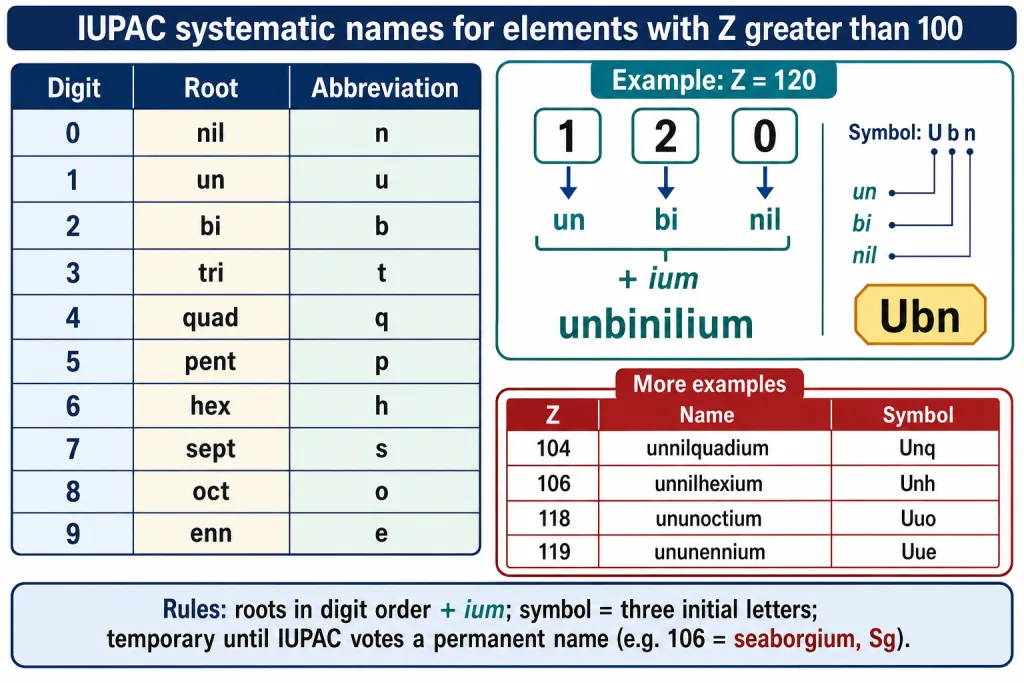
IUPAC recommended that until a new element's discovery is proved and its name officially recognised, it carries a systematic, temporary name derived from its atomic number. One root stands for each digit:
| Digit | Root | Abbreviation |
|---|---|---|
| 0 | nil | n |
| 1 | un | u |
| 2 | bi | b |
| 3 | tri | t |
| 4 | quad | q |
| 5 | pent | p |
| 6 | hex | h |
| 7 | sept | s |
| 8 | oct | o |
| 9 | enn | e |
Key Point (Rule): Write the digits of the atomic number in order, replace each by its root, join them, and add "ium" at the end. The symbol is the three letters formed by the first letter of each root.
The rule in action
For : digits 1, 2, 0 give roots un, bi, nil, so the name is un-bi-nil-ium = unbinilium, symbol Ubn.
A few more:
| Digits | Roots | Systematic name | Symbol | |
|---|---|---|---|---|
| 104 | 1, 0, 4 | un, nil, quad | unnilquadium | Unq |
| 109 | 1, 0, 9 | un, nil, enn | unnilennium | Une |
| 110 | 1, 1, 0 | un, un, nil | ununnilium | Uun |
| 119 | 1, 1, 9 | un, un, enn | ununennium | Uue |
| 120 | 1, 2, 0 | un, bi, nil | unbinilium | Ubn |
| 121 | 1, 2, 1 | un, bi, un | unbiunium | Ubu |
Two spelling conventions: when the roots bi or tri are followed by "ium", one i is dropped (112 is ununbium, not ununbiium), and the double n where un meets nil is kept (unnilquadium, unnilennium). Symbols never change — always the three initial letters.
The symbol is three letters, and that matters
Ordinary elements have one- or two-letter symbols, so a three-letter symbol (Unq, Uue, Ubn) marks a temporary IUPAC systematic name. Once the discovery is confirmed, IUPAC representatives from each country vote on a permanent name and a conventional one- or two-letter symbol. A permanent name may honour the country or state of discovery (americium, berkelium, moscovium, tennessine, nihonium) or a scientist (mendelevium, nobelium, lawrencium, rutherfordium, seaborgium, bohrium, meitnerium, roentgenium, copernicium, oganesson).
[Board] "IUPAC name of the element with " almost always wants the systematic name, even for elements like 104 that now have official names. Write unnilquadium (Unq) for "IUPAC nomenclature" and rutherfordium only if the question says "official" or "permanent" name. Decoding is asked as often as encoding: "Uus" gives 1, 1, 7, so ; "Ubh" gives 1, 2, 6, so .
The Named Elements from 101 to 118
Every element from 101 to 118 now has an official name and a conventional symbol. The systematic names still matter because questions ask for both, and because the digit roots are tested through them.
| Systematic IUPAC name | Symbol | Official IUPAC name | Symbol | Named after | |
|---|---|---|---|---|---|
| 101 | Unnilunium | Unu | Mendelevium | Md | Dmitri Mendeleev |
| 102 | Unnilbium | Unb | Nobelium | No | Alfred Nobel |
| 103 | Unniltrium | Unt | Lawrencium | Lr | Ernest Lawrence (Berkeley laboratory) |
| 104 | Unnilquadium | Unq | Rutherfordium | Rf | Ernest Rutherford |
| 105 | Unnilpentium | Unp | Dubnium | Db | Dubna, Russia |
| 106 | Unnilhexium | Unh | Seaborgium | Sg | Glenn T. Seaborg |
| 107 | Unnilseptium | Uns | Bohrium | Bh | Niels Bohr |
| 108 | Unniloctium | Uno | Hassium | Hs | Hesse (German state) |
| 109 | Unnilennium | Une | Meitnerium | Mt | Lise Meitner |
| 110 | Ununnilium | Uun | Darmstadtium | Ds | Darmstadt, Germany |
| 111 | Unununium | Uuu | Roentgenium (Rontgenium) | Rg | Wilhelm Roentgen |
| 112 | Ununbium | Uub | Copernicium | Cn | Nicolaus Copernicus |
| 113 | Ununtrium | Uut | Nihonium | Nh | Nihon (Japan) |
| 114 | Ununquadium | Uuq | Flerovium | Fl | Flerov Laboratory, Dubna |
| 115 | Ununpentium | Uup | Moscovium | Mc | Moscow region |
| 116 | Ununhexium | Uuh | Livermorium | Lv | Livermore laboratory, USA |
| 117 | Ununseptium | Uus | Tennessine | Ts | Tennessee, USA |
| 118 | Ununoctium | Uuo | Oganesson | Og | Yuri Oganessian |
Patterns that make the table easier to use:
- 101 to 109 all begin with unnil- (digits 1, 0) and their symbols with Un-. Only the third root changes: unium, bium, trium, quadium, pentium, hexium, septium, octium, ennium.
- 110 to 118 all begin with unun- (digits 1, 1) and their symbols with Uu-.
- 119 continues the unun- series (ununennium, Uue), and 120 starts the unbi- series (unbinilium, Ubn).
- 118, oganesson, is the noble gas closing period 7; 117, tennessine, sits under astatine among the halogens.
- Names ending in -ine (tennessine) and -on (oganesson) follow the halogen and noble-gas habits; every other new element ends in -ium.
Key Point: Elements with atomic numbers up to 118 have been discovered, and IUPAC has announced official names for all of them. The systematic un-nil-/un-un- names remain the correct answer whenever a question asks for the "IUPAC nomenclature" of an element above 100.
The three questions this table is used for
- Name from : 106 gives un-nil-hex-ium, unnilhexium, Unh (official: seaborgium, Sg).
- from name or symbol: "Uuo" gives 1, 1, 8, so , oganesson.
- Position from : 118 is the last element of period 7 (group 18); counting back, 117 is group 17, 116 group 16, 114 group 14, 113 group 13, and 112 is group 12 (the last d-block element of period 7).
[NEET] Three "named after whom" favourites: mendelevium (Mendeleev), seaborgium (Seaborg), meitnerium (Lise Meitner). A systematic nomenclature above 100 was needed because superheavy elements are made in minute amounts and identified with difficulty, and rival laboratories claimed the same discovery (rutherfordium versus kurchatovium for 104), so IUPAC gave a temporary name computed from until a permanent name is voted.
Solved Examples
Question 1: IUPAC name and symbol for Z = 120
What would be the IUPAC name and symbol for the element with atomic number 120?
Answer:
I split the atomic number into digits: 120 gives 1, 2, 0. Each digit has a root: 1 is un, 2 is bi, 0 is nil.
Joining them and adding "ium" gives un + bi + nil + ium = unbinilium. The symbol is the first letter of each root, u, b, n, written as Ubn — three letters, capital first.
Ans: Unbinilium, symbol Ubn.
Question 2: Three more systematic names
Write the IUPAC systematic name and symbol for the elements with atomic numbers (a) 119, (b) 125, (c) 130.
Answer:
(a) 119 gives digits 1, 1, 9, so the roots are un, un, enn: un-un-enn-ium = ununennium, initials u, u, e, symbol Uue.
(b) 125 gives 1, 2, 5, roots un, bi, pent: un-bi-pent-ium = unbipentium, symbol Ubp.
(c) 130 gives 1, 3, 0, roots un, tri, nil: un-tri-nil-ium = untrinilium, symbol Utn.
I check each one: the name ends in "ium", the symbol has exactly three letters, and the letters follow the digits in order.
Ans: (a) Ununennium, Uue; (b) Unbipentium, Ubp; (c) Untrinilium, Utn.
Watch out: The first two digits fix the start of the name — 11x gives unun-, 12x gives unbi-, 13x gives untri-. Only the last root changes within a decade.
Question 3: Systematic versus official name for Z = 111
For the element with atomic number 111, give (a) its IUPAC systematic name and three-letter symbol, and (b) its official name and symbol. Which one would you write if a question simply asks for "the IUPAC nomenclature"?
Answer:
(a) The digits are 1, 1, 1, so the roots are un, un, un: unununium, symbol Uuu.
(b) Element 111 was confirmed and named roentgenium (spelt rontgenium in some books), symbol Rg, after Wilhelm Roentgen, who discovered X-rays.
"IUPAC nomenclature" means the digit-root name, so I write unununium, Uuu. Roentgenium goes in only when the question says "official" or "permanent" name.
Ans: (a) Unununium, Uuu; (b) Roentgenium, Rg. For "IUPAC nomenclature" write unununium (Uuu).
Watch out: Every element from 101 to 118 has two correct names; read the question to see which one it wants.
Question 4: Decode the symbols Unh and Uue
What are the atomic numbers of the elements with the temporary symbols (a) Unh and (b) Uue? Name each element systematically and, where one exists, give its official name.
Answer:
I read each letter back as a root: u = un = 1, n = nil = 0, h = hex = 6, e = enn = 9.
(a) Unh gives 1, 0, 6, so . The systematic name is unnilhexium; the official name is seaborgium, Sg, after Glenn Seaborg.
(b) Uue gives 1, 1, 9, so . The systematic name is ununennium. Element 119 has not been discovered, so it has no official name yet.
As a check, 106 lies inside the named range 101 to 118 and 119 lies beyond it, which fits.
Ans: (a) Unh: , unnilhexium, officially seaborgium (Sg). (b) Uue: , ununennium, no official name.
Watch out: The tricky letters when decoding are n = nil = 0, e = enn = 9, s = sept = 7 and p = pent = 5.
Question 5: Where do Lawrencium and Seaborgium come from?
Which element do you think would have been named by (a) the Lawrence Berkeley Laboratory, and (b) Seaborg's group? Give the atomic numbers and systematic names too.
Answer:
A permanent name may honour a scientist, a place, or the laboratory that made the discovery.
(a) The Lawrence Berkeley Laboratory is named after Ernest Lawrence and sits in Berkeley, California. Two elements carry those names: lawrencium (Lr, ) and berkelium (Bk, ). The systematic name of 103 is un-nil-tri-ium, unniltrium, Unt.
(b) Seaborg's team discovered plutonium (1940) and the transuranium elements 94 to 102, and element 106, seaborgium (Sg), is named in his honour. Its systematic name is un-nil-hex-ium, unnilhexium, Unh.
Seaborg's group also named americium (95), curium (96), berkelium (97) and californium (98), but the element carrying his name is 106.
Ans: (a) Lawrencium (, unniltrium, Unt) and also berkelium (); (b) Seaborgium (, unnilhexium, Unh).
Question 6: How many elements in each period, and why?
State the number of elements in each of the seven periods of the long form of the periodic table, and explain in one line why the numbers are what they are.
Answer:
The counts are 2, 8, 8, 18, 18, 32 and (theoretical maximum) 32 for periods 1 to 7.
Period 1 fills only the orbital: one orbital, two electrons, two elements (H and He). Periods 2 and 3 fill and : orbitals, eight electrons, eight elements each. Periods 4 and 5 fill , and : orbitals, eighteen electrons. Periods 6 and 7 fill , , and : orbitals, thirty-two electrons.
So the number of elements in a period is twice the number of orbitals available in the energy level being filled, because each orbital holds two electrons.
As a check, , exactly the number of elements known.
Ans: 2, 8, 8, 18, 18, 32, 32 (the last a theoretical maximum). Each equals twice the number of orbitals being filled in that period.
Question 7: Period and group from Z = 114
Predict the period, group and name of the element with atomic number 114. Is it a metal or non-metal? What is its systematic name?
Answer:
The noble gases close the periods at . Since , element 114 is in period 7.
Period 7 ends at 118 in group 18. Counting back, , so the group is . Element 114 sits in group 14, right under lead.
The configuration confirms this: the ending means group 14, period 7.
Its official name is flerovium (Fl); the systematic name is un-un-quad-ium, ununquadium (Uuq).
Down group 14 the elements turn metallic (C non-metal, Si and Ge metalloids, Sn and Pb metals), so element 114 is expected to be a metal.
Ans: Period 7, group 14; flerovium (Fl), systematically ununquadium (Uuq); expected to be a metal.
Watch out: For any between 87 and 118 the period is 7, and once you are in the p-block () the group is .
Question 8: Z from period and group — period 3, group 17
Which element is in period 3, group 17? Write its atomic number and outer configuration, and explain your reasoning.
Answer:
Period 3 runs from sodium () to argon () — eight elements filling and .
Group 17 is one column short of group 18. Argon is group 18 at , so group 17 in the same period is .
That is chlorine, a halogen. Its configuration is : highest gives period 3, and electrons in and give group .
Ans: Chlorine, , .
Watch out: For p-block elements, group number (number of outer and electrons). Work from the nearest noble gas when converting between position and .
Question 9: Period and group for Z = 37, 56 and 87
Give the period and group of the elements with atomic numbers 37, 56 and 87, and name the family each belongs to.
Answer:
I use the noble-gas markers 2 (He), 10 (Ne), 18 (Ar), 36 (Kr), 54 (Xe), 86 (Rn), 118 (Og). Each new period begins one past a noble gas.
is one past krypton (36), so it is the first element of period 5, group 1 — rubidium, an alkali metal, .
is two past xenon (54), so it is the second element of period 6, group 2 — barium, an alkaline earth metal, .
is one past radon (86), so it is the first element of period 7, group 1 — francium, an alkali metal, .
Ans: 37: period 5, group 1 (alkali metal, Rb). 56: period 6, group 2 (alkaline earth metal, Ba). 87: period 7, group 1 (alkali metal, Fr).
Watch out: One past a noble gas is always group 1, two past is always group 2. The seven noble-gas atomic numbers unlock every position question.
Question 10: Why Moseley's discovery mattered for the swapped pairs
Mendeleev had to place argon before potassium, cobalt before nickel and tellurium before iodine even though in each pair the first element is heavier. Explain how Moseley's work removed these anomalies.
Answer:
Mendeleev's law ordered elements by atomic mass. By mass, K (39.10) should come before Ar (39.95), Ni (58.69) before Co (58.93) and I (126.90) before Te (127.60). But chemically K belongs with the alkali metals and Ar with the noble gases, so he swapped them, breaking his own rule to keep the chemistry right.
In 1913 Moseley found that of an element's characteristic X-rays gives a straight line against atomic number , while the plot against atomic mass does not. So is the fundamental property.
Checking the pairs by : Ar is 18 and K is 19; Co is 27 and Ni is 28; Te is 52 and I is 53. In every pair Mendeleev's "wrong-way" order is exactly the order of increasing atomic number.
The anomalies were never anomalies of chemistry — they came from using the wrong variable. Replacing atomic mass by atomic number in the law puts all three pairs in place with no hand-swapping.
Ans: Moseley showed atomic number, not atomic mass, is fundamental; ordered by (Ar 18 < K 19, Co 27 < Ni 28, Te 52 < I 53), the three pairs fall in natural order and the anomalies vanish.
Question 11: Converting old group labels to IUPAC numbers
Convert the following old group labels into IUPAC group numbers and name one element from each: (a) IIA, (b) VIIA, (c) VIII, (d) IB, (e) 0, (f) IVB.
Answer:
For the A groups: IA and IIA are groups 1 and 2; IIIA to VIIA sit on the right of the table, so add 10.
For the B groups: IIIB to VIIB are groups 3 to 7 directly; VIII covers three columns (8, 9, 10); IB and IIB are 11 and 12.
(a) IIA is group 2 — magnesium. (b) VIIA is group 17 — chlorine. (c) VIII is groups 8, 9 and 10 — iron (8), cobalt (9), nickel (10). (d) IB is group 11 — copper. (e) 0 is group 18 — argon. (f) IVB is group 4 — titanium.
Ans: (a) 2, Mg; (b) 17, Cl; (c) 8-10, Fe/Co/Ni; (d) 11, Cu; (e) 18, Ar; (f) 4, Ti.
Watch out: Left-side A groups (IA, IIA) stay 1 and 2; right-side A groups add 10. B groups run 3 to 7, VIII is 8-10, IB and IIB are 11 and 12, and 0 is 18.
Question 12: Mendeleev's law versus the modern law, and the count of natural elements
(a) What is the basic difference in approach between Mendeleev's periodic law and the modern periodic law? (b) Why do we say there are 94 naturally occurring elements rather than 92?
Answer:
(a) Mendeleev arranged elements in order of increasing atomic weight and let similar properties fall into columns. Where the weights disagreed with the chemistry, he trusted the chemistry and swapped elements or left gaps.
The modern law arranges elements in order of increasing atomic number. Since equals the nuclear charge and the number of electrons, it fixes the electronic configuration, and the periodic repetition of configurations is the real reason properties repeat. Nothing needs swapping. In one line: the basis changed from atomic mass, which depends on the isotope mixture, to atomic number, the proton count, which never changes for an element.
(b) Uranium () is the heaviest element found in bulk in nature. But neptunium (93) and plutonium (94) also occur in tiny traces in pitchblende, the uranium ore, alongside actinium and protactinium. Counting them gives 94 naturally occurring elements. Everything from 95 upwards is artificial.
Ans: (a) Mendeleev used atomic mass; the modern law uses atomic number, which is fundamental because it determines electronic configuration. (b) Neptunium and plutonium occur naturally in pitchblende, taking the count from 92 to 94.