
The Part of Periodicity Your Textbook Left Out
Sections 1 to 8 cover what the Board paper asks. JEE Main asks something else: the effective nuclear charge felt by a 3d electron in zinc, which element has successive ionization enthalpies of 578, 1817, 2745 and 11577 kJ/mol, why the second electron gain enthalpy of oxygen is kJ/mol when the first is , why hafnium is the same size as zirconium, and above all arrange the following in increasing order of radius, ionization enthalpy, electron gain enthalpy, electronegativity, metallic character, oxidizing power, basicity of oxides.
This section builds that toolkit: Slater's rules, the three kinds of radius and the ionic-radius rules, successive ionization enthalpies as a code that identifies an element, the sign conventions of electron affinity and electron gain enthalpy, the Pauling, Mulliken and Allred-Rochow scales with one worked conversion each, and a map of oxides and hydroxides. The last two blocks are the ordering-question bank and the trap list.
What "beyond the textbook" means here
| Textbook gives you | JEE Main also wants | JEE Advanced adds |
|---|---|---|
| "inner electrons shield the outer ones" | , why rises by about 0.65 per element across a period | Slater's rules with actual numbers |
| covalent and metallic radius | van der Waals radius, why noble gases look big, the three-radius inequality | radius-ratio rules, lanthanoid contraction pairs |
| reading a successive-IE table to find the group and the stable valence | d-block and inert-pair irregularities in IE | |
| of F, Cl, O, S | electron affinity sign convention, second electron gain enthalpy of O and S | the correction |
| Pauling scale values | Mulliken and its conversion to Pauling units | Allred-Rochow, hybridisation and oxidation-state dependence, percent ionic character |
| basic, amphoteric, acidic oxides | the electronegativity rule and the oxidation-state rule for oxide character | hydride and hydroxide acid-base orders |
Every rule here is stated once, boxed, illustrated with real numbers, then used in the worked questions.
Key Point: Almost every periodic trend is a fight between two quantities: the effective nuclear charge pulling the outer electron in, and the principal quantum number of that electron pushing it out. Across a period wins; down a group wins. The anomalies (Be/B, N/O, O/S, F/Cl, Ga/Al, Tl/In) are the places where a third effect — subshell type, electron pairing, poor d or f shielding — tips the balance. If you can name which of the three is operating, you can answer the question.
Screening, Effective Nuclear Charge and Slater's Rules
Why the outer electron does not feel the whole nucleus
An electron in a sodium atom is attracted by a nucleus of charge but repelled by the other ten electrons, which sit between it and the nucleus most of the time. They screen or shield it, and the effect is bundled into the shielding constant :
is the charge the electron behaves as if it sees, and it sets the radius, the ionization enthalpy and the electronegativity. Three qualitative facts come first:
- Electrons in the same shell shield each other poorly, being at roughly the same distance from the nucleus. Across a period each added proton is only partly cancelled by the added electron, so rises — by about 0.65 per element on Slater's recipe.
- Electrons in inner shells shield well. Down a group a whole inner shell is added, and the felt by the outermost electron stays nearly constant (Na 3s and K 4s both feel 2.20). What changes down a group is , and hence the size.
- Penetration order : an s electron spends more time close to the nucleus than a p electron of the same shell, so it is shielded less and held more tightly. Hence 2s lies below 2p, B has a lower ionization enthalpy than Be, and d and f electrons are poor shields for the electrons outside them.
Slater's rules — the recipe
Slater (1930) estimated like this. Step 1: write the configuration in these groups, in this order:
and are lumped together; and stand alone. Step 2: pick the electron you care about and add up the contributions of every other electron:
| Electron of interest | Other electrons in the same group | Electrons in shell | Electrons in shell or lower |
|---|---|---|---|
| or | 0.35 each (0.30 if the group is ) | 0.85 each | 1.00 each |
| or | 0.35 each | 1.00 each (all groups to the left) | 1.00 each |
Electrons in groups to the right of the chosen electron contribute nothing. The d/f row says a d or f electron is buried so deep that everything inside it shields fully.
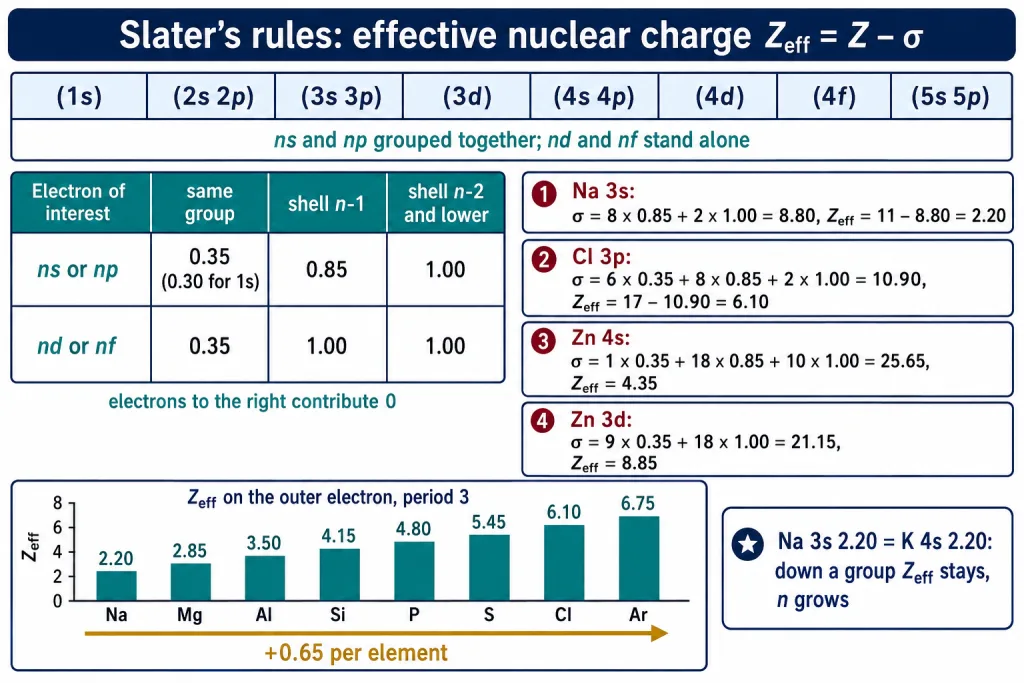
Four worked values
Sodium, 3s electron (): . Same group: none. Shell 2: 8 at 0.85 . Shell 1: 2 at 1.00 .
Chlorine, 3p electron (): . Same group: 6 others at 0.35 . Shell 2: . Shell 1: .
Zinc, 4s electron (): . Same group: 1 other at 0.35. Shell 3 (, and — 18 electrons) at 0.85 . Shells 1 and 2: 10 at 1.00.
Zinc, 3d electron: same group, 9 others at 0.35 ; everything to the left (, , : 18 electrons) at 1.00; the two 4s electrons are to the right and count zero.
A 3d electron in zinc feels twice the nuclear charge a 4s electron feels — the quantitative reason the 4s electrons are ionised first from every 3d metal, even though 4s fills before 3d.
The period-2 and period-3 tables you should be able to regenerate
For a (or ) electron, , so each step across the period adds one proton and 0.35 of shielding — a net gain of 0.65 in .
| Element | Li | Be | B | C | N | O | F | Ne |
|---|---|---|---|---|---|---|---|---|
| (outer electron) | 1.30 | 1.95 | 2.60 | 3.25 | 3.90 | 4.55 | 5.20 | 5.85 |
| Element | Na | Mg | Al | Si | P | S | Cl | Ar |
|---|---|---|---|---|---|---|---|---|
| (outer electron) | 2.20 | 2.85 | 3.50 | 4.15 | 4.80 | 5.45 | 6.10 | 6.75 |
Down group 1: Li 1.30, Na 2.20, K 2.20 (for K, , so ). The near-constancy from Na onward is the point.
How explains the trends
| Trend | In terms of and |
|---|---|
| Radius falls across a period | same , up by 0.65 per step: the cloud is pulled in |
| Radius rises down a group | roughly constant, up by one: a new, bigger shell |
| Ionization enthalpy rises across, falls down | roughly for the outer electron |
| Electronegativity rises across, falls down | Allred-Rochow: |
| Ga is not much bigger than Al, and has a slightly higher IE | ten 3d electrons shield at only 0.85 (for 4p) — Ga 4p feels 5.00 against Al 3p's 3.50 — the d-block contraction |
| Hf is the same size as Zr | fourteen 4f electrons shield 5d and 6s poorly — the lanthanoid contraction |
| Second-period anomaly Be/B | B's 2p electron is less penetrating than Be's 2s (Slater's numbers do not see this; penetration does) |
[JEE Main] Memorise the grouping, the triple 0.35 / 0.85 / 1.00, the 0.30 exception for 1s, and the "everything inside counts 1.00 for d and f" rule. Slater's rules are a model, not a law — they give the same for 2s and 2p, so they cannot explain the Be/B or N/O anomalies. For those, argue from penetration and pairing, not from Slater.
The Three Radii, the Ionic-Radius Rules and the Lanthanoid Contraction
Covalent, metallic and van der Waals radius — and their order
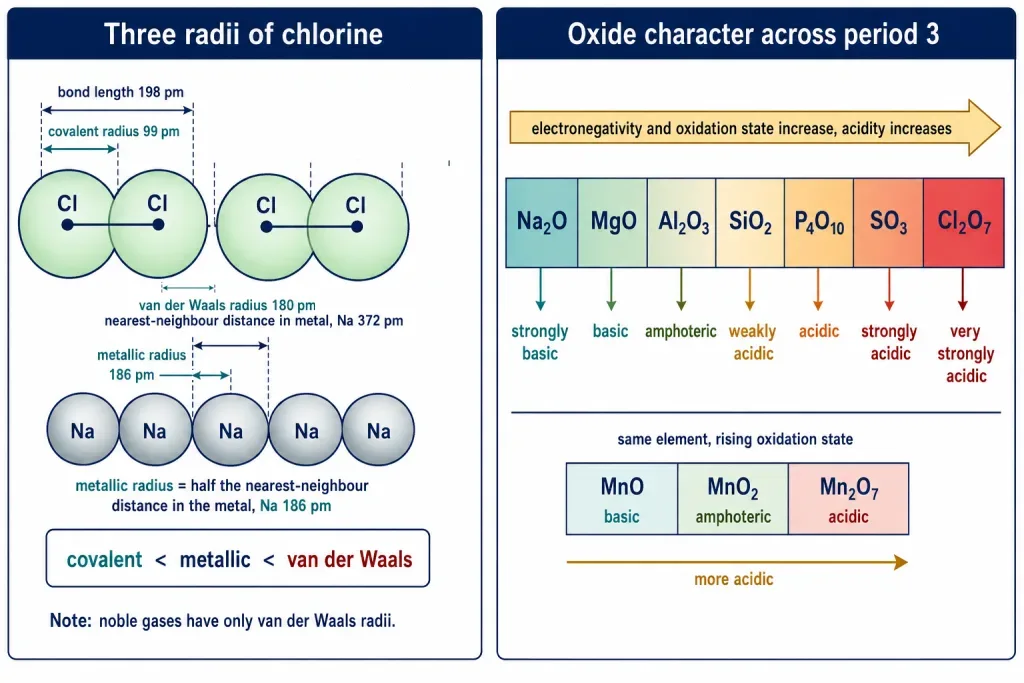
An atom has no edge, so "radius" always means half of some measured internuclear distance. There are three such distances.
| Radius | Half of… | Example | Typical for |
|---|---|---|---|
| Covalent radius | the bond length between two like atoms joined by a single covalent bond | in : 198 pm, so pm | non-metals |
| Metallic radius | the distance between adjacent nuclei in the metal crystal | 256 pm, so pm; Na 186 pm | metals |
| van der Waals radius | the closest distance between nuclei of two non-bonded atoms in neighbouring molecules (solid state) | Cl: 180 pm; Ne: about 160 pm; Ar: about 190 pm | noble gases, and the "size" of any atom that is not bonded |
The covalent radius is smallest because bonding pulls the nuclei together and the clouds overlap. The metallic radius is larger because metallic bonding is weaker and less directional (sodium: covalent about 154 pm, metallic 186 pm). The van der Waals radius is largest because there is no overlap at all. Chlorine's pair, 99 pm (covalent) and 180 pm (van der Waals), is worth remembering.
Key Point (Why noble gases "look big"): Noble gases do not form molecules, so no covalent radius can be measured for them; only the van der Waals radius is available. A table listing Ne at 160 pm next to F at 64 pm (covalent) compares a van der Waals radius with a covalent one. That is why noble gases appear to be the largest atoms of their period, and why a correct radius comparison across a period stops at the halogen. If a question forces the noble gas in, it is the largest — but say why.
Ionic radius: the rules
A cation is smaller than its atom (a whole shell is often gone, and the remaining electrons feel a higher ); an anion is larger (extra repulsion in the same shell, lower ). Na 186 pm to 95 pm; F 64 pm to 136 pm. Three rules cover every comparison JEE sets.
Rule 1 — Isoelectronic species: higher nuclear charge, smaller ion. (all ten-electron species). Same for the 18-electron set . Equivalently: in an isoelectronic series, size falls as (nuclear charge to electron number) rises.
Rule 2 — Same element, different charge: the more positive, the smaller. Each electron removed raises on those left behind. is extreme: a bare proton, about of the atom's radius, which is why it never exists free and is always attached to something (, ).
Rule 3 — Different elements, not isoelectronic: use group and period first, then charge. (down a group); (95) (72) (across, and more charge). Watch for diagonal near-equalities: (76) and (72) are almost the same size, one root of the Li/Mg diagonal relationship.
Radius ratio — what the ion sizes decide
The ratio decides how many anions fit round a cation in a crystal (its coordination number). This is Class 12 solid-state material, but JEE Advanced sometimes links it to periodicity, so keep the bands:
| Coordination number | Geometry | Example | |
|---|---|---|---|
| below 0.155 | 2 | linear | — |
| 0.155 to 0.225 | 3 | trigonal planar | |
| 0.225 to 0.414 | 4 | tetrahedral | ZnS |
| 0.414 to 0.732 | 6 | octahedral | NaCl |
| 0.732 to 1.0 | 8 | cubic | CsCl |
Down group 1 the cation grows, the ratio with rises, and the structure shifts from the NaCl type (6:6) to the CsCl type (8:8).
Lanthanoid contraction and the pairs that come out equal
Across the lanthanoids (Ce to Lu, to 71) electrons enter the deeply buried 4f subshell, which shields the outer electrons very poorly. Atomic and ionic size shrink steadily across fourteen elements: 103 pm down to 86 pm. This lanthanoid contraction almost exactly cancels the size increase expected from period 5 to period 6, so each 5d element is nearly the same size as the 4d element above it:
| 4d element | Radius | 5d element | Radius | Consequence |
|---|---|---|---|---|
| Zr | 160 pm | Hf | 159 pm | Zr and Hf occur together and are hard to separate |
| Nb | 146 pm | Ta | 146 pm | near-identical chemistry, similar ionization enthalpies |
| Mo | 139 pm | W | 139 pm | same |
| Ag | 144 pm | Au | 144 pm | but Au has much higher IE — relativistic effects add to the contraction |
Ti 147 to Zr 160 pm is a 13 pm jump; Zr to Hf is 1 pm. Two exam consequences: the 4d/5d pairs have similar radii, similar ionization enthalpies and very similar chemistry; and the 5d elements are much denser than the 4d ones (same volume, nearly double the mass — W 19.3 g/cm³ against Mo 10.2).
The same logic one row up is the d-block contraction (or scandide contraction): the ten 3d electrons before gallium shield the 4p electron poorly, so Ga (135 pm) is smaller than Al (143 pm) even with one more shell, and Ga's first ionization enthalpy (579 kJ/mol) is marginally higher than Al's (577). Similarly Ge is close to Si in size and As to P.
[JEE Main] Three radius facts come as one-liners: the van der Waals radius of chlorine (180 pm) against its covalent radius (99 pm); the isoelectronic order , , , (reverse order of ); and Zr Hf from the lanthanoid contraction.
Successive Ionization Enthalpies — Reading the Code
The general pattern
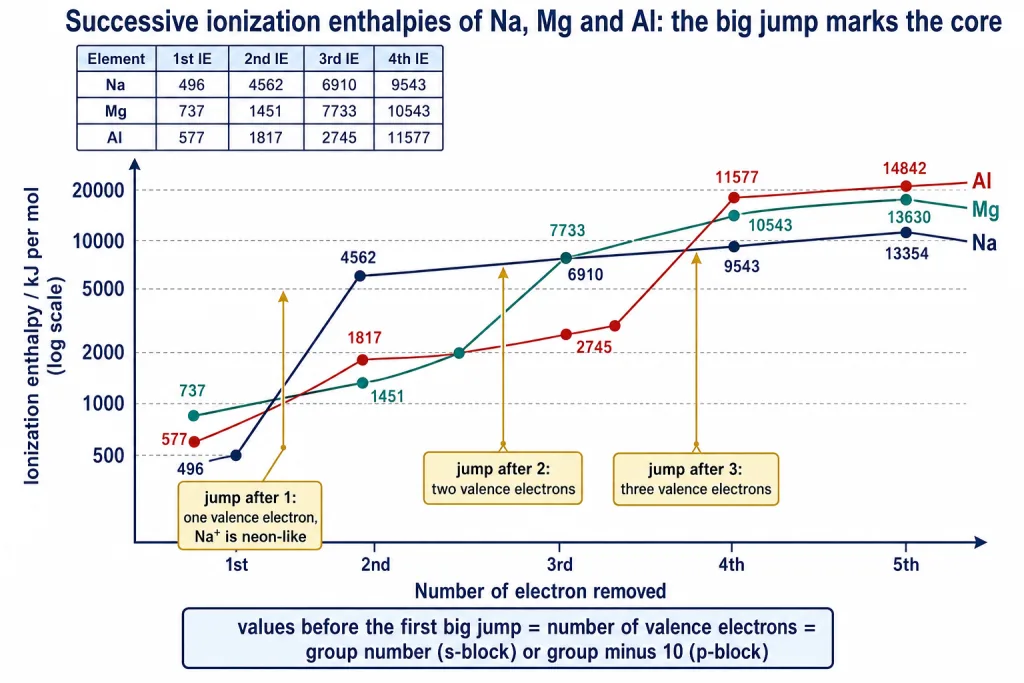
Each ionization is harder than the one before: the electron is pulled away from an ion of higher positive charge, and every electron that leaves raises on those left behind. The rise is not uniform. Within a shell it grows gently; when the next electron must come from an inner, noble-gas-like core, the value jumps by a factor of 3 to 6. Count the values before the jump and you have the number of valence electrons, hence the group and the stable valence.
Key Point: The number of "small" successive ionization enthalpies before the first big jump the number of valence electrons the group number (for s-block) or group number minus 10 (for p-block) the highest stable positive oxidation state.
The three elements JEE uses most (kJ/mol)
| Valence electrons | Reading | ||||||
|---|---|---|---|---|---|---|---|
| Na | 496 | 4562 | 6910 | 9543 | 13354 | 1 | jump after 1st (): is neon-like; NaCl not |
| Mg | 737 | 1451 | 7733 | 10543 | 13630 | 2 | jump after 2nd (): , never |
| Al | 577 | 1817 | 2745 | 11577 | 14842 | 3 | jump after 3rd (): ; is neon-like |
Bold numbers mark the first big jump. Compare the columns, not just the rows: runs Na (496) Al (577) Mg (737); runs Mg (1451) Al (1817) Na (4562); runs Al (2745) Na (6910) Mg (7733). Which element has the highest -th ionization enthalpy depends entirely on whether that electron is a valence or a core electron.
A few more rows for the identification game
| Element | Jump after | ||||||
|---|---|---|---|---|---|---|---|
| Li | 520 | 7298 | 11815 | 1st | |||
| Be | 899 | 1757 | 14849 | 21007 | 2nd | ||
| B | 801 | 2427 | 3660 | 25026 | 32827 | 3rd | |
| C | 1086 | 2353 | 4621 | 6223 | 37831 | 4th | |
| Si | 786 | 1577 | 3232 | 4356 | 16091 | 19805 | 4th |
| P | 1012 | 1903 | 2912 | 4957 | 6274 | 21269 | 5th |
| K | 419 | 3052 | 4420 | 1st | |||
| Ca | 590 | 1145 | 4912 | 6491 | 2nd |
How to read an unknown set. Say the values are 1012, 1903, 2912, 4957, 6274, 21269. Ratios of neighbours: 1.9, 1.5, 1.7, 1.3, 3.4. The only big ratio is between the 5th and 6th values, so 5 valence electrons: group 15, , stable oxidation states and , chloride (or ). The slightly larger step from the 3rd to the 4th value (2912 to 4957, ratio 1.7) is the 4th electron coming from the pair — a sub-jump inside the valence shell. Sub-jumps of about 1.5 to 2 mark the s/p boundary; jumps of 3 to 9 mark the core.
The irregularities JEE builds questions on
1. Group 13: Ga Al, Tl In. First ionization enthalpies: B 801, Al 577, Ga 579, In 558, Tl 589 kJ/mol. The expected steady fall breaks twice. Ga's ten 3d electrons shield its 4p electron poorly (d-block contraction), so on that electron is high and the value does not fall below Al's. Tl sits after the 4f and 5d series: fourteen 4f plus ten 5d electrons shield poorly (lanthanoid contraction), and relativistic contraction of the 6s orbital tightens it further. The same reasoning gives Pb (716) Sn (709) in group 14 and explains the inert pair effect: the pair in Tl, Pb, Bi is so tightly held that the lower oxidation states , , are the stable ones.
2. 4s versus 3d in the transition metals. The first two electrons removed from any 3d metal are the 4s electrons, which feel the lower (Zn 4s 4.35, 3d 8.85). across Sc to Zn rises only gently (Sc 631 to Zn 906 kJ/mol), because the 3d electrons added alongside shield the 4s fairly well; the third ionization, which takes a 3d electron, is much larger.
3. Cu versus Zn. : Cu 745 Zn 906 — Zn's 4s electron comes from a filled pair with a higher nuclear charge. But : Cu 1958 Zn 1733 — the second electron from must break the stable shell, whereas merely gives up its remaining 4s electron. Same reversal for Cr/Mn: Cr 653 Mn 717, but Cr 1591 Mn 1509 because is (half-filled).
4. Second-period second ionization enthalpies. : Li 7298 Be 1757; N 2856, O 3388, F 3374. of O is marginally higher than F's: is (half-filled) while is and loses a paired electron. The anomaly that puts O below N in puts F below O in — the pattern shifts one place right per electron already removed. (A tendency, not a law: by the third ionization the extra proton wins and Ne's value edges above F's again.)
Ionization enthalpy of ions — the same numbers, relabelled
"The first ionization enthalpy of " is the second ionization enthalpy of Mg, 1451 kJ/mol. For a one-electron ion you can compute it: for , eV kJ/mol, which is of helium (the first is 2372 kJ/mol).
Ionization enthalpy, reducing power and the reactivity of metals
Low ionization enthalpy means the atom gives up its electron easily — a good reducing agent and a reactive metal. Down group 1 the ionization enthalpy falls (Li 520, Na 496, K 419, Rb 403, Cs 376 kJ/mol), so gas-phase reducing power rises Li Na K Rb Cs and caesium is the most reactive metal. Two cautions: in aqueous solution lithium is the strongest reducing agent (its tiny ion has a huge hydration enthalpy), so "strongest reducing agent among alkali metals" has two answers depending on whether the question says "in solution"; and non-metals run the other way, high ionization enthalpy and highly negative electron gain enthalpy meaning strong oxidizing power (F Cl O N, and ).
[JEE Main] When a table of successive ionization enthalpies is given, do not match numbers to memory. Compute the ratios of neighbouring values, find the first ratio above 3, and count. It works even for made-up data.
Electron Affinity versus Electron Gain Enthalpy, and the Second Electron
Two names, opposite signs
Electron gain enthalpy follows the thermodynamic convention: negative when energy is released (Cl: kJ/mol), positive when energy must be supplied (Ne: kJ/mol). Electron affinity is the older quantity, defined as the energy released on adding the electron, so it carries the opposite sign: kJ/mol (or 3.62 eV), kJ/mol. Strictly, electron affinity is defined at 0 K while enthalpy is measured at temperature ; allowing for the heat capacities of the gaseous species gives At 298 K the correction kJ/mol — small, and ignored in ordering questions, but JEE Advanced has tested the statement that the electron gain enthalpy is slightly more negative than the negative of the electron affinity.
The data with the anomalies (kJ/mol)
| Group 1 | Group 16 | Group 17 | Group 18 | ||||
|---|---|---|---|---|---|---|---|
| H | O | F | He | ||||
| Li | S | Cl | Ne | ||||
| Na | Se | Br | Ar | ||||
| K | Te | I | Kr | ||||
| Rb | Po | At | Xe | ||||
| Cs | Rn |
Key Point (The orders):
- Halogens: in magnitude (). Fluorine is second, not first: its 2p shell is so small that the incoming electron feels strong repulsion from the seven electrons already there.
- Chalcogens: (). Oxygen is last for the same reason. (Do not write S O Se: selenium at is far more negative than oxygen at .)
- Overall, chlorine has the most negative electron gain enthalpy of all elements.
- The alkali metals do release energy on gaining an electron (, exist in the gas phase): for H down to for Cs, becoming less negative down the group as the atom grows.
Positive and near-zero values, and why
| Species | Reason | |
|---|---|---|
| N | about 0 (tables give to ) | the electron must pair up in the half-filled shell; the exchange stability is lost |
| Be, Mg | positive | the electron would enter the higher-energy subshell above a filled |
| Noble gases | positive (He to Ne ) | the electron must start a new shell outside a closed octet; Ne is the most positive of all |
| Mn, Zn | near zero or positive | half-filled and full respectively |
Among the group-18 values the order is He Ne Ar Kr Xe Rn: neon is the hardest to force an electron on, and helium is anomalous because it is so small that the added electron goes into 2s at fairly short range.
The second electron gain enthalpy: always positive
Adding an electron to a negative ion means pushing a negative charge onto something that already repels it, so the second electron gain enthalpy is always endothermic: Net for : kJ/mol. For sulfur: and about kJ/mol, net about . Forming or in the gas phase is uphill — the oxide and sulfide ions exist only because the lattice enthalpy of the solid (MgO about kJ/mol, CaO about ) pays the bill many times over. The same logic says there is no isolated ion in the gas phase.
[JEE Main] Sign discipline settles most of the marks here. "Highest electron affinity" and "most negative electron gain enthalpy" are the same element (chlorine). "Positive electron gain enthalpy" is the noble gases, Be, Mg, N (roughly zero) — and the second electron of anybody. If the options mix signs, re-read the stem for which quantity it names.
Three Electronegativity Scales, and What Electronegativity Depends On
Electronegativity is the tendency of a bonded atom to pull the shared electrons toward itself. It is not measurable directly, so every scale is a recipe built on something measurable.
Pauling's scale — from bond energies
A bond A-B is always stronger than the average of A-A and B-B, and the excess grows with the bond's polarity. Pauling defined the excess with the geometric mean: (some texts use the arithmetic mean instead) and then set The scale gives only differences, so one value is fixed by hand: fluorine (hydrogen was later set at 2.1). The ladder is Li 1.0, Be 1.5, B 2.0, C 2.5, N 3.0, O 3.5, F 4.0; Na 0.9, Mg 1.2, Al 1.5, Si 1.8, P 2.1, S 2.5, Cl 3.0; K 0.8, Rb 0.8, Cs 0.7; Br 2.8, I 2.5, At 2.2. Worked: for HCl with , , kcal/mol, , , , so , which rounds to the tabulated 3.0 (or 3.16 on the modern revised scale).
Mulliken's scale — from IE and EA
An atom that holds its own electron hard (high ionization enthalpy) and grabs an extra one readily (high electron affinity) should be strongly electronegative. Mulliken averaged the two: With energies in kJ/mol, kJ/mol, so (kJ/mol). here is the electron affinity — a positive number for chlorine — not the electron gain enthalpy with its negative sign. A slightly better fit is ; JEE uses the simple 2.8 divisor.
| Element | IE (eV) | EA (eV) | Pauling | ||
|---|---|---|---|---|---|
| F | 17.42 | 3.40 | 10.41 | 3.72 | 4.0 |
| Cl | 12.97 | 3.62 | 8.29 | 2.96 | 3.0 |
| O | 13.62 | 1.46 | 7.54 | 2.69 | 3.5 |
| S | 10.36 | 2.07 | 6.22 | 2.22 | 2.5 |
The conversion is approximate (oxygen comes out low), but the ordering F Cl O S is preserved. Because the Mulliken value averages two energies per atom, that scale has units (eV) while the Pauling scale is dimensionless.
Allred-Rochow — from and radius
Electronegativity is the electrostatic pull of the nucleus on a bonding electron at the covalent radius, so it should scale as : This scale explains the trends most directly: across a period rises and falls, both raising ; down a group is flat and grows, so falls. It also explains why the halogens are the most electronegative — smallest radii for their . (Two further scales you may see named: Sanderson's, from electron density, and Allen's, from configuration energies; JEE names them at most.)
Electronegativity is a property of the atom in its situation
Unlike ionization enthalpy, which belongs to the isolated atom, electronegativity changes with what the atom is doing.
| Factor | Effect | Example |
|---|---|---|
| Oxidation state | higher positive charge, higher | ; Mn in far more electronegative than in MnO, which is why is acidic |
| Hybridisation (s-character) | more s-character, electron held closer, higher : | carbon: about 3.3 in ethyne (), 2.75 in ethene (), 2.5 in ethane (); ethyne's C-H is weakly acidic for this reason |
| Charge on the atom | anion less electronegative, cation more | attracts less than O |
| Neighbours | electron-withdrawing substituents raise the effective | C in against C in |
Electronegativity difference, bond polarity and percent ionic character
The bigger , the more polar the bond. Pauling's rough rule: means more than 50% ionic character — treat as ionic; between 0.4 and 1.7 polar covalent; below 0.4 essentially non-polar. Two formulas quantify it:
For HCl (): Hannay-Smyth gives ; the dipole-moment route (observed 1.03 D against pm D for a fully ionic bond) gives . For HF (): . For Pauling's formula gives 51% — the source of the "1.7 rule". Bond polarity in the hydrogen halides runs HF HCl HBr HI, the reverse of their acid strength — a trap covered in the next block.
[JEE Main] Three numbers to keep ready: the divisor 2.8 (Mulliken to Pauling), the factor 0.208 (Pauling from kcal bond energies) and the threshold 1.7 (50% ionic). When a question gives IE and EA in kJ/mol, divide by 96.5 first or use 540 as the divisor — do not average kJ values and then divide by 2.8.
Acidic, Basic and Amphoteric — Oxides, Hydroxides and Hydrides Across the Table
The two rules that predict oxide character
Rule 1 — electronegativity of the element. If E is far less electronegative than oxygen (a metal, ), the E-O bond is ionic and the oxide releases , which takes protons from water: basic (). If E is close to oxygen (, a non-metal), the E-O bond is covalent and the oxide gives an oxoacid with water: acidic (; ). In between ( about 1.5 to 2, near the metalloid line) the oxide can act either way: amphoteric (, , , , , , , , ). A few low-oxidation-state non-metal oxides do not react with water at all: neutral (CO, NO, , ).
Across period 3 the whole spectrum appears in one row:
| Oxide | MgO | ||||||
|---|---|---|---|---|---|---|---|
| Character | strongly basic | basic | amphoteric | weakly acidic | acidic | strongly acidic | very strongly acidic |
| Product with water | NaOH | — | — ( with alkali) |
So basicity falls and acidity rises across a period; basicity rises down a group ( amphoteric MgO CaO SrO BaO; ; in group 15, and acidic, and amphoteric, basic).
Rule 2 — oxidation state of the element. The same element in a higher oxidation state is smaller, more electronegative and more covalently bonded to oxygen, so its oxide is more acidic. This is the rule for transition metals:
| Element | Basic | Amphoteric | Acidic |
|---|---|---|---|
| Mn | MnO (), () | () | (), (, gives ) |
| Cr | CrO () | () | (, gives ) |
| V | VO (), () | (), (, mainly acidic) | — |
| Pb, Sn | — | PbO, SnO () | , (, more acidic than ) |
| N | — | — | (acidity rises with oxidation state); , NO neutral |
| Cl | — | — |
Two combined orderings appear as MCQs: in acidic strength (across the period), and (higher oxidation state, further right).
Hydroxides: basicity follows the metal
can break at E-O (giving : a base) or at O-H (giving : an acid). A large, low-charge, low-electronegativity E pushes the break to E-O:
, , , , and are amphoteric — they dissolve in both acid and excess alkali (). Hydroxides of the same metal in higher oxidation states are more acidic, as for oxides.
Hydrides: two different rules for two directions
Across a period the acidity of the hydride tracks the electronegativity of the central atom, because a more electronegative E stabilises better: . is a base (lone pair on a not-very-electronegative N), is neutral/amphiprotic, HF is a weak acid.
Down a group the rule flips: acidity is decided by the E-H bond strength, and the bond gets longer and weaker as E grows. HI is the strongest hydrohalic acid although H-I is the least polar of them; HF is the weakest although H-F is the most polar, because the 570 kJ/mol H-F bond is very hard to break (and is strongly hydrogen-bonded to undissociated HF). Polarity governs across a period; bond strength governs down a group.
Key Point (One-line summary): Basic character of oxides and hydroxides rises with metallic character (down a group, leftward across a period, lower oxidation state). Acidic character rises with non-metallic character and with oxidation state. Hydride acidity rises across a period with electronegativity and down a group with weakening E-H bonds.
[JEE Main] "Which oxide is amphoteric?" — the metalloid neighbourhood (Be, Al, Ga, Zn, Sn, Pb, As, Sb) or a / transition-metal oxide (, ). "Most acidic oxide" — highest oxidation state of the most non-metallic element listed. "Most basic hydroxide" — the biggest, least electronegative metal in its lowest oxidation state.
The Ordering-Question Bank
Every JEE Main paper carries at least one "arrange in increasing/decreasing order" from this chapter. Below: the recipe for each property, fifteen ready-made sets with reasons, then the anomaly checklist to run before you commit.
Recipes
| Property | Across a period () | Down a group () | Then check for |
|---|---|---|---|
| Atomic radius | decreases | increases | noble gas (van der Waals, exclude); Ga Al; Zr Hf |
| Ionic radius | isoelectronic: falls with | increases | same element: more positive is smaller |
| increases | decreases | Be B; N O; Mg Al; P S; Ga Al; Tl In; Pb Sn | |
| , | shift the anomaly one place right per electron removed | — | Na Mg for ; Cu Zn for |
| (magnitude) | increases | decreases | Cl F; S O; N, Be, Mg, noble gases positive |
| Electronegativity | increases | decreases | N Cl 3.0; C S I 2.5; higher oxidation state or more s-character raises it |
| Metallic character / reducing power | decreases | increases | in solution Li is the strongest reducing agent |
| Non-metallic character / oxidizing power | increases | decreases | F Cl O N as oxidizers (not the order) |
| Basicity of oxides | decreases | increases | falls with oxidation state of the same element |
| Acidity of oxides | increases | decreases | rises with oxidation state of the same element |
Fifteen ready-made sets
| # | Property | Order | Why |
|---|---|---|---|
| 1 | Atomic radius | Na Mg Al Si P S Cl (186, 160, 143, 117, 110, 104, 99 pm) | up 0.65 per step, same shell |
| 2 | Atomic radius | Cs Rb K Na Li (262, 244, 231, 186, 152 pm) | new shell each step |
| 3 | Ionic radius (isoelectronic) | ten electrons, nuclear charge 7 to 13 | |
| 4 | Ionic radius (same element) | ; | more positive, higher on the rest |
| 5 | , period 2 | Ne F N O C Be B Li | N/O and Be/B swaps |
| 6 | , period 3 | Ar Cl P S Si Mg Al Na | P/S and Mg/Al swaps |
| 7 | , group 13 | B Tl Ga Al In (801, 589, 579, 577, 558) | d-block and lanthanoid contraction |
| 8 | , group 14 | C Si Ge Pb Sn (1086, 786, 762, 716, 709) | Pb above Sn for the same reason as Tl above In |
| 9 | Na Al Mg; Li Be; O F N | second electron of Na and Li is a core electron; is half-filled | |
| 10 | (more negative first) | Cl F Br I; S Se Te Po O | period-2 compactness penalty |
| 11 | (most positive first) | Ne Ar Kr Xe Rn He | closed shells; He anomalous |
| 12 | Electronegativity | F O N Cl Br C S I H P (both 2.1); carbon | Pauling values; s-character |
| 13 | Metallic character | K Mg Al B; Cs Rb K Na Li | low , large size |
| 14 | Oxidizing power | F Cl O N; | electronegativity plus (for ) weak F-F bond and high hydration enthalpy of |
| 15 | Basicity of oxides | ; MnO | metallic character; oxidation state |
The anomaly checklist — run it before you answer
- Is a noble gas in the radius list? Its radius is van der Waals; if forced, it is the largest.
- Is Be/B, N/O, Mg/Al or P/S in an ionization-enthalpy list? Swap them (filled s or half-filled p wins).
- Is it the second or third ionization enthalpy? Shift every anomaly one place right per electron already gone; check whether the electron now comes from the core.
- Is F or O in an electron-gain list? Put Cl above F and S above O (and Se, Te above O too).
- Are Ga/Al, Tl/In, Pb/Sn in an IE list? The heavier one is higher.
- Are Zr/Hf, Nb/Ta in a radius list? Nearly equal.
- Is the question about oxidizing power rather than ? Then F beats Cl.
- Is it reducing power in water? Then Li beats Cs.
- Is a transition-metal oxide series given? Rank by oxidation state, not by position.
- Are the hydrogen halides given as acids? HI strongest, HF weakest — the reverse of polarity.
- Does the list mix electronegativity of the same element in different oxidation states or hybridisations? Higher oxidation state and more s-character win.
- Is "electron affinity" (positive for Cl) or "electron gain enthalpy" (negative for Cl) the word used? Fix the sign before ranking.
[JEE Main] When two options differ only by the position of one pair, that pair is the anomaly the setter planted. Find the pair, name the rule that flips it, and you have the answer without checking the rest of the sequence.
The Traps JEE Sets (read before every test)
| # | Trap | The fix |
|---|---|---|
| 1 | of Zn 3d computed with 0.85 for the inner shells | for a d or f electron every inner electron counts 1.00: Zn 3d , |
| 2 | Forgetting that 3d belongs to shell for a 4s electron | Zn 4s: the 18 electrons of all count 0.85: |
| 3 | Using 0.35 for the 1s partner | the 1s group uses 0.30: He 1s |
| 4 | Comparing Ne's radius (van der Waals, 160 pm) with F's (covalent, 64 pm) | different definitions; exclude noble gases from a period's radius order |
| 5 | Writing because Na is a bigger atom | isoelectronic: more protons, smaller; (136) (95) |
| 6 | Assuming Ga is much bigger than Al and has a lower IE | d-block contraction: Ga 135 pm Al 143 pm; IE Ga 579 Al 577 |
| 7 | Expecting Hf to be bigger than Zr | lanthanoid contraction: 159 vs 160 pm — practically equal |
| 8 | Ranking like | : Na (4562) Mg (1451); Cu (1958) Zn (1733); O F |
| 9 | Identifying an element from IE numbers by memory | compute neighbour ratios; the first ratio above 3 marks the core; count values before it |
| 10 | Group 13 IE written as steadily decreasing | B Tl Ga Al In; group 14: Pb Sn |
| 11 | "First ionization enthalpy of " answered as 496 | it is of Na, 4562 kJ/mol |
| 12 | Electron affinity of Cl quoted as | electron affinity is kJ/mol (3.62 eV); electron gain enthalpy is |
| 13 | F given the most negative | Cl () F (); and S () Se () O () |
| 14 | Second electron gain enthalpy of O taken as negative | it is kJ/mol; every second electron gain enthalpy is positive |
| 15 | of N taken as strongly negative | about zero (half-filled ); Be, Mg and noble gases positive |
| 16 | Mulliken computed from kJ/mol and then divided by 2.8 | convert to eV first (divide by 96.5), or use in kJ/mol |
| 17 | Using with its negative sign in Mulliken's formula | use the electron affinity (positive for halogens) |
| 18 | Electronegativity treated as a fixed property of the element | rises with oxidation state () and with s-character () |
| 19 | HF called the strongest hydrohalic acid because H-F is the most polar | HI HBr HCl HF: bond strength decides down a group |
| 20 | called basic because Mn is a metal | oxidation state : strongly acidic, gives ; MnO is basic, amphoteric |
| 21 | Oxidizing power ranked by (Cl F) | oxidizing power F Cl Br I; the F-F bond is weak and is strongly hydrated |
| 22 | "Strongest reducing agent among alkali metals" answered as Cs without reading the medium | gas phase / by IE: Cs; in aqueous solution: Li (hydration enthalpy) |
| 23 | Radius ratio bands mixed up | 0.225 to 0.414 tetrahedral (4); 0.414 to 0.732 octahedral (6); 0.732 to 1 cubic (8) |
| 24 | Slater's rules used to explain Be/B or N/O | Slater gives the same to 2s and 2p; those anomalies are penetration and pairing, not screening |
[JEE Main] Nearly every JEE Main question from this section is one rule wearing a costume. Strip it: "the element whose successive IEs are …" becomes "count before the jump"; "electron affinity 3.62 eV" becomes ""; "Zr and Hf" becomes "lanthanoid contraction"; "" becomes "oxidation state , acidic"; "which is most polar / which is the strongest acid" becomes "polarity across, bond strength down". Translate first, then answer.
Solved Examples
Question 1: Slater's rules on sodium, chlorine and potassium
Using Slater's rules, calculate the effective nuclear charge felt by (a) the 3s electron of Na, (b) a 3p electron of Cl, and (c) the 4s electron of K. (d) Na and K come out with the same — so why is potassium bigger, with a lower ionization enthalpy?
Answer:
First I group the configurations. Na: . Cl: . K: .
(a) Na 3s: no other electron in ; shell 2 has 8 at 0.85 ; shell 1 has 2 at 1.00 . So and .
(b) Cl 3p: six others in at 0.35 ; shell 2, ; shell 1, . So and .
(c) K 4s: no partner in ; shell 3 (, 8 electrons) at 0.85 ; shells 1 and 2 (10 electrons) at 1.00 . So and .
(d) K's outer electron feels the same 2.20 as Na's but sits in , not . Size goes roughly as and ionization enthalpy roughly as , so the larger makes K bigger (231 pm against 186 pm) and easier to ionise (419 against 496 kJ/mol).
Ans: (a) 2.20; (b) 6.10; (c) 2.20; (d) same , larger .
Watch out: Across a period climbs (Na 2.20 to Cl 6.10); down a group it stays put (Na 2.20, K 2.20) and the shell number decides.
Question 2: 4s against 3d in zinc and in copper
(a) Calculate for a 4s electron and for a 3d electron in Zn (). (b) Do the same for Cu (, ). (c) Which electron leaves first when and form, and why? (d) Why is of Zn (906 kJ/mol) higher than that of Cu (745 kJ/mol), yet of Cu (1958) higher than that of Zn (1733)?
Answer:
Zn grouped: .
(a) Zn 4s: one partner at 0.35; shell 3 holds electrons at 0.85 ; shells 1 and 2, 10 at 1.00. So and .
Zn 3d: nine partners at 0.35 ; all 18 electrons to the left at 1.00; the 4s pair is to the right and counts nothing. So and .
(b) Cu 4s: no partner; shell 3, 18 at 0.85 ; inner 10 at 1.00. So and . Cu 3d: , so .
(c) In both atoms the 4s electron feels about half the charge a 3d electron feels (4.35 against 8.85; 3.70 against 7.85), so 4s is held far more loosely and goes first: , .
(d) For the first ionization, Zn's 4s electron feels the higher (4.35 against 3.70) and is part of a filled , so it costs more: 906 against 745. For the second, still has a 4s electron to give, but is and must surrender a 3d electron that feels 7.85 and breaks a closed shell. So Cu overtakes: 1958 against 1733.
Ans: (a) Zn: 4s 4.35, 3d 8.85; (b) Cu: 4s 3.70, 3d 7.85; (c) 4s first, both ions ; (d) Zn Cu from the higher on a filled 4s; Cu Zn because must lose a 3d electron.
Watch out: Slater's numbers turn "4s leaves before 3d" into arithmetic, and the same numbers predict which second ionization is harder.
Question 3: Building the period-2 table and reading the radius trend off it
(a) Show that for the second period on the outer electron rises by exactly 0.65 per element on Slater's rules, and list the values from Li to Ne. (b) Use the values to explain why the radius falls from Li (152 pm) to F (64 pm). (c) Why do Slater's rules give identical for the 2s and 2p electrons of boron, and what does that say about their ability to explain the Be/B ionization anomaly?
Answer:
(a) For an electron in the group of an element with protons and electrons in that group, . One step to the right adds 1 to and 1 to , so changes by .
For Li (): , . Adding 0.65 each time: Be 1.95, B 2.60, C 3.25, N 3.90, O 4.55, F 5.20, Ne 5.85.
(b) Every outer electron here is in , so only the pull changes: 1.30 on lithium's electron, 5.20 on fluorine's — four times stronger. The covalent radius drops steadily: 152, 111, 88, 77, 74, 66, 64 pm. The fall flattens toward the right because the added electrons also repel each other more in the shrinking shell.
(c) Slater puts 2s and 2p in the same group with the same shielding, so B's 2s and 2p electrons both get . In reality the 2s electron penetrates closer to the nucleus and is held more tightly; B's 2p electron is easier to remove than Be's 2s electron (801 against 899 kJ/mol). Slater's rules cannot see this because they ignore penetration within a shell.
Ans: (a) per element; Li 1.30, Be 1.95, B 2.60, C 3.25, N 3.90, O 4.55, F 5.20, Ne 5.85. (b) Same , four-fold rise in : the atom shrinks. (c) Same group, same — the rules are blind to penetration, so they cannot explain Be/B.
Watch out: Slater's rules handle the smooth trends and not the anomalies. Explain Be/B and N/O by orbital type and electron pairing, not by screening arithmetic.
Question 4: Identify the element from its successive ionization enthalpies
The successive ionization enthalpies of an element are 578, 1817, 2745, 11577 and 14842 kJ/mol. (a) How many valence electrons does it have, and to which group does it belong? (b) Write its outer configuration and the formula of its chloride and oxide. (c) A second element has values 738, 1451, 7733 and 10543 kJ/mol. Identify its group and explain why its third value is so high. (d) Which of the two has the higher second ionization enthalpy, and does that mean it is the less reactive metal?
Answer:
(a) I take ratios of neighbours: , , , . The big ratio followed by a return to small ratios sits between the 3rd and 4th values — that is where the core begins. Three electrons come off cheaply, so 3 valence electrons: group 13. (The 3.1 between the 1st and 2nd values is the ordinary rise from removing a p electron and then an s electron from a ion; the tell-tale is that 4.2 is followed by 1.3.)
(b) Outer configuration ; with these numbers it is aluminium, . Chloride (), oxide (). The ion is neon-like, which is why the 4th electron costs 11577 kJ/mol.
(c) For the second element: , , . Two cheap electrons, then the wall: 2 valence electrons, group 2 (magnesium, ). The third electron would come from the octet of , much closer to a nucleus with a net charge pulling on it — hence 7733 kJ/mol.
(d) Al's second value (1817) is higher than Mg's (1451), because that electron leaves (, a filled subshell) whereas gives up an unpaired electron. That alone does not make Al less reactive: reactivity depends on the total cost of reaching the stable ion (Mg: ; Al: kJ/mol for ) against what the lattice or hydration returns. Al is less reactive than Mg in practice, but that argument needs all three ionizations and the protective oxide layer.
Ans: (a) 3 valence electrons, group 13; (b) , and ; (c) group 2, the third electron is a core electron; (d) Al, but reactivity needs the whole picture.
Watch out: Work with ratios, not raw numbers. The first ratio above about 3 that is followed by small ratios marks the core; count the values before it.
Question 5: Six elements, three columns — the reactivity table
The first and second ionization enthalpies and the electron gain enthalpy (all in kJ/mol) of six elements are: I (520, 7300, ); II (419, 3051, ); III (1681, 3374, ); IV (1008, 1846, ); V (2372, 5251, ); VI (738, 1451, ). Identify (a) the least reactive element, (b) the most reactive metal, (c) the most reactive non-metal, (d) the least reactive non-metal, (e) the metal forming a stable halide, (f) the metal forming a predominantly covalent halide.
Answer:
I read the signatures first. V has the highest (2372) and a positive (): a noble gas (helium). I, II and VI have low first values; I and II show jumps of 14 and 7 times between the 1st and 2nd values (one valence electron, group 1), while VI's jump is only 2 times (two valence electrons, group 2). III and IV have high first values and very negative — halogens; III (1681, ) is fluorine, IV (1008, ) is iodine.
(a) Least reactive: V, the noble gas.
(b) Most reactive metal: the alkali metal with the lower , so II (419 — potassium). Element I (520) is lithium.
(c) Most reactive non-metal: III, the halogen with the higher and more negative (fluorine).
(d) Least reactive non-metal: IV, the halogen with the least negative and lowest (iodine).
(e) Stable : VI — two cheap ionizations (738, 1451) before the wall, so is its stable state (magnesium).
(f) Covalent : of the group-1 candidates, the smaller, higher-IE one polarises the halide more — I (lithium; LiCl and LiI are noticeably covalent). Its very high second value (7300) also rules out anything but .
Ans: (a) V; (b) II; (c) III; (d) IV; (e) VI; (f) I.
Watch out: Classify each row (noble gas, alkali metal, alkaline earth, halogen) from the pattern of the three numbers before comparing anything.
Question 6: Second ionization enthalpies — Na against Mg, and O against F
(a) Explain why but , with numbers. (b) Second ionization enthalpies of N, O and F are 2856, 3388 and 3374 kJ/mol. Explain why O is above F. (c) What is the first ionization enthalpy of , and of in kJ/mol?
Answer:
(a) Na loses its single 3s electron: 496 kJ/mol. Mg has one more proton pulling on a 3s electron of the same shell (higher , 2.85 against 2.20) and a filled : 737 kJ/mol. So Na Mg.
For the second ionization, is and its next electron is a 2p core electron in a smaller shell, held by a net ion: 4562 kJ/mol. is and still has a valence electron to give: 1451 kJ/mol. Na's second value is about three times Mg's.
(b) is , is (half-filled, extra exchange stability), is (one paired electron repelling its partner). Taking the second electron from breaks a half-filled shell; from it removes a paired electron. That is the N/O anomaly of the first ionization shifted one place right, enough to put O (3388) marginally above F (3374) even though F has one more proton.
(c) kJ/mol. For , a one-electron ion, eV, so the ionization enthalpy is kJ/mol — exactly the second ionization enthalpy of helium.
Ans: (a) 496 737 but 4562 1451, because must lose a core electron; (b) is half-filled ; (c) 1451 kJ/mol and 5250 kJ/mol.
Watch out: Each electron removed shifts the whole pattern one place to the right. Ask what the ion is losing before comparing second or third values.
Question 7: Electron affinity, electron gain enthalpy and the second electron of oxygen
(a) The electron affinity of chlorine is 3.62 eV per atom. Write its electron gain enthalpy in kJ/mol, ignoring and then including the term at 298 K. (b) Given and kJ/mol, find the enthalpy change for . (c) Using of Mg kJ/mol and a lattice enthalpy of MgO of about kJ/mol, explain why MgO forms even though (b) is endothermic. (d) Why is the second electron gain enthalpy positive for every element?
Answer:
(a) Electron affinity is energy released, so . In kJ/mol, , so kJ/mol. With the temperature term, kJ/mol. Ordering questions use the tabulated ; the correction matters only if the question asks for it.
(b) Two steps: is ; is . Sum: kJ/mol.
(c) The rough budget for MgO: sublimation of Mg (about ) ionization to () half the dissociation of (about ) electron gain to () about kJ/mol spent. The lattice enthalpy returns about kJ/mol, so the budget lands near kJ/mol against a measured — close enough, given that every term here is rounded. The small, doubly charged and ions attract so strongly in the solid that they pay for everything. Without a lattice or solvation, would not exist.
(d) The second electron is pushed onto something already negative. The anion repels it, and that repulsion must be paid for before the nucleus can pull the electron in.
Ans: (a) kJ/mol; kJ/mol with the term; (b) kJ/mol; (c) the lattice enthalpy (about ) outweighs the spent; (d) adding an electron to an anion is always repulsive.
Watch out: "Highest electron affinity" and "most negative electron gain enthalpy" name the same atom; the second electron gain enthalpy is positive for everyone, and ionic oxides exist only because the lattice pays.
Question 8: Pauling's electronegativity from bond energies
Bond energies in kcal/mol: H-H 104.2, F-F 36.6, Cl-Cl 58.0, H-F 135, H-Cl 103.2. Taking , calculate the Pauling electronegativities of F and Cl using the geometric-mean form and . Comment on the results.
Answer:
For HF: kcal/mol, so . Then and , giving .
For HCl: , so . Then and , giving .
The formula gives only the difference, so I assign the larger value to the atom that ends up negative. H is in both bonds, so F and Cl take the higher values.
Both are close to the tabulated 4.0 and 3.0 (the modern revised scale lists 3.98 and 3.16, which these match even better). The difference shows the H-F bond is much more polar than H-Cl, consistent with HF's 43% ionic character against HCl's 17%. The excess is large for HF partly because the F-F bond is unusually weak (36.6 kcal/mol) from lone-pair repulsion in the tiny molecule — one reason Pauling's scale over-emphasises fluorine.
Ans: , .
Watch out: Take the square root of the excess, multiply by 0.208 (kcal) or 0.102 (kJ), and give the bigger number to the atom carrying the negative end.
Question 9: Mulliken electronegativity and the conversion to Pauling units
For chlorine, kJ/mol and kJ/mol; for fluorine, 1681 and kJ/mol. (a) Compute the Mulliken electronegativity of each in eV. (b) Convert to the Pauling scale. (c) A student averages the kJ/mol values and divides by 2.8 — what does she get and why is it wrong? (d) Why does Mulliken's scale place Cl and F in the same order as Pauling's although Cl has the more negative electron gain enthalpy?
Answer:
(a) kJ/mol. For Cl, eV and the electron affinity eV (positive — it is the energy released), so eV. For F, eV, eV, eV.
(b) Divide by 2.8: Cl gives ; F gives (tabulated 4.0). The conversion is a rough fit, but the ratio F : Cl comes out right.
(c) , and — meaningless, because the 2.8 divisor is calibrated for eV. In kJ/mol the divisor is : , the same answer by a different route. Using with its sign would give , also wrong — the formula wants the electron affinity.
(d) Mulliken's value averages two energies. Fluorine's ionization enthalpy (1681) beats chlorine's (1251) by 430 kJ/mol, while chlorine's electron affinity beats fluorine's by only 21. The ionization term dominates, so F is still the more electronegative. Electron gain enthalpy alone would put Cl first.
Ans: (a) Cl 8.29 eV, F 10.41 eV; (b) Cl 2.96, F 3.72; (c) 286, because 2.8 is an eV divisor — use 540 for kJ/mol and the positive electron affinity; (d) the ionization term dominates the average.
Watch out: "Most negative " (Cl) and "most electronegative" (F) are different questions with different answers. Always feed the positive electron affinity into Mulliken's formula.
Question 10: Percent ionic character three ways
(a) Using the Hannay-Smyth equation, find the percent ionic character of H-F, H-Cl, H-Br and H-I (electronegativities H 2.1, F 4.0, Cl 3.0, Br 2.8, I 2.5). (b) The dipole moment of HCl is 1.03 D and its bond length 127 pm; find the percent ionic character from the dipole moment ( C m). (c) For what does Pauling's expression give 50%? (d) Arrange the four hydrogen halides by bond polarity and by acid strength, and explain why the two orders are opposite.
Answer:
(a) Hannay-Smyth: ionic . HF, : . HCl, : . HBr, : . HI, : .
(b) If the HCl bond were 100% ionic, a full charge would sit at each end: C m, which is D. Percent ionic — almost the same as the 17.2% from electronegativities.
(c) Set : then , , , . A difference of 1.7 gives about 50% ionic character, the usual borderline between "ionic" and "polar covalent".
(d) Polarity: HF HCl HBr HI (43, 17, 13, 7%). Acid strength in water: HI HBr HCl HF. Across a period polarity would decide acidity, but down a group the deciding factor is how easily the H-X bond breaks: H-F is 570 kJ/mol, H-I only 298. The large, soft is also a stable, poorly hydrated anion, while HF stays mostly undissociated and hydrogen-bonded. So the most polar hydride is the weakest acid.
Ans: (a) HF 43%, HCl 17%, HBr 13%, HI 7%; (b) 16.9%; (c) ; (d) polarity HF HCl HBr HI, acidity HI HBr HCl HF — bond strength, not polarity, controls acidity down a group.
Watch out: Use for a quick percent and when a dipole moment is given.
Question 11: Oxides, hydroxides and hydrides — predict the character
(a) Classify MnO, , , CrO, and as basic, amphoteric or acidic and give the reason. (b) Arrange , , , and MgO in increasing order of acidic character. (c) Which of , , , are amphoteric, and which is the strongest base? (d) Why is basic, neutral and HF acidic, yet HCl is a much stronger acid than HF?
Answer:
(a) Within one element, acidity rises with oxidation state. Mn: MnO () basic, () amphoteric, () acidic — it dissolves in water to give permanganic acid . Cr: CrO () basic, () amphoteric (dissolves in both acid and alkali), () acidic (gives ). A metal in a high oxidation state is small and strongly polarising, its bonds to oxygen are covalent, and the E-O-H unit releases rather than .
(b) The further right the element (higher , more covalent E-O bond) and the higher its oxidation state, the more acidic: . and MgO are basic, amphoteric, and give the strong acids and .
(c) Amphoteric: , , — small or fairly electronegative metal ions that can hand over or accept it to form , , . Strongest base: — the largest, least electronegative metal of the four, whose Ba-O bond breaks most readily to release .
(d) Across period 2, acidity of E-H tracks the electronegativity of E: N (3.0) is not electronegative enough to release and its lone pair makes a base; O (3.5) gives a molecule that can go either way, neutral on balance; F (4.0) stabilises well enough that HF is a weak acid. Down group 17 the rule changes: HCl is the stronger acid because H-Cl (432 kJ/mol) breaks far more easily than H-F (570), and is a bigger, better-stabilised anion that does not hydrogen-bond back to the acid the way does.
Ans: (a) MnO, CrO basic; , amphoteric; , acidic. (b) . (c) Be, Al, Zn hydroxides amphoteric; strongest base. (d) Electronegativity across the period, bond strength down the group.
Watch out: Two rules cover every oxide question — electronegativity of the element (left basic, right acidic, middle amphoteric) and oxidation state (higher is more acidic). Hydrides need the across-versus-down switch.
Question 12: Five ordering questions in one
Arrange, with a one-line reason each: (a) , , , , by ionic radius; (b) B, Al, Ga, In, Tl by first ionization enthalpy; (c) O, S, Se, F, Cl by electron gain enthalpy (most negative first); (d) the carbon atoms of ethane, ethene and ethyne by electronegativity; (e) , , , , by basic character.
Answer:
(a) Isoelectronic, ten electrons each; more protons means a smaller ion: (140, 136, 95, 72, 54 pm) — the same ten electrons pulled by 8, 9, 11, 12 and 13 protons.
(b) Values 801, 577, 579, 558, 589, so . Ga's 4p electron is poorly shielded by the ten 3d electrons (d-block contraction); Tl's 6p electron is poorly shielded by the 4f and 5d electrons (lanthanoid contraction plus relativistic 6s contraction), so both are held more tightly than the smooth trend predicts.
(c) . Halogens beat chalcogens (one electron short of an octet), and within each group the compact period-2 atom repels the incoming electron, so F falls below Cl and O below S and Se.
(d) Hybridisation decides: ethyne (, 50% s-character, ) ethene (, 33%, ) ethane (, 25%, ). More s-character keeps the bonding electrons closer to the nucleus, which is why ethyne's C-H hydrogen is acidic enough to be removed by .
(e) Basic character falls as the element becomes more electronegative and its oxide bonds become covalent: (basic) (amphoteric) (weakly acidic) (acidic) (strongly acidic, gives ). rises 1.0, 1.5, 2.0, 2.5, 3.0 and the oxidation state rises from to — both push toward acidity.
Ans: (a) ; (b) ; (c) ; (d) carbon; (e) .
Watch out: Apply the recipe, then run the anomaly checklist: isoelectronic reverses ; groups 13 and 14 have the heavy-element reversals; F and O drop one place in electron gain; s-character and oxidation state raise electronegativity and acidity.