
What Ionization Enthalpy Measures
Atomic size was one question; how tightly an atom holds its outermost electron is a sharper one. Sodium gives one up easily; neon will not part with one at any reasonable price. The number that measures this reluctance is the ionization enthalpy.
Key Point (Definition): The ionization enthalpy of an element is the energy required to remove an electron from an isolated gaseous atom in its ground state. For an element X, the first ionization enthalpy is the enthalpy change for It is expressed in .
Why "isolated gaseous atom"?
An atom in a solid or liquid is surrounded by neighbours, so pulling an electron off it means fighting its own nucleus and the attractions around it: the measured energy would depend on the sample, not the element. In the gas phase at low pressure each atom is on its own.
Why "ground state"?
An excited atom already has an electron in a higher orbital, held less tightly, so removing it takes less energy, and the value would depend on how excited the atom was. The ground state fixes the starting point.
Both conditions exist for comparison: sodium's value means something next to magnesium's only if both were measured identically. The same two conditions appear in the definition of electron gain enthalpy.
Second, third and higher ionization enthalpies
Once the first electron is gone you have , and you can keep going. The second ionization enthalpy is the energy required to remove the second most loosely bound electron:
The third is for , and so on. A neutral atom with electrons has successive ionization enthalpies.
Key Point: "Ionization enthalpy" without a qualifier means the first ionization enthalpy .
Two facts that hold for every element
1. Ionization enthalpies are always positive. An electron is bound to the nucleus by electrostatic attraction, so you must supply energy to take it away. The process is always endothermic, .
2. Successive ionization enthalpies always increase. For any element,
The second electron is pulled from a positive ion, , not a neutral atom. The same nucleus now holds one fewer electron, so the rest repel each other less and feel a stronger net pull; the departing electron also fights an already positive ion. Both effects make the second harder to remove than the first, the third harder still.
| Element | Remark | |||
|---|---|---|---|---|
| Na | 496 | 4562 | 6910 | huge jump after the 1st |
| Mg | 738 | 1451 | 7733 | huge jump after the 2nd |
| Al | 577 | 1817 | 2745 | steady rise; jump comes after the 3rd (11577) |
(All values in .) The pattern of those jumps is taken up later in this section.
Units and a hydrogen check
Ionization enthalpy is a molar quantity. The electron in a ground-state hydrogen atom has energy J, so removing it takes J per atom. Multiplying by Avogadro's number:
A big number for a one-electron atom, and part of why hydrogen does not behave like an alkali metal.
[Board] A full definition has three parts — energy required, isolated gaseous atom, ground state — plus the equation.
[NEET] Ionization enthalpy is a quantitative measure of an element's tendency to lose an electron: the lower the value, the more metallic and the more easily oxidised the element.
The Big Picture — Ionization Enthalpy against Atomic Number
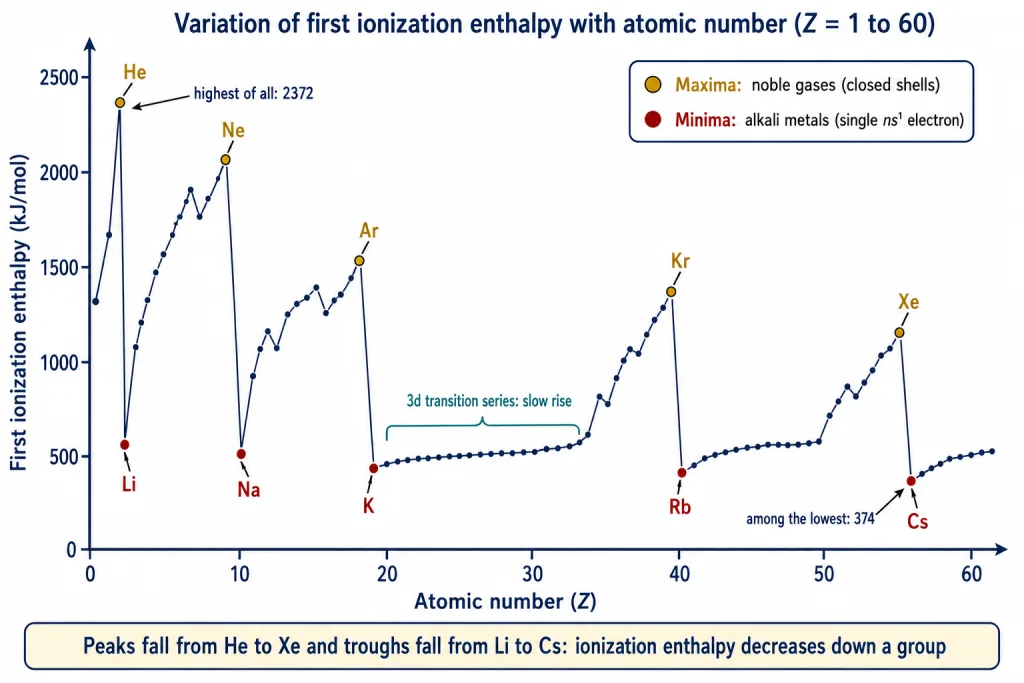
Plot the first ionization enthalpy of every element from hydrogen () to neodymium () against atomic number and you get a saw-tooth, not a smooth curve. Every tooth is one period.
Peaks at the noble gases
The maxima sit at He (), Ne (10), Ar (18), Kr (36) and Xe (54), each with a completely filled outer shell, for helium and for the rest. A closed shell is exceptionally stable: a large effective nuclear charge holds the outermost electrons and there is no loose electron to remove. Helium's 2372 is the largest first ionization enthalpy of any element.
Troughs at the alkali metals
The minima sit at Li (), Na (11), K (19), Rb (37) and Cs (55). Each has a single electron outside a noble-gas core, in a new larger shell, far from the nucleus and well shielded, so it comes off easily. Caesium, at about 374 , has one of the lowest values of any element.
Key Point: On the versus graph, maxima occur at the noble gases (closed shells, very stable configurations) and minima at the alkali metals (one loosely held electron). This periodicity is a direct picture of the periodic recurrence of electronic configurations.
Those minima also explain why alkali metals are so reactive: every reaction starts with the metal losing its outermost electron, and a low ionization enthalpy makes that step cheap. The noble gases at the peaks are the least reactive elements for the mirror-image reason.
| Element | () | Position on graph | |
|---|---|---|---|
| He | 2 | 2372 | highest peak of all |
| Li | 3 | 520 | trough |
| Ne | 10 | 2081 | peak |
| Na | 11 | 496 | trough |
| Ar | 18 | 1521 | peak |
| K | 19 | 419 | trough |
| Kr | 36 | 1351 | peak |
| Rb | 37 | 403 | trough |
| Xe | 54 | 1170 | peak |
| Cs | 55 | 374 | trough |
The peaks get lower from He to Xe and the troughs from Li to Cs: the down-a-group trend. Between each trough and the next peak the values climb, with a couple of wobbles: the across-a-period trend.
Key Point: The first ionization enthalpy generally increases across a period from left to right and decreases down a group from top to bottom. Ionization enthalpy and atomic radius are closely related: a smaller atom generally holds its electron more tightly and has the higher ionization enthalpy.
Radius decreases across a period and increases down a group; ionization enthalpy does the opposite.
Inside the saw-tooth: the transition metals
Between Ca () and Zn (30), and again between Sr (38) and Cd (48), the graph flattens into a plateau. In these -block elements each added electron enters an inner orbital and partly shields the outer electrons, so their effective nuclear charge rises slowly and the ionization enthalpy creeps up.
[Board] On an unlabelled against graph, the peaks are the noble gases and the troughs the alkali metals; the first peak () is helium, the trough after it () lithium.
Why the Trends Happen — Attraction, Repulsion and Shielding
Every trend here comes from a tug of war on the outermost electron:
- Attraction towards the nucleus, set by the nuclear charge and the electron-nucleus distance. Larger charge, or shorter distance, means a higher .
- Repulsion by the other electrons, which partly cancels the nuclear pull.
Shielding, or screening
Key Point (Definition): The effective nuclear charge experienced by a valence electron is less than the actual charge on the nucleus because of shielding (or screening) of the valence electron from the nucleus by the intervening core electrons.
In lithium, , the nucleus carries , but the two electrons sit between it and the electron and repel that electron outwards, so the net charge it feels is a little over .
Shielding is most effective when the inner shells are completely filled: a filled shell is spherical and dense and wraps the nucleus almost completely — the alkali-metal situation, one electron outside a noble-gas core.
| Element | Configuration | Actual nuclear charge | Core electrons | What the valence electron feels |
|---|---|---|---|---|
| Li | 2 (filled ) | roughly | ||
| Na | 10 (filled , , ) | roughly | ||
| K | 18 (filled through ) | roughly |
(Approximate values; exact ones come from Slater's rules in the JEE Corner. Eighteen core electrons cut a nucleus down to about .)
Across a period: nuclear charge wins
From lithium to fluorine each step adds one proton and one electron to the same shell, . Electrons in one shell shield each other poorly, so shielding by the inner core stays at two electrons while the nuclear charge climbs from to .
Key Point: Across a period, the increase in nuclear charge outweighs the increase in shielding. The effective nuclear charge rises, the outermost electrons are held more tightly, the atom shrinks, and the ionization enthalpy increases.
| Period 2 | Li | Be | B | C | N | O | F | Ne |
|---|---|---|---|---|---|---|---|---|
| () | 520 | 899 | 801 | 1086 | 1402 | 1314 | 1681 | 2081 |
| Atomic radius (pm) | 152 | 111 | 88 | 77 | 74 | 66 | 64 | — |
Roughly a fourfold rise from lithium to neon. Two entries, B and O, break the climb; they are the subject of the next block.
Down a group: distance and shielding win
From lithium to sodium to potassium each step adds a whole new shell, putting the outermost electron in , then , with an extra shell of core electrons in between. The nuclear charge also rises, to to , but almost all of that is cancelled by those core electrons.
Key Point: Down a group, the increase in shielding and the increase in distance outweigh the increase in nuclear charge. The outermost electron is farther away and better screened, so it needs less energy to remove and the ionization enthalpy decreases.
| Group 1 | Li | Na | K | Rb | Cs |
|---|---|---|---|---|---|
| Outer electron | |||||
| () | 520 | 496 | 419 | 403 | 374 |
| Atomic radius (pm) | 152 | 186 | 231 | 244 | 262 |
The same holds for every main group: halogens F (1681) > Cl (1251) > Br (1140) > I (1008); noble gases He (2372) > Ne (2081) > Ar (1521) > Kr (1351) > Xe (1170).
Summary of the factors
| Factor | Effect on | Where it dominates |
|---|---|---|
| Larger nuclear charge | increases | across a period |
| Larger atomic radius (outer electron farther away) | decreases | down a group |
| More shielding by inner electrons | decreases | down a group |
| Penetration of the orbital (s > p > d > f) | s electrons hardest to remove | Be vs B anomaly |
| Half-filled or fully filled subshell | increases (extra stability) | N vs O anomaly; noble gases |
[JEE/NEET] Three factors make ionization enthalpy fall down a group: increasing atomic size; increasing shielding by inner-shell electrons; and a rise in nuclear charge more than offset by those two, so stays roughly constant.
The Two Famous Anomalies — Be/B and N/O
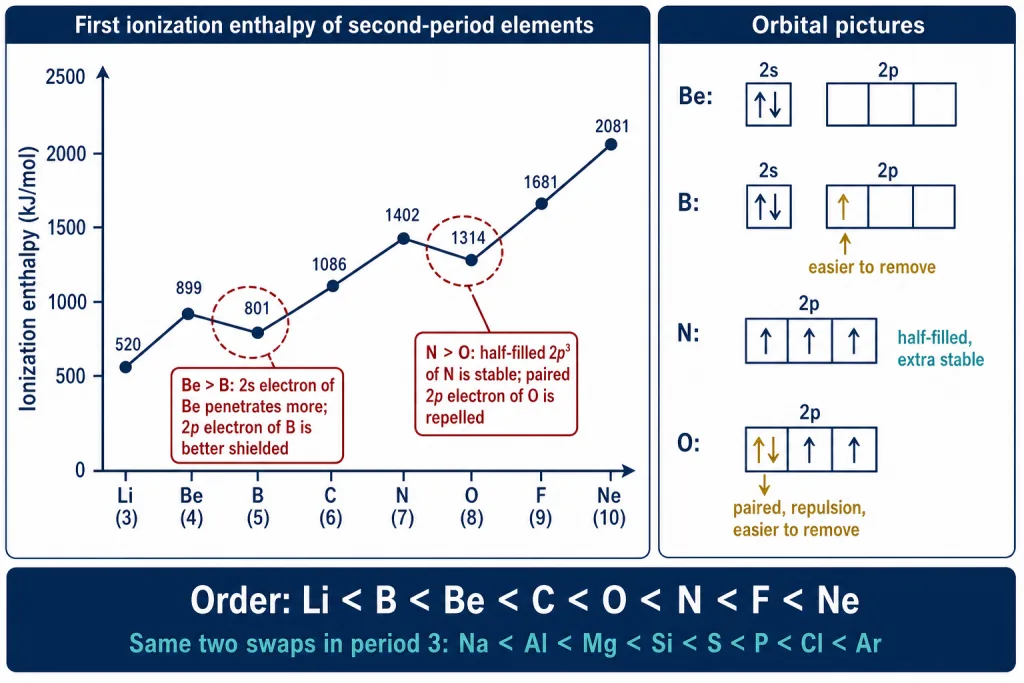
Across period 2 the ionization enthalpy is supposed to climb, and mostly it does. Twice it dips: boron (801) below beryllium (899), and oxygen (1314) below nitrogen (1402). The pattern repeats in the third period (Al 577 < Mg 737; S 1000 < P 1012) and in every period after. These are not errors but a window into orbital shapes and electron pairing.
Anomaly 1: boron is below beryllium (2s versus 2p)
Beryllium is ; boron is . Boron has the larger nuclear charge ( against ), so by the across-a-period rule its ionization enthalpy should be higher. It is lower.
Beryllium loses a electron; boron loses a electron. Within a shell an electron is attracted more strongly, because an orbital penetrates closer to the nucleus: a electron spends part of its time inside the core, while a electron has zero probability at the nucleus. Boron's electron is therefore more effectively shielded by the core, feels a smaller effective nuclear charge, and comes off more easily despite boron's stronger nucleus. A smaller contribution: removing an electron from beryllium breaks up a filled, extra-stable subshell, while boron's electron is on its own.
Key Point: Within the same shell, penetration decreases in the order , and so does the ease of holding the electron. Removing a electron (B) needs less energy than removing a electron (Be). Hence (B) < (Be).
Anomaly 2: oxygen is below nitrogen (paired 2p electrons)
Nitrogen is ; oxygen is . Again oxygen has the larger nuclear charge and the lower ionization enthalpy. Both lose a electron, so penetration is not the explanation. Electron pairing is.
In nitrogen, by Hund's rule, the three electrons sit one in each orbital with parallel spins: . This exactly half-filled subshell is symmetric and unusually stable. Oxygen's fourth electron has no empty orbital left and must pair up: . Two electrons in the same small region repel strongly, raising the paired electron's energy and making it easier to remove.
Key Point: Nitrogen's is exactly half-filled and extra stable; oxygen's fourth electron is paired and suffers increased electron-electron repulsion. Hence (O) < (N). Fluorine and neon then resume the climb, because their extra nuclear charge outweighs the pairing.
The correct order for period 2
Two swaps from the plain left-to-right order: B with Be, and O with N. Everything else is in order.
| Pair | Expected (by ) | Actual | Reason |
|---|---|---|---|
| Be, B | B > Be | Be > B | Be loses a penetrating electron; B loses a better-shielded |
| N, O | O > N | N > O | N has stable half-filled ; O's fourth electron is paired and repelled |
| Mg, Al | Al > Mg | Mg > Al | same as Be/B, one shell up ( vs ) |
| P, S | S > P | P > S | same as N/O, one shell up ( vs ) |
Using the anomalies: predicting aluminium
The first ionization enthalpies of Na, Mg and Si are 496, 737 and 786 . Will aluminium's be closer to 575 or to 760? A naive guess from its position between Mg and Si is 760. But aluminium is : it loses a electron, well shielded by the pair, exactly like boron after beryllium, so its value drops below magnesium's. The answer is 575; the measured value is 577.
[JEE/NEET] The two anomalies give the same two swaps in every period of the -block: group 13 below group 2, group 16 below group 15. Third period: Na < Al < Mg < Si < S < P < Cl < Ar. The words a marker wants are penetration and shielding for Be/B, half-filled stability and electron-electron repulsion for N/O.
Two Puzzles That Look Like Contradictions — Na/Mg and Group 13
Data that seems to break the basic rules is a favourite exam move. Two classic cases.
Puzzle 1: sodium versus magnesium, first and second
| Na | 496 | 4562 |
| Mg | 738 | 1451 |
Sodium has the lower first ionization enthalpy but the much higher second. Both follow from the configurations.
First ionization. Na is and Mg is . Both lose a electron, but magnesium has the larger nuclear charge ( against ) with the same neon core shielding it, so its electron feels a larger and is held more tightly. Mg is also the smaller atom (160 pm against 186 pm). So (Na) < (Mg): the ordinary across-a-period trend.
Second ionization. After the first electron goes, is , the stable noble-gas configuration of neon. A second electron must come out of that closed shell, from , much closer to the nucleus and inside an already positive ion: 4562 . is , still with an outer electron, and removing it gives the stable () — 1451 against 738, more than the first because the ion is positive, but nothing like sodium's leap. Hence (Na) (Mg).
Key Point: Removing an electron from a noble-gas core always produces a huge jump in ionization enthalpy. After sodium's one valence electron is gone, the next must come out of the neon core; magnesium's second electron is still a valence electron.
Puzzle 2: group 13 does not fall smoothly
| Group 13 | B | Al | Ga | In | Tl |
|---|---|---|---|---|---|
| () | 801 | 577 | 579 | 558 | 589 |
The down-a-group rule says these should fall steadily. B to Al does (801 to 577, as expected for a new shell and new core electrons). But Ga is slightly higher than Al, and Tl is higher than In.
Al to Ga. Between aluminium () and gallium () the ten electrons of the first transition series have been added; gallium is . The nuclear charge has gone up by 18 units, but orbitals are diffuse and shield poorly, cancelling much less than ten units of it. Gallium's electron feels a larger than expected, and its atom is barely larger than aluminium's (135 pm against 143 pm), so its value is essentially equal to, in fact marginally above, aluminium's.
In to Tl. Ga to In (579 to 558) is a normal drop: indium's shields about as poorly as gallium's . But between indium and thallium () the fourteen electrons of the lanthanoids have been added as well as ten electrons. The orbitals shield even more poorly than orbitals, so on thallium's electron rises enough to push the value back up to 589, above indium's.
Key Point: In group 13, the poorly shielding electrons (Ga) and plus electrons (Tl) increase more than the extra shell decreases it, so the expected fall in is interrupted. The order is B > Tl > Ga > Al > In.
[JEE Main] Shielding effectiveness runs . When a or series has just been filled before the element, expect a higher ionization enthalpy than the simple group trend predicts.
A quick word on isotopes
Two isotopes of an element, say and , have the same ionization enthalpy. They differ only in neutrons, which carry no charge; nuclear charge, electron count, configuration and shielding are identical. Nuclear mass is the one factor in the usual list that does not affect the valence shell.
Successive Ionization Enthalpies — Reading the Big Jump
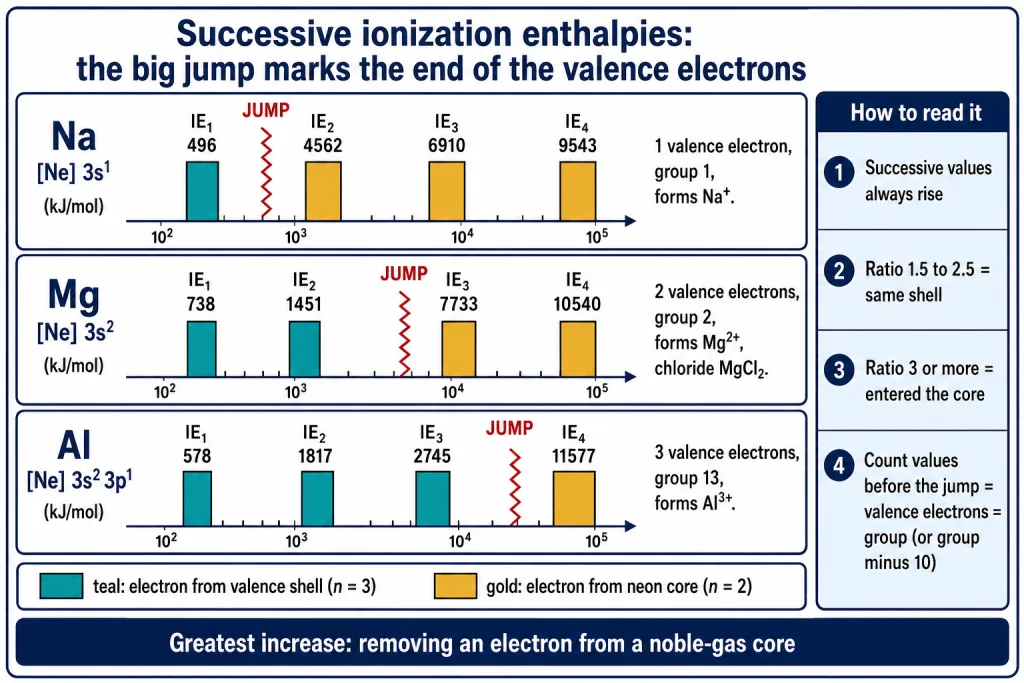
Every atom has as many ionization enthalpies as it has electrons, and they always rise — but not evenly. Somewhere comes a jump so large it dwarfs everything before it, and that jump tells you how many valence electrons the atom has, and so its group.
Why there is a jump
Take magnesium, .
| Step | Electron removed | From | () | Ratio to previous |
|---|---|---|---|---|
| 1st | Mg (neutral) | 738 | — | |
| 2nd | 1451 | about 2 | ||
| 3rd | , a neon core | 7733 | more than 5 | |
| 4th | 10540 | about 1.4 |
The first two are valence electrons from the orbital; the second costs about twice the first because it leaves a positive ion. The third must come from the subshell, which is (a) in a lower shell, much closer to the nucleus, (b) shielded by only two electrons instead of ten, and (c) part of a filled, extra-stable noble-gas configuration. The price leaps from 1451 to 7733.
Key Point: The end of the valence electrons is marked by a big jump in successive ionization enthalpies. The greatest increase occurs when the next electron has to be removed from a noble-gas core. The number of ionization enthalpies before the jump equals the number of valence electrons, which for a main-group element equals its group number (groups 1 and 2) or group number minus 10 (groups 13 to 18).
Three worked fingerprints
| Element | Jump after | Valence electrons | Group | ||||
|---|---|---|---|---|---|---|---|
| Na | 496 | 4562 | 6910 | 9543 | 1st | 1 | 1 |
| Mg | 738 | 1451 | 7733 | 10540 | 2nd | 2 | 2 |
| Al | 577 | 1817 | 2745 | 11577 | 3rd | 3 | 13 |
(All in .) Cover the element names and each row is still identifiable from the jump alone.
How to use it in an exam
- Write the successive values in order.
- Take the ratio of each to the one before. Ratios of 1.5 to 2.5 are the ordinary cost of removing an electron from a more positive ion; a ratio of 3 or more (often 4 to 6) is the jump.
- Count the values before the jump: that is the number of valence electrons, .
- means group 1, group 2, group 13, group 14, and so on. The most stable ion has charge and the chloride is .
For 738, 1451, 7733 : 1451/738 is about 2, then 7733/1451 about 5.3 — the jump. Two values before it means two valence electrons, so group 2; the element is magnesium, ion , chloride .
The one incorrect statement
A common multiple-choice item asks which of four statements is incorrect. The false one is usually that "removal of an electron from an orbital with a lower value is easier than from an orbital with a higher value". Lower means closer to the nucleus, less shielded, and harder to remove.
Key Point: increases for each successive electron; the biggest jump comes at the noble-gas core; the jump marks the end of the valence electrons; and electrons in higher orbitals are the easier ones to remove.
[JEE/NEET] "Identify the group from the successive ionization enthalpies" and "which element forms a stable halide" are the same question: count the values before the jump.
Solved Examples
Question 1: Defining ionization enthalpy correctly
Define first and second ionization enthalpy with equations. Why is the term "ionization enthalpy", when used alone, taken to mean the first ionization enthalpy?
Answer:
The first ionization enthalpy is the energy I need to pull one electron off an isolated gaseous atom in its ground state. For an element X:
The unit is .
Once the atom has become , the energy needed to remove the next most loosely held electron is the second ionization enthalpy:
Both are always positive, because I am pulling a negative electron away from a positive centre.
The question that usually matters is how easily an atom starts to lose electrons, and the first electron decides that, so the unqualified term means the first one.
Ans: is the enthalpy change for and that for , both for isolated gaseous ground-state species in . "Ionization enthalpy" alone means .
Watch out: A full-mark definition has three ingredients — energy required, isolated gaseous atom, ground state — plus the equation.
Question 2: Why "isolated gaseous atom" and why "ground state"?
What is the significance of the terms "isolated gaseous atom" and "ground state" in the definitions of ionization enthalpy and electron gain enthalpy?
Answer:
In a solid or liquid an atom is bonded to or attracted by its neighbours. Pulling an electron off it there would spend part of the energy fighting those neighbours, and the number would depend on the sample rather than the element. In the gas phase at low pressure the atoms are far apart, so the energy measured belongs to that atom alone.
If the atom is already excited, one electron sits in a higher orbital, farther out and held loosely, so removing it takes less energy — and different excited states would give different numbers. The ground state fixes the starting line.
Together the two conditions let one element's value be compared fairly with any other's. The same reasoning applies to electron gain enthalpy, where an electron is added.
Ans: "Isolated gaseous atom" removes the influence of neighbouring atoms; "ground state" removes the influence of excitation. Both are needed so values for different elements are measured under identical, comparable conditions.
Question 3: Ionization enthalpy of hydrogen in joules per mole
The energy of the electron in the ground state of the hydrogen atom is J. Calculate the ionization enthalpy of atomic hydrogen in .
Answer:
Ionizing hydrogen means taking the electron from its ground state (, energy J) to infinity, where its energy is zero. For one atom:
That is per atom, and ionization enthalpy is per mole, so I multiply by Avogadro's number :
Tidied up, , or .
Ans: , about .
Watch out: Keep the sign straight — the electron's energy is negative, the energy required to remove it is positive.
Question 4: Predicting aluminium's value from its neighbours
The first ionization enthalpies of Na, Mg and Si are 496, 737 and 786 . Predict whether the value for Al will be closer to 575 or to 760 , and justify.
Answer:
Mg is and Al is , so magnesium loses a electron and aluminium its single electron.
Within a shell an electron penetrates closer to the nucleus than a electron, so aluminium's electron is shielded more effectively by the pair and the inner core, feels a smaller , and comes off more easily.
Aluminium's value therefore drops below magnesium's 737 instead of climbing towards silicon's 786. The actual value is 577.
Ans: Closer to 575 , because the electron of Al is better shielded (less penetrating) than the electron of Mg.
Watch out: At any "s to p" boundary expect a small drop — group 13 dips below group 2.
Question 5: The period-2 order, explained
Among the second-period elements the actual first ionization enthalpies are in the order Li < B < Be < C < O < N < F < Ne. Explain why (i) Be has a higher than B, and (ii) O has a lower than N and F.
Answer:
The general trend first. Across a period the nuclear charge grows by one at each step while electrons enter the same poorly shielding shell, so rises and the outer electron gets harder to remove — the rise from Li to Ne.
(i) Be > B. Be is and B is , so Be loses a electron and B a electron. A electron penetrates closer to the nucleus, so boron's electron is shielded more effectively by the inner core, feels a smaller , and needs less energy to remove — even though boron's nucleus is against beryllium's . Be's fully filled adds extra stability.
(ii) O < N. Nitrogen is , one electron in each orbital with parallel spins by Hund's rule — an unusually stable half-filled subshell. Oxygen is , so its fourth electron shares an orbital; the two repel, raising that electron's energy and making it easier to pull off, so oxygen dips below nitrogen.
(ii) O < F. From O to F the nuclear charge rises from to and the added electron enters the same subshell. Fluorine also has a paired electron, so the pairing penalty is equal and the extra nuclear charge decides.
Ans: (i) Be loses a penetrating, less shielded electron and B a better-shielded electron, so Be > B. (ii) N has an extra-stable half-filled while O's fourth electron is paired and repelled, so O < N; F has a larger nuclear charge with the same pairing, so O < F.
Watch out: The same two swaps appear in every period: group 13 below group 2, group 16 below group 15.
Question 6: Sodium versus magnesium, first and second ionization enthalpies
The first ionization enthalpy of sodium is lower than that of magnesium, but the second ionization enthalpy of sodium is higher than that of magnesium. Explain.
Answer:
Na is and Mg is .
For the first ionization both lose a electron. Magnesium has one more proton ( against ) with the same neon core shielding, so its electron feels a bigger and its atom is smaller (160 pm against 186 pm): (Na) = 496 < (Mg) = 737 , the normal across-the-period rise.
For the second I look at what is left. is , neon's closed shell, so the next electron must come out of that stable core, from , much closer to the nucleus, much less shielded and inside a positive ion: 4562 .
is and still has an outer valence electron; losing it gives the stable . That costs more than the first (1451 against 737) because the ion is positive, but far less than breaking into a core. So (Na) (Mg).
Ans: : Na < Mg because Mg has the higher on its electron. : Na > Mg because has a stable noble-gas core and its second electron must come from the shell, whereas still has a valence electron to lose.
Watch out: Always ask what is left after the previous electron went. A noble-gas core means the next ionization enthalpy is enormous.
Question 7: Why ionization enthalpy falls down a group
What are the factors that make the ionization enthalpy of main-group elements decrease down a group?
Answer:
Atomic size increases. Each step down adds a whole new shell, so the outermost electron sits farther from the nucleus and attraction falls off with distance: Li 152 pm to Cs 262 pm.
Shielding increases. Each new shell adds a full layer of core electrons between the nucleus and the valence electron, and filled shells screen very effectively.
Nuclear charge rises, but not enough. It goes up (Li , Na , K ), which alone would raise the ionization enthalpy, but almost all of it is cancelled by the extra core electrons, so on the outer electron stays roughly constant — a little over to for every alkali metal.
Distance and shielding therefore win. Group 1 values: Li 520, Na 496, K 419, Rb 403, Cs 374 .
Ans: Down a group, (i) the atomic radius increases so the outer electron is farther from the nucleus, and (ii) shielding increases with the number of inner shells; these outweigh (iii) the increase in nuclear charge, so on the valence electron barely changes and decreases.
Watch out: Distance and shielding beat nuclear charge down a group; across a period, nuclear charge beats shielding.
Question 8: The group 13 irregularity
The first ionization enthalpies (in ) of the group 13 elements are B 801, Al 577, Ga 579, In 558, Tl 589. How would you explain this deviation from the general trend?
Answer:
The expected trend is a steady fall from B to Tl. B to Al obeys it, 801 to 577, because Al has a new shell and a fresh set of core electrons. The trouble starts at Ga and again at Tl.
Ga is slightly above Al. Between Al () and Ga () the ten electrons have been added, giving . The nuclear charge has risen by 18, but electrons shield poorly and cancel much less than that. Gallium's electron feels an unexpectedly large , its atom is barely larger than aluminium's, and its value is 579, slightly above aluminium's 577.
Ga to In falls normally, 579 to 558: indium has a new shell and its shields about as poorly as gallium's .
Tl is above In. Between In () and Tl () the fourteen electrons of the lanthanoids have been added along with ten , giving . The electrons shield even more poorly than electrons, so the electron feels a strongly increased and the value rises to 589.
Ans: The poorly shielding electrons preceding Ga, and the plus electrons preceding Tl, raise the on the valence electron by more than the extra shell lowers it, so the fall is interrupted: B > Tl > Ga > Al > In.
Watch out: Shielding power runs . An element straight after a filled or series has a higher ionization enthalpy than the simple group trend predicts.
Question 9: Do isotopes have different ionization enthalpies?
Would you expect the first ionization enthalpies of two isotopes of the same element to be the same or different? Justify.
Answer:
Isotopes have the same atomic number, so the same protons and the same nuclear charge; they differ only in neutrons, which carry no charge and change the mass of the nucleus but not the electrostatic pull on the electrons.
Both therefore have the same nuclear charge, electron count, configuration and shielding, so their outermost electron is held with the same force and takes the same energy to remove. Strictly, the heavier nucleus changes the reduced mass by a minute amount, far too small to matter here.
Ans: The same. Ionization enthalpy depends on nuclear charge and electronic configuration, which are identical for isotopes; the extra neutrons add mass but no charge.
Watch out: Of principal quantum number, nuclear charge, nuclear mass and number of core electrons, nuclear mass is the one with no effect on the valence shell.
Question 10: Ordering three sets of elements
Arrange in increasing order of first ionization enthalpy, with reasons: (a) Na, Mg, Al, Si; (b) N, O, F; (c) Li, Na, K.
Answer:
(a) All third period. The general rise would give Na < Mg < Al < Si, but Al is and loses a well-shielded electron while Mg loses a penetrating electron, so Al drops below Mg: Na (496) < Al (577) < Mg (737) < Si (786).
(b) Second period, all losing a electron. Nitrogen's is half-filled and stable; oxygen's fourth electron is paired and repelled, so O falls below N. Fluorine has the highest nuclear charge and is also paired, so it is highest: O (1314) < N (1402) < F (1681).
(c) Group 1, one new shell at each step; larger radius plus more shielding holds the outer electron less tightly going down. Order: K (419) < Na (496) < Li (520).
Ans: (a) Na < Al < Mg < Si; (b) O < N < F; (c) K < Na < Li.
Watch out: For a same-period set, write the plain order first, then apply the two swaps (13 below 2, 16 below 15).
Question 11: Identifying an element from its successive ionization enthalpies
The first three ionization enthalpies of an element are 738, 1451 and 7733 . Identify the group of the element, name it, and give the formula of its chloride.
Answer:
— the ordinary increase when the second electron leaves a positive ion.
— far too big for another electron from the same shell, so the third must come out of a noble-gas core.
So the atom has exactly two easily removed electrons before the core, an valence shell: group 2.
A first value of 738 is magnesium's (Be is 899, Ca 590), so the element is Mg, . Losing both valence electrons gives with the neon configuration, so the chloride is .
Ans: Group 2; the element is magnesium; its chloride is .
Watch out: Count the values before the big jump: that count is the number of valence electrons, and for a main-group element it gives the group (1, 2, or count + 10 for 13 to 18).
Question 12: Six elements, six ionization and electron-gain data
The first and second ionization enthalpies and the electron gain enthalpy (all in ) of six elements are:
| Element | |||
|---|---|---|---|
| I | 520 | 7300 | |
| II | 419 | 3051 | |
| III | 1681 | 3374 | |
| IV | 1008 | 1846 | |
| V | 2372 | 5251 | |
| VI | 738 | 1451 |
Which of these is likely to be (a) the least reactive element, (b) the most reactive metal, (c) the most reactive non-metal, (d) the least reactive non-metal, (e) the metal that forms a stable binary halide , (f) the metal that forms a predominantly covalent halide ?
Answer:
(a) V. Highest of all (2372, helium's value) plus a positive , so it neither loses nor gains an electron. A noble gas.
(b) II. The lowest (419) loses its electron most easily, and the jump to 3051 shows one valence electron. Potassium's data.
(c) III. The most negative () gains an electron most readily, and its high (1681) says it will not lose one. Fluorine.
(d) IV. Still a non-metal, with 1008 and , but both weaker than III's. Iodine.
(e) VI. Its first two values (738, 1451) rise only twofold, so two valence electrons come off easily and the third would be from the core. That gives and . Magnesium.
(f) I. One valence electron (520, then a jump to 7300), so it forms . Its of 520 is the highest among the one-valence-electron metals here, and its ion is very small with a high charge density, so its halides are largely covalent. Lithium.
Ans: (a) V, (b) II, (c) III, (d) IV, (e) VI, (f) I.
Watch out: Read the three columns together. Low means metal; strongly negative means reactive non-metal; positive with a huge means noble gas; the jump from to counts the valence electrons.