
From Quantum Numbers to a Seat in the Table
The principal quantum number names the shell and names the subshell ( for s, p, d, f). Electrons enter subshells in the order set by the rule:
The distribution of electrons among the orbitals of an atom is its electronic configuration.
Key Point: An element's location in the periodic table reflects the quantum numbers of the last orbital filled. The period is fixed by of the valence shell; the block is fixed by of the orbital that received the last electron; and the group is fixed by how many electrons sit in those outer orbitals.
The long form of the table is the configurations laid out on paper: every row is one shell being filled, every column one ending of a configuration.
Period number = of the valence shell
The period gives for the outermost (valence) shell. A new period begins when electrons start entering the next higher principal energy level: period 1 fills , and so on to period 7.
How many elements fit in a period
Key Point: The number of elements in a period = twice the number of atomic orbitals available in the energy level being filled, because each orbital holds at most two electrons (Pauli's principle).
The phrase "energy level being filled" does not mean all orbitals with that . It means the orbitals that fill while the outer shell is , which by the rule includes some inner d and f orbitals.
| Period | Outer shell | Orbitals filled during the period | Number of orbitals | Elements orbitals |
|---|---|---|---|---|
| 1 | 1 | 1s | 1 | 2 |
| 2 | 2 | 2s, 2p | 1 + 3 = 4 | 8 |
| 3 | 3 | 3s, 3p | 1 + 3 = 4 | 8 |
| 4 | 4 | 4s, 3d, 4p | 1 + 5 + 3 = 9 | 18 |
| 5 | 5 | 5s, 4d, 5p | 1 + 5 + 3 = 9 | 18 |
| 6 | 6 | 6s, 4f, 5d, 6p | 1 + 7 + 5 + 3 = 16 | 32 |
| 7 | 7 | 7s, 5f, 6d, 7p | 1 + 7 + 5 + 3 = 16 | 32 |
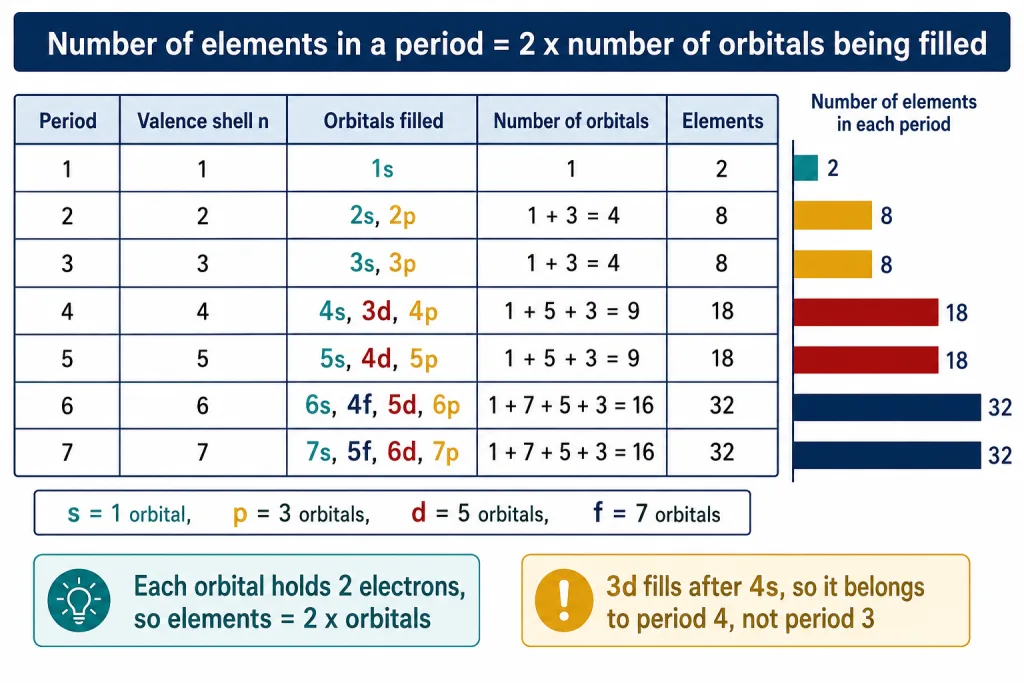
Period 3 has only 8 elements even though the shell has nine orbitals. The 3d orbitals lie above 4s in energy, so they stay empty until the fourth period begins, and on the table the 3d electrons belong to period 4. The same logic delays 4d to period 5, 4f and 5d to period 6, and 5f and 6d to period 7.
[Board] For "justify on the basis of quantum numbers", give the values allowed for the outer , the energy order of the orbitals that actually fill, and the orbital count multiplied by 2.
Periods 1 to 5, Element by Element
Period 1 (): 1s only — 2 elements
The first shell has one orbital, 1s, holding two electrons: hydrogen () and helium (). Helium's shell is complete, so it behaves as a noble gas even though its last electron went into an s orbital.
Period 2 (): 2s then 2p — 8 elements
Lithium starts the period, its third electron entering 2s (). Beryllium completes 2s, and boron to neon fill the three 2p orbitals: elements, Li to Ne, ending at neon with a filled shell.
Period 3 (): 3s then 3p — 8 elements
Sodium begins with one electron in 3s (). Magnesium completes 3s, and aluminium to argon fill 3p. Again 8 elements, Na to Ar, ending at argon . The 3d orbitals stay empty until the next period.
Period 4 (): 4s, then 3d, then 4p — 18 elements
- Potassium () starts it with ; calcium () completes 4s.
- With 4s full, the five 3d orbitals fill. Scandium (), , opens the 3d transition series, which ends ten electrons later at zinc (), — Sc, Ti, V, Cr, Mn, Fe, Co, Ni, Cu, Zn.
- Gallium () to krypton () fill 4p.
Count: elements, K to Kr, closing at krypton .
Key Point: The 3d series (Sc to Zn) sits inside period 4, between the s-block pair (K, Ca) and the p-block six (Ga to Kr). The ten d-block columns stretch periods 4 and 5 from 8 to 18.
[JEE/NEET] Two configurations here are exceptions: chromium and copper (extra stability of half-filled and fully-filled d subshells). Positions do not change — Cr is still group 6, Cu still group 11 — but write the configurations correctly.
Period 5 (): 5s, then 4d, then 5p — 18 elements
Period 5 copies period 4 one shell higher. Rubidium (), , opens it; strontium completes 5s. The 4d transition series runs from yttrium (), , to cadmium (), . Indium to xenon () fill 5p. Again elements, Rb to Xe.
| Period | First element (Z) | Series inside | Last element (Z) | Count |
|---|---|---|---|---|
| 1 | H (1) | — | He (2) | 2 |
| 2 | Li (3) | — | Ne (10) | 8 |
| 3 | Na (11) | — | Ar (18) | 8 |
| 4 | K (19) | 3d: Sc (21) to Zn (30) | Kr (36) | 18 |
| 5 | Rb (37) | 4d: Y (39) to Cd (48) | Xe (54) | 18 |
Every period ends in a noble gas whose atomic number is the running total of elements so far: 2, 10, 18, 36, 54, 86, 118. Those seven numbers place any element in its period — lies between 18 and 36, so period 4; between 36 and 54, so period 5.
Periods 6 and 7 and the Inner Transition Series
Period 6 (): 6s, 4f, 5d, 6p — 32 elements
Caesium (), , and barium (), , fill 6s. Next in energy come 4f (seven orbitals, 14 electrons), 5d (five orbitals, 10 electrons) and 6p (three orbitals, 6 electrons).
- Lanthanum () is conventionally written and heads the group 3 column.
- The 4f orbitals fill from cerium () to lutetium (): fourteen elements forming the 4f inner transition series, the lanthanoids.
- Hafnium () to mercury () complete the 5d series.
- Thallium () to radon () fill 6p.
Count: elements, Cs to Rn.
Period 7 (): 7s, 5f, 6d, 7p — 32 elements
Period 7 repeats period 6 with 7s, 5f, 6d and 7p. Francium (), , opens it. After actinium () the 5f orbitals fill, giving the 5f inner transition series, the actinoids (thorium to lawrencium ). Then come the 6d elements ( to 112) and the 7p elements. The period ends at , oganesson, of the noble-gas family. Most elements here are man-made and radioactive.
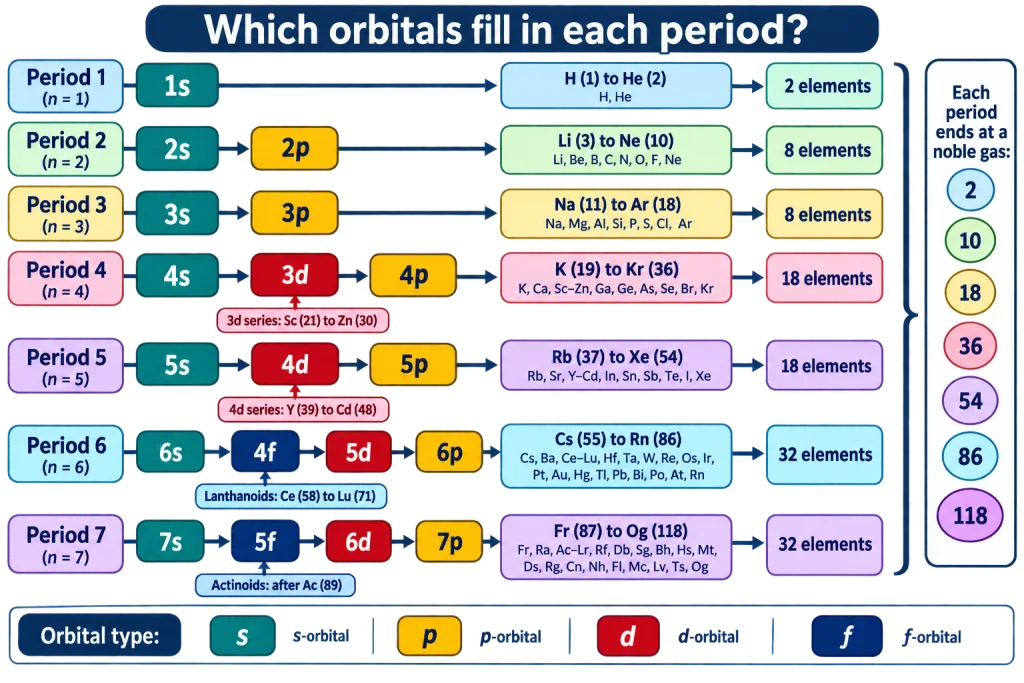
The f-series are placed separately
Slotting the lanthanoids and actinoids into the main body between groups 3 and 4 would need 32 columns and make the table impractically wide. The deeper reason is that a group exists so elements with similar properties stand in a single column. The fourteen lanthanoids are chemically very alike, differing only in an inner 4f orbital, and so are the actinoids. A separate row at the bottom for each series keeps the 18-column structure intact.
Key Point: The 4f and 5f inner transition series are placed separately to maintain the structure of the table and to preserve the principle of classification — keeping elements with similar properties in a single column.
Justifying period lengths from quantum numbers
The fifth period has 18 elements. For the allowed values of are 0, 1, 2, 3 (5s, 5p, 5d, 5f). But the orbitals that fill while the outer shell is are, in increasing energy order,
(5d and 5f lie higher than 6s and fill only later). Orbitals , electrons , so 18 elements.
The sixth period has 32 elements. For , the orbitals that fill before 6p is complete are
Orbitals , electrons , so 32 elements, Cs () to Rn ().
[Board] Write the energy order explicitly. "32 elements because there are 16 orbitals" earns partial credit; naming 6s, 4f, 5d, 6p with their orbital counts earns full marks. Cross-check a period length by blocks: s (2) + d (10, from period 4) + f (14, from period 6) + p (6) — period 2 gives , period 4 gives , period 6 gives ; periods 3, 5 and 7 repeat the length of the period before them.
Groupwise Electronic Configurations
Now read the table column by column.
Key Point (Definition): Elements in the same vertical column, or group, have similar valence-shell electronic configurations — the same number of electrons in the outer orbitals, distributed in the same way — and therefore similar properties.
Group 1, the alkali metals, shows this most clearly.
| Atomic number | Symbol | Electronic configuration |
|---|---|---|
| 3 | Li | (or) |
| 11 | Na | (or) |
| 19 | K | (or) |
| 37 | Rb | (or) |
| 55 | Cs | (or) |
| 87 | Fr |
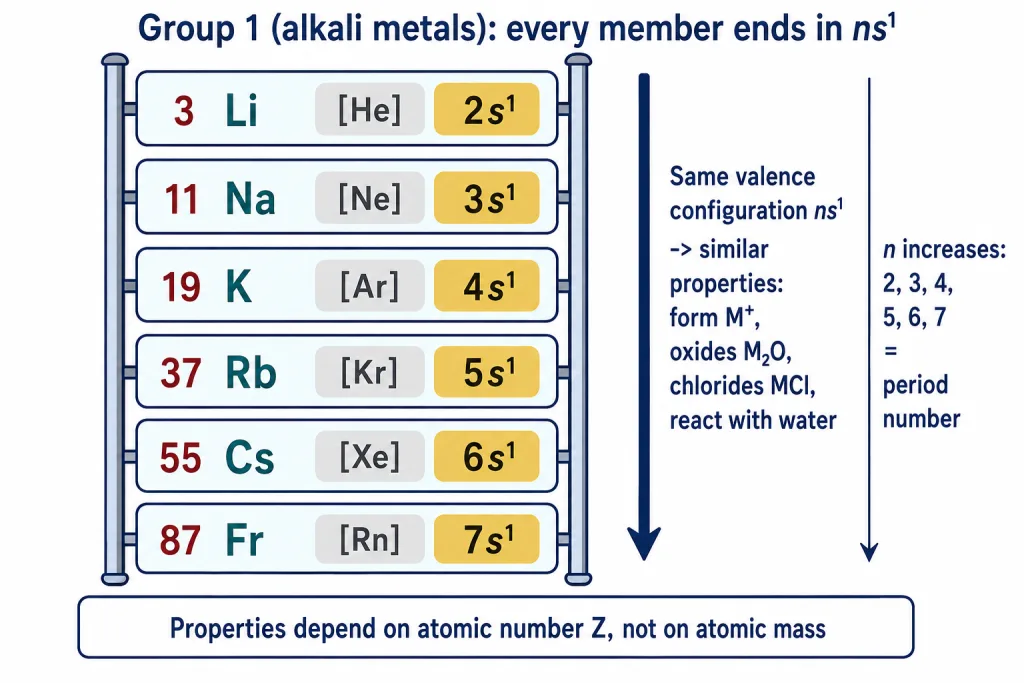
Every one ends in : a noble-gas core plus one loosely held s electron. All six lose it easily to form ions, all are soft reactive metals, all form oxides and chlorides , and all react with water to give hydrogen. The same holds for any group.
| Group | Family | Valence configuration | Example |
|---|---|---|---|
| 1 | Alkali metals | Na | |
| 2 | Alkaline earth metals | Mg | |
| 13 | Boron family | Al | |
| 14 | Carbon family | Si | |
| 15 | Nitrogen family | P | |
| 16 | Chalcogens | S | |
| 17 | Halogens | Cl | |
| 18 | Noble gases | (He: ) | Ar |
Similar configuration means similar chemistry
Chemical behaviour is decided almost entirely by the outermost electrons, since those are lost, gained or shared in a reaction; inner electrons sit in filled shells and take no part. Two atoms with the same outer configuration therefore behave the same way, whatever their inner cores. Sodium and potassium both have a single s electron outside a noble-gas core, and a chlorine atom takes the electron from either.
Differences within a group — potassium is more reactive than sodium — come from atomic size and how far the outer electron sits from the nucleus.
Properties depend on , not on atomic mass
A configuration is built by adding electrons one at a time, and a neutral atom has electrons. Configurations therefore repeat periodically as increases: each time a new shell begins, the outer configuration returns to , then , and so on. Atomic mass depends on neutrons too and has nothing to do with this pattern, which is why Moseley's atomic number replaced Mendeleev's atomic mass.
Key Point: The properties of an element have a periodic dependence on its atomic number and not on its relative atomic mass, because it is (through the electron count) that fixes the electronic configuration, and the configuration fixes the chemistry.
[NEET] For "why do elements of the same group have similar properties?", answer: same number and same distribution of electrons in the outermost shell. Say "valence shell", not just "electrons".
Reading Period and Group off a Configuration
Given an atomic number, write the configuration, then read the position in two steps.
Step 1: the period
Period the largest value of that carries any electrons (the valence shell). For iron, , the largest is 4, so period 4 — the 3d electrons do not push it back to period 3.
Step 2: the group, by block
The subshell that received the last electron (the "differentiating" electron) fixes the block, and each block has its own group formula.
| Block | Last electron enters | Valence configuration | Group number |
|---|---|---|---|
| s-block | = number of s electrons (1 or 2) | ||
| p-block | = 10 + number of valence electrons , i.e. 12 + p electrons | ||
| d-block | d electrons + electrons | ||
| f-block | placed in group 3 (lanthanoids / actinoids) |
Checking on familiar elements:
- Sodium, : s-block, one s electron, group 1. Period 3.
- Chlorine, : p-block, valence electrons , group . Period 3.
- Neon, : valence electrons 8, group . Period 2.
- Titanium, : d-block, group . Period 4.
- Zinc, : group . Period 4.
- Copper, : group . The exceptional configuration still gives the right group, since the formula adds both d and s electrons.
[JEE Main] For the p-block, a faster route is group (electrons needed to complete the octet). Sulphur needs 2 more, so group 16.
The seven periods at a glance
| Period | First element | Last element | Number of elements | ||
|---|---|---|---|---|---|
| 1 | Hydrogen (H) | 1 | Helium (He) | 2 | 2 |
| 2 | Lithium (Li) | 3 | Neon (Ne) | 10 | 8 |
| 3 | Sodium (Na) | 11 | Argon (Ar) | 18 | 8 |
| 4 | Potassium (K) | 19 | Krypton (Kr) | 36 | 18 |
| 5 | Rubidium (Rb) | 37 | Xenon (Xe) | 54 | 18 |
| 6 | Caesium (Cs) | 55 | Radon (Rn) | 86 | 32 |
| 7 | Francium (Fr) | 87 | Oganesson (Og) | 118 | 32 |
Every period starts with an alkali metal (hydrogen the exception in period 1) and ends with an noble gas (helium, , in period 1).
A routine you can reuse
Take .
- From the noble-gas totals, , so period 4. The core holds 18 electrons; 15 remain.
- Fill in order: (13 left), (3 left), .
- Configuration . Last electron in 4p, so p-block. Valence electrons ; group .
- The element is arsenic, group 15 (nitrogen family), period 4.
Finish by naming the element or its family and checking it fits — a wrong count usually shows up as a family that does not.
Traps, Checks and Quick Recall
The places students slip, and the fixes.
Trap 1 — "3d belongs to period 3"
It does not. The 3d subshell fills only after 4s, so scandium to zinc sit in period 4. The period is the largest occupied, never the of the last subshell filled. The same goes for 4d (period 5), 4f and 5d (period 6), 5f and 6d (period 7).
Trap 2 — counting all orbitals of the shell
"Period 3 has nine orbitals (: 3s, 3p, 3d) so 18 elements" is wrong. Only orbitals that fill before the next count, and 3d does not fill before 4s. Period 3 uses 3s and 3p: 4 orbitals, 8 elements.
Trap 3 — group of a d-block element
Quoting only the number of d electrons is wrong. For a transition element the group number is the sum of and electrons: manganese is group 7, not group 5.
Trap 4 — the p-block "+10"
Group of a p-block element is (valence electrons), not the valence electrons alone. Aluminium has three valence electrons but sits in group 13. The "+10" is the ten d-block columns crossed to reach the p-block in a long period.
Trap 5 — hydrogen and helium
Hydrogen () sits at the top of group 1 for its configuration, but it is not an alkali metal. Helium () sits in group 18 because its shell is complete, even though its last electron went into an s orbital. Both are conventions to remember.
The numbers to carry in your head
| Fact | Value |
|---|---|
| Period lengths | 2, 8, 8, 18, 18, 32, 32 |
| Noble gas (period ends) | 2, 10, 18, 36, 54, 86, 118 |
| Alkali metal (period starts) | 3, 11, 19, 37, 55, 87 |
| 3d series | Sc (21) to Zn (30), to |
| 4d series | Y (39) to Cd (48) |
| Lanthanoids (4f) | Ce (58) to Lu (71), 14 elements |
| Actinoids (5f) | after Ac (89): Th (90) to Lr (103), 14 elements |
| Group formulas | s: no. of s electrons; p: 10 + valence electrons; d: d + s electrons |
Quick self-test
Cover the right-hand column and answer.
| Given | Period, group, block |
|---|---|
| 2, 14, p (carbon) | |
| 4, 2, s (calcium) | |
| 4, 5, d (vanadium) | |
| 5, 17, p (iodine) | |
| 6, 1, s (caesium) | |
| 5, 14, p (tin) |
If the d-block one gave trouble, reread Trap 3.
Solved Examples
Question 1: Period and group of
An element has atomic number 19. Write its electronic configuration and find its period, group and block.
Answer:
The noble gas just below 19 is argon, , so I start from with one electron left. After 3p comes 4s, since the rule puts 4s below 3d: , or .
The highest shell carrying electrons is , so period 4. The last electron went into an s orbital, so s-block, and the group is the number of s electrons, 1: potassium, an alkali metal.
Ans: ; period 4, group 1, s-block (potassium).
Watch out: Start from the nearest noble gas below — it saves writing and gives the period at once.
Question 2: Period and group of
Locate the element with atomic number 35 in the periodic table using its electronic configuration.
Answer:
Since , the core is , with electrons left. Filling in order: (15 left), (5 left), , giving .
The largest is 4, so period 4. The last electron entered 4p, so p-block, and valence electrons give group : bromine, a halogen, one electron short of krypton's octet.
Ans: ; period 4, group 17, p-block (bromine).
Watch out: The electrons are filled and inert here — they neither change the period nor count as valence electrons.
Question 3: Period and group of
Find the period, group and block of the element with .
Answer:
Since , the core is , with eight electrons left. I fill first (6 left), then : .
The largest occupied is 4 — the 3d electrons have , but 4s is occupied — so period 4. The last electron entered a d orbital, so d-block, a transition element, and group d electrons + s electrons : iron.
Ans: ; period 4, group 8, d-block (iron).
Watch out: For a transition element, add the d and s electrons. Quoting only ", so group 6" is the classic mistake.
Question 4: Period and group of
Write the electronic configuration of the element with atomic number 56 and state its period and group.
Answer:
Since , the core is xenon, . Two electrons remain, and after 5p comes 6s: .
The highest is 6, so period 6. The last electron went into 6s, so s-block, and the group is the number of s electrons, 2: barium, an alkaline earth metal.
Ans: ; period 6, group 2, s-block (barium).
Watch out: The two elements after each noble gas are always the and pair — groups 1 and 2 of the next period.
Question 5: Period and group of
Locate the element with and name the family it belongs to.
Answer:
Since , the core is , with electrons to place. Filling in the period-6 order 6s, 4f, 5d, 6p: (26 left), (12 left), (2 left), . That gives .
The largest is 6, so period 6. The last electron entered 6p, so p-block, and valence electrons give group : lead, in the carbon family. It sits four elements before radon (), consistent with needing four more to reach .
Ans: ; period 6, group 14, p-block (lead, carbon family).
Watch out: In period 6 you must spend 14 electrons on 4f before 5d. Forgetting it lands you ten or fourteen groups off.
Question 6: How many elements are there in the fourth period, and why?
State the number of elements in the fourth period of the periodic table and justify it from the orbitals being filled.
Answer:
The fourth period has as its valence shell and begins when the first electron enters 4s, at potassium. In increasing energy, the orbitals filled before the period ends are ; 4d and 4f lie above 5s and belong to later periods.
Orbitals: 4s has 1, 3d has 5, 4p has 3, so . Each holds 2 electrons, so electrons and 18 elements.
By name: K, Ca (4s); Sc to Zn (3d, ten); Ga to Kr (4p, six) — , from to .
Ans: 18 elements (K to Kr), because the 4s, 3d and 4p orbitals — 9 orbitals, 18 electrons — are filled in this period.
Watch out: Twice the number of orbitals being filled — and 3d counts in period 4, not period 3.
Question 7: Configurations of the group 17 elements
Write the valence-shell electronic configurations of all the halogens and state what they have in common.
Answer:
Group 17 is in the p-block, and group valence electrons, so there are 7 valence electrons and the ending is .
| Element | Configuration | |
|---|---|---|
| F | 9 | |
| Cl | 17 | |
| Br | 35 | |
| I | 53 | |
| At | 85 | |
| Ts | 117 |
Every one ends in : seven valence electrons, one short of a noble-gas octet. So all halogens readily gain one electron to form and show a valence of 1.
Only the inner core differs — Br and I carry filled d subshells, At and Ts filled f and d subshells, and rises from 2 to 7. Those electrons change the size and the strength of the trends, not the family itself.
Ans: F , Cl , Br , I , At , Ts — all .
Watch out: A group is a fixed ending of the configuration; the period only tells you which to attach.
Question 8: Which orbitals fill in period 6, and in what order?
Name the orbitals that receive electrons in the sixth period, give the order in which they fill, and use it to justify the number of elements in the period.
Answer:
The outer shell is , and the period opens at caesium when the first electron enters 6s.
By the rule the orbitals after 5p are 6s (), 4f (), 5d (), 6p (); among the three with , the lower fills first. The order is , and after 6p comes 7s, which starts period 7.
Orbitals: . Electrons: .
By name: Cs, Ba (6s); La and the lanthanoids Ce to Lu, then Hf to Hg (4f and 5d, 24 together); Tl to Rn (6p, six). Total 32, to .
Ans: 6s, 4f, 5d and 6p, in that order; 16 orbitals, so 32 elements (Cs to Rn).
Watch out: Give the order, the orbital count and the doubling; an answer missing the order loses marks.
Question 9: The element in period 4, group 16
Find the atomic number and configuration of the element that lies in period 4 and group 16.
Answer:
Group 16 is in the p-block, so the valence electrons number : the valence configuration is , and with period 4 that is . Before 4p can hold electrons, 3d must be full, so the configuration is .
Counting: , so — selenium, a chalcogen, two elements before krypton, consistent with being two short of .
Ans: , (selenium).
Watch out: Going from position to is the same routine in reverse, but do not forget the ten d electrons hiding in every long period.
Question 10: The element that follows xenon
Xenon has atomic number 54. What is the atomic number, configuration, period and group of the element immediately after it? Explain why it starts a new period.
Answer:
Xenon is , its outer shell complete for period 5 (5s and 5p full). The next electron cannot enter 5d or 4f, since both lie above 6s in energy, so it goes into 6s: is . One s electron puts it in group 1 — caesium, an alkali metal.
Each period corresponds to one value of for the valence shell. The moment an electron enters 6s the valence shell changes from to , opening a new principal energy level, so period 6 begins.
Ans: , caesium, , period 6, group 1.
Watch out: Every noble gas is followed by an alkali metal in the next period — the table restarts at each time a new shell opens.
Question 11: How many elements lie between calcium and gallium, and why?
Calcium is and gallium is . How many elements lie between them in the periodic table? Explain, using electronic configurations, why these elements appear there.
Answer:
The elements strictly between and are to , so 10 elements.
Calcium is , with 4s full. By the rule, 3d () lies below 4p (also , but higher ), so the next ten electrons enter the five 3d orbitals one element at a time: scandium through zinc . Only then does 4p open, at gallium .
Exactly ten, because five d orbitals hold two electrons each. This 3d transition series is why period 4 stretches to 18 elements while period 3 has 8 — there is no 2d subshell between magnesium and aluminium.
Ans: 10 elements (Sc to Zn, to 30), the 3d transition series, because the five 3d orbitals fill between 4s and 4p.
Watch out: The gap between the group 2 and group 13 elements of a period is the size of the d subshell — ten — from period 4 onwards, and zero before that.
Question 12: Why do elements in the same group have similar physical and chemical properties?
Explain, with an example, why the elements of a group show similar properties.
Answer:
The valence-shell electrons are the ones that bond — lost, gained or shared — while inner electrons sit in filled shells and stay out of it. Elements in the same vertical column have the same number and the same distribution of electrons in their valence shell, that is, the same valence-shell electronic configuration.
The alkali metals show it: Li , Na , K , Rb , Cs , Fr all have . Each has one loosely held electron, so each forms , an oxide , a chloride , and reacts with water to release hydrogen.
Physical properties follow: the same valence configuration gives the same bonding — metallic bonding with one electron per atom for group 1 — hence similar softness, low density and low melting points down the group.
Gradual changes within a group, such as Cs being more reactive than Li, come from increasing atomic size, not from a change in the kind of configuration.
Ans: Because they have the same valence-shell electronic configuration, and the outer electrons determine chemical and most physical behaviour.
Watch out: Same ending of the configuration, same chemistry; the period only changes how strongly that ending is felt.