
Valence: The Most Characteristic Chemical Property
The first chemical property that comes straight out of the electronic configuration is valence: how many bonds an atom makes, or how many electrons it gives, takes or shares when it forms a compound.
For the representative elements (the s- and p-blocks) the rule is simple.
Key Point: The valence of a representative element is usually (though not always) equal to the number of electrons in the outermost shell, or to eight minus that number. The first choice applies to elements with few outer electrons (they lose or share them); the second to elements with many outer electrons (they need a few more to reach eight).
For the s-block the outer electrons are the electrons; for the p-block, plus .
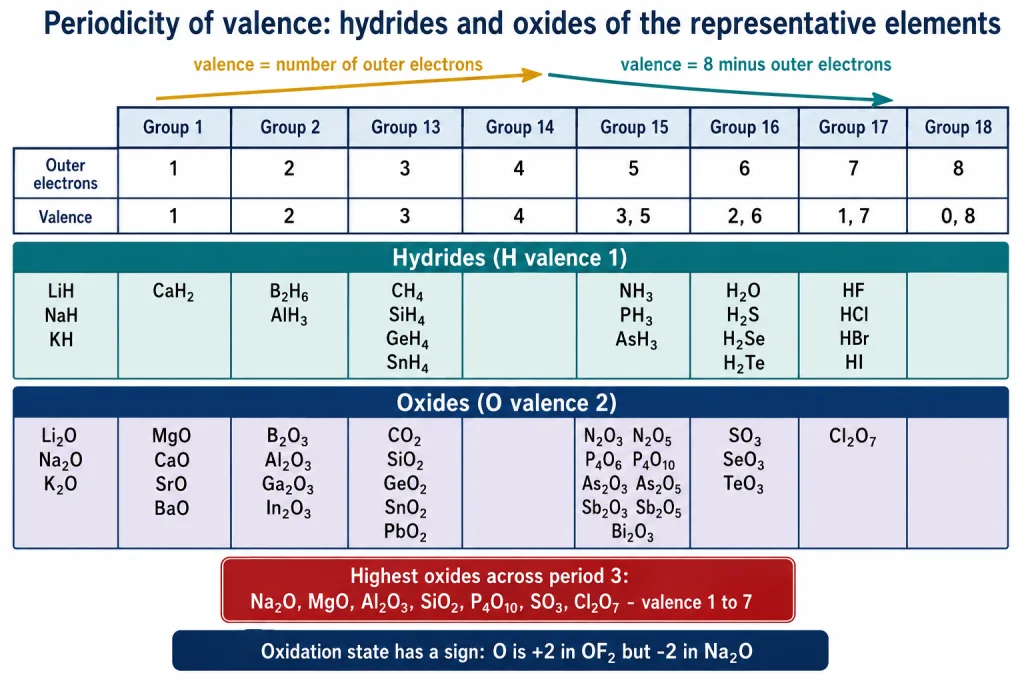
| Group | 1 | 2 | 13 | 14 | 15 | 16 | 17 | 18 |
|---|---|---|---|---|---|---|---|---|
| Outer configuration | ||||||||
| Number of valence electrons | 1 | 2 | 3 | 4 | 5 | 6 | 7 | 8 |
| Valence | 1 | 2 | 3 | 4 | 3, 5 | 2, 6 | 1, 7 | 0, 8 |
Up to group 14 the valence equals the number of outer electrons — sodium gives one, magnesium two, aluminium three, carbon shares four. From group 15 two numbers appear. The first is (outer electrons): nitrogen needs three more to reach eight, so its common valence is 3 (); oxygen needs two (); chlorine needs one (). The second is the outer-electron count itself, reached by the heavier members when they use all their outer electrons with a very electronegative partner — phosphorus in (5), sulphur in (6), chlorine in (7). Group 18 has valence 0 in the ordinary case (the shell is already full) and 8 as the formal count of outer electrons.
Valence and oxidation state
Oxidation state is often used in place of valence, but the two are not the same. Compare and , with electronegativities F (4.0) > O (3.5) > Na (0.9).
- In , each fluorine is more electronegative than oxygen, so each pulls one electron towards itself and counts as . Oxygen has given up one electron to each of two fluorines, so it counts as .
- In , oxygen is the more electronegative partner. It takes one electron from each sodium atom and counts as ; each sodium () has lost its one electron and is .
Oxygen's valence is 2 in both — two bonds either way. Its oxidation state is in one and in the other. That sign is the extra information oxidation state carries.
Key Point (Definition): The oxidation state of an element in a particular compound is the charge acquired by its atom on the basis of electronegativity considerations from the other atoms in the molecule — the more electronegative atom is assigned the electrons of the bond.
Predicting a formula from the table
For a binary compound, find the valence of each element and cross them so the bonding capacities match. Silicon (group 14, valence 4) with bromine (group 17, valence 1) gives . Aluminium (group 13, valence 3) with sulphur (group 16, valence 2) gives : two aluminiums supply and three sulphurs need .
[Board] "Valence" means the ordinary combining capacity from the table; "oxidation state" needs a sign; "covalency" is the number of shared pairs — aluminium can have oxidation state and covalency 6.
[JEE/NEET] For a p-block element the maximum valence equals the group number minus 10 (group 15 → 5, group 16 → 6, group 17 → 7), but only from the third period downward. Second-period elements (N, O, F) cannot reach these maxima — nitrogen never forms — and the reason is the theme of the fourth block of these notes.
Periodic Trends in Hydrides and Oxides
Hydrogen has valence 1 and oxygen (in normal oxides) has valence 2, so the formula of a hydride or oxide is a direct readout of the element's own valence.
| Group | 1 | 2 | 13 | 14 | 15 | 16 | 17 |
|---|---|---|---|---|---|---|---|
| Hydrides | , , | , | , , , | , , | , , , | , , , | |
| Oxides | , , | , , , | , , , | , , , , | , ; , ; , ; , ; | , , |
Reading the hydride row
Count hydrogens per atom of the element across a period: 1 (LiH), 2 (CaH in group 2), 3 (AlH), 4 (CH, SiH), then 3 (NH, PH), 2 (HO, HS), 1 (HF, HCl). The numbers climb 1-2-3-4 and fall 3-2-1, matching the valence row of the previous table, and the pattern repeats period after period — periodicity in a chemical property.
Two formulas need a second look. Boron's hydride is (diborane), not ; dimerises because boron is short of electrons, but the valence per boron is still 3. And LiH, NaH, KH are ionic solids containing , whereas CH, NH, HO and HF are covalent molecules — hydrogen changes character from to as its partner becomes more electronegative than it.
Reading the oxide row
Here the valence shows up as the ratio of element to oxygen. Group 1 gives (valence 1), group 2 gives (valence 2), group 13 gives (valence 3), group 14 gives (valence 4). From group 15 the higher valence takes over with oxygen, the second most electronegative element: nitrogen and phosphorus give both (valence 3) and (valence 5), sulphur reaches (valence 6) and chlorine (valence 7). Phosphorus's oxides carry their actual molecular formulas and — the empirical formulas and give the same valences of 3 and 5.
Key Point: In their highest oxides the representative elements of a period run , , , , , , — valence climbing 1, 2, 3, 4, 5, 6, 7, i.e. the group number for groups 1 and 2 and the group number minus 10 for groups 13 to 17.
Down a group the formula type stays the same (all group 2 oxides are MO; all group 14 oxides are MO) because the outer configuration is the same. What changes is the bonding — CO is a gas of small molecules, SiO a giant covalent solid, SnO and PbO increasingly ionic — and, near the bottom of groups 13 to 15, the lower valence becomes more stable (bismuth is happiest as , and the table lists no ). That is the inert pair effect.
[Board] When predicting a formula, cross-multiply valences and then simplify: valence 3 with valence 2 gives ; valence 4 with valence 2 gives , not .
Variable valence
Representative elements mostly show one, or at most two, valences. Transition elements and actinoids show a whole range: iron is and , manganese runs from to , uranium from to . Their (or ) electrons sit close in energy to the outer electrons, so a variable number can be pulled into bonding. This is why the "outer electrons or eight minus" rule is stated only for representative elements.
[NEET] Direct-recall points: the group 15 hydride is and its oxides are and ; the highest oxide of a group 17 element is ; the group 2 hydride is . Given a formula like , read it as "valence 6 → group 16".
The Odd Ones Out: Anomalous Properties of the Second Period
The first element of each s- and p-block group — lithium in group 1, beryllium in group 2, and boron, carbon, nitrogen, oxygen and fluorine in groups 13 to 17 — behaves noticeably differently from the elements below it.
What "different" looks like
- Lithium forms compounds with a pronounced covalent character, unlike sodium, potassium and the rest of the alkali metals, whose compounds are essentially ionic. Lithium chloride is soluble in organic solvents; sodium chloride is not.
- Beryllium does the same in group 2. Its halides are covalent and its compounds hydrolyse, while the compounds of magnesium, calcium and barium are ionic.
- Boron makes only covalent compounds and behaves as a non-metal; aluminium below it is a metal.
- Nitrogen exists as a triple-bonded molecule; phosphorus exists as with single bonds. Oxygen is a gas of molecules; sulphur is a solid of rings. Carbon forms long chains and multiple bonds far more readily than silicon.
Lithium resembles magnesium (the second element of group 2) much more than it resembles sodium, and beryllium resembles aluminium (the second element of group 13) more than it resembles magnesium.
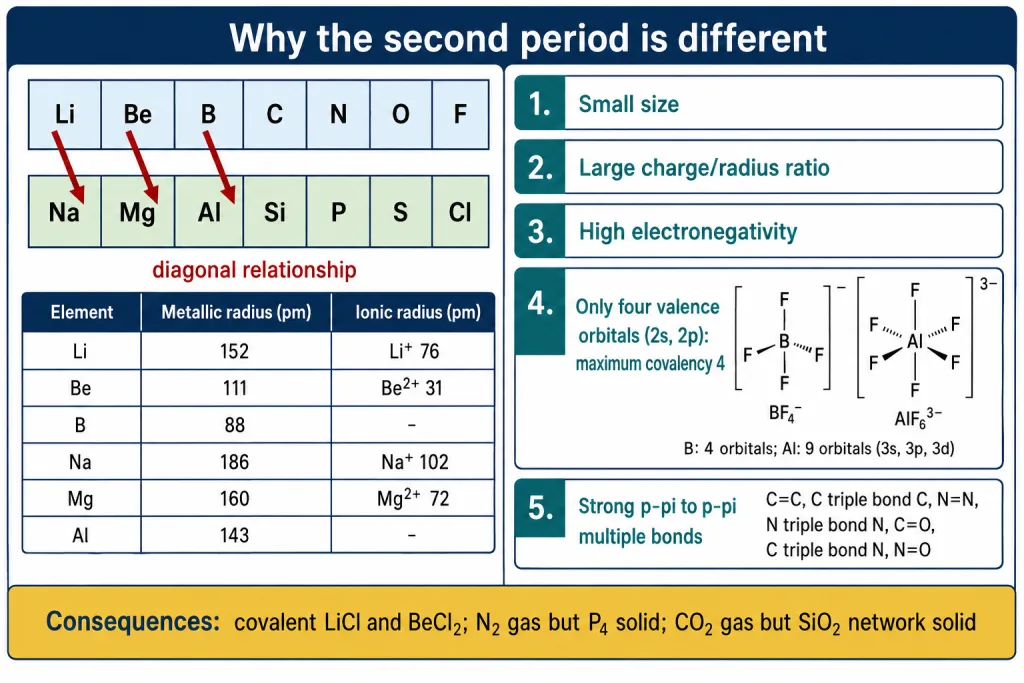
Key Point (Definition): The similarity between the first element of a group and the second element of the next group — Li with Mg, Be with Al, and B with Si — is called the diagonal relationship. The pairs sit diagonally across the table, one step right and one step down.
Why the second period is special — the three size-based reasons
The anomalous behaviour is attributed to three closely linked features: small size, a large charge-to-radius ratio, and high electronegativity compared with the rest of the group.
| Property | Li | Be | B | Na | Mg | Al |
|---|---|---|---|---|---|---|
| Metallic radius (pm) | 152 | 111 | 88 | 186 | 160 | 143 |
| Ionic radius of (pm) | 76 | 31 | — | 102 | 72 | — |
| Electronegativity (Pauling) | 1.0 | 1.5 | 2.0 | 0.9 | 1.2 | 1.5 |
at 76 pm is closer in size to (72 pm) than to (102 pm), and at 31 pm is tiny. A small, highly charged cation like has a very large charge/radius ratio, and such an ion strongly pulls the electron cloud of a neighbouring anion towards itself. That distortion (called polarisation in the Chemical Bonding chapter) turns an ionic bond partly covalent. The bigger, softer cations and do not distort their anions much, so their compounds stay ionic.
The diagonal relationship follows. Going down a group makes the cation bigger, dropping the charge/radius ratio; going one group to the right raises the charge and pushes the ratio up. Moving diagonally, the two effects roughly cancel, so and end up with similar ratios and similar chemistry. The electronegativity row agrees: Li 1.0 is closer to Mg 1.2 than Na 0.9 is; Be 1.5 exactly matches Al 1.5.
[Board] "Give three reasons for the anomalous behaviour of second-period elements": small size, large charge/radius ratio, high electronegativity — plus the orbital reason, only four valence orbitals and so a maximum covalency of 4. Naming the diagonal pairs Li-Mg and Be-Al earns the last mark.
[JEE/NEET] Three things Li shares with Mg and not with Na: its nitride (, like ; Na does not form a nitride directly), its carbonate decomposing on heating to the oxide (like ; is stable), and its nitrate decomposing to the oxide rather than the nitrite. Three things Be shares with Al: an amphoteric oxide and hydroxide, covalent chlorides existing as bridged dimers or chains, and a protective oxide layer that makes the metal resist acids.
Four Orbitals Only: Maximum Covalency, and Multiple Bonds
A second, separate reason for the second period's odd behaviour comes purely from counting orbitals.
Only 2s and 2p are available
The first member of each group has valence shell : one orbital and three orbitals — four valence orbitals, with no (the subshell begins only at ). Four orbitals hold at most four electron pairs, so the atom forms at most four covalent bonds.
The second member of each group is in period 3, with , and orbitals — nine valence orbitals. Such atoms can expand their valence shell beyond eight electrons.
Key Point: The maximum covalency of a second-period element is 4, because it has only four valence orbitals ( and three ). Elements from the third period onward can show covalencies of 5, 6 or more, using empty orbitals.
The classic pair is boron versus aluminium with fluoride. Boron forms (tetrafluoroborate) — four fluorines, four pairs, all four orbitals used, no way to attach a fifth. Aluminium forms (hexafluoroaluminate), using its orbitals as well.
| Element | Period | Valence orbitals | Maximum covalency | Fluoro-complex |
|---|---|---|---|---|
| B | 2 | , (4) | 4 | |
| Al | 3 | , , (9) | 6 | |
| N | 2 | , (4) | 4 | (no ) |
| P | 3 | , , (9) | 6 | , |
| O | 2 | , (4) | 4 | (no ) |
| S | 3 | , , (9) | 6 |
The same reasoning explains why nitrogen stops at while phosphorus goes on to , and why oxygen stops at while sulphur reaches . A period-2 element can show its higher valence (5 for N, 7 for Cl-type) only with oxygen, through multiple bonding and charge separation as in and , never by attaching five separate halogen atoms.
Oxidation state versus covalency
Take the ion . Aluminium is bonded to one chloride and five water molecules — six bonds, so its covalency is 6. Its oxidation state comes from charges: the water molecules are neutral, the chloride is , the whole ion is , so aluminium is . Same atom, oxidation state , covalency 6. Question 7 below works this through.
Stronger multiple bonds: - bonding
The last special feature of the second-period p-block elements is their greater ability to form - multiple bonds — with themselves (, , , ) and with other second-period elements (, , , ). A bond needs two orbitals to overlap sideways. Second-period atoms are small, so their orbitals are close enough for strong sideways overlap. Third-period atoms are bigger; their orbitals are more diffuse and further apart, the overlap is weak, and silicon, phosphorus and sulphur prefer more single bonds instead.
That one fact explains a lot:
- Nitrogen is , a tiny triple-bonded gas; phosphorus is , a solid tetrahedron of single bonds.
- Oxygen is ; sulphur is , a crown of single bonds.
- is a gas of discrete molecules; is a giant three-dimensional network of single bonds and melts above 1600 C.
Key Point: Second-period anomalies — (1) small size, (2) large charge/radius ratio, (3) high electronegativity, (4) only four valence orbitals, hence maximum covalency 4, (5) strong - multiple bonding. Consequences: covalent character in Li and Be compounds, the diagonal relationship (Li/Mg, Be/Al, B/Si), but , but , gaseous but solid .
[JEE Main] Of , , and , the one that does not exist is — nitrogen has no orbitals and cannot hold five bonding pairs. Nitrogen does show in , but there its covalency is still 4 (three sigma bonds and one bond in the unit, with a formal positive charge), not 5.
From Trends to Reactivity: Where the Elements Are Most Reactive
Radii, ionization enthalpy, electron gain enthalpy, electronegativity and valence all follow from the electronic configuration, so chemical reactivity follows a periodic pattern too.
Across a period
Left to right across a period the atomic radius shrinks. The outer electrons are held closer, so the ionization enthalpy generally increases (with the Be/B and N/O exceptions) and the electron gain enthalpy becomes more negative (noble gases aside — their filled shells give them positive values).
- The element at the extreme left (an alkali metal) has the lowest ionization enthalpy in the period. It gives away its single electron easily and forms a cation — a good electron donor, or reducing agent.
- The element at the extreme right (a halogen) has the most negative electron gain enthalpy in the period. It accepts an electron easily and forms an anion — a good electron acceptor, or oxidising agent.
- The elements in the middle (carbon, silicon and their neighbours) are neither good at losing electrons (fairly high ionization enthalpies) nor at gaining them (only mildly negative electron gain enthalpies). They mostly share electrons and are the least reactive of the period.
Key Point: Chemical reactivity is highest at the two extremes of a period and lowest in the centre. On the left it comes from the ease of losing an electron (low , cation formation, reducing behaviour); on the right from the ease of gaining one (large negative , anion formation, oxidising behaviour).
The same reasoning gives metallic and non-metallic character. A metal tends to lose electrons, so metallic character is highest at the extreme left and decreases across the period, while non-metallic character increases left to right. In the third period: Na, Mg, Al are metals, Si is a metalloid, and P, S, Cl are non-metals.
| Period 3 element | Na | Mg | Al | Si | P | S | Cl |
|---|---|---|---|---|---|---|---|
| Atomic radius (pm) | 186 | 160 | 143 | 117 | 110 | 104 | 99 |
| () | 496 | 737 | 577 | 786 | 1012 | 1000 | 1251 |
| Electronegativity | 0.9 | 1.2 | 1.5 | 1.8 | 2.1 | 2.5 | 3.0 |
| Character | metal | metal | metal | metalloid | non-metal | non-metal | non-metal |
| Reactivity type | loses (strong reducing) | loses | loses | shares | shares/gains | gains | gains (strong oxidising) |
Down a group
Within a group the atomic and ionic radii increase with atomic number as new shells are added, giving a gradual decrease in ionization enthalpy and — for the main-group elements — a regular decrease in the magnitude of electron gain enthalpy (with the well-known exceptions in the second period: O less negative than S, F less negative than Cl).
For the metals of groups 1 and 2, a lower ionization enthalpy means the outer electron is lost even more easily, so reactivity increases down the group: Li < Na < K < Rb < Cs. Metallic character increases and non-metallic character decreases going down.
For the non-metals of group 17, the ability to attract and hold an extra electron falls as the atom gets bigger and the incoming electron sits further from the nucleus, so oxidising reactivity decreases down the group: F > Cl > Br > I. (Fluorine's electron gain enthalpy, , is slightly less negative than chlorine's because of repulsion in its compact shell, yet fluorine is still the most reactive halogen — the small size of F and the weak F-F bond in more than compensate.)
Key Point: Down a group of main-group elements, metallic character increases and non-metallic character decreases. Alkali metals get more reactive down the group (Cs is the most reactive); halogens get less reactive down the group (F is the most reactive).
The transition metals are the calm middle
Among the 3d transition metals the change in atomic radius across the period is much smaller than among the representative elements, because the added electrons go into the inner subshell and partly shield the outer electrons; among the 4f inner-transition metals the change is smaller still. Their ionization enthalpies are intermediate between those of the s- and p-blocks, so they are less electropositive than the group 1 and 2 metals — iron does not fizz in water the way sodium does. For the transition elements the group trend in reactivity is actually reversed: the heavier members (e.g. Au, Pt) are less reactive than the lighter ones (Cu, Ni), explained by their small size increase and higher ionization enthalpies.
[NEET] Order of metallic character among B, Al, Mg and K: K > Mg > Al > B. Order of non-metallic character among B, C, N, F and Si: F > N > C > B > Si. Order of oxidising power among F, Cl, O and N: F > Cl > O > N.
Reaction with Oxygen: Basic, Amphoteric, Neutral and Acidic Oxides
An element's reactivity shows up in its reactions with oxygen and with the halogens. The oxides give a second periodic pattern: their acid-base character.
Elements at the two extremes of a period combine readily with oxygen, but what they form differs completely in character.
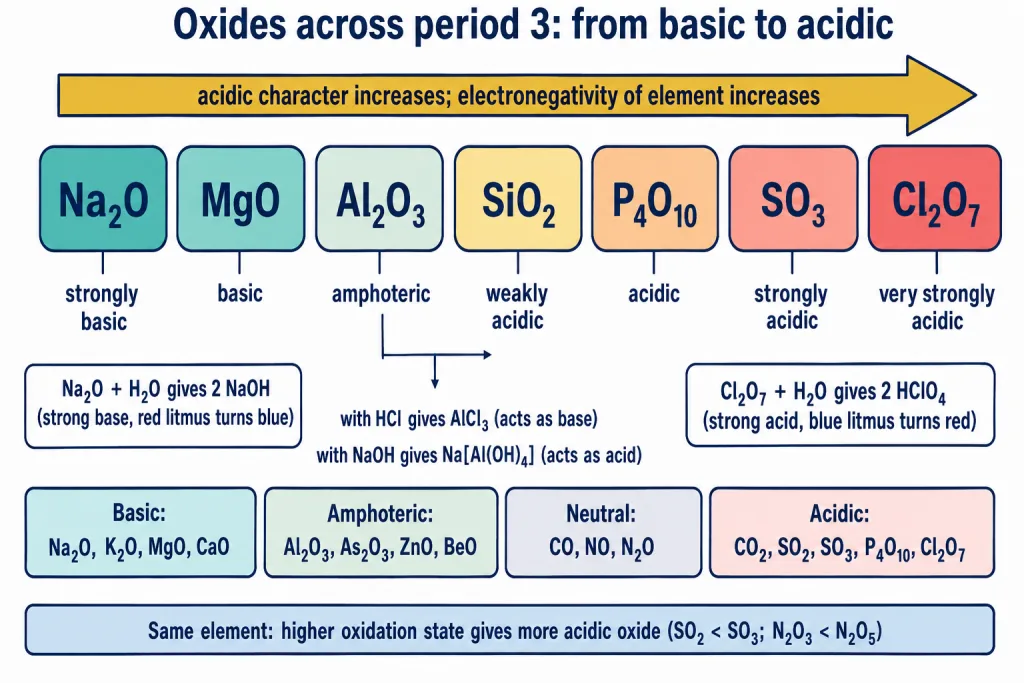
- The normal oxide of the element on the extreme left is the most basic. Sodium oxide, , dissolves in water to give a strong base:
- The oxide of the element on the extreme right is the most acidic. Dichlorine heptoxide, , dissolves in water to give a strong acid:
- The oxides of the elements in the centre are either amphoteric — for example and — or neutral — for example , and .
Key Point (Definition): An amphoteric oxide behaves as an acid towards bases and as a base towards acids. A neutral oxide has neither acidic nor basic properties — it does not react with acids, bases or water to give a salt.
Aluminium oxide shows the amphoteric behaviour on both sides:
A soluble oxide can be tested with litmus paper: the solution from turns red litmus blue, the solution from turns blue litmus red.
The whole of period 3 in one row
| Oxide | |||||||
|---|---|---|---|---|---|---|---|
| Character | strongly basic | basic | amphoteric | weakly acidic | acidic | strongly acidic | very strongly acidic |
| With water gives | (strong base) | (weak base, sparingly soluble) | insoluble | insoluble (reacts with alkali) | |||
| Bonding | ionic | ionic | ionic with covalent character | giant covalent | molecular covalent | molecular covalent | molecular covalent |
Acidity increases steadily from left to right as the element becomes more electronegative and its oxide more covalent. The switch from basic to acidic happens at aluminium, the amphoteric hinge.
Why electronegativity decides it
Consider an oxide meeting water. If E is a metal of low electronegativity, the bond is ionic; oxide ion is released and grabs a proton from water, giving — a base. If E is a non-metal of high electronegativity, the bond is covalent and E pulls electron density away from any attached group, so the bond breaks to release — an acid. Elements of intermediate electronegativity (Al 1.5, As 2.0) go either way: amphoteric.
The same logic works down a group: as the element becomes more metallic, its oxide becomes more basic. In group 15, and are acidic, and are amphoteric, and is basic. And for one element with several oxides, the higher the oxidation state the more acidic the oxide: is more acidic than ; more than ; more than ; and among manganese oxides is basic while is acidic.
| Class | Examples | Behaviour with water | Litmus |
|---|---|---|---|
| Basic | , , , , | give hydroxides (bases) | red → blue |
| Amphoteric | , , , , , , | react with both acids and bases | no change (insoluble) |
| Neutral | , , , | no salt with acid or base | no change |
| Acidic | , , , , , , | give oxoacids | blue → red |
[NEET] The three neutral oxides all come from period 2 non-metals in low oxidation states: , , . Do not put or in the neutral list — both are acidic. The two amphoteric oxides named in the chapter are and ; , , and are the other classics.
Solved Examples
Question 1: Formulas of compounds of silicon with bromine, and aluminium with sulphur
Using the periodic table, predict the formulas of the compounds that might be formed by (a) silicon and bromine, (b) aluminium and sulphur.
Answer:
I start with each element's group and valence. Silicon is in group 14 with four outer electrons (), so valence 4. Bromine is in group 17 with seven outer electrons and needs one more, so valence . Crossing these, one silicon needs four bromines: .
Aluminium is group 13, valence 3; sulphur is group 16 with six outer electrons, valence . The smallest numbers that balance 3 and 2 are two aluminiums () and three sulphurs (): .
Ans: (a) ; (b) .
Watch out: Cross the valences and then simplify — a 4-and-2 pair gives , not .
Question 2: Oxidation state of oxygen in and
Oxygen shows valence 2 in both and . Work out its oxidation state in each compound and explain why the two answers differ.
Answer:
First I order the electronegativities: F (4.0) > O (3.5) > Na (0.9). In any bond the more electronegative atom gets the shared electrons.
In fluorine wins, so each of the two O-F bonds counts as oxygen losing one electron. Two lost electrons make oxygen and each fluorine . Check: .
In oxygen wins. It takes one electron from each sodium (), so oxygen is and each sodium . Check: .
Valence only counts bonds — two in each case. Oxidation state also asks which way the bonding electrons are pulled, so it carries a sign.
Ans: O is in and in ; F is and Na is . The oxidation state is the charge an atom is taken to have when each bonding pair is handed to the more electronegative atom.
Watch out: Valence has no sign; oxidation state does, and the sign is decided by electronegativity.
Question 3: Stable binary compounds of six element pairs
Predict the formulas of the stable binary compounds formed by (a) lithium and oxygen, (b) magnesium and nitrogen, (c) aluminium and iodine, (d) silicon and oxygen, (e) phosphorus and fluorine, (f) element 71 and fluorine.
Answer:
I take each pair and cross the valences.
- Li (group 1, valence 1) + O (group 16, valence 2): two Li per O, .
- Mg (valence 2) + N (group 15, valence 3): three Mg () and two N (), .
- Al (valence 3) + I (valence 1): .
- Si (valence 4) + O (valence 2): the 4 : 2 ratio simplifies to 2 : 1, .
- P (valence 3 or 5) + F (valence 1): phosphorus shows both valences with fluorine, giving and . The second is possible because phosphorus, a third-period element, has empty orbitals and can hold five bonding pairs.
- Element 71 is lutetium, the last lanthanoid, with the stable state typical of the f-block: .
Ans: (a) (b) (c) (d) (e) and (f) .
Watch out: For group 15-17 elements below period 2, expect two possible valences with a very electronegative partner like fluorine; for the lanthanoids, expect .
Question 4: Hydride and oxides of the element with
An element has atomic number 33. Locate it in the periodic table and write the formulas of its hydride and its two oxides. State the valence of the element in each.
Answer:
I write the configuration first: gives . The last electron entered a orbital, so it is a p-block element; the outer shell is , so period 4; the group is . This is arsenic.
Group 15 has five outer electrons, so the ordinary valence is . With hydrogen (valence 1) the hydride is , like and above it. Valence 3.
Valence 3 with oxygen (valence 2) gives the lower oxide . Arsenic can also use all five outer electrons with oxygen, giving , valence 5.
From the table of oxides, is one of the two amphoteric oxides named in the chapter; , in the higher oxidation state, is acidic.
Ans: Arsenic, period 4, group 15. Hydride (valence 3); oxides (valence 3, amphoteric) and (valence 5, acidic).
Watch out: Group 15 gives , and from N to Bi — but Bi stops at the oxide.
Question 5: Why lithium and beryllium form covalent compounds
Lithium and beryllium form compounds with pronounced covalent character while the other alkali and alkaline earth metals form ionic compounds. Explain, and name the elements that lithium and beryllium actually resemble.
Answer:
I start from the sizes. is 76 pm against 102 pm; is only 31 pm against 72 pm.
A small ion packs its charge into a tiny volume, so its charge-to-radius ratio is large. , with two units of charge on a 31 pm ball, is an extreme case. Such a cation strongly pulls the electron cloud of a neighbouring anion towards itself, so the shared electron density sits partly between the two atoms and the bond picks up covalent character. Bigger, softer cations like and distort their anions far less, so their compounds stay ionic.
Electronegativity backs this up: Li (1.0) and Be (1.5) are the most electronegative members of their groups, so the gap between them and a non-metal is smaller and the bond less polar than for Na (0.9) or Mg (1.2).
Moving one step right and one step down roughly restores the charge/radius ratio: (76 pm, charge 1) behaves like (72 pm, charge 2), and behaves like . This is the diagonal relationship.
Ans: Because of their small size, large charge/radius ratio and high electronegativity, Li and Be polarise anions and form covalent-type compounds. Lithium resembles magnesium and beryllium resembles aluminium — the diagonal relationship.
Question 6: exists but does not, while does
Boron forms but not , whereas aluminium readily forms . Explain.
Answer:
I count boron's valence orbitals. Boron is in period 2, so its valence shell is : one and three orbitals, four in all, with no subshell.
Each covalent bond needs one orbital on boron to hold a shared pair, so four orbitals allow at most four bonds. In all four are used ( plus one donating a pair into boron's last empty orbital). A fifth or sixth fluoride has nowhere to attach.
Aluminium is in period 3: , three and five orbitals, nine in all. It can expand its valence shell beyond eight electrons, so it holds six fluorides and forms (covalency 6).
Ans: The maximum covalency of a second-period element is 4 because it has only four valence orbitals (, ); third-period elements have nine (, , ) and can show covalency 6. Hence but .
Watch out: The same argument explains but , and but .
Question 7: Oxidation state and covalency of Al in
Are the oxidation state and covalency of aluminium in the same?
Answer:
Covalency is the number of bonds aluminium makes. Inside the bracket it is joined to one chloride and five water molecules — six shared pairs, so covalency 6. Six is allowed because aluminium is a third-period element with orbitals.
Oxidation state comes from charge bookkeeping. Each water molecule is neutral (0), chloride is , and the whole ion carries . So , giving .
The two numbers differ because oxidation state counts electrons formally gained or lost, while covalency counts shared pairs regardless of where they came from.
Ans: No. The oxidation state of Al is and its covalency is 6.
Watch out: Covalency can exceed oxidation state whenever some bonds are made with pairs donated by the ligand (coordinate bonds), as with the five water molecules here.
Question 8: Why nitrogen is but phosphorus is
Nitrogen exists as a diatomic gas with a triple bond, while phosphorus exists as molecules with single bonds. Similarly is a gas but is a hard, high-melting solid. Explain both facts with one idea.
Answer:
A double or triple bond contains bonds, and a - bond forms when two orbitals on neighbouring atoms overlap sideways.
Second-period atoms are small. Nitrogen (74 pm) and carbon (77 pm) bring their orbitals very close to a neighbour's, so the sideways overlap is strong and the bonds are stable: nitrogen makes (one plus two ), carbon makes .
Third-period atoms are bigger. Phosphorus (110 pm) and silicon (117 pm) have larger, more diffuse orbitals held further apart, so overlap is weak and and bonds are not worth making. They make single bonds instead: phosphorus satisfies its valence of 3 with three single bonds in a tetrahedron, and silicon its valence of 4 with four single bonds that link into a giant three-dimensional network — a solid melting above 1600 C, while stays a gas of small separate molecules.
Ans: Second-period elements form strong - multiple bonds because their small orbitals overlap sideways effectively; third-period elements cannot, so they prefer more single bonds — versus , and molecular versus network .
Question 9: Reactivity order in group 1 versus group 17
The increasing order of reactivity among group 1 elements is Li < Na < K < Rb < Cs, whereas that among group 17 elements is F > Cl > Br > I. Explain why the two groups run in opposite directions.
Answer:
An alkali metal reacts by losing its single electron to form ; a halogen reacts by gaining one electron to complete its shell and form . The two react in opposite ways, so the same size trend pushes them in opposite directions.
Down group 1 the atom gets bigger (Li 152 pm, Na 186 pm, K 231 pm, Rb 244 pm, Cs 262 pm) and the outer electron is further from the nucleus and better shielded. Ionization enthalpy falls, the electron comes off more easily, and reactivity rises: Li < Na < K < Rb < Cs. Caesium is the most reactive metal.
Down group 17 the atom also gets bigger (F 64 pm, Cl 99 pm, Br 114 pm, I 133 pm). The incoming electron enters a shell further from the nucleus and is attracted less strongly, so the electron gain enthalpy becomes less negative from Cl to I (, , ) and the tendency to gain an electron drops: F > Cl > Br > I.
Fluorine needs a separate note. Its electron gain enthalpy () is slightly less negative than chlorine's () because of electron repulsion in its very compact shell. Even so, fluorine is the most reactive halogen — it is the smallest and most electronegative, and the F-F bond is unusually weak, so splits and reacts more readily than .
Ans: Alkali metals react by losing an electron, which gets easier as size increases and ionization enthalpy falls, so reactivity increases down group 1. Halogens react by gaining an electron, which gets harder as size increases and the electron gain enthalpy becomes less negative, so reactivity decreases down group 17.
Watch out: Decide first whether the element reacts by losing or gaining an electron; the direction of the size trend then gives the direction of the reactivity trend.
Question 10: Identifying elements from ionization and electron gain enthalpy data
The first and second ionization enthalpies (in ) and the electron gain enthalpy (in ) of six elements are:
| Element | |||
|---|---|---|---|
| I | 520 | 7300 | |
| II | 419 | 3051 | |
| III | 1681 | 3374 | |
| IV | 1008 | 1846 | |
| V | 2372 | 5251 | |
| VI | 738 | 1451 |
Which of these is likely to be (a) the least reactive element, (b) the most reactive metal, (c) the most reactive non-metal, (d) the least reactive non-metal, (e) the metal that forms a stable binary halide , (f) the metal that forms a predominantly covalent halide ?
Answer:
First I sort the data into types. Low with a mildly negative means a metal (I, II, VI). High with a strongly negative means a non-metal (III, IV). A very high with a positive means a noble gas (V).
(a) V. With , the highest here, it will not lose an electron, and with it will not accept one — helium's values.
(b) II. Of the metals it has the lowest first ionization enthalpy (419). The jump to 3051 for the second electron says that electron comes from a noble-gas core, so it is a group 1 metal — potassium's values.
(c) III. Most negative electron gain enthalpy () with a very high (1681) — fluorine's values.
(d) IV. Still a non-metal () but with a lower (1008) and a less negative than III — a heavier halogen, matching iodine.
(e) VI. A stable needs a metal that loses two electrons comfortably. VI has and : the second is less than twice the first, with no big jump. Group 2, magnesium. In I and II the second ionization enthalpy is many times the first.
(f) I. , fourteen times , marks a group 1 metal. Among group 1 metals the one with covalent halides is the smallest, lithium — and 520 is lithium's first ionization enthalpy, the highest in the group.
Ans: (a) V (b) II (c) III (d) IV (e) VI (f) I.
Watch out: Read three signals — the size of , the jump from to , and the sign and size of .
Question 11: Showing that is basic and is acidic
Show by chemical reactions with water that is a basic oxide and is an acidic oxide. Then classify the following as basic, amphoteric, neutral or acidic: , , , , , , .
Answer:
Sodium sits at the extreme left of period 3; its oxide is ionic and gives hydroxide ions in water: The product is a strong base and red litmus turns blue, so is basic.
Chlorine sits at the extreme right (excluding the noble gas); its oxide is covalent and gives an oxoacid: Perchloric acid is a very strong acid and blue litmus turns red, so is acidic.
Now I classify the rest by position and oxidation state. : group 2 metal oxide, basic. : centre of period 3, reacts with both acids and bases, amphoteric. : carbon in the low state, neutral. : non-metal in its highest state (), acidic (gives ). : arsenic is a metalloid in the middle of the p-block, amphoteric. : nitrogen in the state, neutral. : phosphorus in the state, acidic (gives ).
Ans: (basic); (acidic). Basic: . Amphoteric: , . Neutral: , . Acidic: , .
Watch out: Metal oxide → basic; non-metal oxide → acidic; the hinge elements in the middle (Al, As, Zn, Be, Sn, Pb) → amphoteric; CO, NO, NO → neutral.
Question 12: Oxidising power of F, Cl, O and N
Arrange fluorine, chlorine, oxygen and nitrogen in decreasing order of chemical reactivity in terms of oxidising property, and justify the order.
Answer:
An oxidising agent takes electrons, so the stronger the pull on an extra electron — high electronegativity, strongly negative electron gain enthalpy, small size — the better the oxidiser.
Across period 2, F (electronegativity 4.0, ) beats O (3.5, ), which beats N (3.0, whose half-filled shell makes it reluctant to take an electron). So F > O > N.
Chlorine (3.0, ) has the most negative electron gain enthalpy of all four, yet it is a weaker oxidiser than fluorine because fluorine's tiny size, higher electronegativity and weak F-F bond make it more reactive overall. Chlorine is still a far better electron acceptor than oxygen ( against ) and nitrogen.
Ans: F > Cl > O > N.
Watch out: Do not let chlorine's more negative tempt you to put it above fluorine.