
Four Blocks: Ask Where the Last Electron Went
The configuration also sorts the whole table into four families. Build up the configuration electron by electron and look at the last electron added. The type of orbital it entered gives the element's block.
Key Point (Definition): The elements are classified into the s-block, p-block, d-block and f-block according to the type of atomic orbital (, , or ) that is being filled with electrons — that is, the orbital that receives the last (differentiating) electron.
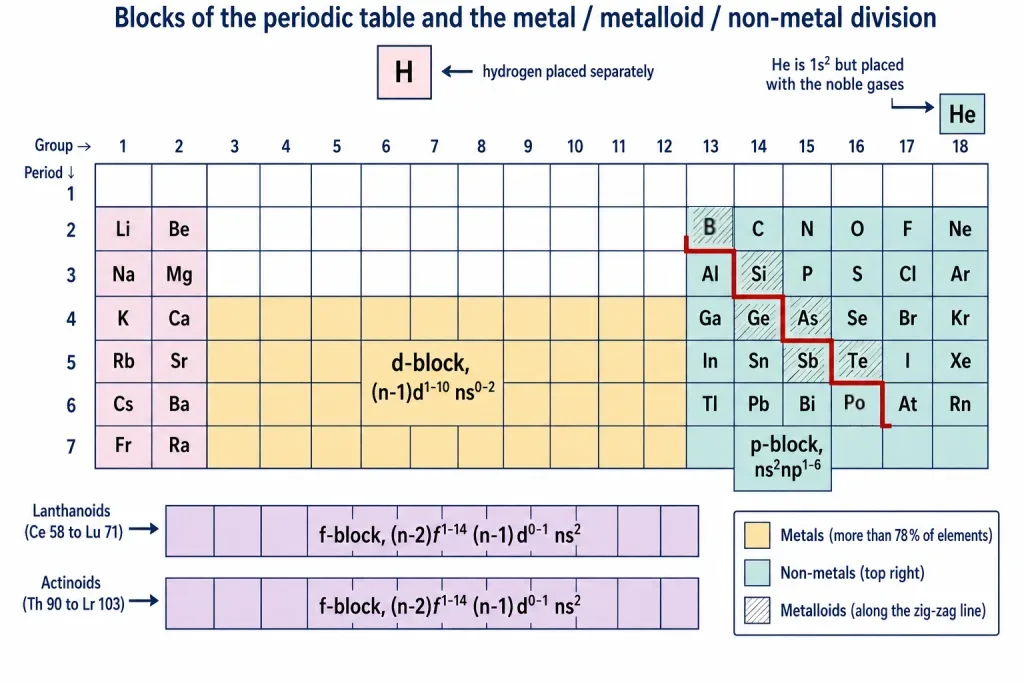
The long form of the table is a picture of the aufbau principle. Read a period left to right and you are watching orbitals fill in energy order. The two columns on the far left are the orbital filling; the six on the far right are the orbitals; the ten in the middle, from the fourth period onward, are the orbitals; the fourteen-element rows at the bottom are the orbitals. Each block's width equals the capacity of that subshell.
| Block | Orbital receiving the last electron | Groups | Number of columns | Why that many |
|---|---|---|---|---|
| s | 1, 2 | 2 | one orbital holds 2 electrons | |
| p | 13 to 18 | 6 | three orbitals hold 6 electrons | |
| d | 3 to 12 | 10 | five orbitals hold 10 electrons | |
| f | (lanthanoids and actinoids, placed under group 3) | 14 | seven orbitals hold 14 electrons |
Each block has as many columns as the number of electrons its subshell can hold. The p-block has 6 columns, not 8; the d-block has 10, not 8. An option claiming "the d-block has 8 columns because 8 electrons can occupy a d-subshell" is wrong on both counts.
The block also tells you the azimuthal quantum number
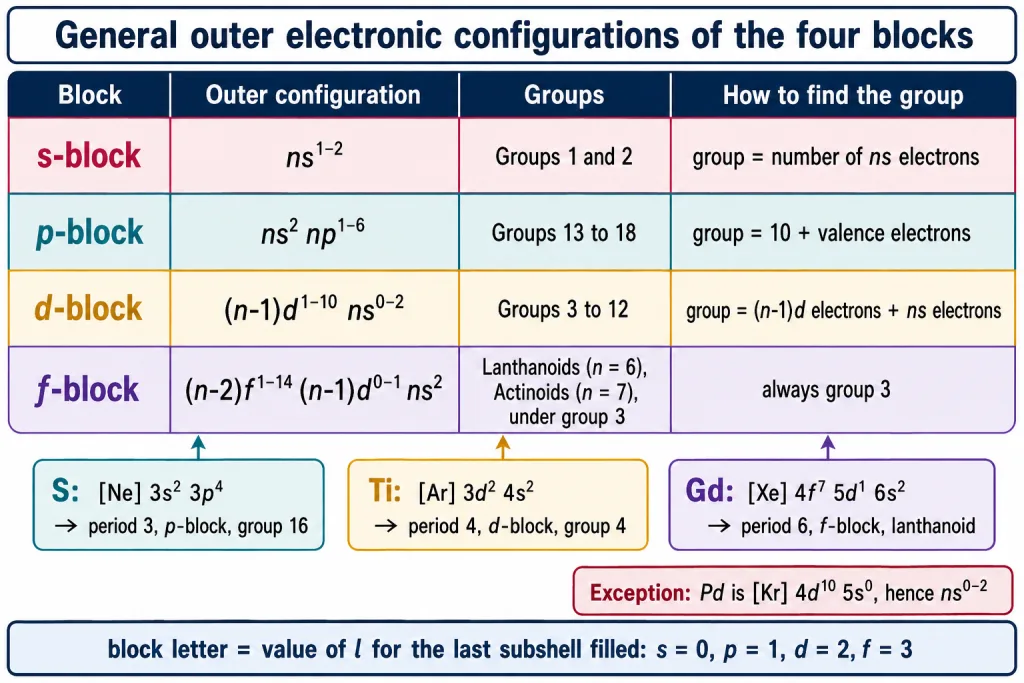
The block letter is the value of for the last subshell filled: s-block , p-block , d-block , f-block . The period number gives . So "period 4, d-block" says the last electron went into an orbital with and , a 3d orbital.
[Board] "The block indicates the value of the azimuthal quantum number of the last subshell filled" is a correct statement, and so is "the period indicates the value of the principal quantum number".
A quick check with three elements
- Sodium, : . Last electron in 3s. s-block, period 3, group 1.
- Chlorine, : . Last electron in 3p. p-block, period 3.
- Iron, : . By aufbau, 4s filled first and the last electron went into 3d. d-block, period 4 (the outermost shell is , even though the differentiating electron is in ).
The third bullet is where students slip. The period comes from the highest occupied (4s, so period 4). The block comes from the orbital that received the last electron (3d, so d-block).
Two elements refuse to fit this scheme — hydrogen and helium — and they get their own discussion later.
The s-Block: Groups 1 and 2
Group 1 is the alkali metals (Li, Na, K, Rb, Cs, Fr), outer configuration ; Group 2 is the alkaline earth metals (Be, Mg, Ca, Sr, Ba, Ra), . In both, the last electron entered an orbital of the outermost shell.
Key Point (Definition): The elements of Group 1 (alkali metals, ) and Group 2 (alkaline earth metals, ) constitute the s-block elements.
Why the s-block is so reactive
A sodium atom is a neon core with one 3s electron far outside it, shielded by the ten inner electrons and feeling only a small effective nuclear charge. It is held loosely — sodium's first ionization enthalpy is only 496 kJ/mol, among the lowest in its period — and losing it leaves the stable noble-gas core, so forms readily. Magnesium loses two 3s electrons (first ionization enthalpy 737 kJ/mol) to give .
Key Point: s-block elements are all reactive metals with low ionization enthalpies. They lose their outermost electron(s) readily to form (alkali metals) or (alkaline earth metals). Because of this high reactivity they are never found free (pure) in nature — always combined, as chlorides, carbonates, sulphates and so on.
Down the group: bigger, softer, more reactive
Down group 1 from Li to Cs the outer electron sits in a higher shell (, , , , ), further from the nucleus and behind more shielding, so it gets easier to remove.
Caesium reacts explosively with water; lithium only fizzes. The same runs down group 2 from Be to Ba.
Their compounds are ionic — except for Li and Be
The s-block metal hands over its electron(s) completely, so its compounds are built from ions — , , — and are predominantly ionic.
The exceptions are the first members, lithium and beryllium. Their ions (, 76 pm; , 31 pm) are tiny and carry a high charge for their size, so they pull hard on a neighbouring anion's electron cloud and give the bond covalent character. is a covalent chain-forming solid, and dissolves in ethanol while does not. This returns as the anomalous behaviour of the first member and the diagonal relationship (Li resembles Mg, Be resembles Al).
[NEET] s-block elements are (i) reactive metals with low ionization enthalpies, (ii) never found pure in nature, (iii) form predominantly ionic compounds except lithium and beryllium.
s-block at a glance
| Feature | Group 1 (alkali metals) | Group 2 (alkaline earth metals) |
|---|---|---|
| Outer configuration | ||
| Ion formed | ||
| Members | Li, Na, K, Rb, Cs, Fr | Be, Mg, Ca, Sr, Ba, Ra |
| First ionization enthalpy | very low (Na 496 kJ/mol) | low, but higher than group 1 (Mg 737 kJ/mol) |
| Nature of compounds | ionic (Li shows covalent character) | ionic (Be shows covalent character) |
| Trend down the group | reactivity and metallic character increase | reactivity and metallic character increase |
| Found free in nature? | never | never |
The s-block and p-block together are called the representative or main group elements.
The p-Block: Groups 13 to 18
Six columns on the right, groups 13 through 18, in which the last electron enters a orbital of the outermost shell. The p-block holds the most varied chemistry on the table: metals (aluminium, lead), metalloids (silicon), non-metals (carbon, nitrogen, oxygen, the halogens) and the noble gases.
Key Point (Definition): The p-block elements are those of Groups 13 to 18. Their outermost configuration runs from (group 13) to (group 18) in each period. The s-block and p-block elements together are called the representative elements or main group elements.
| Group | Outer configuration | Family name | Second-period member |
|---|---|---|---|
| 13 | boron family | B | |
| 14 | carbon family | C | |
| 15 | nitrogen family (pnictogens) | N | |
| 16 | chalcogens | O | |
| 17 | halogens | F | |
| 18 | noble gases | Ne |
A useful rule: group number = 10 + (number of valence electrons). Chlorine has 7 valence electrons (), so group 17. Silicon has 4 (), group 14.
The noble gases: a closed shell and very little chemistry
Every period ends with a noble gas whose valence shell is completely filled, (helium is but behaves the same way). Such a shell is hard to disturb, either by adding an electron (no room) or by removing one (noble gases have the highest ionization enthalpies in their periods), so noble gases show very low chemical reactivity. Their electron gain enthalpies are positive — helium +48 kJ/mol, neon +116 kJ/mol — because the incoming electron would have to start a new shell.
Halogens and chalcogens: one or two electrons short
- Halogens (group 17), : one electron short of a noble-gas shell. They take up an electron to form and release a lot of energy — electron gain enthalpies are highly negative: F , Cl , Br , I kJ/mol.
- Chalcogens (group 16), : two electrons short. They add one or two electrons (O , S kJ/mol for the first) to reach the noble-gas configuration, giving ions such as and .
Key Point: Halogens (group 17) and chalcogens (group 16) have highly negative electron gain enthalpies and readily add one or two electrons respectively to attain the stable noble-gas configuration.
Two trends that run through the p-block
- Non-metallic character increases from left to right across a period.
- Metallic character increases down a group.
Group 14 shows the down-the-group version: carbon (non-metal), silicon and germanium (metalloids), tin and lead (metals). Period 3 shows the across-the-period version: aluminium (metal), silicon (metalloid), phosphorus, sulphur, chlorine (non-metals). The p-block is the only block that crosses that boundary, so the zig-zag line separating metals from non-metals lies entirely inside it.
[JEE Main] Group 18 is a "closed shell" only in the sense that the valence shell is full. Do not write for helium — helium is and there is no . Its placement in group 18 rests on its behaviour, not its configuration.
The d-Block and the f-Block: Transition and Inner Transition Elements
The d-block, groups 3 to 12
Between the s-block and the p-block lie ten columns, groups 3 to 12, in which electrons fill an inner subshell, the orbitals, while the outer shell is already occupied — the d-block elements, or transition elements.
Key Point (Definition): The d-block elements (groups 3 to 12) are characterised by the filling of the inner orbitals. Their general outer electronic configuration is . All of them are metals.
The part matters. Most transition metals have (Sc , Fe ), a few have (Cr , Cu ), and palladium has none: .
Three series of ten fill the fourth, fifth and sixth periods (3d, 4d, 5d), and a fourth (6d) fills the seventh. For the group, add the and electrons: iron gives , group 8; zinc gives 12, group 12.
What makes a transition metal "transition"?
Partly filled orbitals lie behind almost everything characteristic of these elements:
| Property | Why partly filled d orbitals cause it |
|---|---|
| Coloured ions ( blue, yellow-brown, green) | electrons hop between d orbitals of slightly different energy by absorbing visible light |
| Variable valence (oxidation states) (, ; Mn from +2 to +7) | and electrons are close in energy, so different numbers can be lost |
| Paramagnetism | unpaired d electrons behave like tiny magnets |
| Catalytic activity (Fe in Haber process, VO in contact process, Ni in hydrogenation) | variable oxidation states and a surface that can hold reactants |
So: all metals, mostly coloured ions, variable valence, often paramagnetic, frequently catalysts.
Zn, Cd and Hg: in the block, but not typical
Group 12: , , . The subshell is completely full, , in the atom and in the common ion — so no colour, no easy second oxidation state, no unpaired electrons. Zinc salts are white, is diamagnetic, and zinc shows only .
Key Point: Zn, Cd and Hg, with the configuration , do not show most of the properties of transition elements. They are placed in the d-block by position but are not typical transition metals.
Where the name comes from
The s-block metals on the left are fiercely reactive; the metals of groups 13 and 14 are far less active. The d-block metals in between are moderately reactive: iron rusts slowly, copper, silver and gold barely react. They form a bridge between the chemically active metals of the s-block and the less active elements of groups 13 and 14.
The f-block: the two rows at the bottom
Key Point (Definition): The lanthanoids, Ce () to Lu (), and the actinoids, Th () to Lr (), have the outer configuration . The last electron enters an orbital, two shells inside the outermost — hence they are called the inner transition elements or f-block elements.
For the lanthanoids , so the 4f orbitals fill while 6s is already full (). For the actinoids and the 5f orbitals fill (). At this level:
- They are all metals.
- Within each series the elements are remarkably similar — the differentiating electron is buried deep inside, so the outer or that does the chemistry hardly changes along the series.
- The chemistry of the early actinoids is more complicated than that of the corresponding lanthanoids, because a large number of oxidation states is possible (uranium shows +3 to +6).
- Actinoid elements are radioactive. Many have been made only in nanogram quantities or less, by nuclear reactions, and their chemistry is not fully studied.
- Elements after uranium () are called transuranium elements — Np, Pu, Am and onward, all man-made.
[NEET] "Inner transition elements" means f-block; "transition elements" means d-block. The f-block rows sit below the table only to keep it from becoming unmanageably wide; formally they belong in period 6 and period 7, under group 3.
Hydrogen, Helium, and Predicting Position from Configuration
Two elements that do not fit the pattern
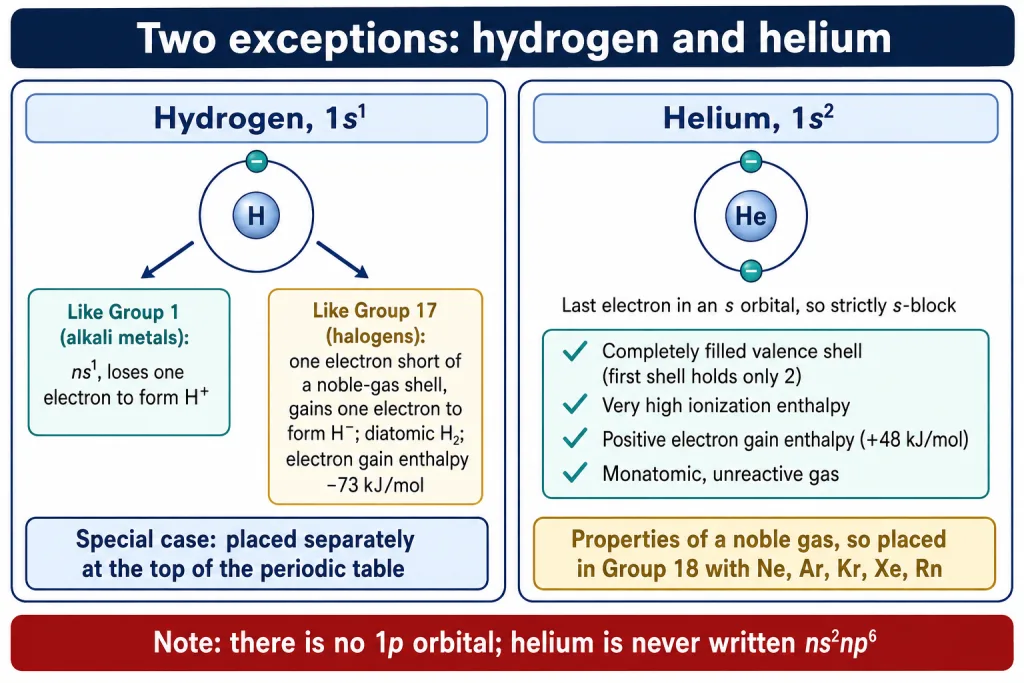
Helium. Its configuration is : the last electron went into an orbital, so strictly it belongs to the s-block. Yet every periodic table puts it in the p-block, in group 18, because is a completely filled valence shell — the first shell holds only two electrons and both are present — and that is what makes a noble gas a noble gas. Helium is unreactive, with a very high ionization enthalpy and a positive electron gain enthalpy (+48 kJ/mol), like neon and argon. Its position in group 18 is justified by its properties, not by its configuration.
Hydrogen. With one electron, , hydrogen looks like an alkali metal () and can lose that electron to form , so it could sit in group 1. But it can also gain an electron to become (hydride), reaching the helium configuration — what a group 17 halogen does in forming . Its electron gain enthalpy, kJ/mol, is negative like a halogen's, and it is a diatomic gas, , like . It resembles both groups while being fully at home in neither.
Key Point: Because it is a special case, hydrogen is placed separately at the top of the periodic table, not inside any group. Helium, though (s-block by orbital), is placed in group 18 of the p-block because its completely filled valence shell gives it the properties of a noble gas.
Reading position from a configuration: the three-question method
Given a configuration (or a from which you can write one), ask three questions in order.
- Period: the largest that has any electrons.
- Block: the subshell the last electron entered under aufbau.
- Group: count electrons using the rule for that block.
| Block | Group number rule | Worked case |
|---|---|---|
| s | number of electrons (1 or 2) | K : group 1 |
| p | (number of and electrons) | S : |
| d | (number of electrons) (number of electrons) | Ti : |
| f | group 3 (lanthanoid if , actinoid if ) | Gd : group 3, lanthanoid |
Two standard cases — elements undiscovered when this problem was written.
. Radon is , so 31 more electrons go into the seventh period: , , reaching 112, then reaching 117. Configuration . Last electron in , so p-block; . A halogen, group 17, period 7 — now called tennessine, Ts.
. Oganesson () completes the seventh period. Two more electrons start the eighth period in : . An configuration means group 2, the alkaline earth metals, period 8. (Older keys write the core as , ununoctium, the temporary name element 118 carried before 2016.)
[JEE Main] The seventh period, like the sixth, holds 32 elements: (2) (14) (10) (6). Any from 87 to 118 lives there. Beyond 118 you are in period 8, starting with .
Metals, Non-metals and the Zig-zag Line
The same map carries an older, broader division: metals and non-metals.
Metals: more than 78% of all elements
Metals make up more than 78% of all known elements and occupy the left side and centre of the periodic table — the whole s-block, d-block and f-block, and the lower-left part of the p-block.
| Property | Metals | Non-metals |
|---|---|---|
| Physical state at room temperature | solids (mercury is a liquid; gallium, m.p. 303 K, and caesium, m.p. 302 K, melt in your hand) | solids or gases (bromine is the only liquid) |
| Melting and boiling points | usually high (W melts above 3600 K) | usually low (boron and carbon are exceptions — both have very high melting points) |
| Conduction of heat and electricity | good conductors | poor conductors (graphite is the well-known exception) |
| Malleability (hammered into sheets) | malleable | brittle |
| Ductility (drawn into wires) | ductile | not ductile |
| Position in the table | left side and centre | top right-hand side |
| Chemical tendency | lose electrons, form cations, basic oxides | gain electrons, form anions, acidic oxides |
Key Point: Metals are usually solids with high melting and boiling points, good conductors of heat and electricity, malleable and ductile. Non-metals sit at the top right, usually have low melting and boiling points, are poor conductors, and non-metallic solids are brittle — neither malleable nor ductile.
The two directions of the trend
In period 3, Na, Mg and Al are metals, Si is a metalloid, P, S and Cl are non-metals. In group 14, C is a non-metal, Si and Ge are metalloids, Sn and Pb are metals.
- Metallic character increases down a group and decreases left to right across a period.
- Non-metallic character does the opposite: increases across a period, decreases down a group.
The most metallic elements sit at the bottom left (Cs, Fr); the most non-metallic at the top right (F, O, Cl), ignoring the noble gases.
The zig-zag line and the metalloids
The change from metallic to non-metallic character is not abrupt. It is shown by a thick zig-zag (stepped) line starting near boron and running diagonally down and to the right through the p-block, between Al and Si, Ge and As, Sb and Te, Po and At. Elements bordering the line show properties of both: silicon and germanium are semiconductors (poor conductors that conduct better when heated, the reverse of a metal), arsenic and antimony are brittle yet lustrous, tellurium is a semiconductor too.
Key Point (Definition): The elements bordering the zig-zag line and running diagonally across the periodic table — silicon, germanium, arsenic, antimony and tellurium — show properties characteristic of both metals and non-metals and are called semi-metals or metalloids. Boron is usually included as well.
[Board] "Name the metalloids" wants Si, Ge, As, Sb, Te (B and Po are accepted). "Where are they placed?" — along the zig-zag line separating metals from non-metals, running diagonally through the p-block.
Putting it to work
Arrange Si, Be, Mg, Na and P in increasing order of metallic character. Na, Mg, Si and P are all in period 3, so left to right they get less metallic: Na > Mg > Si > P. Be sits above Mg in group 2, so it is less metallic than Mg but, being a genuine metal, still more metallic than the metalloid Si.
The trend gets a full physical explanation once we reach ionization enthalpy and electronegativity.
[NEET] When two elements are in different groups and different periods, compare each with an element sharing a row or column with both — as Be was compared with Mg above.
Solved Examples
Question 1: Naming the block from the configuration
To which block do the elements with the following configurations belong? (a) (b) (c) (d) (e)
Answer:
The block is the letter of the orbital that received the last electron, so I check each configuration for that orbital.
In (a) it is : s-block, calcium, group 2. In (b) it is : p-block, phosphorus, group 15.
In (c) the filled first and then the : d-block, chromium, group . The half-filled is chromium's exception to the simple aufbau order, but the block is unchanged.
In (d) it is : f-block, a lanthanoid (europium). The is why appears in the general configuration.
In (e), even with no electron, the differentiating electrons went into : d-block. This is palladium, the one element with in the d-block.
Ans: (a) s (b) p (c) d (d) f (e) d.
Watch out: Look at where the last electron went, not at which shell is outermost. Palladium's and chromium's do not change the block.
Question 2: General outer configurations of the four blocks
Write the general outer electronic configuration of s-, p-, d- and f-block elements, and state the groups each block covers.
Answer:
In the s-block the outermost orbital fills, holding at most two. In the p-block the is full and the orbitals take one to six. In the d-block the inner subshell fills while the outer holds zero, one or two electrons — the covers palladium (). In the f-block the subshell two shells inside fills, with at most one electron and a full outer ; lanthanoids , actinoids , both under group 3.
| Block | General outer configuration | Groups |
|---|---|---|
| s | 1, 2 | |
| p | 13 to 18 | |
| d | 3 to 12 | |
| f | lanthanoids and actinoids |
Ans: As in the table above.
Watch out: Write the superscript ranges exactly — for the d-block and for the f-block are the two details examiners check.
Question 3: Period, block and group of Z = 34 and Z = 40
Find the period, block and group of the elements with atomic numbers 34 and 40.
Answer:
For I count up from argon (18): to 20, to 30, to 34, giving . Highest shell : period 4. Last electron in : p-block. Valence electrons , so group . Selenium, a chalcogen.
For I start from krypton (36): to 38, to 40, giving . Highest shell : period 5. Last electron in : d-block. Group . Zirconium.
Ans: : period 4, p-block, group 16 (Se). : period 5, d-block, group 4 (Zr).
Watch out: Period from the highest ; block from the last orbital filled; group from the block's counting rule.
Question 4: Assigning position from an outer configuration
Assign the position in the periodic table of the element having the outer configuration (i) for (ii) for (iii) for .
Answer:
In (i), gives . Period 3, p-block (last electron in ), group . Full configuration , : sulphur.
In (ii), gives . Period 4, d-block, group . Full configuration , : titanium.
In (iii), gives . Period 6, f-block (last electron in ), a lanthanoid under group 3. Full configuration , : gadolinium.
Ans: (i) period 3, group 16, p-block — S. (ii) period 4, group 4, d-block — Ti. (iii) period 6, group 3, f-block (lanthanoid) — Gd.
Watch out: Substitute the given first; once the configuration is concrete, period, block and group follow directly.
Question 5: The undiscovered elements Z = 117 and Z = 120
The elements and had not been discovered when this problem was first set. In which family or group would you place each, and what is its electronic configuration?
Answer:
For I start from radon, . The seventh period fills as , , , : to 88, to 102, to 112, and five more in give 117. Configuration . The outer shell is , the halogen pattern: group , period 7, p-block. This is tennessine, Ts.
For , the seventh period ends at oganesson, , . The next two electrons open the eighth period in , giving . An outer shell is the alkaline earth metal pattern: group 2, period 8, s-block.
Ans: : group 17 (halogens), . : group 2 (alkaline earth metals), .
Watch out: For heavy elements, count from the nearest noble gas and fill , , , in that order. An older answer key writes for the core — the temporary name for oganesson.
Question 6: Why zinc is not a typical transition element
Zinc lies in the d-block, yet zinc salts are colourless, is diamagnetic and zinc shows only the oxidation state. Explain.
Answer:
Zinc is , . Forming it loses the two electrons and becomes .
Colour, paramagnetism and variable oxidation states all come from partly filled orbitals: electrons hop between levels by absorbing light, unpaired electrons act as tiny magnets, and electrons sit close in energy to the electrons so different numbers can be lost.
Zinc has none of that. Its subshell is full in the atom and in the ion, every electron paired — no unpaired spins (diamagnetic), no low-energy -to- transitions (colourless) — and removing a electron from the stable full subshell costs far too much (only ). Cd () and Hg () behave the same way.
Ans: Zinc has the configuration with a completely filled subshell in both the atom and the ion, so it lacks the partly filled orbitals responsible for colour, paramagnetism and variable oxidation states. Zn, Cd and Hg are therefore not typical transition elements.
Watch out: "In the d-block" is about position; "transition element" is about having partly filled orbitals. Group 12 satisfies the first and not the second.
Question 7: Why helium is in group 18 and hydrogen stands alone
(a) Helium has the configuration , which is an s-block configuration. Why is it placed in group 18 of the p-block? (b) Why is hydrogen not placed in either group 1 or group 17, although it resembles both?
Answer:
(a) A noble gas is defined by a completely filled valence shell that is hard to disturb. Neon and argon have ; helium's first shell holds only two electrons, and fills it. So helium behaves like a noble gas in every way that matters — very high ionization enthalpy, positive electron gain enthalpy (+48 kJ/mol), no known stable compounds, a monatomic gas. Its properties put it with group 18, even though by the last-orbital rule it is technically s-block.
(b) Hydrogen resembles group 1 because is and it loses that electron to give , as Na gives . It also resembles group 17: one electron short of the noble-gas configuration , it gains an electron to give , as Cl gives ; its electron gain enthalpy is negative ( kJ/mol) and it is a diatomic gas like the halogens. But it is not a metal like the alkali metals, and it forms a positive ion far more readily than any halogen does, so either column would misrepresent it.
Ans: (a) Helium's is a completely filled valence shell, so it shows the characteristic properties of noble gases and is placed in group 18. (b) Hydrogen resembles both the alkali metals (, forms ) and the halogens (one electron short of a noble-gas shell, forms ); being a special case it is placed separately at the top of the periodic table.
Watch out: Position is settled by chemical behaviour when the configuration is ambiguous.
Question 8: Using the periodic table to identify elements
Using the periodic table, (a) identify an element with five electrons in its outer subshell; (b) identify an element that would tend to lose two electrons; (c) identify an element that would tend to gain two electrons; (d) identify the group that contains a metal, a non-metal, a liquid and a gas at room temperature.
Answer:
(a) Five electrons in the outer subshell means , the halogen configuration : any group 17 element, fluorine () or chlorine ().
(b) An element loses two electrons to reach a noble-gas core when it has : group 2. Magnesium () gives ; calcium works equally well.
(c) An element gains two electrons when it is two short of a noble-gas shell, : group 16. Oxygen forms , sulphur .
(d) I need one group with every state of matter and both metallic and non-metallic members. Group 17 fits: fluorine and chlorine are gases, bromine a liquid, iodine a solid non-metal, and astatine at the bottom is metallic in character (a metalloid/metal).
Ans: (a) F or Cl (group 17) (b) Mg or Ca (group 2) (c) O or S (group 16) (d) group 17.
Watch out: Translate each phrase into a configuration first — "five outer electrons" is , "loses two" is , "gains two" is — and the group follows.
Question 9: Ordering elements by metallic character
Considering atomic number and position in the periodic table, arrange the following elements in increasing order of metallic character: Si, Be, Mg, Na, P.
Answer:
Na (), Mg (12), Si (14) and P (15) are all in period 3; Be () is in period 2, directly above Mg in group 2.
Across a period metallic character decreases left to right, so Na > Mg > Si > P. Down a group it increases, so Be < Mg. Be is a true metal while Si is a metalloid, so Si < Be < Mg. Combining, P < Si < Be < Mg < Na.
Ans: P < Si < Be < Mg < Na.
Watch out: Handle the elements sharing a period first, then slot in the odd one out by comparing it with its group neighbour.
Question 10: Two multiple-choice orderings
(a) Considering the elements B, Al, Mg and K, the correct order of metallic character is: (i) B > Al > Mg > K (ii) Al > Mg > B > K (iii) Mg > Al > K > B (iv) K > Mg > Al > B. (b) Considering the elements B, C, N, F and Si, the correct order of non-metallic character is: (i) B > C > Si > N > F (ii) Si > C > B > N > F (iii) F > N > C > B > Si (iv) F > N > C > Si > B.
Answer:
For (a): B is period 2, group 13; Al is period 3, group 13; Mg is period 3, group 2; K is period 4, group 1. Down group 13, Al is more metallic than B. Across period 3, Mg is more metallic than Al. K, further left and further down than any of them, is the most metallic. So K > Mg > Al > B, option (iv).
For (b): B, C, N and F are all in period 2; Si is in period 3, directly below C. Across period 2, non-metallic character increases to the right: F > N > C > B. Down group 14, Si is less non-metallic than C. Comparing Si with B, Si is a metalloid one period lower and is the least non-metallic of the set. So F > N > C > B > Si, option (iii).
Ans: (a) (iv) K > Mg > Al > B. (b) (iii) F > N > C > B > Si.
Watch out: Non-metallic character is the mirror image of metallic character. In both orderings the element lowest and furthest left (K, Si) is at the metallic end.
Question 11: Metals versus non-metals, and the metalloids
(a) List the major differences between metals and non-metals. (b) Name the metalloids and explain where they are placed and why.
Answer:
(a) Position: metals occupy the left side and centre (over 78% of all elements); non-metals are at the top right.
State: metals are solids at room temperature (mercury is liquid; gallium, m.p. 303 K, and caesium, m.p. 302 K, are nearly so); non-metals are solids or gases (bromine is the liquid).
Melting and boiling points: metals usually high; non-metals usually low, with boron and carbon as exceptions.
Conduction: metals are good conductors of heat and electricity; non-metals are poor conductors.
Mechanical: metals are malleable and ductile; solid non-metals are brittle, neither malleable nor ductile.
Chemical: metals lose electrons to form cations and give basic oxides; non-metals gain electrons to form anions and give acidic oxides.
(b) The metalloids are silicon, germanium, arsenic, antimony and tellurium (boron and polonium are often added). They lie along the thick zig-zag line running diagonally through the p-block. The change from metallic to non-metallic character is gradual, not abrupt, so elements on the border show properties of both kinds — Si and Ge are semiconductors.
Ans: (a) Metals: left/centre, solid, high m.p. and b.p., good conductors, malleable and ductile, form cations and basic oxides. Non-metals: top right, solid or gas, low m.p. and b.p. (except B, C), poor conductors, brittle, form anions and acidic oxides. (b) Si, Ge, As, Sb, Te — bordering the zig-zag line, showing intermediate behaviour.
Watch out: Give at least four contrasting pairs, and always name the exceptions — Hg, Ga, Cs; B and C.