
How to Use This Section
This is the last section of the chapter, meant to be read the night before the paper and again in the queue outside the hall.
Nothing new is taught here. Every card compresses something Sections 1 to 13 worked through properly, in the same notation and with the same numbers. If a line surprises you, go back and reread that section instead of memorising the line.
Eight cards, one mistake checklist, one 60-second panic list. Screenshot the three figures.
| Card | Topic | Sections it compresses | Who needs it most |
|---|---|---|---|
| 1 | The classification timeline — Dobereiner to Seaborg, and Mendeleev's predictions | 1, 2 | Board, NEET |
| 2 | Structure of the long form — periods, groups, lanthanoids and actinoids, the period/group/block finder | 2, 3, 4 | Everyone |
| 3 | IUPAC digit roots and the names of elements 101 to 118 | 2 | Board, NEET |
| 4 | The four blocks, their configurations and properties; metals, non-metals, metalloids | 4 | Everyone |
| 5 | Atomic and ionic radius — data, rules, isoelectronic species | 5 | Everyone |
| 6 | Ionization enthalpy — trends, factors, anomalies, successive values | 6, 10 | Everyone |
| 7 | Electron gain enthalpy and electronegativity — data tables and anomalies | 7, 10 | Everyone |
| 8 | Chemical trends — valence, hydrides and oxides, second-period anomalies, diagonal pairs, reactivity, oxide character | 8, 12 | Everyone |
Key Point: The whole chapter is one idea. Properties of elements are periodic functions of their atomic numbers, because atomic number fixes the electronic configuration, and the outer configuration repeats after every 2, 8, 8, 18, 18, 32 elements. Every trend below — radius, ionization enthalpy, electron gain enthalpy, electronegativity, valence, oxide character — is the outer configuration plus two competing effects: nuclear charge pulling in and shielding by inner electrons pushing out. Across a period nuclear charge wins; down a group shielding and the new shell win. Hold on to that and the anomalies become footnotes instead of a separate list.
Card 1 — The Classification Timeline and Mendeleev's Predictions
Who did what, and where it broke
| Year | Scientist | The idea | Where it failed or what it lacked |
|---|---|---|---|
| 1829 | Dobereiner (Germany) | Triads: groups of three similar elements in which the middle atomic weight is roughly the mean of the other two — Li (7), Na (23), K (39): mean ; Ca (40), Sr (88), Ba (137): mean ; Cl (35.5), Br (80), I (127): mean | Worked for only a handful of elements; dismissed as coincidence |
| 1862 | de Chancourtois (France) | Elements in order of increasing atomic weight on a cylinder (telluric helix); similar elements fell on vertical lines | Little attention; awkward to use |
| 1865 | Newlands (England) | Law of octaves: arranged by atomic weight, every eighth element resembles the first, like the notes of music | Held only up to calcium; ridiculed at the time, Davy Medal only in 1887 |
| 1869 | Lothar Meyer (Germany) | Plotted physical properties (atomic volume, melting and boiling points) against atomic weight and saw a repeating pattern; his 1868 table resembled Mendeleev's | Published after Mendeleev, with less bold predictions |
| 1869 | Mendeleev (Russia) | Periodic law: properties of elements are a periodic function of their atomic weights. Arranged 63 elements in rows and columns by weight, but gave similar properties priority over weight — so he swapped iodine (higher weight) after tellurium, and left gaps for undiscovered elements | Positions of Ar/K, Co/Ni, Te/I could not be explained by weight; isotopes had no place; hydrogen had no fixed home |
| 1913 | Moseley (England) | X-ray spectra: of the characteristic X-ray line is a straight line against atomic number , not against atomic weight; so is the fundamental property. Modern periodic law: physical and chemical properties of elements are periodic functions of their atomic numbers | Fixed every Mendeleev anomaly at once: Ar (18) before K (19), Co (27) before Ni (28), Te (52) before I (53) |
| 1940s onward | Glenn Seaborg (USA) | Discovered the transuranium elements from plutonium (94) to 102 and placed the actinoids as a second f-series below the lanthanoids; element 106 named seaborgium in his honour | — |
Key Point (Definition): Mendeleev's periodic law — the physical and chemical properties of the elements are a periodic function of their atomic weights. Modern periodic law — the physical and chemical properties of the elements are periodic functions of their atomic numbers. Write the correct noun; that is the one-mark difference.
Mendeleev's predictions
| Property | Eka-aluminium (predicted) | Gallium (found, 1875) | Eka-silicon (predicted) | Germanium (found, 1886) |
|---|---|---|---|---|
| Atomic weight | 68 | 70 | 72 | 72.6 |
| Density / g cm | 5.9 | 5.94 | 5.5 | 5.36 |
| Melting point / K | Low | 302.93 | High | 1231 |
| Formula of oxide | ||||
| Formula of chloride |
"Eka" is Sanskrit for one: eka-aluminium means "one place below aluminium" in the same group (group 13). Eka-boron was scandium, eka-manganese was technetium.
Element counts: about 31 known in 1800, 63 by 1865 (Mendeleev's table), 114 with official names when your textbook was printed and 118 today. Classification became necessary because nobody can remember 100-plus elements one at a time.
[NEET] Why Mendeleev is remembered and Newlands is not: Mendeleev trusted the pattern more than the data — he left gaps, predicted the properties of the missing elements, and even suggested that some atomic weights had been measured wrongly. Newlands forced every element into an octave whether it fit or not.
Card 2 — Structure of the Long Form of the Periodic Table
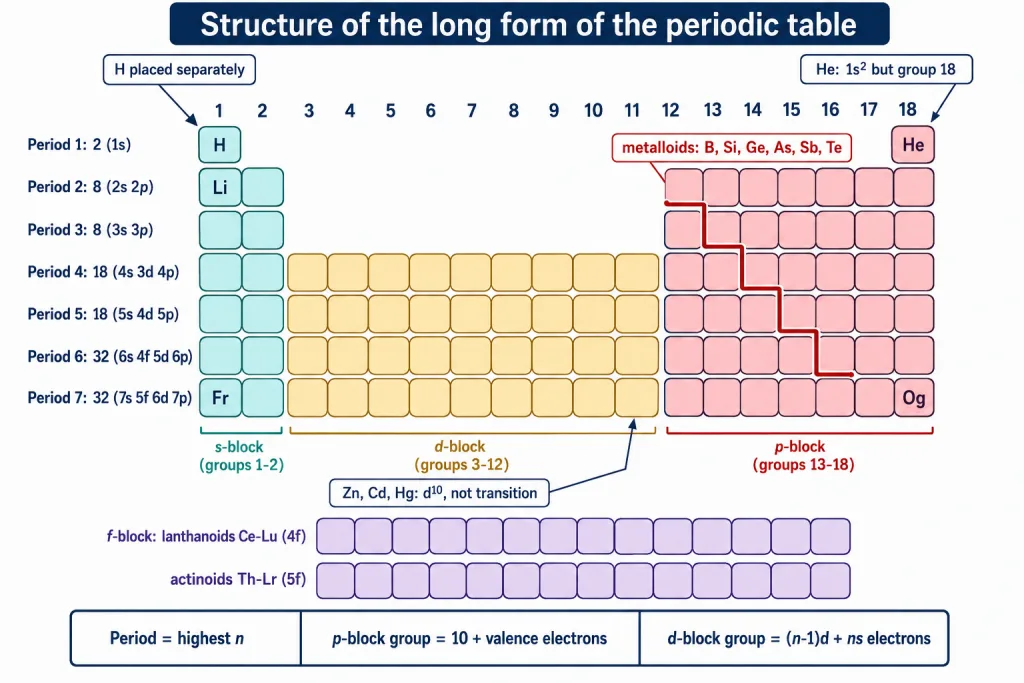
Periods — how long, and why
Key Point: The period number equals the principal quantum number of the valence shell, and the number of elements in a period is twice the number of orbitals being filled (one orbital, two electrons).
| Period | Orbitals filled (in order) | Number of orbitals | Elements | From | To |
|---|---|---|---|---|---|
| 1 | 1 | 2 | H (1) | He (2) | |
| 2 | , | 1 + 3 = 4 | 8 | Li (3) | Ne (10) |
| 3 | , | 4 | 8 | Na (11) | Ar (18) |
| 4 | , , | 1 + 5 + 3 = 9 | 18 | K (19) | Kr (36) |
| 5 | , , | 9 | 18 | Rb (37) | Xe (54) |
| 6 | , , , | 1 + 7 + 5 + 3 = 16 | 32 | Cs (55) | Rn (86) |
| 7 | , , , | 16 | 32 | Fr (87) | Og (118) |
The third period has 8, not 18, because after the next orbital in energy is , not (the rule, : versus : ). So is filled in the fourth period (Sc to Zn, the first transition series), in the fifth (Y to Cd), in the sixth (La, Hf to Hg) and in the seventh.
Groups
| Group (1 to 18) | Old notation | Family name | Outer configuration |
|---|---|---|---|
| 1 | IA | alkali metals | |
| 2 | IIA | alkaline earth metals | |
| 3 to 12 | IIIB, IVB, VB, VIB, VIIB, VIII (8, 9, 10), IB, IIB | transition metals | |
| 13 | IIIA | boron family | |
| 14 | IVA | carbon family | |
| 15 | VA | pnictogens (nitrogen family) | |
| 16 | VIA | chalcogens (oxygen family) | |
| 17 | VIIA | halogens | |
| 18 | 0 (or VIIIA) | noble gases | (He: ) |
Elements of one group have the same number of valence electrons in the same type of orbital, which is why they behave alike: the alkali metals Li, Na, K, Rb, Cs, Fr are all with .
Lanthanoids and actinoids
| Series | Elements | Orbital being filled | Period | Where they sit |
|---|---|---|---|---|
| Lanthanoids (4f inner transition) | Ce (58) to Lu (71) | 6 | separate panel below the table, belonging to group 3 after La | |
| Actinoids (5f inner transition) | Th (90) to Lr (103) | 7 | separate panel below the lanthanoids, after Ac |
They are printed separately only to keep the table from becoming 32 columns wide. Elements after uranium (92) are the transuranium elements, all man-made.
The period, group and block finder
| To find | Rule |
|---|---|
| Period | the highest principal quantum number in the configuration |
| Block | the subshell that received the last electron: , , or |
| Group, s-block | number of electrons: is group 1, is group 2 |
| Group, p-block | number of valence electrons number of electrons: is group 16 |
| Group, d-block | number of electrons number of electrons: is group 8 |
| Group, f-block | always group 3, period 6 (4f) or 7 (5f) |
| Given | Work | Answer |
|---|---|---|
| period 7, group 17, p-block, halogen | ||
| period 8, group 2, s-block, alkaline earth metal | ||
| period 7, group 14, p-block | ||
| , | S | period 3, group 16, p-block |
| , | Ti | period 4, group 4, d-block |
| , | Gd | period 6, group 3, f-block (lanthanoid) |
[Board] The 100th element (fermium) is in period 7. The fifth period has 18 elements because allows (1), (5) and (3) orbitals to fill before : 9 orbitals, 18 electrons.
Card 3 — IUPAC Nomenclature for Elements With Z > 100
Why it exists
Both American and Soviet groups claimed element 104 (rutherfordium versus kurchatovium). To avoid such fights, IUPAC gives every new element a temporary systematic name built from the digits of its atomic number until the discovery is confirmed and an official name is agreed.
The digit roots
| Digit | 0 | 1 | 2 | 3 | 4 | 5 | 6 | 7 | 8 | 9 |
|---|---|---|---|---|---|---|---|---|---|---|
| Root | nil | un | bi | tri | quad | pent | hex | sept | oct | enn |
| Letter | n | u | b | t | q | p | h | s | o | e |
Key Point: Roots are joined in order of the digits, the name ends in -ium, and the symbol is the first letter of each root (three letters). Two spelling rules: a final "i" of bi or tri is dropped before "ium" (so 102 is unnilbium, not unnilbiium), and a double "nn" from enn + nil is written with a single "n" (so 190 would be unennilium).
Elements 101 to 118 — compact
| Systematic name (symbol) | Official name (symbol) | Systematic name (symbol) | Official name (symbol) | ||
|---|---|---|---|---|---|
| 101 | Unnilunium (Unu) | Mendelevium (Md) | 110 | Ununnilium (Uun) | Darmstadtium (Ds) |
| 102 | Unnilbium (Unb) | Nobelium (No) | 111 | Unununium (Uuu) | Roentgenium (Rg) |
| 103 | Unniltrium (Unt) | Lawrencium (Lr) | 112 | Ununbium (Uub) | Copernicium (Cn) |
| 104 | Unnilquadium (Unq) | Rutherfordium (Rf) | 113 | Ununtrium (Uut) | Nihonium (Nh) |
| 105 | Unnilpentium (Unp) | Dubnium (Db) | 114 | Ununquadium (Uuq) | Flerovium (Fl) |
| 106 | Unnilhexium (Unh) | Seaborgium (Sg) | 115 | Ununpentium (Uup) | Moscovium (Mc) |
| 107 | Unnilseptium (Uns) | Bohrium (Bh) | 116 | Ununhexium (Uuh) | Livermorium (Lv) |
| 108 | Unniloctium (Uno) | Hassium (Hs) | 117 | Ununseptium (Uus) | Tennessine (Ts) |
| 109 | Unnilennium (Une) | Meitnerium (Mt) | 118 | Ununoctium (Uuo) | Oganesson (Og) |
Practice the mechanism on unfamiliar numbers, because that is what is asked: is unbinilium (Ubn), is unbiunium (Ubu), is untrinilium (Utn), is unpentnilium (Upn).
[NEET] Three one-liner facts: element 106 is named after Seaborg (the only element named after a living person at the time); 117 tennessine and 118 oganesson are the newest halogen and noble gas; the temporary symbol always has three letters, the official one has one or two.
Card 4 — The Four Blocks; Metals, Non-metals and Metalloids
The four blocks in one table
| Block | Groups | Outer configuration | Members | Key properties |
|---|---|---|---|---|
| s | 1, 2 (plus He) | alkali and alkaline earth metals | soft, low IE, highly reactive, reactivity increases down the group; +1 and +2 oxidation states; mostly ionic compounds (Li and Be are the exceptions); never found free in nature | |
| p | 13 to 18 | metals, metalloids, non-metals, halogens (17), chalcogens (16), noble gases (18) | s + p together are the representative (main-group) elements; non-metallic character rises across the block; halogens and chalcogens have very negative ; noble gases are closed-shell and inert | |
| d | 3 to 12 | transition metals (Sc to Zn, Y to Cd, La and Hf to Hg, Ac and Rf to Cn) | all metals, coloured ions, variable oxidation states, paramagnetism, catalysts; a bridge between the very reactive s-block metals and the less reactive metals of groups 13 and 14 | |
| f | inside group 3 | lanthanoids Ce to Lu, actinoids Th to Lr | inner transition elements, all metals, all similar to each other; actinoids radioactive, elements after U synthetic (transuranium) |
The exceptions to remember
| Case | Rule it bends | The fact |
|---|---|---|
| Helium | placed in group 18 although it is (s-block by configuration) | its shell is complete, so it behaves as a noble gas — the property wins over the block label |
| Hydrogen | has one electron like the alkali metals, but needs only one more to fill its shell like the halogens | placed separately at the top of the table; it is not a metal, not an alkali metal |
| Zn, Cd, Hg | group 12, | -subshell completely filled in the element and in its common ions, so they show none of the typical transition properties (colourless ions, no variable oxidation state); they are in the d-block but are not transition elements in the strict sense |
| Pd () | the case | configuration ; this is why the general d-block configuration is written , not |
| Cr, Cu | cases | and — half-filled and fully filled |
Metals, non-metals and metalloids
| Class | Where | How many | Properties |
|---|---|---|---|
| Metals | left and centre; more than 78% of all elements | about 91 | solid at room temperature (Hg is the exception, and Cs and Ga melt in the hand), high melting and boiling points, good conductors, malleable and ductile |
| Non-metals | top right corner | about 20 | mostly gases or brittle solids (Br is a liquid), low melting points, poor conductors |
| Metalloids (semi-metals) | on the zig-zag line separating the two | B, Si, Ge, As, Sb, Te, (Po, At) | in-between properties; semiconductors |
Metallic character increases down a group (Be to Ba, C to Pb) and decreases across a period (Na to Cl); non-metallic character does the opposite. The most metallic elements are at the bottom left (Cs, Fr), the most non-metallic at the top right (F, O).
[JEE/NEET] Because the change is gradual, Sn and Pb are metals, Ge and Si are metalloids, and C is a non-metal — all in the same group 14. Do not call boron a metal even though it heads group 13.
Card 5 — Atomic Radius and Ionic Radius
The definitions
Key Point (Definition): Atomic size cannot be measured directly (the electron cloud has no sharp edge), so it is defined from bond lengths. Covalent radius = half the distance between the nuclei of two bonded atoms of the same element in a molecule: the Cl-Cl distance in is 198 pm, so pm. Metallic radius = half the internuclear distance between neighbouring atoms in a metal crystal: the Cu-Cu distance is 256 pm, so pm. Noble gases have only a van der Waals radius (from non-bonded contact), which is why their large values are not compared with the others in a period.
The data
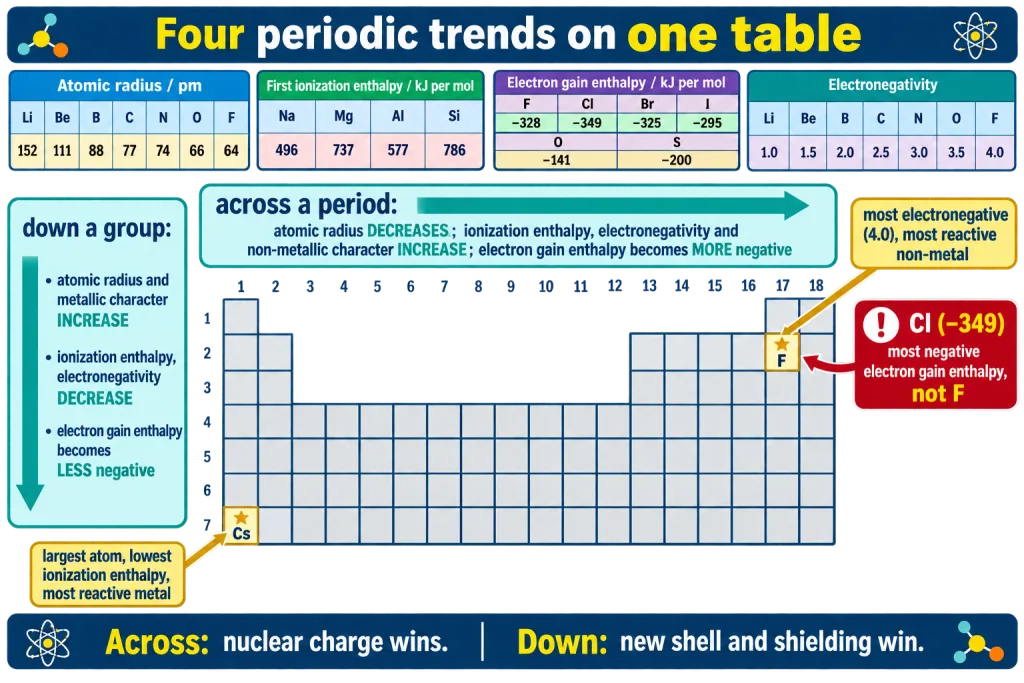
| Period 2 | Li | Be | B | C | N | O | F |
|---|---|---|---|---|---|---|---|
| Atomic radius / pm | 152 | 111 | 88 | 77 | 74 | 66 | 64 |
| Period 3 | Na | Mg | Al | Si | P | S | Cl |
|---|---|---|---|---|---|---|---|
| Atomic radius / pm | 186 | 160 | 143 | 117 | 110 | 104 | 99 |
| Group 1 | Li | Na | K | Rb | Cs |
|---|---|---|---|---|---|
| Atomic radius / pm | 152 | 186 | 231 | 244 | 262 |
| Group 17 | F | Cl | Br | I | At |
|---|---|---|---|---|---|
| Atomic radius / pm | 64 | 99 | 114 | 133 | 140 |
The two rules and why
| Direction | Trend | Reason |
|---|---|---|
| Across a period (left to right) | radius decreases | electrons enter the same shell; each extra proton raises the nuclear charge but the same-shell electrons shield each other poorly, so the effective nuclear charge rises and the cloud is pulled in |
| Down a group | radius increases | each step adds a new shell ( rises), and the inner shells shield the outer electrons from the nucleus; the shell effect beats the extra protons |
Ionic radius
| Ion type | Size relative to the atom | Reason | Example |
|---|---|---|---|
| Cation | smaller | electrons are removed, often an entire outer shell disappears; the remaining electrons feel a larger net pull | Na 186 pm, 95 pm |
| Anion | larger | electrons are added to the same shell; more repulsion, same nuclear charge, so the cloud expands | F 64 pm, 136 pm |
Same element, different charge: the higher the positive charge, the smaller the ion — ; .
Isoelectronic species — the one rule
Key Point: Isoelectronic species have the same number of electrons. Among them, the one with the largest nuclear charge is the smallest, because the same cloud is pulled by more protons.
Other sets to recognise on sight: (18 electrons); , He, , (2 electrons); , Kr, , (36 electrons).
[NEET] Ordering traps: (1) (18 electrons, outer shell) is larger than (10 electrons, ) — a new shell beats charge. (2) — same shell, rising charge. (3) The largest atom in any period is the alkali metal, and the largest bonded atom overall is Cs (262 pm) or Fr — leave the noble gases out of size comparisons unless the question says van der Waals radius.
Card 6 — Ionization Enthalpy
The definition and its three conditions
Key Point (Definition): The first ionization enthalpy is the enthalpy change when the most loosely bound electron is removed from an isolated gaseous atom in its ground state: The second, , removes the next electron from . Units . Every ionization enthalpy is positive (energy is always needed to pull an electron away from a positive nucleus), and always, because each electron leaves a more positive ion.
Three words that carry marks: isolated (no neighbouring atoms), gaseous (no lattice or solvent energy), ground state (not excited).
The periodicity graph, to 60
Maxima at the noble gases (He highest of all, 2372 ), minima at the alkali metals (Cs lowest, then Rb, K). Each period starts at a minimum (Li, Na, K, Rb, Cs) and climbs to a maximum (Ne, Ar, Kr, Xe), with two dips on the way in periods 2 and 3.
| Direction | Trend | Reason |
|---|---|---|
| Across a period | increases | same shell, rising effective nuclear charge, shrinking radius |
| Down a group | decreases | outer electron in a higher shell, farther away and shielded by more inner electrons; the extra nuclear charge is more than cancelled |
The factors on which it depends
| Factor | Effect on |
|---|---|
| Atomic size (radius) | larger atom, lower |
| Nuclear charge / effective nuclear charge | higher , higher |
| Shielding by inner shells | more shielding, lower |
| Penetration of the subshell | ; an electron is closer to the nucleus, so it is harder to remove than a electron of the same shell |
| Half-filled or fully filled subshells | extra stability, higher (, , , ) |
The two classic anomalies
| Anomaly | Values / | Reason |
|---|---|---|
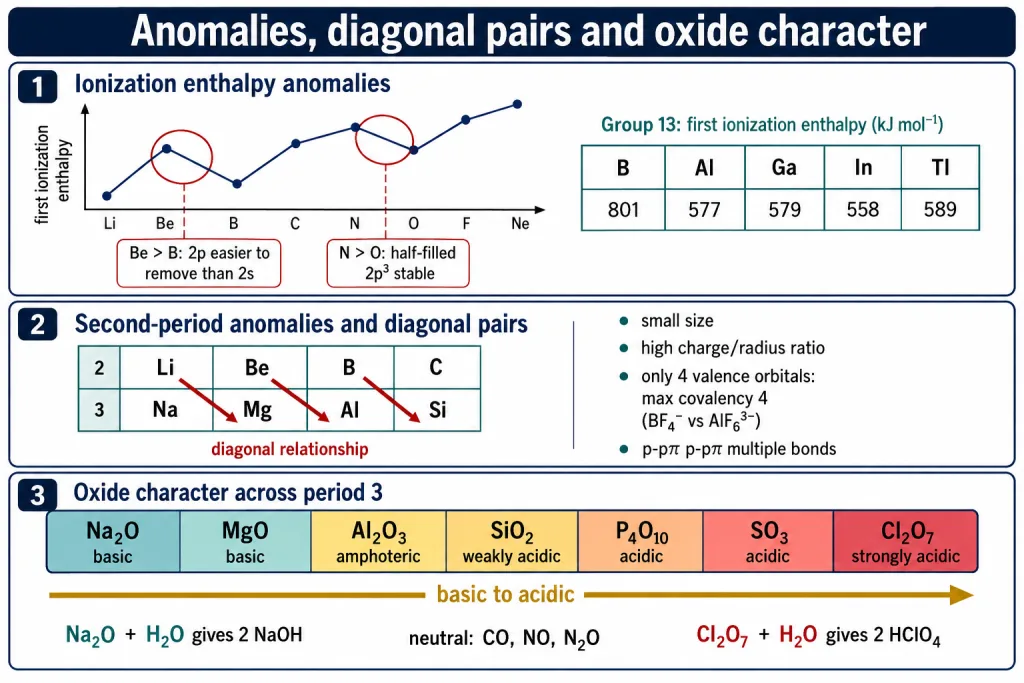
| Be > B (also Mg > Al) | Be 899, B 801; Mg 737, Al 577 | B removes a electron, Be a electron; is higher in energy, less penetrating and better shielded by the pair, so it comes off more easily |
| N > O (also P > S) | N 1402, O 1314; P 1012, S 1000 | N is : three electrons in three separate orbitals (half-filled, extra stable). O is : the fourth electron is paired in an orbital and is pushed out by repulsion |
The order in period 2 is , and in period 3 . Predicting aluminium from its neighbours — Na 496, Mg 737, Si 786 — gives "between 496 and 786 but below Mg", and the value is 577.
The group 13 irregularity
| Element | B | Al | Ga | In | Tl |
|---|---|---|---|---|---|
| / | 801 | 577 | 579 | 558 | 589 |
Ga is slightly above Al because the ten electrons between Al and Ga shield poorly, so Ga's outer electron feels a larger effective nuclear charge than the size increase would suggest. Tl is above In for the same reason with the electrons added (lanthanoid contraction).
Successive ionization enthalpies — the jump rule
Key Point: A sudden big jump between and means the th electron comes from a noble-gas core. The element has valence electrons, sits in group (s-block) or (p-block), and its stable valence is .
| Values / | Reading |
|---|---|
| 520, 7300 | jump after 1: one valence electron, group 1 (Li), covalent MX possible for such a small ion |
| 738, 1451, then 7733 | jump after 2: two valence electrons, group 2 (Mg), forms |
| 578, 1817, 2745, then 11 577 | jump after 3: group 13 (Al) |
| 2372, 5251 | huge first value: noble gas (He), least reactive |
The Na/Mg puzzle
| Na | 496 | about 4562 |
| Mg | 737 | 1451 |
First ionization: Na (loses its lone electron) is lower than Mg (two electrons, higher nuclear charge, smaller atom). Second ionization: Na is now with the stable neon core , so the next electron is torn from a closed shell in a lower level — enormous cost. still has one electron to give. So but .
[JEE Main] Hydrogen's ionization enthalpy in J per atom is J; multiply by Avogadro's number and you get , or if the question asks in those units.
Card 7 — Electron Gain Enthalpy and Electronegativity
Electron gain enthalpy — definition and sign
Key Point (Definition): Electron gain enthalpy is the enthalpy change when an electron is added to an isolated gaseous atom to form a gaseous anion: It is negative (exothermic) for most elements because a neutral atom usually attracts an electron; it is positive (endothermic) for the noble gases (the electron must enter the next higher shell) and for a few elements (Be, Mg) and elements (N) with stable configurations.
Sign convention: electron affinity (EA) is the energy released, so a positive EA means a negative of roughly the same size: EA of Cl means . (Strictly ; ignore the small term unless asked.)
The data
| Group 1 | H | Li | Na | K | Rb | Cs |
|---|---|---|---|---|---|---|
| / |
| Group 16 | O | S | Se | Te | Po |
|---|---|---|---|---|---|
| / |
| Group 17 | F | Cl | Br | I | At |
|---|---|---|---|---|---|
| / |
| Group 18 | He | Ne | Ar | Kr | Xe | Rn |
|---|---|---|---|---|---|---|
| / |
Trends and the two anomalies
| Direction | Trend | Reason |
|---|---|---|
| Across a period | becomes more negative | smaller atom, higher effective nuclear charge; the added electron enters the same shell close to the nucleus |
| Down a group | becomes less negative | the added electron enters a shell farther from the nucleus |
| O and F are less negative than S and Cl | O versus S ; F versus Cl | O and F are so small that the subshell is already crowded; the incoming electron feels strong repulsion from the electrons already there. In S and Cl the subshell is larger, so the repulsion is smaller |
So chlorine has the most negative electron gain enthalpy of all elements (), not fluorine. Among the halogens the order is (most to least negative). Fluorine is still the most electronegative element and the most reactive non-metal; those are different properties.
Electronegativity — the Pauling scale
Key Point (Definition): Electronegativity is the ability of an atom in a chemical compound to attract the shared electrons of a bond to itself. It is not a measurable quantity and has no units; it is a number on an arbitrary scale. On Pauling's scale fluorine is assigned 4.0 and every other element is placed relative to it. It depends on the bonding partner and the oxidation state, so it is a property of an atom in a molecule, not of an isolated atom.
| Period 2 | Li | Be | B | C | N | O | F |
|---|---|---|---|---|---|---|---|
| Electronegativity | 1.0 | 1.5 | 2.0 | 2.5 | 3.0 | 3.5 | 4.0 |
| Period 3 | Na | Mg | Al | Si | P | S | Cl |
|---|---|---|---|---|---|---|---|
| Electronegativity | 0.9 | 1.2 | 1.5 | 1.8 | 2.1 | 2.5 | 3.0 |
| Group 1 | Li | Na | K | Rb | Cs | Group 17 | F | Cl | Br | I | At |
|---|---|---|---|---|---|---|---|---|---|---|---|
| Electronegativity | 1.0 | 0.9 | 0.8 | 0.8 | 0.7 | 4.0 | 3.0 | 2.8 | 2.5 | 2.2 |
Trend: increases across a period (Li 1.0 to F 4.0), decreases down a group (F 4.0 to At 2.2; Li 1.0 to Cs 0.7). It moves with ionization enthalpy and non-metallic character and against atomic radius and metallic character — smaller atom, higher , stronger pull on bond electrons. The most electronegative element is F, the least is Cs (Fr).
Three properties that students mix up
| Property | What is measured | Isolated atom? | Units | Sign |
|---|---|---|---|---|
| Ionization enthalpy | energy to remove an electron | yes, gaseous | always positive | |
| Electron gain enthalpy | enthalpy change on adding an electron | yes, gaseous | usually negative, positive for noble gases | |
| Electronegativity | tendency to attract shared electrons in a bond | no, atom in a compound | none | relative number, 0.7 to 4.0 |
[JEE Main] The Mulliken scale is in eV; divide by 2.8 to get a Pauling-like value. The second electron gain enthalpy of O and S () is strongly positive because a negative ion is being asked to accept another electron.
Card 8 — Chemical Trends: Valence, Hydrides and Oxides, Second-Period Anomalies, Reactivity and Oxide Character
Valence of the representative elements
Key Point: Valence number of valence (outermost) electrons, or that number. Groups 1, 2, 13, 14 use the first; groups 15, 16, 17 mostly the second (with respect to hydrogen).
| Group | 1 | 2 | 13 | 14 | 15 | 16 | 17 | 18 |
|---|---|---|---|---|---|---|---|---|
| Valence electrons | 1 | 2 | 3 | 4 | 5 | 6 | 7 | 8 |
| Valence | 1 | 2 | 3 | 4 | 3, 5 | 2, 6 | 1, 7 | 0, 8 |
| Hydride | LiH, NaH, KH | , | , , , | , , | , , , | HF, HCl, HBr, HI | — | |
| Oxide | , , | MgO, CaO, SrO, BaO | , , , | , , , , | , ; , ; , ; , ; | , , | — |
Oxidation state follows electronegativity: in oxygen is (F is more electronegative), in oxygen is . Transition elements and actinoids show variable valence. In the oxidation state of Al is but its covalency is 6 (six bonds) — oxidation state and covalency are not the same number.
Anomalous behaviour of the second-period elements (Li, Be, B, C, N, O, F)
| Cause | Consequence |
|---|---|
| Very small size and high charge/radius ratio | Li 152 pm versus Na 186 pm; 76 pm versus 102 pm; 31 pm versus 72 pm — so Li and Be form covalent compounds where their group-mates form ionic ones |
| High electronegativity | polarising, more covalent |
| Only four valence orbitals (, , , ) versus nine for period 3 (, , ) | maximum covalency 4: boron gives , aluminium gives ; nitrogen cannot form while phosphorus forms |
| Small atoms come close enough for sideways overlap | strong - multiple bonds: , , , , ; the heavier members prefer single bonds |
Diagonal relationship
Key Point: The first element of a group often resembles the second element of the next group because their sizes and charge/radius ratios are similar: Li and Mg, Be and Al, B and Si.
| Pair | Shared behaviour |
|---|---|
| Li / Mg | both form nitrides directly with , carbonates that decompose on heating, and covalent-ish compounds |
| Be / Al | both form amphoteric oxides and hydroxides, covalent chlorides that fume in air |
| B / Si | both non-metals with acidic oxides and covalent hydrides |
Chemical reactivity — the ends-of-period rule
| Position | Behaviour | Reason |
|---|---|---|
| Extreme left (group 1) | most reactive metals; reactivity increases down the group (Li < Na < K < Rb < Cs) | lowest ; lose an electron easily |
| Extreme right (group 17) | most reactive non-metals; reactivity decreases down the group (F > Cl > Br > I) | most negative , highest electronegativity; gain an electron easily |
| Centre (groups 13, 14, transition) | least reactive | middling and ; the noble gases at the far right are inert for a different reason (closed shells) |
Metallic character and reactivity of metals go down and left; non-metallic character and reactivity of non-metals go up and right. The elements change from electropositive (electron losers) at the left to electronegative (electron gainers) at the right.
Oxide character
| Type | Where in the table | Examples | Reaction with water |
|---|---|---|---|
| Basic | extreme left (group 1, 2 metals) | , , MgO, CaO | (strong base) |
| Amphoteric | centre-left, near the zig-zag line | , , ZnO, BeO, PbO | react with both acids and bases: ; |
| Neutral | centre (non-metals in low oxidation states) | CO, NO, | neither acidic nor basic |
| Acidic | extreme right (non-metals) | , , , , | (strong acid); |
Across period 3: (strongly basic), MgO (basic), (amphoteric), (weakly acidic), (acidic), (strongly acidic), (most acidic). Down a group the oxides become more basic ( acidic, basic). The higher the oxidation state of the same element, the more acidic the oxide (, acidic while MnO is basic).
[Board] "Predict the formulas of the compounds between": silicon and bromine gives (valence 4 and 1); aluminium and sulphur gives (3 and 2); element with and hydrogen gives (group 14). Read the group, read the valence, cross-multiply.
The Mistakes That Cost the Most Marks
Each of these was flagged somewhere in Sections 1 to 13, ordered roughly by how often they show up in answer scripts.
1. Saying fluorine has the most negative electron gain enthalpy. It is chlorine (); F is . The small subshell of F repels the incoming electron. F is the most electronegative (4.0) and the most reactive non-metal — three different properties, three different winners.
2. Ranking B above Be and O above N in ionization enthalpy. Be () > B (): the electron is less penetrating and better shielded. N (, half-filled) > O (, one pair repelling). Period 2 order: . Same shape in period 3 with Al/Mg and S/P.
3. Writing "atomic mass" in the modern periodic law, or "atomic number" in Mendeleev's. Mendeleev: periodic function of atomic weights. Modern (after Moseley, 1913): periodic function of atomic numbers. Moseley plotted against and got a straight line.
4. Calling helium s-block, or hydrogen an alkali metal. He is but sits in group 18 because its shell is complete. H is placed separately — one electron like group 1, one short of a full shell like group 17.
5. Comparing a noble-gas radius with the others in its period. Noble-gas radii are van der Waals radii (non-bonded), so they come out larger than the halogen before them. Leave them out of the "smallest atom in the period" answer — in period 2 it is F (64 pm), not Ne.
6. Ordering an isoelectronic series by size the wrong way. Same electrons, so more protons means smaller: . The anion with the lowest is the largest. For the same element, .
7. Reading the p-block group number as the number of electrons. Group valence electrons for the p-block: is group 16, not 4 or 6. For the d-block, group electrons electrons: is group 8. Period highest .
8. Treating electronegativity as a measurable energy with units. Electronegativity is a relative, unitless number on an arbitrary scale (Pauling: F ) for an atom in a compound. Ionization enthalpy and electron gain enthalpy are measured for isolated gaseous atoms in .
9. Getting the electron affinity sign backwards. Electron affinity is energy released, so a positive EA is a negative : EA(Cl) , . Noble gases have positive (He , Ne ).
10. Confusing the second ionization enthalpy of Na and Mg. : Na (496) < Mg (737). : Na (about 4562) Mg (1451), because has the neon core. The big jump in successive values tells you the number of valence electrons and hence the group.
11. Missing the group 13 irregularity. Ionization enthalpy does not fall smoothly: B 801, Al 577, Ga 579, In 558, Tl 589. Poor shielding by (for Ga) and (for Tl) electrons keeps the outer electron more tightly held.
12. Calling acidic or basic, and CO acidic. (and , ZnO, BeO) is amphoteric — reacts with both acids and bases. CO, NO and are neutral. Acidic: , , ; basic: , MgO. Across a period oxides go basic to acidic; down a group they become more basic.
Key Point: Two more that cost single marks: writing the IUPAC name with the roots in the wrong order or a four-letter symbol (105 is unnilpentium, Unp, official dubnium, Db), and forgetting that Zn, Cd and Hg are in the d-block but are not transition elements because their subshell is full in the element and its ions.
The 60-Second Revision
The irreducible minimum, for the queue outside the hall.
History. Dobereiner 1829 triads (Li-Na-K, Ca-Sr-Ba, Cl-Br-I; middle weight is the mean). de Chancourtois 1862 cylinder. Newlands 1865 octaves, works only to Ca. Lothar Meyer atomic-volume curves. Mendeleev 1869: periodic law by atomic weight, 63 elements, swapped Te/I, gaps for eka-Al (Ga: 68 predicted, 70 found; , ) and eka-Si (Ge: 72 predicted, 72.6 found; , ). Moseley 1913: , modern periodic law by atomic number. Seaborg: actinoids, transuranium elements, seaborgium (106).
Table. 7 periods with 2, 8, 8, 18, 18, 32, 32 elements — twice the orbitals filled (; ; ; ; ; ; ). Period highest . 18 groups: 1 alkali (), 2 alkaline earth (), 3 to 12 transition (), 13 to 18 p-block (); 15 pnictogens, 16 chalcogens, 17 halogens, 18 noble gases. Lanthanoids Ce to Lu (), actinoids Th to Lr (), group 3. p-block group valence electrons; d-block group electrons. He in group 18 (full shell); H alone. Zn, Cd, Hg: d-block, not transition. Metals 78%; metalloids B, Si, Ge, As, Sb, Te on the zig-zag.
IUPAC. nil un bi tri quad pent hex sept oct enn (0 to 9); roots in digit order + "ium"; three-letter symbol. 104 Unq/Rf, 106 Unh/Sg, 110 Uun/Ds, 114 Uuq/Fl, 117 Uus/Ts, 118 Uuo/Og, 120 Ubn.
Radius. Covalent (half of Cl-Cl 198 pm gives 99), metallic (half of Cu-Cu 256 gives 128), van der Waals for noble gases (do not compare). Decreases across (Li 152 to F 64; Na 186 to Cl 99), increases down (Li 152, Na 186, K 231, Rb 244, Cs 262; F 64, Cl 99, Br 114, I 133, At 140). Cation smaller (Na 186, 95), anion larger (F 64, 136). Isoelectronic: more protons, smaller — .
Ionization enthalpy. Isolated gaseous ground-state atom; always positive; . Increases across, decreases down; max at noble gases (He 2372), min at alkali metals. Anomalies Be > B, N > O (Mg > Al, P > S). Period 2: Li < B < Be < C < O < N < F < Ne. Na 496, Mg 737, Al 577, Si 786; B 801, Al 577, Ga 579, In 558, Tl 589. Big jump in successive values reveals the group. : Na Mg. H: .
Electron gain enthalpy. ; more negative across, less negative down; noble gases positive (He +48, Ne +116, Ar +96). Cl most negative of all; F ; Br ; I ; O < S . EA positive means negative.
Electronegativity. Unitless, relative, atom in a bond, Pauling F = 4.0; Li 1.0, Be 1.5, B 2.0, C 2.5, N 3.0, O 3.5, F 4.0; Na 0.9 to Cl 3.0; Cs 0.7 lowest. Rises with and non-metallic character, falls with radius.
Chemistry. Valence = valence electrons or 8 minus them: hydrides LiH, , , , , , HF; oxides , MgO, , , , , . Second period anomalous: tiny size, high charge/radius, high electronegativity, only 4 valence orbitals (covalency 4: versus ), - bonds. Diagonal pairs Li/Mg, Be/Al, B/Si. Reactivity highest at both ends: metals down-left (Cs), non-metals up-right (F). Oxides: basic (to NaOH), amphoteric , , neutral CO, NO, , acidic (to ).
That is the whole chapter.