
How NEET Tests This Chapter — and the 40-Second Mindset
NEET wants 1 to 2 questions a year from this chapter, each a recall-plus-one-comparison item. No Slater's rules, no Mulliken scale, almost never a calculation. Get the tables below into your head and each question is a 40-second .
| Question style | What it looks like | Time you should spend |
|---|---|---|
| Ordering (the big one) | "The correct order of atomic radius / first ionization enthalpy / electron gain enthalpy / electronegativity is…" | 35 seconds |
| Anomaly spotting | "Which has higher first ionization enthalpy, N or O?" / "Which halogen has the most negative electron gain enthalpy?" | 20 seconds |
| Block, group, period identification | "The element with configuration belongs to…" / " is in which group and block?" | 30 seconds |
| IUPAC name or symbol | "The IUPAC name / symbol of element 104 (or 120) is…" | 20 seconds |
| Isoelectronic size order | "Arrange , , , , in order of size" | 25 seconds |
| Oxide / hydride character | "Which oxide is amphoteric?" / "The most acidic oxide of period 3 is…" | 20 seconds |
| History and law statements | "Who gave the law of octaves?" / "Modern periodic law is based on…" | 15 seconds |
| Assertion-Reason / statement-type | "Assertion: Cl has more negative than F. Reason: F is smaller and its 2p shell is crowded" | 40 seconds |
Eight styles, and every one lives in this section.
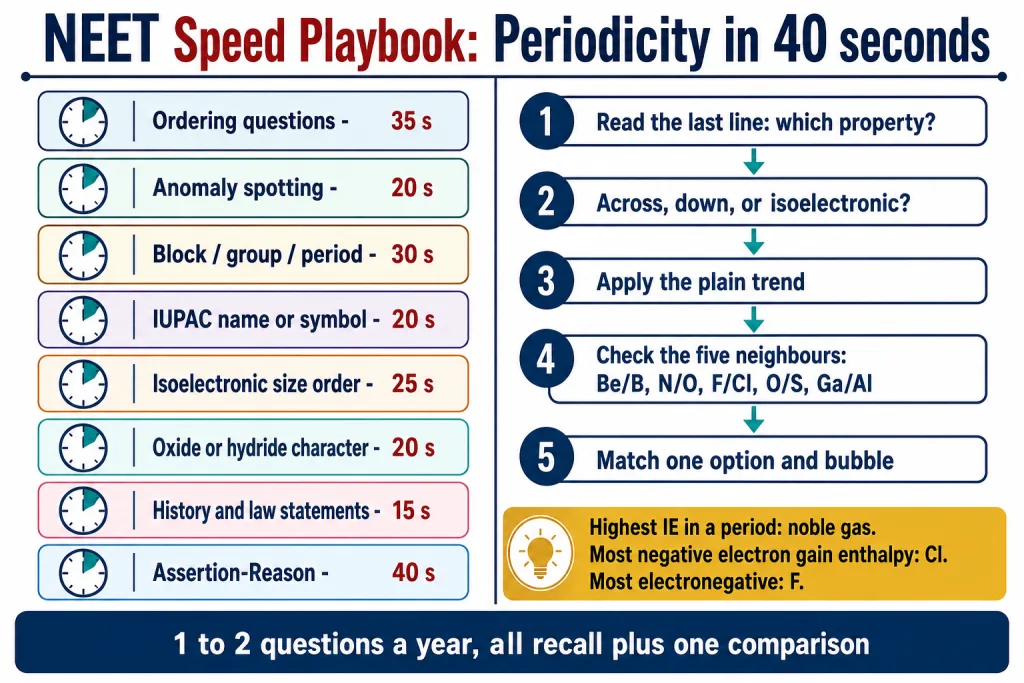
Favourite topics, ranked
If you only have time for five things:
- The four trends and their anomalies — radius, ionization enthalpy, electron gain enthalpy, electronegativity across and down, with Be/B, N/O, O/S, F/Cl, Ga/Al ready to quote.
- Size ordering — isoelectronic sets and the same element in different charges.
- Block, group and period from a configuration — the finder rules in Block 3 below.
- Oxide character — basic on the left, amphoteric in the middle, acidic on the right; which ones are neutral.
- IUPAC digit roots — nil, un, bi, tri, quad, pent, hex, sept, oct, enn.
The 40-second mindset
NEET is 180 questions in 200 minutes, so a periodicity question is where you bank time for Biology. The target is solve it in 40 seconds and move on.
- Read the last line first. It names the property being ordered — radius, , , electronegativity, basicity. Fix the property before you look at the elements.
- Decide "across" or "down" — or "isoelectronic". Same period, same group and same electron count are three different rules, never mixed.
- Apply the plain trend first, then ask whether a famous anomaly is sitting in the list: Be/B, N/O, O/S, F/Cl, Ga/Al, noble gases. If yes, flip that one pair.
- Watch the direction word. "Increasing" versus "decreasing", "most negative" versus "highest". Half the wrong bubbles here are direction errors, not chemistry errors.
- Match to the options and go. If your order appears exactly once, bubble. If it does not appear, you have missed an anomaly — check step 3 once, then move on.
Key Point: This chapter rewards knowing which rule applies and which pair is anomalous, not explaining effective nuclear charge at length. Treat it as a recall chapter with five famous exceptions.
[NEET] Negative marking () makes a 40-second wrong answer worse than a 40-second skip. If an ordering question matches no option after one anomaly check, mark it for review and come back.
What NEET does NOT ask from this chapter
- Slater's rules or numerical — never.
- Mulliken or Allred-Rochow electronegativity numbers — never.
- Long successive-ionization-enthalpy data tables to decode — rare, and then only as a one-jump "find the group" item.
- Lanthanoid contraction in detail — that belongs to Class 12 d- and f-block.
Anything here taking more than 90 seconds means you are using the wrong tool.
The Verbatim-Recall Tables — History and the Definitions NEET Asks Word for Word
"Who did what, when" and "define this term" pay exactly as much as a hard ordering item. Learn these two tables as flash-cards.
Table 1: Who did what, and when
| Year | Scientist | Idea | The one line NEET asks |
|---|---|---|---|
| 1829 | Johann Dobereiner (German) | Triads — groups of three similar elements in which the middle atomic weight is about the average of the other two | Li (7), Na (23), K (39): ; Ca (40), Sr (88), Ba (137): ; Cl (35.5), Br (80), I (127): |
| 1862 | A. E. B. de Chancourtois (French geologist) | Arranged elements by increasing atomic weight on a cylinder (telluric screw) to show recurrence of properties | First to see periodicity as a repeating spiral; ignored at the time |
| 1865 | John Newlands (English) | Law of Octaves — every eighth element resembles the first, like notes in music | Worked only up to calcium; Davy Medal in 1887 |
| 1868/1869 | Lothar Meyer (German) | Plotted atomic volume, melting and boiling points against atomic weight; got a periodic curve and a table close to the modern one (1868), published after Mendeleev | "Physical properties" man; shared credit for the periodic law (1869) |
| 1869 | Dmitri Mendeleev (Russian) | Periodic Law on atomic weight; left gaps, predicted eka-aluminium (Ga) and eka-silicon (Ge), swapped I and Te on the basis of properties | "Chemical properties" man; credited with the periodic table |
| 1913 | Henry Moseley (English) | X-ray spectra: against atomic number is a straight line, not against atomic mass | Basis of the modern periodic law |
| 1940s-1950s | Glenn T. Seaborg (American) | Discovered plutonium and elements 94 to 102; placed the actinoids below the lanthanoids; Nobel Prize 1951; element 106 is seaborgium | Reconfigured the table; the actinoid concept |
| 1984 | IUPAC | Groups numbered 1 to 18, replacing IA to VIIA, VIII, IB to VIIB and 0 | "According to IUPAC, the halogens are group 17" |
[NEET] Mendeleev's law was based on atomic weight (mass); the modern law on atomic number. His two famous predictions: eka-aluminium became gallium (1875) and eka-silicon became germanium (1886) — predicted atomic weights (68 and 72) and densities ( and ) against real values (, ; , ).
Table 2: The definitions NEET asks verbatim
| Term | Definition as NEET wants it | Instant example |
|---|---|---|
| Mendeleev's periodic law | The properties of the elements are a periodic function of their atomic weights | I placed before Te by properties, not weight |
| Modern periodic law | The physical and chemical properties of the elements are periodic functions of their atomic numbers | Based on Moseley's work |
| Period | A horizontal row; the period number equals the highest principal quantum number of the elements in it | Period 3: , Na to Ar |
| Group | A vertical column of elements with similar outer electronic configuration; 18 groups | Group 1: |
| Representative (main-group) elements | The s-block and p-block elements (groups 1, 2 and 13 to 18) | Na, Al, Cl |
| Transition elements | d-block elements, , with incompletely filled d orbitals in the atom or a common ion; groups 3 to 12 | Fe, Cu; Zn, Cd, Hg are not typical |
| Inner-transition elements | f-block: lanthanoids (Ce to Lu) and actinoids (Th to Lr), | Elements after U are transuranium |
| Covalent radius | Half the internuclear distance between two like atoms joined by a single covalent bond | Cl: pm |
| Metallic radius | Half the internuclear distance between two adjacent atoms in a metallic crystal | Cu: pm |
| van der Waals radius | Half the distance between nuclei of two non-bonded neighbouring atoms of adjacent molecules | Noble-gas radii are van der Waals radii |
| Isoelectronic species | Atoms and ions with the same number of electrons | , , Ne, , (10 electrons) |
| Ionization enthalpy | The energy required to remove an electron from an isolated gaseous atom in its ground state; ; always positive | Na: 496 kJ/mol |
| Second ionization enthalpy | Energy to remove an electron from the unipositive gaseous ion; ; always larger than the first | Na: 4562 kJ/mol |
| Electron gain enthalpy | The enthalpy change when an electron is added to a neutral gaseous atom to form an anion; ; negative (exothermic) for most, positive for noble gases | Cl: kJ/mol |
| Electron affinity | The negative of , quoted as a positive number for an exothermic gain (older convention) | Cl: 349 kJ/mol |
| Electronegativity | A qualitative measure of the ability of an atom in a compound to attract shared electrons to itself; not measurable directly; Pauling scale F | Not the same as |
| Metalloids (semi-metals) | Elements bordering the zig-zag line with properties between metals and non-metals | B, Si, Ge, As, Sb, Te |
| Diagonal relationship | Similarity in properties between the first element of a group and the second element of the next group in period 2 and 3 | Li/Mg, Be/Al, B/Si |
| Valence (representative elements) | Number of electrons in the outermost shell, or eight minus that number | S: 6 or |
| Amphoteric oxide | An oxide that behaves as acidic with bases and basic with acids | , |
Key Point (Definition): Ionization enthalpy and electron gain enthalpy are both about isolated gaseous atoms — "gaseous" is part of the definition, and a stock NEET option drops it to make the statement wrong. Electronegativity is about an atom inside a molecule and has no unit.
[NEET] What gets tested is that electron affinity is positive for chlorine while its electron gain enthalpy is negative — same physical fact, opposite sign convention.
The IUPAC Digit-Root Table and the Block-Group-Period Finder
Two skills, both worth a guaranteed mark, both finished in under 30 seconds once the rules are memorised.
Skill 1: naming an element above 100
| Digit | Root | Digit | Root |
|---|---|---|---|
| 0 | nil | 5 | pent |
| 1 | un | 6 | hex |
| 2 | bi | 7 | sept |
| 3 | tri | 8 | oct |
| 4 | quad | 9 | enn |
The rule: write the digits of as roots in order, add "-ium", and the symbol is the first letter of each root. Two spelling rules NEET checks: a final "i" of "bi" or "tri" is dropped before "ium" (102 is unnilbium, not unnilbi-ium), and a final "n" of "enn" is dropped before "nil" (190 would be un-enn-nilium, written "unennilium").
| Systematic name | Symbol | Official name and symbol | |
|---|---|---|---|
| 101 | Unnilunium | Unu | Mendelevium, Md |
| 102 | Unnilbium | Unb | Nobelium, No |
| 103 | Unniltrium | Unt | Lawrencium, Lr |
| 104 | Unnilquadium | Unq | Rutherfordium, Rf |
| 105 | Unnilpentium | Unp | Dubnium, Db |
| 106 | Unnilhexium | Unh | Seaborgium, Sg |
| 107 | Unnilseptium | Uns | Bohrium, Bh |
| 108 | Unniloctium | Uno | Hassium, Hs |
| 109 | Unnilennium | Une | Meitnerium, Mt |
| 110 | Ununnilium | Uun | Darmstadtium, Ds |
| 111 | Unununium | Uuu | Roentgenium, Rg |
| 112 | Ununbium | Uub | Copernicium, Cn |
| 113 | Ununtrium | Uut | Nihonium, Nh |
| 114 | Ununquadium | Uuq | Flerovium, Fl |
| 115 | Ununpentium | Uup | Moscovium, Mc |
| 116 | Ununhexium | Uuh | Livermorium, Lv |
| 117 | Ununseptium | Uus | Tennessine, Ts |
| 118 | Ununoctium | Uuo | Oganesson, Og |
| 120 | Unbinilium | Ubn | (not yet made) |
[NEET] Three favourites: 120 = Ubn, unbinilium; 106 = seaborgium; 118 = oganesson, the last element of period 7 and a noble gas by position.
Skill 2: block, group and period from a configuration
The period is the highest in the configuration. The block is the subshell the last electron entered. The group follows from three little formulas:
| Block | Last electron enters | Group number | Example |
|---|---|---|---|
| s | number of electrons (1 or 2) | Na : group 1 | |
| p | (number of + electrons), i.e. 12 + number of electrons | S : | |
| d | number of electrons + number of electrons | Fe : | |
| f | always group 3; period 6 = lanthanoid, period 7 = actinoid | Gd : group 3, period 6 |
Two exceptions: helium () sits in group 18 though it is s-block by configuration, and hydrogen () sits in group 1 but is not an alkali metal.
The noble-gas ladder for finding a period from
Memorise the noble-gas atomic numbers 2, 10, 18, 36, 54, 86, 118. The period is one more than the number of noble gases you pass, and the position inside the period gives the block:
- Period 4 (Z = 19 to 36): 19-20 s-block, 21-30 d-block, 31-36 p-block.
- Period 5 (Z = 37 to 54): 37-38 s, 39-48 d, 49-54 p.
- Period 6 (Z = 55 to 86): 55-56 s, 57 then 58-71 f (lanthanoids), 72-80 d, 81-86 p.
- Period 7 (Z = 87 to 118): 87-88 s, 89 then 90-103 f (actinoids), 104-112 d, 113-118 p.
Ten worked one-liners
| Given | Configuration | Period | Block | Group |
|---|---|---|---|---|
| 4 | s | 1 (K) | ||
| 4 | d | (Zn) | ||
| 4 | p | (Br) | ||
| 6 | s | 2 (Ba) | ||
| 6 | f | 3 (Gd, lanthanoid) | ||
| e.g. | p | 16 (chalcogen) | ||
| e.g. | d | 4 (Ti family) | ||
| e.g. | f | 3 (Gd or Cm) | ||
| 7 | p | 14 (Fl) | ||
| 7 | p | 17 (Ts, halogen) |
And beyond the table: is — period 8, s-block, group 2, an alkaline-earth metal.
Key Point: For a d-block element the group is s electrons plus d electrons; for a p-block element it is 10 plus the valence electrons. Adding 10 for a d-block element, or forgetting to add 10 for a p-block element, lands you on a distractor NEET has already placed in the options.
The Master Trends Card — Four Properties, Two Directions, Every Anomaly
Everything NEET asks about trends fits on one card: the plain rule, then the anomaly list, then the reasons in one line each.
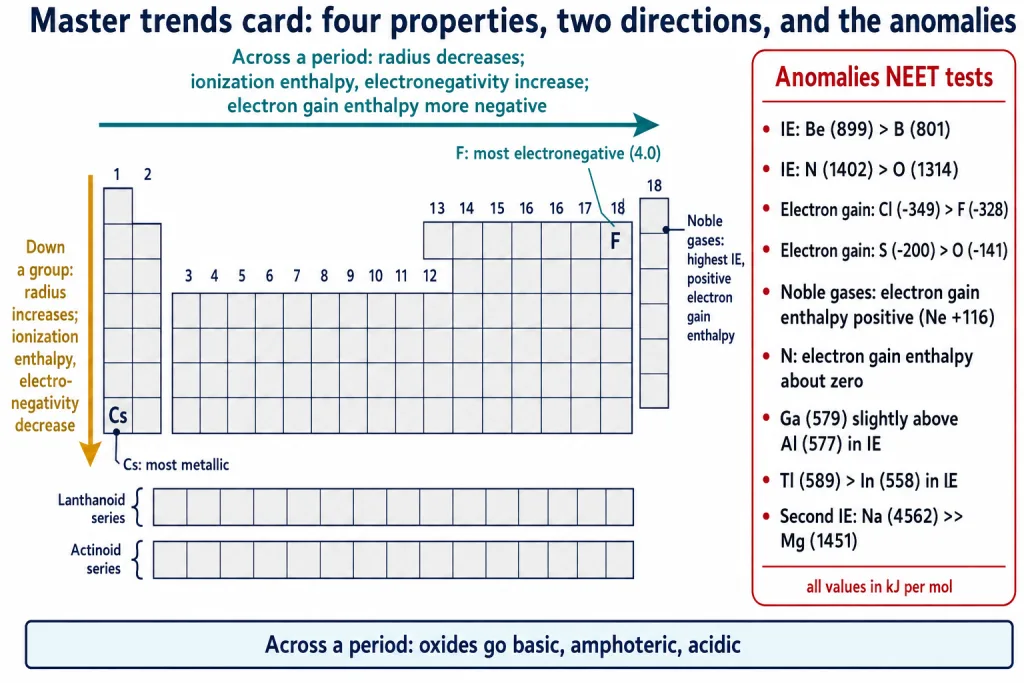
The card
| Property | Across a period (left to right) | Down a group | One-line reason |
|---|---|---|---|
| Atomic radius | Decreases (Li 152 to F 64 pm; Na 186 to Cl 99 pm) | Increases (Li 152, Na 186, K 231, Rb 244, Cs 262 pm) | Across: same shell, more nuclear charge pulls tighter. Down: a new shell each step, and inner shells shield the pull |
| Ionization enthalpy | Increases (Na 496, Mg 737, Si 786 kJ/mol) | Decreases | Across: smaller atom, tighter hold. Down: outer electron farther and better shielded |
| Electron gain enthalpy | Becomes more negative (metals to halogens) | Becomes less negative (Cl , Br , I kJ/mol) | Across: higher nuclear charge, smaller size welcome an electron. Down: added electron sits farther away |
| Electronegativity | Increases (Li 1.0 to F 4.0; Na 0.9 to Cl 3.0) | Decreases (F 4.0, Cl 3.0, Br 2.8, I 2.5, At 2.2) | Tracks radius inversely: small atom, strong pull on a shared pair |
| Metallic character | Decreases | Increases | Metals lose electrons easily; low means metallic |
| Non-metallic character | Increases | Decreases | Mirror of metallic character |
| Reactivity | High at both ends, lowest in the middle | Metals: increases; non-metals: decreases | Left end loses an electron easily, right end gains one easily |
| Basicity of oxides | Decreases (basic to amphoteric to acidic) | Increases | Follows metallic character |
[NEET] "Highest first ionization enthalpy in a period" is always the noble gas; "lowest" is the alkali metal. "Most electronegative element" is F; "most electropositive" (and least electronegative) is Cs among stable elements, Fr in principle. "Most negative " is Cl, not F.
The anomaly list — the pairs that flip the plain rule
| Anomaly | The fact | Why, in one line |
|---|---|---|
| Be vs B (ionization enthalpy) | : Be (899) B (801) kJ/mol, though B is to the right | Be removes a paired electron; B removes a electron, which is farther out, less penetrating and easier to take |
| N vs O (ionization enthalpy) | : N (1402) O (1314) kJ/mol | N has a stable half-filled ; O's fourth electron is paired and repelled, so it leaves more easily |
| Same pairs again in period 3 | Mg (737) Al (577); P (1012) S (1000) kJ/mol | Same -versus- and half-filled logic |
| F vs Cl (electron gain enthalpy) | Cl () is more negative than F () kJ/mol | F's shell is tiny and crowded; the incoming electron feels strong repulsion |
| O vs S (electron gain enthalpy) | S () is more negative than O () kJ/mol | Same reason: small, crowded in oxygen |
| Noble gases (electron gain enthalpy) | Positive: He , Ne , Ar , Kr , Xe , Rn kJ/mol | The extra electron must start a new shell, far from the nucleus |
| Nitrogen (electron gain enthalpy) | Close to zero, slightly positive | Adding to a stable half-filled is not favourable |
| Second of O and S | Positive ( needs energy) | Pushing an electron into an already negative ion costs energy |
| Ga vs Al (radius and ) | Radius Ga (135) Al (143) pm — nearly equal; Ga (579) Al (577) kJ/mol, Ga slightly higher | The ten electrons before Ga shield poorly, so Ga's outer electron feels more pull than the group trend predicts |
| Tl vs In () | Tl (589) In (558) kJ/mol | Poorly shielding and electrons before Tl |
| Group 13 whole column | B 801, Al 577, Ga 579, In 558, Tl 589 kJ/mol — not a smooth decrease | d- and f-electron shielding |
| Noble-gas radii | Appear larger than the halogen next to them | They are van der Waals radii, not covalent; do not compare them with the rest of the period |
| Second of Na vs Mg | First: Na (496) Mg (737); second: Na (4562) Mg (1451) kJ/mol | is a noble-gas core (); still has a electron to give |
Key Point: Whenever an ordering question puts B next to Be, O next to N, F next to Cl, O next to S, or Ga next to Al, the plain trend is not the answer. Scan for these five neighbours before you bubble.
The ready-made ordered sets
| Property | Correct order |
|---|---|
| , period 2 | Li B Be C O N F Ne |
| , period 3 | Na Al Mg Si S P Cl Ar |
| (most negative first) | Cl F Br I (i.e. , , , kJ/mol) |
| , group 16 | S Se Te Po O (, , , , kJ/mol) |
| , group 1 | Li () Na () K () Rb () Cs () kJ/mol; H is |
| Electronegativity, period 2 | Li 1.0 Be 1.5 B 2.0 C 2.5 N 3.0 O 3.5 F 4.0 |
| Electronegativity, halogens | F 4.0 Cl 3.0 Br 2.8 I 2.5 At 2.2 |
| Metallic character, period 3 | Na Mg Al Si P S Cl |
| Metallic character, group 14 | C Si Ge Sn Pb |
[NEET] In an electron gain enthalpy order, "more negative" means larger magnitude, more exothermic. "The order of electron gain enthalpy is Cl F" means Cl's value is more negative; "electron affinity Cl F" means Cl's positive number is bigger. Both state the same fact.
Size-Ordering Rules — Atoms, Ions and Isoelectronic Sets in One Sweep
Size questions are the most predictable here. There are exactly four situations, each with its own rule; identify which one you are in and the order writes itself.
Rule 1: across a period, size falls; down a group, size rises
| Period 2 (pm) | Li 152 | Be 111 | B 88 | C 77 | N 74 | O 66 | F 64 |
|---|---|---|---|---|---|---|---|
| Period 3 (pm) | Na 186 | Mg 160 | Al 143 | Si 117 | P 110 | S 104 | Cl 99 |
| Group 1 (pm) | Li 152 | Na 186 | K 231 | Rb 244 | Cs 262 |
|---|---|---|---|---|---|
| Group 17 (pm) | F 64 | Cl 99 | Br 114 | I 133 | At 140 |
Ready-made orders: Cs Rb K Na Li; I Br Cl F; Na Mg Al Si P S Cl. When two elements sit in different periods and different groups, the one lower and further left is bigger (K Ca Mg; Na Al B).
Rule 2: a cation is smaller than its atom; an anion is larger
- Cation: fewer electrons, less repulsion, and usually a whole shell is gone. Na 186 pm 95 pm.
- Anion: extra electron, more repulsion, same nuclear pull spread over more electrons. F 64 pm 136 pm.
- Same element, different charge: more positive means smaller. ; ; .
| Ion | Radius (pm) | Ion | Radius (pm) |
|---|---|---|---|
| 76 | 31 | ||
| 102 | 72 |
(Two data sets exist for : 95 pm when compared with the Na atom, 102 pm in the group-wise ionic table. Either way it is far smaller than Na at 186 pm.)
Rule 3: isoelectronic species — more protons, smaller ion
Same electron count, so the only variable is nuclear charge: the higher the , the smaller the species. Equivalently, the most negative ion is the largest and the most positive cation the smallest.
| Electrons | Species in order of decreasing size |
|---|---|
| 2 | |
| 10 | |
| 18 | |
| 36 |
Quick numbers for the 10-electron set: 140, 136, 95 (or 102), 72 (or 65), 50 pm — the direction matters, not the decimals.
[NEET] "The size of isoelectronic species , Ne and is affected by" — the answer is nuclear charge. Not principal quantum number (same for all three), not number of electrons (same), not electron-electron repulsion (same electrons). Only differs.
Rule 4: don't mix the rules
- versus : isoelectronic (18 electrons), so though K is the bigger atom.
- versus : same group, different shells, so — Rule 1, not Rule 3.
- versus versus : same period and isoelectronic, so — both rules agree.
- versus : same element, so — Rule 2.
Ready-made mixed sets
| Set | Correct order (largest first) | Which rule |
|---|---|---|
| Na, , , | Na | 2 then 3 |
| Cl, , , Ar | ; Cl atom (99 pm) is smaller than (181 pm) and also smaller than (138 pm) | 2 and 3 |
| Li, Be, B, | Li Be B | 1 then 2 |
| , , | 1 (down the group) | |
| Al, Ga, In, Tl | Tl In Ga Al (Ga 135 pm slightly smaller than Al 143 pm) | 1 with the Ga anomaly |
Key Point: Three questions in order: Same element? (charge decides), Same electron count? (nuclear charge decides), Else? (period and group decide). In that sequence no size question takes more than 25 seconds.
The Valence, Hydride and Oxide Map — with the Water Reactions NEET Quotes
The last part of the chapter, as one table and a handful of equations.
Valence of representative elements
| Group | 1 | 2 | 13 | 14 | 15 | 16 | 17 | 18 |
|---|---|---|---|---|---|---|---|---|
| Valence electrons | 1 | 2 | 3 | 4 | 5 | 6 | 7 | 8 |
| Valence | 1 | 2 | 3 | 4 | 3, 5 | 2, 6 | 1, 7 | 0, 8 |
Rule: valence number of outer electrons, or that number. Groups 1, 2, 13, 14 use the first; groups 15 to 17 show both (N in is 3, in is 5; Cl in HCl is 1, in is 7).
Oxidation state versus valence: "oxidation state" is the working term today. In oxygen is (F is more electronegative); in it is . The two can differ: in the oxidation state of Al is but its covalency is .
Predicting a formula: take the valence of each element from its group and cross-multiply. Si (group 14, valence 4) with Br (group 17, valence 1) gives ; Al (group 13, valence 3) with S (group 16, valence 2) gives .
Hydrides and oxides across the table
| Group | 1 | 2 | 13 | 14 | 15 | 16 | 17 |
|---|---|---|---|---|---|---|---|
| Hydride | LiH, NaH, KH | , | , , , | , , | , , , | HF, HCl, HBr, HI | |
| Oxide (highest) | , , | MgO, CaO, SrO, BaO | , , , | , , , , | , , , (and , , , , ) | , , |
The top row gives hydride valence: 1, 2, 3, 4, 3, 2, 1. In the bottom row the oxygen count climbs from to as the group number rises.
The period-3 oxide sequence — basic to amphoteric to acidic
| Oxide | MgO | ||||||
|---|---|---|---|---|---|---|---|
| Character | strongly basic | basic | amphoteric | weakly acidic | acidic | strongly acidic | very strongly acidic |
| With water gives | NaOH | (insoluble) | (insoluble) |
Basic oxides belong to metals on the left; acidic oxides to non-metals on the right; amphoteric oxides sit in the middle (, , also ZnO, BeO, , PbO); neutral oxides are a short list — CO, NO, — reacting with neither acid nor base.
The reactions NEET expects you to write
Amphoteric aluminium oxide, both ways:
Reactivity in one line each
- Across a period, reactivity is high at both ends and lowest in the middle: Na loses an electron easily, Cl gains one easily, Si does neither readily.
- Down a group of metals (1, 2), reactivity increases — lower (Cs is the most reactive metal).
- Down a group of non-metals (16, 17), reactivity decreases — less negative (F is the most reactive non-metal).
- Down a group of representative elements, the highest oxide becomes more basic: acidic, basic; acidic, amphoteric.
Key Point: Basicity of oxides follows metallic character: left and down means basic; right and up means acidic. "Most basic oxide" asks for the biggest, most metallic element in the list; "most acidic" for the smallest, most electronegative one.
The NEET Traps List — Where the Minus One Comes From
Every trap here has cost real marks. Read the list twice.
Trap 1: electron affinity has the opposite sign
Chlorine's electron gain enthalpy is kJ/mol (exothermic, negative). Its electron affinity is quoted as kJ/mol. "The electron affinity of chlorine is negative" is false; "the electron gain enthalpy of chlorine is negative" is true. Read which word the question uses.
Trap 2: F is not the champion of electron gain enthalpy
Most electronegative: F. Most negative electron gain enthalpy: Cl. The reason is size: fluorine's shell is so compact that the incoming electron is strongly repelled. Same story with O () versus S ().
Trap 3: noble gases in a radius order
Noble-gas radii are van der Waals radii and come out larger than the covalent radius of the halogen beside them. A question saying "atomic radius decreases across period 2 up to F and then increases at Ne" is quoting this, and a question asking you to order Li to F excludes Ne for the same reason. Do not call Ne the smallest atom in period 2 — the smallest by covalent radius is F, and Ne is not compared.
Trap 4: second ionization enthalpy — Na versus Mg
First : Na (496) Mg (737). Second : Na (4562) Mg (1451). The reversal comes from having the stable core while still holds a lone electron. Assertion-Reason items love this: both statements true, and the reason does explain the assertion.
Trap 5: valence versus oxidation state versus covalency
Valence of N in is 3; oxidation state is . Oxygen's oxidation state in is , in it is , and its valence is 2 in both. Al in : oxidation state , covalency 6. Three different words — the question uses exactly one.
Trap 6: "highest" versus "most negative"
For and electronegativity, "highest" means the largest positive number. For , "highest" or "maximum" in a NEET sense means the most negative value (Cl), while the noble gases have the least favourable (positive) values. When an option list mixes signs, read the sign of every entry.
Trap 7: which anomaly is which
Be B and N O are ionization enthalpy anomalies. Cl F and S O are electron gain enthalpy anomalies. Ga Al is a radius and ionization enthalpy anomaly. Students transplant them and claim "Cl has a higher ionization enthalpy than F" (false: F 1681 Cl 1251 kJ/mol) or "N has a more negative electron gain enthalpy than O" (false: N is near zero). Keep each anomaly attached to its own property.
Trap 8: period number from the "biggest" subshell
For Zn, , the period is 4 (highest is 4), not 3 because of the . For Gd, , the period is 6. The period is the highest , full stop.
Trap 9: group number for the d-block
Fe is , group , not 6 and not 16. Zn is group 12, not 2. Cu () is group 11. For the p-block, add 10: Br is , group , not 7.
Trap 10: Mendeleev versus Moseley versus Newlands
Mendeleev: atomic weight, gaps, predictions, 1869. Moseley: atomic number, X-rays, 1913, modern law. Newlands: octaves, 1865, every eighth element, fails after Ca. Dobereiner: triads, 1829. Lothar Meyer: atomic volume curves. A question pairing "law of octaves" with Dobereiner, or "triads" with Newlands, is a swap.
Trap 11: metalloids and the zig-zag
The zig-zag line runs from B through Si, Ge, As, Sb, Te (and Po by some tables), separating metals (left, below) from non-metals (right, above). Al is a metal, not a metalloid, even though it touches the line. About 78 percent of elements are metals.
Trap 12: which block hydrogen and helium belong to
Helium is — filled shell — so it sits in group 18 with the noble gases although its configuration is s-type. Hydrogen is and is placed alone at the top of group 1, but it is not an alkali metal; it can lose an electron (like Li) or gain one (like F).
Key Point: Most losses here are word errors: affinity versus gain enthalpy, highest versus most negative, valence versus oxidation state, weight versus number, period versus of the subshell. Underline the noun in the last line, then answer.
The 40-second checklist (say it before you bubble)
- Did I read which property — radius, , , electronegativity, basicity — and which direction (increasing or decreasing)?
- Is this a period, group, or isoelectronic comparison — and did I use that rule and only that rule?
- Did I scan for the five famous neighbours — Be/B, N/O, F/Cl, O/S, Ga/Al — and the noble gases?
- For a block or group question, did I take the highest for the period and use or valence for the group?
- Does my answer match exactly one option?
Solved Examples
Question 1: Which law, which scientist
Match each idea with its author: (i) every eighth element resembles the first; (ii) properties are a periodic function of atomic number; (iii) the middle element of three has an atomic weight about the average of the other two; (iv) elements arranged on a cylinder by atomic weight.
Answer:
"Every eighth element" is the musical octave idea, so (i) is Newlands, 1865.
Only one person made the basis of the law: Moseley, 1913. That gives (ii), the modern periodic law.
Middle weight equal to the average of the other two is the triad rule, so (iii) is Dobereiner, 1829.
The cylinder is the telluric screw, so (iv) is de Chancourtois, 1862.
Ans: (i) Newlands, (ii) Moseley, (iii) Dobereiner, (iv) de Chancourtois.
Watch out: Mendeleev is the odd one out here — he used atomic weight, left gaps and predicted gallium and germanium, but none of these four statements is his.
Question 2: Name and symbol of an element above 100
Write the IUPAC systematic name and symbol for the elements with and , and give the official name of .
Answer:
I split 104 into 1, 0, 4: un, nil, quad. Adding "-ium" gives unnilquadium, and the first letters give the symbol Unq. Element 104 is officially rutherfordium, Rf.
For 120 the digits are 1, 2, 0: un, bi, nil. That is unbinilium, symbol Ubn. It has no official name because it has not been made.
Ans: 104: unnilquadium, Unq (rutherfordium, Rf); 120: unbinilium, Ubn.
Watch out: The spelling wrinkle is dropping the final "i" of bi or tri before "-ium" (unnilbium, unniltrium).
Question 3: Block, period and group from a configuration
An element has the outer configuration . Find its period, block and group, and name it.
Answer:
The highest is 4, so the period is 4.
The last electron went into a orbital, so this is the p-block.
For the p-block the group is valence electrons .
Period 4, group 15 is arsenic, (Ar is 18, plus more).
Ans: Period 4, p-block, group 15 — arsenic (a metalloid).
Watch out: Ignore the when deciding the period; it belongs to the shell below. Add 10 for the p-block group.
Question 4: The ionization enthalpy order with anomalies
Arrange Be, B, C, N and O in increasing order of first ionization enthalpy.
Answer:
The plain trend across period 2 says the value rises: Be B C N O.
Then I check for anomalies, and two famous neighbours are in this list — Be/B and N/O.
Be B because boron's electron comes from a orbital, which is farther out and easier to remove than beryllium's paired electron. N O because nitrogen's is half-filled and extra stable, while oxygen's fourth electron is paired and pushed out by repulsion.
Flipping both pairs gives B Be C O N, matching 801, 899, 1086, 1314, 1402 kJ/mol.
Ans: B Be C O N.
Watch out: Any period-2 or period-3 ionization enthalpy order has exactly two flips: group 2 above group 13, and group 15 above group 16.
Question 5: Most negative electron gain enthalpy
Which of F, Cl, Br and I has the most negative electron gain enthalpy, and why is it not fluorine?
Answer:
The values are F , Cl , Br , I kJ/mol, so chlorine is the most negative.
Fluorine loses out on size. Its shell is tiny and crowded, so the incoming electron is repelled by the electrons already there. That repulsion cancels part of the attraction and leaves the value less negative than chlorine's.
Below Cl the trend is normal: the added electron sits farther away, so Br and I are less negative.
Ans: Chlorine ( kJ/mol).
Watch out: The same "small and crowded" argument makes sulphur () beat oxygen (). In both groups the second member is the champion.
Question 6: Size of isoelectronic species
Arrange , , , , and in order of increasing ionic radius.
Answer:
Each species has 10 electrons, so the set is isoelectronic.
With the electron count fixed, the only difference is nuclear charge, and more protons pull the same cloud in tighter.
The proton counts are N 7, O 8, F 9, Na 11, Mg 12, Al 13. The smallest is the one with the most protons.
Ans: .
Watch out: In an isoelectronic set, the most positive cation is the smallest and the most negative anion the largest. Read the charge and the order follows.
Question 7: Second ionization enthalpy — sodium versus magnesium
The first ionization enthalpy of Na is lower than that of Mg, but the second ionization enthalpy of Na is much higher than that of Mg. Explain in two lines.
Answer:
Na () is bigger and holds its lone electron loosely, so the first value follows the normal trend: Na (496) Mg (737) kJ/mol.
After that electron leaves, is — a completely filled, stable core, and pulling the next electron out of it costs 4562 kJ/mol. still has a electron in the outer shell, which goes for only 1451 kJ/mol.
Ans: has a noble-gas configuration, so its second electron comes from a stable inner shell; still has an outer electron to give.
Watch out: Successive ionization enthalpies always rise, but the big jump comes when you break into a filled inner shell — that jump tells you the group.
Question 8: Basic, amphoteric or acidic
Classify , , , and CO, and write the reaction of and with water.
Answer:
Left of the period means metallic and basic, so is basic. The middle is amphoteric: reacts with both HCl and NaOH. The right is acidic: gives and gives , the strongest of the lot.
CO is one of the three neutral oxides (CO, NO, ) and reacts with neither acid nor base.
The two equations: and .
Ans: basic; amphoteric; and acidic; CO neutral.
Watch out: Keep the short neutral list (CO, NO, ) separate from the amphoteric list (, , ZnO).
Question 9: Formula from group valence
Predict the formulas of the compounds formed between (a) silicon and bromine, (b) aluminium and sulphur, and (c) magnesium and nitrogen.
Answer:
First I read the valences off the groups: Si (14) is 4, Br (17) is 1, Al (13) is 3, S (16) is , Mg (2) is 2, N (15) is .
One Si needs four Br, giving . Cross-multiplying 3 and 2 gives . Cross-multiplying 2 and 3 gives .
Ans: , , .