
Why Elements Are Classified
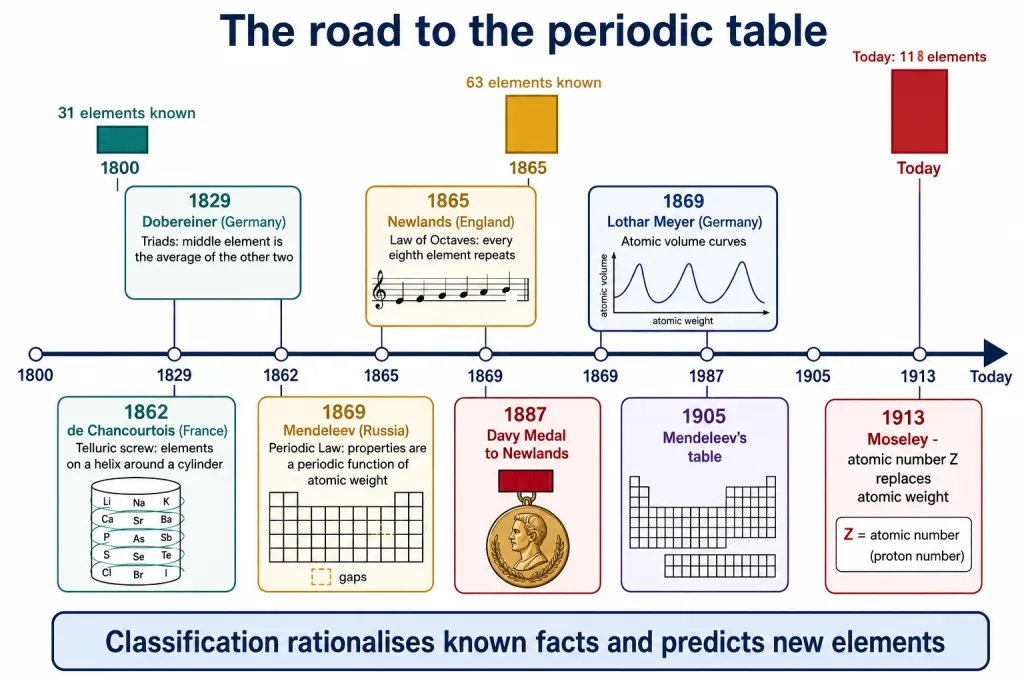
In 1800, chemists knew of only 31 elements — few enough to learn one by one. But the nineteenth century was the great age of element hunting, and by 1865 the count had more than doubled to 63. Today we know 114 elements (the textbook figure — the official list has since grown to 118), the newest ones made in accelerators.
Studying 114 elements and their innumerable compounds one at a time, with no organising idea, is hopeless. Every fact stays an isolated fact. That is the problem classification solves.
What a good classification buys you
- It rationalises what is already known. If sodium and potassium behave alike, and lithium behaves like both, you learn one "family chemistry" instead of three.
- It predicts what is not yet known. A good scheme has empty slots, and those slots tell you what to look for and what the missing thing will be like. Mendeleev's predictions of gallium and germanium are the famous example.
Key Point: Scientists searched for a systematic way to organise their knowledge of the elements because the number of known elements grew from 31 (in 1800) to 63 (by 1865) to 114 (today), and studying each element and its compounds separately became impossible. A good classification both rationalises known chemical facts and predicts new ones for further study.
The two questions every scheme must answer
- The ordering property. In the nineteenth century the only candidate was atomic weight (relative atomic mass), known reasonably well for many elements though not always correctly.
- The pattern to look for. The deep discovery of the 1860s was that similar properties recur at regular intervals when elements are lined up by weight. That recurrence is what periodic means.
The rest of this section follows the move from the first idea (group things that look alike) to the second (properties repeat periodically with weight), and finally to the modern statement that they repeat periodically with atomic number.
| Year | Who | What |
|---|---|---|
| 1800 | — | 31 elements known |
| 1829 | Johann Dobereiner (German) | Triads: middle element's atomic weight is the average of the other two |
| 1862 | A. E. B. de Chancourtois (French geologist) | Cylindrical table (telluric screw) of elements in order of atomic weight |
| 1865 | John Alexander Newlands (English) | Law of Octaves: every eighth element resembles the first; 63 elements known |
| 1868-1869 | Lothar Meyer (German, 1830-1895) | Curves of atomic volume, melting point and boiling point against atomic weight; a table resembling the modern one |
| 1869 | Dmitri Mendeleev (Russian, 1834-1907) | Periodic Law based on atomic weights; the periodic table with gaps and predictions |
| 1887 | Royal Society, London | Davy Medal awarded to Newlands for his earlier work |
| 1905 | Mendeleev | The version of his periodic table usually reproduced in textbooks |
[NEET] Dobereiner 1829, de Chancourtois 1862, Newlands 1865, Mendeleev and Lothar Meyer 1869. Mendeleev is credited with publishing the periodic law first; Dobereiner with initiating the study of periodic relationships.
Dobereiner's Triads (1829) and de Chancourtois's Cylinder (1862)
The first pattern: groups of three
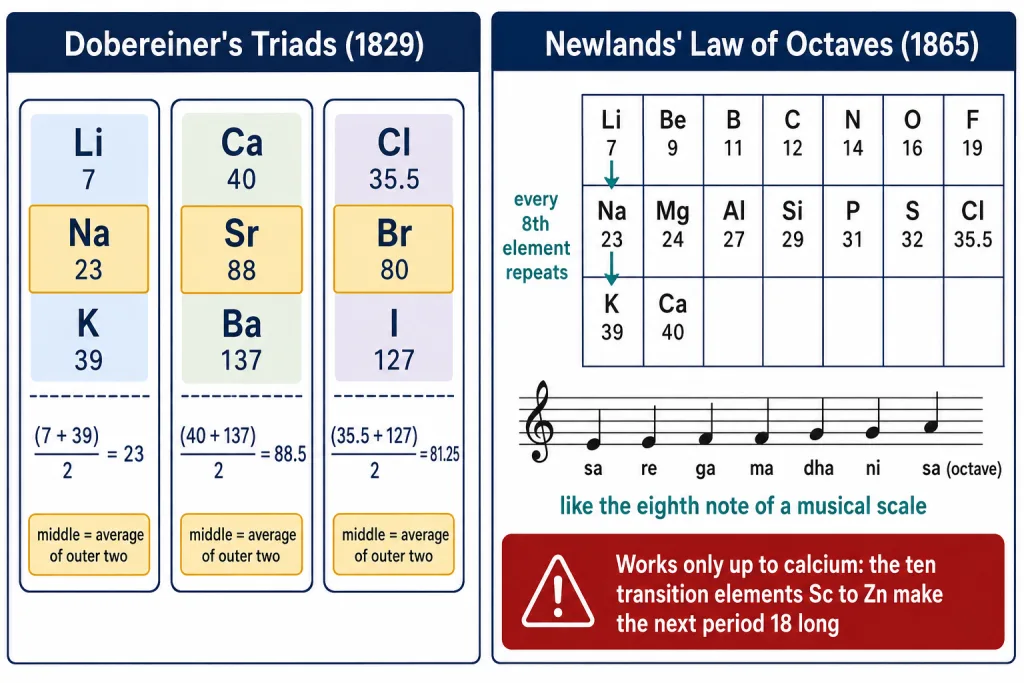
The German chemist Johann Dobereiner was the first to look for trends among the properties of elements rather than just cataloguing them. By 1829 he had noticed a pattern in several groups of three chemically similar elements, which he called triads.
| Triad | Element | Atomic weight | Element | Atomic weight | Element | Atomic weight |
|---|---|---|---|---|---|---|
| Alkali metals | Li | 7 | Na | 23 | K | 39 |
| Alkaline earths | Ca | 40 | Sr | 88 | Ba | 137 |
| Halogens | Cl | 35.5 | Br | 80 | I | 127 |
In each row, the middle element has an atomic weight about half way between the other two:
The properties of the middle element also sit between those of the other two: sodium is more reactive than lithium but less than potassium; bromine is a liquid between gaseous chlorine and solid iodine; strontium's compounds are intermediate in solubility between calcium's and barium's.
Key Point (Definition): Dobereiner's Law of Triads (1829): in a group of three elements with similar properties, the atomic weight of the middle element is approximately the arithmetic mean of the atomic weights of the other two, and its properties are intermediate between theirs.
Why the triads were dismissed
The relationship worked for a handful of groups and then stopped: no triad for iron, for carbon, or for most elements known in 1829. With so few examples, chemists called it a coincidence. In hindsight it was the first sighting of a periodic pattern — each triad is three consecutive members of a modern group.
[Board] Asked whether three atomic weights form a triad, check that the middle value is close to the average of the outer two and say the three must be chemically similar. Three numbers alone do not make a triad.
de Chancourtois and the telluric screw (1862)
The next attempt came from a French geologist, A. E. B. de Chancourtois, in 1862. He wrote the elements in order of increasing atomic weight along a helix wound round a cylinder, one full turn covering sixteen atomic-weight units. Elements with similar properties then landed roughly one above another — properties recurred at regular intervals as you went round.
He called it the vis tellurique (telluric screw, after tellus, the Earth). It was a genuine periodic table, arguably the first, but his paper appeared in a geology journal without its diagram and attracted almost no attention.
Key Point: de Chancourtois (1862) arranged the then-known elements in increasing order of atomic weight on a cylindrical table to show the periodic recurrence of properties. His work went largely unnoticed.
Dobereiner grouped elements that already looked alike and then found a number pattern. de Chancourtois did the reverse — he ordered all the elements by a number and found that likeness came back at regular intervals. That is the seed of the periodic law.
Newlands' Law of Octaves (1865)
Every eighth element
In 1865 the English chemist John Alexander Newlands did what de Chancourtois had done, but in a flat table. He arranged the known elements in increasing order of atomic weight and found that every eighth element had properties similar to the first — the eighth from lithium was sodium, the eighth from sodium potassium, and so on.
| Element | Li | Be | B | C | N | O | F |
|---|---|---|---|---|---|---|---|
| At. wt. | 7 | 9 | 11 | 12 | 14 | 16 | 19 |
| Element | Na | Mg | Al | Si | P | S | Cl |
| At. wt. | 23 | 24 | 27 | 29 | 31 | 32 | 35.5 |
| Element | K | Ca | |||||
| At. wt. | 39 | 40 |
Column by column, the modern groups appear: Li, Na, K; Be, Mg, Ca; B and Al; C and Si; N and P; O and S; F and Cl. (The weights are those in use at the time — silicon's 29 is Newlands' value, not today's 28.)
The musical analogy
Newlands was musically inclined. In an octave the notes go sa, re, ga, ma, pa, dha, ni and then sa again — the eighth note resembles the first — so he called the regularity the Law of Octaves.
Key Point (Definition): Newlands' Law of Octaves (1865): when elements are arranged in increasing order of atomic weight, every eighth element has properties similar to the first, just as every eighth note in music resembles the first.
The noble gases have no place in the table above — they were not discovered until the 1890s. Newlands' "eight" is the modern "eight" minus the noble gas: Li to F is seven elements, and the eighth begins the next row.
Where it breaks: only true up to calcium
After calcium come the transition metals — titanium, vanadium, chromium, manganese, iron and the rest — ten of them between calcium and the next element that really resembles boron or carbon. Counting "eighth from potassium" lands on cobalt or nickel, not on something like sodium. To keep the pattern going Newlands had to cram two elements into one slot in places and put unrelated elements together. His law seemed to be true only for elements up to calcium.
Two more things counted against him:
- His table had no room for elements yet to be discovered, assuming a complete list, which in 1865 it was not.
- The music analogy invited ridicule. At the Chemical Society of London one member is said to have asked whether he had tried arranging the elements alphabetically.
The idea was not widely accepted at the time. Yet Newlands had genuinely seen the periodicity, and the Royal Society of London awarded him the Davy Medal in 1887.
[JEE/NEET] Three things about Newlands: (i) order by atomic weight, (ii) every eighth element repeats the first, (iii) valid only up to calcium — beyond that, the transition elements make the repeat length longer than eight.
Why a fixed length of eight was always going to fail
Periods in the real periodic table are not all the same length: 2, 8, 8, 18, 18, 32. Eight works for the second and third periods only; the fourth has 18 elements, because the ten 3d elements slot in between calcium and gallium. Newlands' fixed repeat length had to fail exactly where the period length changes. Lothar Meyer was the first to notice that it changes, which is the next part of the story.
Lothar Meyer: Periodicity Seen in a Graph
The German chemist who nearly got there first
Julius Lothar Meyer (1830-1895) attacked the problem from the physical side, taking measurable physical properties — atomic volume (atomic weight divided by the density of the solid element, roughly the space one mole of atoms takes up), melting point and boiling point — and plotting each against atomic weight.
The atomic-volume graph is a series of sharp peaks and troughs:
- The peaks fall on the alkali metals — Li, Na, K, Rb, Cs — whose large, loosely packed atoms give large atomic volumes.
- The troughs fall on the middle of each period; in later periods these are the transition metals, with small, densely packed atoms.
- On the rising side of each peak sit the halogens; on the falling side, the alkaline earths.
A periodically repeated pattern jumps out of the graph. Melting point and boiling point gave a matching, though less clean, wave.
Key Point: Lothar Meyer plotted physical properties such as atomic volume, melting point and boiling point against atomic weight and obtained a periodically repeated pattern. Periodicity in his hands was a graphical fact, not just a list of resemblances.
The crucial thing he saw that Newlands missed
Look at the spacing of the peaks. Li to Na is short, Na to K about the same, but K to Rb is much longer, and Rb to Cs longer still: the length of the repeating pattern changes for heavier elements. Newlands had insisted the repeat was always eight; this curve made it obvious that it grows. That is why octaves fail after calcium, and what the period lengths 2, 8, 8, 18, 18, 32 express.
By 1868 Lothar Meyer had a table of the elements that closely resembles the modern periodic table, but did not publish it. His full table appeared in 1870, after Mendeleev's paper of 1869, and priority goes to whoever publishes. Mendeleev is therefore generally credited with the modern periodic table, though the periodic law owes its development to both men, working independently in the same year.
What the two men had in common — and what separated them
| Feature | Lothar Meyer | Mendeleev |
|---|---|---|
| Ordering property | Atomic weight | Atomic weight |
| Year of the key statement | 1869 (table ready by 1868, published 1870) | 1869 |
| Basis of the classification | Physical properties (atomic volume, m.p., b.p.) plotted as curves | Physical and chemical properties, especially formulas of compounds (oxides, hydrides, chlorides) |
| Attitude to periodicity | Observed it; noticed that the repeat length changes | Fully recognised its significance and built a complete system on it |
| Elements that did not fit | Placed by atomic weight | Reversed the order where properties demanded it (Te and I) |
| Undiscovered elements | No systematic predictions | Left gaps and predicted their properties in detail |
| Publication | After Mendeleev | First |
Both in 1869 proposed the same core idea: on arranging the elements in increasing order of atomic weight, similarities in physical and chemical properties appear at regular intervals. Mendeleev's system was simply more elaborate, more daring and published first.
[Board] For "Why is Mendeleev rather than Lothar Meyer credited with the periodic table?", give three points: he published first; he used a broader range of properties, particularly compound formulas; and he left gaps and predicted the missing elements' properties, later confirmed.
Mendeleev's Periodic Law and Table (1869)
The law
Dmitri Ivanovich Mendeleev (1834-1907), a Russian chemist writing a textbook at St Petersburg, wanted a logical way to order the chapters and found a law instead. Dobereiner had initiated the study of periodic relationships, but Mendeleev was responsible for publishing the Periodic Law for the first time, in 1869:
Key Point (Definition): Mendeleev's Periodic Law: The properties of the elements are a periodic function of their atomic weights.
A periodic function is one whose values come back at regular intervals, the way a sine wave repeats. Line the elements up by atomic weight, and a property such as valence or metallic character rises, falls and rises again.
How he arranged the elements
Mendeleev wrote the elements in horizontal rows (which he called series) and vertical columns (groups) in order of increasing atomic weight, so that elements with similar properties fell in the same vertical column. Weight along the row, likeness down the column — the skeleton of every periodic table since.
His system was more elaborate than Lothar Meyer's because of the evidence. He fully recognised the significance of periodicity and drew on a broader range of physical and chemical properties, in particular the similarities in the empirical formulas and properties of the compounds formed by the elements. An element forming an oxide went with the alkali metals in Group I; in Group II; in Group III; in Group IV, up to in Group VII. Hydrides did the same job: , , , for Groups IV to VII.
| Mendeleev group | I | II | III | IV | V | VI | VII |
|---|---|---|---|---|---|---|---|
| Typical oxide | |||||||
| Typical hydride | — | — | — |
[Board] "Which property did Mendeleev use, and did he stick to it?" He used atomic weight, but not rigidly — he placed elements by similarity of properties even when that broke the weight order (iodine and tellurium), and left gaps for undiscovered elements.
The tellurium-iodine problem
Some elements did not fit if atomic-weight order was followed strictly. Tellurium has atomic weight about 127.6 and iodine about 126.9, so by weight iodine should come first. But iodine is unmistakably a halogen: it forms and as chlorine forms and , and belongs with fluorine, chlorine and bromine. Tellurium forms as sulfur forms , and belongs in Group VI.
Mendeleev ignored the order of atomic weights, reasoning that the measurements might be wrong, and placed the elements with similar properties together: tellurium in Group VI with oxygen, sulfur and selenium, and iodine — despite its lower atomic weight — in Group VII with fluorine, chlorine and bromine.
Key Point: Mendeleev's primary aim was to keep elements of similar properties in the same group. Where the order of atomic weights conflicted with this, he reversed the order (I after Te) and assumed the atomic weights were in error. We now know the weights were right; the ordering property was wrong. Iodine () really does come after tellurium () by atomic number.
He was right about the placement, though for the wrong reason. Moseley's X-ray work in 1913 showed the true ordering property is atomic number, which removes the anomaly altogether.
Leaving gaps
Keeping similar elements together sometimes meant the next element by weight did not belong in the next slot. Rather than force it in, Mendeleev proposed that some elements were still undiscovered and left several gaps in the table. In 1869 the world knew of 63 elements; his table had room for more.
The two famous gaps were under aluminium and under silicon; gallium and germanium were both unknown then. He named the missing elements eka-aluminium and eka-silicon — eka is Sanskrit for "one", so the name means "one place below aluminium" (and dvi, "two", for two places below, as in dvi-manganese). He also predicted their properties in detail, which the next block takes up.
Mendeleev's Predictions and the 1905 Table
Eka-aluminium and eka-silicon
Having left a gap under aluminium and one under silicon, Mendeleev predicted the existence of gallium and germanium and described their general physical properties — atomic weight, density, melting point, the oxide and chloride formulas — by interpolating between the neighbours above, below and on either side of each gap. Gallium was found in 1875 by Lecoq de Boisbaudran and germanium in 1886 by Winkler.
| Property | Eka-aluminium (predicted) | Gallium (found) | Eka-silicon (predicted) | Germanium (found) |
|---|---|---|---|---|
| Atomic weight | 68 | 70 | 72 | 72.6 |
| Density / (g/cm³) | 5.9 | 5.94 | 5.5 | 5.36 |
| Melting point / K | Low | 302.93 | High | 1231 |
| Formula of oxide | ||||
| Formula of chloride |
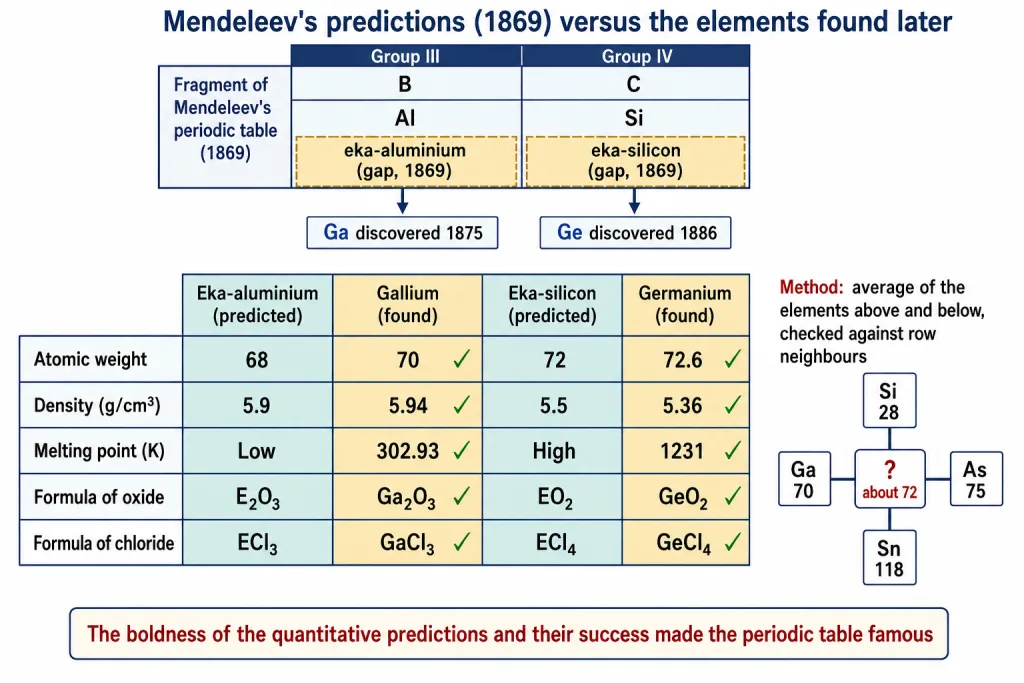
The oxide and chloride formulas are exactly right because they follow from the group: anything under aluminium in Group III forms and ; anything under silicon in Group IV forms and . Gallium's melting point of 302.93 K is famously low — it melts in the hand, at about — and Mendeleev had said "low".
Key Point: The boldness of Mendeleev's quantitative predictions and their eventual success made him and his periodic table famous. A classification that predicts numbers which are later measured and found correct is no longer a filing system; it is a scientific law.
How he arrived at the numbers
For a property that changes smoothly, the missing value is roughly the average of the elements above and below in the group, checked against the row neighbours. For eka-silicon's atomic weight: silicon above is 28, tin below is 118, giving ; the row neighbours gallium (about 70) and arsenic (75) give . Mendeleev quoted 72; germanium is 72.6. Density works the same way — silicon 2.3, tin 7.3, average 4.8, refined with the row neighbours to about 5.5; germanium is 5.36.
The 1905 table
The version of his table usually reproduced in textbooks is the one published in 1905, headed Periodic System of the Elements in Groups and Series. Its features:
- Groups I to VIII across the top, plus Group 0 for the noble gases (found in the 1890s and slotted in without disturbing anything else).
- Each group carries the formula of its higher oxide (, , … , ) and, where relevant, its hydride.
- Rows are called series; two series make one period in the later groups, so each group from I to VII splits into "A" and "B" sub-groups.
- Group VIII holds the triads Fe-Co-Ni, Ru-Rh-Pd and Os-Ir-Pt.
- Gaps still remained for elements yet to be found.
What the table could not explain
His table was built when chemists knew nothing about the internal structure of the atom — no electrons, no nucleus, no atomic number — so it carried problems it could not solve:
| Difficulty | What it looked like | Modern resolution |
|---|---|---|
| Position of hydrogen | Fits Group I (forms , is like with two H) and Group VII (forms , diatomic like halogens) | Still debated; usually placed separately above Group 1 |
| Anomalous pairs | Te (127.6) before I (126.9); Ar (39.9) before K (39.1); Co (58.9) before Ni (58.7) | Ordering by atomic number removes every reversal |
| Isotopes | Same element, different atomic weights — should they get separate places? | Same , same place |
| Dissimilar elements together | Cu, Ag, Au in Group I with Na, K | Sub-groups A and B were a patch; the long form separates them |
Every "anomaly" is an anomaly of atomic weight. Once Moseley showed in 1913 that atomic number is the fundamental property, the periodic law was restated and the anomalies vanished. That is where the next section begins.
[JEE Main] Mendeleev's law says properties are a periodic function of atomic weight; the modern law says of atomic number. Atomic number is more fundamental because it fixes the electronic configuration, and it is the configuration, not the mass, that decides chemistry.
Solved Examples
Question 1: Checking the alkali-metal triad
The atomic weights of lithium, sodium and potassium are 7, 23 and 39. Show that they form a Dobereiner triad.
Answer:
A triad needs three chemically similar elements with the middle one's atomic weight roughly the average of the other two. Li, Na and K are all soft, light metals that react with water to give hydrogen, so the chemical part holds.
Sodium's atomic weight is 23, an exact match. Its properties also sit in the middle — sodium reacts with water more vigorously than lithium and less than potassium.
Ans: The mean of Li and K is 23, equal to the atomic weight of Na; with their matching chemistry, Li, Na and K form a Dobereiner triad.
Watch out: A triad is a chemistry fact backed by a number check. Give both.
Question 2: The other two triads, with the error in each
For Ca/Sr/Ba (40, 88, 137) and Cl/Br/I (35.5, 80, 127), find the mean of the outer members, compare with the middle member and state the percentage difference.
Answer:
Ca/Sr/Ba: mean against Sr at 88. The difference is , so .
Cl/Br/I: mean against Br at 80. The difference is , so .
Both are within about 2%, good for 1829-era weights. Dobereiner said "about half way", not "exactly half way".
Ans: Sr: predicted 88.5, actual 88 (about 0.6% off). Br: predicted 81.25, actual 80 (about 1.6% off). Both triads hold.
Watch out: The triad rule is approximate. Quote the calculated mean, then say it is close to the middle value.
Question 3: Does this set of three form a triad?
Using the atomic weights S = 32, Se = 79, Te = 127.6 and N = 14, P = 31, As = 75, decide which set behaves like a Dobereiner triad and which does not.
Answer:
S/Se/Te: mean against Se at 79 — very close. All three are Group VI elements forming , , , so it is a genuine triad, and Dobereiner listed it.
N/P/As: mean against P at 31 — over 40% away.
N, P and As are chemically related (all form ), but the jump from P to As is far bigger than from N to P, because As comes after the ten 3d transition elements. The weight gap from second period to third is about 16 to 17 units; from third to fourth about 44 units.
The triad rule therefore works only where the three elements are separated by equal-length periods (8 and 8), which is why it was dismissed as a coincidence.
Ans: S, Se, Te form a triad (mean 79.8, Se = 79). N, P, As do not (mean 44.5, P = 31), because the period lengths on either side of P are unequal.
Watch out: Triads are three consecutive members of a modern group with equal period gaps. Where the periods change length, the arithmetic breaks.
Question 4: The basic theme of organisation
What is the basic theme of organisation in the periodic table?
Answer:
With over a hundred elements, studying each one and its compounds separately is impossible; the table makes that study manageable.
Elements are arranged so that those with similar physical and chemical properties fall in the same vertical column (group), while properties change in a regular, repeating way along a horizontal row (period).
This works because elements in a group share the same outer electronic configuration, which repeats periodically as atomic number rises. In Mendeleev's day the ordering property was atomic weight; today it is atomic number.
So a whole group's chemistry can be learnt from one or two members, and trends across a period let me predict any element's properties from its position.
Ans: The basic theme is to classify elements into groups (families) of similar properties and periods of regularly varying properties, so that their chemistry can be studied systematically and predictions made — arranged by atomic weight in Mendeleev's table and by atomic number (hence electronic configuration) in the modern one.
Watch out: "Similar properties in a group, periodic variation along a period" is the one-line answer; add the electronic-configuration reason for full marks.
Question 5: Name the scheme
Identify the classification scheme, the scientist and the year described by each statement: (a) Elements written along a helix wound round a cylinder so that similar elements fall on the same vertical line. (b) The atomic weight of the middle member of a group of three similar elements is roughly the mean of the other two. (c) Curves of atomic volume against atomic weight showing repeating peaks whose spacing increases. (d) Every eighth element resembles the first, as in a musical scale. (e) Elements arranged by atomic weight with gaps left for undiscovered ones and the order of two elements reversed on the basis of properties.
Answer:
(a) The helix round a cylinder is the telluric screw of de Chancourtois, a French geologist, 1862.
(b) The mean rule is the Law of Triads — Dobereiner, 1829.
(c) Atomic-volume curves with a changing repeat length are Lothar Meyer: table by 1868, law proposed 1869, published 1870.
(d) "Every eighth element" with the musical comparison is the Law of Octaves — Newlands, 1865.
(e) Gaps plus the tellurium/iodine reversal are Mendeleev's periodic table, 1869.
Ans: (a) de Chancourtois, cylindrical table, 1862; (b) Dobereiner, triads, 1829; (c) Lothar Meyer, atomic-volume curves, 1869; (d) Newlands, octaves, 1865; (e) Mendeleev, periodic law and table, 1869.
Watch out: Each scheme has one unmistakable keyword — cylinder, triad, curve, octave, gap. Learn the keyword with the year.
Question 6: Why octaves stop working after calcium
Newlands' table runs Li, Be, B, C, N, O, F / Na, Mg, Al, Si, P, S, Cl / K, Ca. Using today's atomic numbers, show why the "every eighth element" rule cannot continue past calcium.
Answer:
First I check where the rule works. Li is , Na is , K is — each 8 more than the last, all alkali metals. F is 9 and Cl is 17, again 8 apart, both halogens. The noble gases ( and 18) were unknown, so Newlands' "eighth" is our "eighth" once they are skipped.
Past calcium, , it breaks. After Ca come Sc (21), Ti (22), V (23), Cr (24), Mn (25), Fe (26), Co (27), Ni (28), Cu (29), Zn (30) — ten transition metals — and only then Ga (31), the true analogue of Al. The real repeat is 18: K (19) to the next alkali metal Rb (37), and Cl (17) to Br (35).
To keep the pattern Newlands squeezed two elements into one box in places and put unrelated elements such as iron with oxygen and sulfur, which is why his idea was rejected.
Period lengths are 2, 8, 8, 18, 18, 32, so a fixed repeat of eight matches only the second and third periods and must fail at the start of the fourth.
Ans: Beyond calcium the ten 3d transition elements (Sc to Zn) are inserted, so the next chemically similar element is the eighteenth, not the eighth. A rule with a fixed repeat length of eight therefore holds only up to Ca.
Watch out: "Octaves fail after calcium" is the symptom; "period length jumps from 8 to 18" is the cause.
Question 7: What Mendeleev used, and whether he stuck to it
Which important property did Mendeleev use to classify the elements in his periodic table, and did he stick to that?
Answer:
He arranged the elements in increasing order of atomic weight — his law says the properties of elements are a periodic function of their atomic weights. Alongside weight he leaned on the formulas of the compounds (oxides and hydrides) each element formed, since those showed its group.
He did not stick to weight rigidly; similarity of properties mattered more, and he broke the order twice over.
He reversed a pair: tellurium (127.6) went before iodine (126.9) so iodine could sit with F, Cl and Br in Group VII and tellurium with O, S and Se in Group VI, assuming the weights had been measured wrongly.
He also left gaps rather than forcing the next element by weight into the next slot — empty places for undiscovered elements (eka-aluminium, eka-silicon) kept known elements in the groups their properties demanded.
Ordering by atomic number later confirmed his placements and removed the anomalies.
Ans: Atomic weight; but he did not stick to it strictly — he placed elements according to similarity of properties, reversing the Te/I order and leaving gaps for undiscovered elements.
Watch out: "Atomic weight, but broken where properties demanded it" needs both the Te/I example and the gaps to score.
Question 8: The iodine-tellurium anomaly explained
Iodine (atomic weight 126.9) is lighter than tellurium (127.6), yet Mendeleev placed iodine after tellurium. Explain what he did, why he did it, and how the modern periodic law settles the matter.
Answer:
By atomic weight the order should be I (126.9) then Te (127.6), which would put iodine in Group VI with oxygen, sulfur and selenium and tellurium in Group VII with the halogens.
The chemistry says otherwise. Iodine is a halogen: it forms , , , exists as , and mirrors chlorine and bromine. Tellurium forms and , as sulfur forms and . So Te belongs in Group VI and I in Group VII.
Mendeleev kept similar elements in the same group and ignored the atomic-weight order, putting Te before I and saying the weights were probably in error.
He was right about the placement, wrong about the reason. The weights were accurate: tellurium is heavier because its natural isotope mixture is richer in heavy isotopes.
The modern law orders elements by atomic number: Te is and I is , so iodine comes after tellurium, exactly where he put it. The anomaly disappears because the property being used was wrong, not the chemistry.
Ans: Mendeleev reversed Te and I so that each fell in the group its properties demanded, assuming the atomic weights were wrong. In fact the weights were right; ordering by atomic number ( for Te, 53 for I) gives his order naturally.
Watch out: Every anomalous pair in Mendeleev's table (Te/I, Ar/K, Co/Ni) is an anomaly of atomic weight that vanishes with atomic number.
Question 9: Mendeleev versus Lothar Meyer
Both Mendeleev and Lothar Meyer proposed in 1869 that properties recur periodically with atomic weight. Compare their approaches and explain why Mendeleev is generally given the credit.
Answer:
Both ordered elements by atomic weight and both saw similar properties appear at regular intervals, working independently in the same year.
Lothar Meyer's route was physical: he plotted atomic volume, melting point and boiling point against atomic weight, got a wave-like curve, and noticed the repeat length grows for heavier elements. By 1868 he had a table close to the modern one.
Mendeleev's route was chemical as well as physical. He used the empirical formulas of oxides, hydrides and chlorides and a broad range of properties, so his system was more elaborate. He was bolder too: he reversed Te and I when properties demanded it, and left gaps for undiscovered elements with detailed predictions. Lothar Meyer did neither systematically.
Publication settled the credit — Mendeleev's paper in 1869, Lothar Meyer's table only in 1870. Gallium (1875) and germanium (1886) then matched Mendeleev's predictions, making him and his table famous.
Ans: Lothar Meyer showed periodicity through graphs of physical properties against atomic weight; Mendeleev used a broader range of physical and chemical properties (especially compound formulas), reversed anomalous pairs, left gaps with quantitative predictions, and published first — hence the credit.
Watch out: Three points win the marks: broader properties, gaps and predictions, published first.
Question 10: Predicting eka-silicon from its neighbours
Mendeleev's gap under silicon had silicon (atomic weight 28, density 2.3 g/cm³) above it, tin (atomic weight 118, density 7.3 g/cm³) below it, and gallium (70) and arsenic (75) on either side in the same row. Estimate the atomic weight, density, oxide formula and chloride formula of eka-silicon, and compare with germanium (72.6; 5.36 g/cm³; ; ).
Answer:
Atomic weight from the group: . From the row: . Both cluster around 72 to 73. Mendeleev quoted 72; germanium is 72.6.
Density from the group: g/cm³. The row neighbours (Ga about 5.9, As about 5.7) pull it up, and Mendeleev settled on 5.5. Germanium is 5.36, within about 3%.
The formulas come from the group. Every Group IV element forms a dioxide and a tetrachloride — , ; , — so eka-silicon must give and , found as and .
Melting point can only be judged in direction: silicon melts very high (about 1687 K), tin low (505 K). Mendeleev said "high"; germanium melts at 1231 K.
Ans: Estimated atomic weight about 72-73 (found 72.6), density about 5.5 (found 5.36), oxide (found ), chloride (found ).
Watch out: Interpolation up-down and left-right gives the numbers; the group gives the formulas.
Question 11: Reading the eka-aluminium card
From the prediction table, list two properties of eka-aluminium that Mendeleev predicted almost exactly and one that he described only qualitatively. Why could he predict the oxide and chloride formulas with complete confidence?
Answer:
Near-exact: density, predicted 5.9 g/cm³ against gallium's 5.94 g/cm³ (under 1% off), and atomic weight, predicted 68 against 70 (about 3% off).
Qualitative: melting point, where he could only say "low". Gallium melts at 302.93 K (about ), in the palm of the hand. Melting points do not vary smoothly down a group, so no number could be interpolated.
The formulas were certain because the gap sat in Group III, directly under aluminium. Group III elements form oxides and chlorides — and above — and the group formula was written into his table heading. Whatever filled the slot had to be and ; gallium forms and .
Ans: Density (5.9 vs 5.94) and atomic weight (68 vs 70) were near-exact; melting point was only "low" (found 302.93 K). Oxide and chloride were certain because they are fixed by the group (Group III, under Al).
Watch out: Group position fixes valence-type properties (formulas) exactly; interpolation fixes magnitudes such as weight and density only approximately, and irregular properties like melting point only in direction.
Question 12: Mendeleev's law versus the modern law
What is the basic difference in approach between Mendeleev's Periodic Law and the Modern Periodic Law?
Answer:
Mendeleev (1869): the properties of the elements are a periodic function of their atomic weights. Atomic weight was the only ordering property available, since nothing was known about the inside of the atom.
Modern (after Moseley, 1913): the physical and chemical properties of the elements are periodic functions of their atomic numbers. Moseley's X-ray spectra showed atomic number, not atomic weight, is the fundamental property of an element.
Atomic number equals the number of protons and hence, in a neutral atom, the number of electrons. It fixes the electronic configuration, and the configuration decides chemical behaviour; atomic weight also depends on neutrons, which have nothing to do with chemistry.
The change fixes real problems: the anomalous pairs (Te/I, Ar/K, Co/Ni) fall into correct order automatically, isotopes with the same share one place, and the basis of periodicity — repeating outer configurations — becomes clear.
Ans: Mendeleev's law takes atomic weight as the basis of periodicity; the modern law takes atomic number, which is more fundamental because it determines the electronic configuration and therefore the properties of an element.
Watch out: Weight versus number — and the reason number wins is electronic configuration.