
From the First Cells to Oxygen in the Air
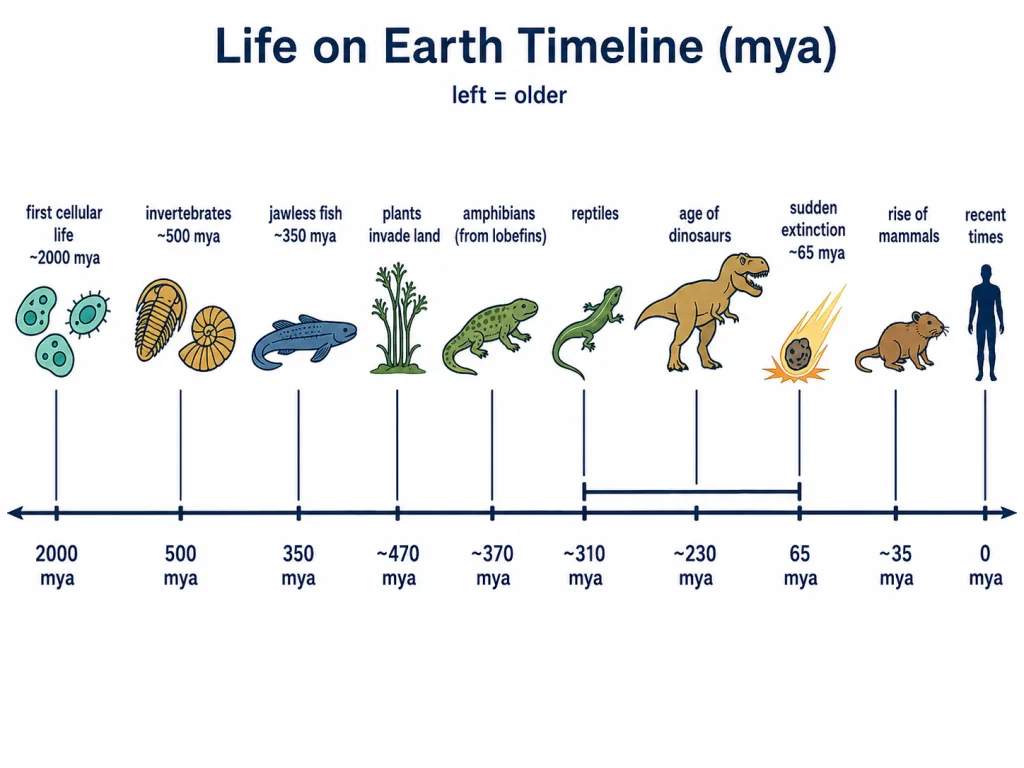
About 2000 million years ago the first cellular forms of life appeared on earth. Exactly how loose aggregates of giant molecules turned into proper cells wrapped in a membrane is still not known, but once cells existed the story of life could really begin.
Some of these early cells could do something remarkable: they could release oxygen. The reaction involved was much like the light reaction of photosynthesis, in which water is split apart using the energy of sunlight captured by light-harvesting pigments. Slowly, single-celled organisms gave rise to multicellular ones, and life grew more complex with time.
Invertebrates, the First Fish, and Plants on Land
By about 500 million years ago the invertebrates had formed and were active in the seas. Around 350 million years ago the jawless fish appeared, and by roughly 320 million years ago seaweeds and a few plants were present.
It is worth pausing on one point: the first organisms to invade the land were plants, not animals. By the time animals began moving onto land, plants were already widespread and waiting there. Meanwhile, certain fish had developed stout, strong fins that let them push themselves onto land and slip back into the water — this too was happening about 350 million years ago. These fish are called lobefins, and they were long thought to have died out completely. Then in 1938 one was caught off the coast of South Africa, a Coelacanth, alive and well, showing that the group had not vanished after all.
Amphibians and Reptiles Take the Stage
The lobefins evolved into the first amphibians, animals that could live both on land and in water. None of those first amphibians survive, but they were the ancestors of today's frogs and salamanders.
The amphibians in turn evolved into reptiles. The great advantage of the reptiles was their egg: it had a thick shell that did not dry out in the sun, unlike the delicate eggs of amphibians. This freed reptiles from a constant dependence on water for breeding. Again we know the group only through its modern descendants — the turtles, tortoises and crocodiles.
Over the next 200 million years or so, reptiles of every shape and size came to dominate the earth. Giant ferns, the pteridophytes, grew alongside them; as these ferns fell and were buried, they slowly formed the coal deposits we mine today.
The Age of Dinosaurs
Some of the land reptiles actually returned to the water and evolved into fish-like reptiles, the Ichthyosaurs, about 200 million years ago. The land reptiles themselves were, of course, the dinosaurs. The largest of them, Tyrannosaurus rex, stood about 20 feet tall and carried huge, fearsome, dagger-like teeth.
Then, about 65 million years ago, the dinosaurs suddenly disappeared from the earth. We still do not know the true reason. Some suggest climatic changes wiped them out; others believe many of them evolved into birds; the truth may lie somewhere in between. What is certain is that small reptiles of that same era are still with us today.
The Rise of the Mammals
The first mammals were small, shrew-like creatures, and their fossils are correspondingly tiny. Two things set them apart. They were viviparous, protecting their unborn young inside the mother's body, and they were more intelligent, at least in sensing and avoiding danger. So when the reptiles declined, the mammals were ready to take over the earth.
Geography shaped what followed. In South America there had been mammals resembling the horse, hippopotamus, bear and rabbit. But continental drift eventually joined South America to North America, and the North American fauna overran the local animals. In Australia, that same drift had the opposite effect: its pouched, marsupial mammals survived precisely because no competing mammals reached them. And we should not forget that some mammals returned fully to the water — whales, dolphins, seals and sea cows all live their whole lives there.
Quick Recap
- First cellular life ≈ 2000 mya; some cells could release O₂ by a reaction like the light reaction of photosynthesis (splitting water). Single cells → multicellular.
- Invertebrates ≈ 500 mya; jawless fish ≈ 350 mya; seaweeds and a few plants ≈ 320 mya. The first land organisms were plants.
- Strong-finned fish moved onto land ≈ 350 mya (lobefins); a living Coelacanth was caught off South Africa in 1938.
- Lobefins → first amphibians (ancestors of frogs and salamanders) → reptiles (thick-shelled eggs); modern descendants are turtles, tortoises and crocodiles.
- Reptiles dominated ~200 million years; fallen giant ferns formed coal. Ichthyosaurs (~200 mya) returned to water. The dinosaurs (Tyrannosaurus rex ≈ 20 ft) vanished suddenly ≈ 65 mya.
- First mammals were shrew-like, viviparous and intelligent, and took over when reptiles declined; continental drift decided which faunas survived (North American over South American; Australian marsupials spared).
Solved Examples — Section 12
Q1. How could some of the earliest cells release oxygen, and what reaction resembled it?
Answer: Certain early cells split water and released oxygen through a reaction much like the light reaction of photosynthesis, in which sunlight captured by pigments is used to break water apart.
Q2. Which group invaded the land first — plants or animals — and why does it matter?
Answer: Plants invaded the land first and were already widespread when animals arrived. This meant animals moving onto land found vegetation, and hence food, already established there.
Q3. What is the significance of the Coelacanth caught in 1938?
Answer: It was a lobefin fish long believed to be extinct. Its capture off South Africa showed the group had survived, and lobefins are the fish that gave rise to the first amphibians.
Q4. What advantage did the reptilian egg have over the amphibian egg?
Answer: The reptilian egg had a thick shell that did not dry out in the sun, so reptiles were not tied to water for breeding the way amphibians were.
Q5. What happened to the dinosaurs about 65 million years ago, and what explanations are offered?
Answer: They suddenly disappeared from the earth. The true cause is unknown; some attribute it to climatic changes, while others think many dinosaurs evolved into birds.
Q6. How did continental drift affect the mammals of South America and Australia differently?
Answer: When drift joined South America to North America, North American fauna overran the local mammals. In Australia the drift left the marsupials isolated, so they survived through lack of competition.