
A Universe, and an Earth, Take Shape
On a clear night the starlight reaching your eyes left those stars millions of years ago, so in a real sense looking at the sky is looking into the past. The universe itself is almost 20 billion years old by NCERT's reckoning (modern astronomy puts it nearer 13.8 billion — but Board and NEET keys follow NCERT). The Big Bang theory describes its beginning as a single, almost unimaginable explosion; as the universe expanded it cooled, hydrogen and helium formed, and gravity slowly gathered the gas and dust into galaxies and stars.
Our own earth took shape in the solar system about 4.5 billion years ago. It began as a hot, molten mass with no atmosphere to speak of.
The Early Earth and the First Oceans
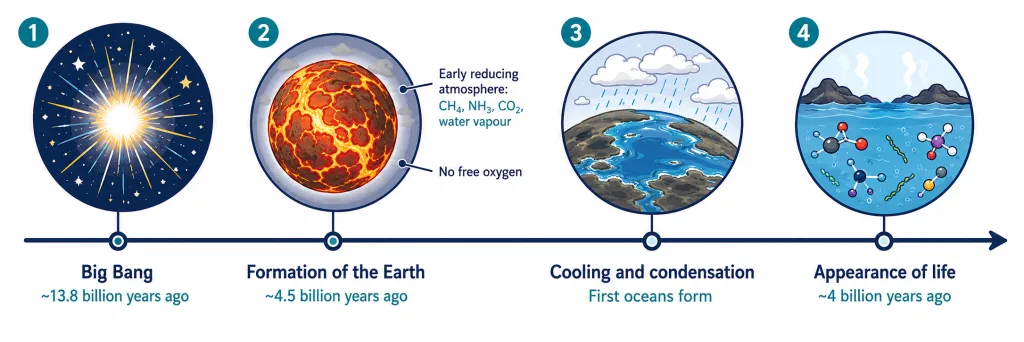
The early earth had no breathable air. Gases escaping from the molten interior — water vapour, methane, carbon dioxide and ammonia — formed a covering around the planet. Ultraviolet light from the sun broke the water vapour into hydrogen and oxygen; the light hydrogen drifted off into space, while the oxygen reacted with ammonia and methane to give water, carbon dioxide and other compounds. An ozone layer gradually built up. As the surface cooled the water vapour condensed and fell as rain, filling the hollows to become the first oceans.
There are two things worth noticing here. First, this early atmosphere had almost no free oxygen and was rich in hydrogen-containing gases, which makes it a reducing atmosphere rather than an oxidising one. Second, life did not appear immediately — it turned up roughly 500 million years after the earth formed, which is about four billion years ago.
Did Life Arrive from Space?
Where did that first life come from? One old answer is that it arrived from elsewhere. Early Greek thinkers imagined life-units, or 'spores', drifting between planets, and a version of this idea — called panspermia — is still entertained by a few astronomers. It has an obvious weakness, though: even if life did travel here, that tells us nothing about how it first arose somewhere.
Life from Non-Life? Pasteur's Answer
Closer to home, people long believed that living things could simply spring from non-living matter — maggots from rotting meat, microbes from mud and straw. This was the theory of spontaneous generation. Louis Pasteur put it to rest with a careful experiment. In flasks that had been sterilised and kept closed, no new life appeared; in flasks left open to the air, organisms did grow. His conclusion was that life comes only from pre-existing life.
That settled one question but immediately raised another. If every living thing comes from a parent, how did the very first one come about?
Oparin, Haldane and Chemical Evolution
The Russian scientist Oparin and the English scientist Haldane offered an answer in the 1920s. They proposed that the first life was not made ready-formed but was preceded by a long chemical evolution — the slow build-up of organic molecules such as amino acids, sugars and nucleic acids from the simple inorganic gases of the early atmosphere, under conditions of high heat and frequent electrical storms. Only later did these molecules come together into something able to copy itself.
This was a hypothesis, and a good hypothesis invites a test. The experiment that tested it, and what is thought to have happened next, is the subject of the next section.
Quick Recap
- The universe is almost 20 billion years old per NCERT (Big Bang; modern astronomy: ~13.8 billion — exams key to NCERT); the earth formed about 4.5 billion years ago.
- The early atmosphere was reducing — water vapour, methane (CH₄), ammonia (NH₃) and CO₂, with no free oxygen at first.
- UV light split water; hydrogen escaped; as the earth cooled, oceans formed. Life appeared about 4 billion years ago.
- Panspermia: life (spores) came from space. Spontaneous generation: life from non-living matter — disproved by Louis Pasteur ("life comes only from pre-existing life").
- Oparin & Haldane: life was preceded by chemical evolution — organic molecules forming from inorganic ones.
Solved Examples — Section 1
Q1. Why do we say that looking at distant stars is "looking into the past"?
Answer: Their light takes millions of years to reach us, so we see them as they were when that light began its journey, not as they are now.
Q2. What was the early earth's atmosphere like, and why is it called a reducing atmosphere?
Answer: It contained water vapour, methane, ammonia and carbon dioxide but no free oxygen. Being rich in hydrogen-containing gases and lacking oxygen, it was reducing rather than oxidising.
Q3. What did Pasteur's experiment demonstrate, and what did it leave unexplained?
Answer: That life arises only from pre-existing life — sealed sterile flasks stayed lifeless while open ones grew organisms — which disproved spontaneous generation. It did not explain how the first life form itself appeared.
Q4. What is panspermia, and why is it not a complete explanation for the origin of life?
Answer: It is the idea that life reached the earth as spores from outer space. It is incomplete because, even if true, it still does not say how life first originated anywhere.
Q5. What did Oparin and Haldane propose?
Answer: That the first life was preceded by chemical evolution — organic molecules forming from the inorganic gases of the early atmosphere under high heat and electrical discharges — before those molecules organised into living matter.
Q6. About how long after the earth's formation did life appear, and how many years ago is that?
Answer: Roughly 500 million years after the earth formed — about four billion years ago, the earth itself being about 4.5 billion years old.