
A Hypothesis Worth Testing
Oparin and Haldane had argued that life was preceded by chemical evolution — organic molecules building up from the inorganic gases of the early earth. The strength of that idea is that it can be tested: if the early atmosphere really could turn simple gases into the molecules of life, then recreating those conditions in the laboratory ought to produce some of those molecules. In 1953 a young American scientist, Stanley Miller, set out to do exactly that.
Miller's Experiment
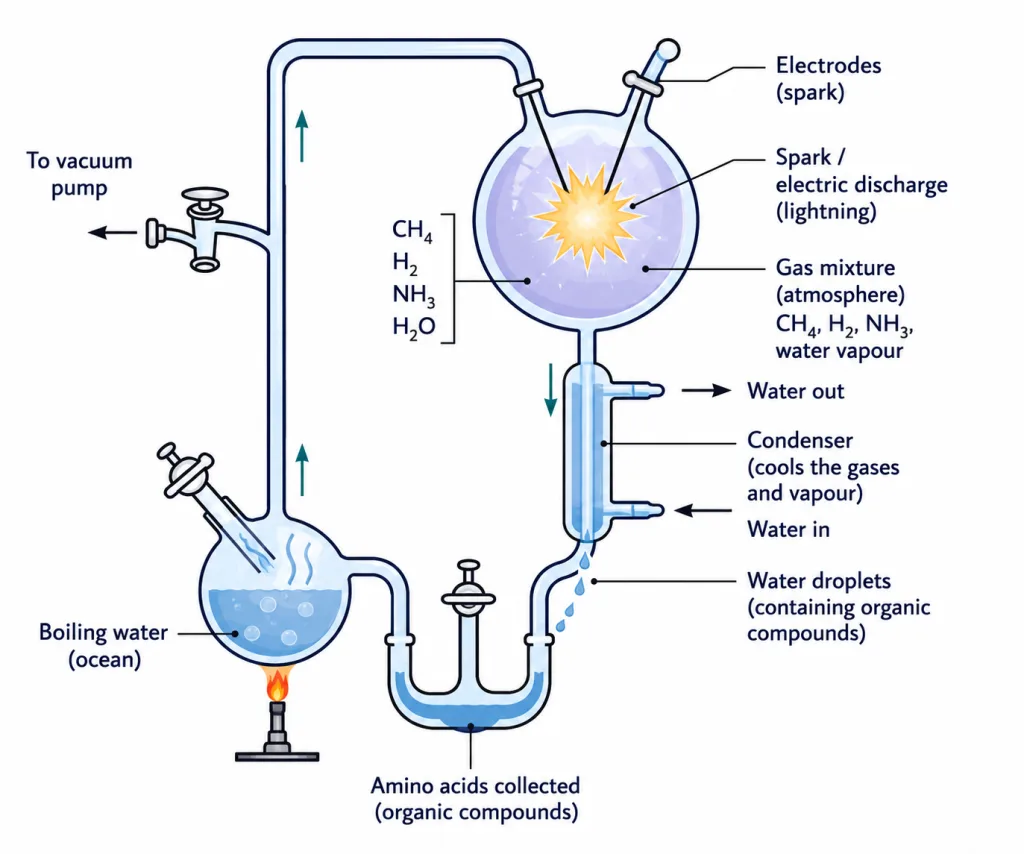
Miller built a closed apparatus that stood in for the early earth. Into it he sealed the gases thought to make up the primitive atmosphere — methane (CH₄), hydrogen (H₂), ammonia (NH₃) and water vapour — and kept them at about 800 °C. To imitate lightning, he passed electric discharges through the gas mixture, while a small flask of boiling water played the part of the early ocean and a condenser cooled the products and returned them to the water.
After running this for a week, he found something striking: amino acids — the building blocks of proteins — had formed in the water. Simple inorganic gases, given energy, had assembled into organic molecules, just as Oparin and Haldane had predicted.
More Molecules, and a Clue from Space
Miller's result was not a one-off. Working along the same lines, other researchers produced sugars, nitrogen bases, pigments and fats from similar mixtures. And when scientists analysed the material inside meteorites, they found many of the same kinds of organic compounds — a hint that these chemical processes are not unique to earth but go on elsewhere in space too. Taken together, this evidence made the first part of the story, chemical evolution, widely accepted.
From Molecules to the First Cells
Producing organic molecules is one thing; producing a living, self-copying cell is another, and exactly how that step happened is still unknown. What is generally pictured is a slow progression. The first non-cellular forms of life may have arisen around 3 billion years ago — giant molecules such as RNA, proteins and polysaccharides that were somehow able to reproduce themselves. True cellular life, in the form of single cells, probably did not appear until about 2000 million (2 billion) years ago, and all of it lived in water.
This whole picture — the first life arising gradually from non-living molecules through natural forces — is the chemical-evolution account that most biologists accept. How those first simple cells then gave rise to the staggering variety of life around us is the story the rest of the chapter tells.
Quick Recap
- Oparin–Haldane: life was preceded by chemical evolution (organic from inorganic).
- Miller (1953): sealed CH₄, H₂, NH₃ and water vapour, heated to ~800 °C, passed electric discharges → amino acids formed. Others later obtained sugars, nitrogen bases and fats; meteorites contain similar molecules.
- First non-cellular life ≈ 3 billion years ago (giant molecules: RNA, protein, polysaccharides).
- First cellular life ≈ 2 billion years ago — single cells, all living in water.
- Accepted view = chemical evolution (Oparin–Haldane: first life arose slowly from non-living molecules).
Solved Examples — Section 2
Q1. What was Miller trying to show with his experiment?
Answer: That the inorganic gases of the early atmosphere, given energy, could form the organic molecules of life — testing the Oparin–Haldane idea of chemical evolution.
Q2. Which gases did Miller seal into his apparatus, and what energy source did he use?
Answer: Methane, hydrogen, ammonia and water vapour, kept at about 800 °C. He supplied energy as electric discharges, standing in for lightning on the early earth.
Q3. What was the main product Miller obtained, and what did others later make using similar setups?
Answer: Miller obtained amino acids. Later experiments along the same lines produced sugars, nitrogen bases, pigments and fats.
Q4. How does the analysis of meteorites support the idea of chemical evolution?
Answer: Meteorites were found to contain the same kinds of organic compounds made in these experiments, suggesting such chemical processes also occur elsewhere in space.
Q5. Roughly when are the first non-cellular and first cellular forms of life thought to have appeared?
Answer: Non-cellular forms (giant molecules like RNA and proteins) about 3 billion years ago; the first cellular, single-celled life about 2 billion years ago, all of it in water.
Q6. In Miller's apparatus, what did the boiling water and the electric sparks each represent?
Answer: The boiling water represented the early ocean (releasing water vapour), and the electric sparks represented the lightning of the primitive atmosphere.