
The First Ape-like and Man-like Primates
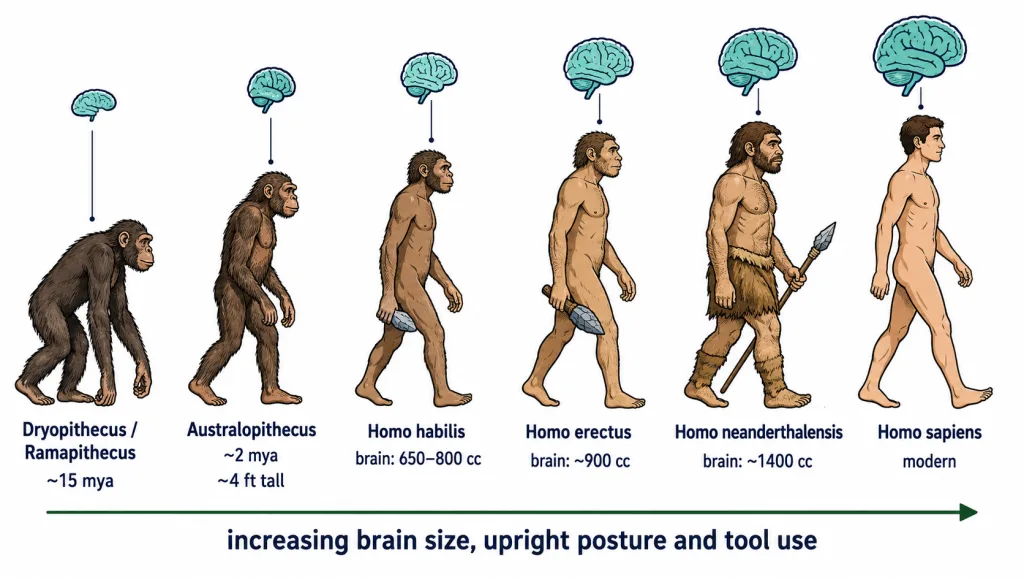
About 15 million years ago two kinds of primates were living side by side: Dryopithecus and Ramapithecus. Both were hairy and walked much as gorillas and chimpanzees do today. Of the two, Ramapithecus was the more man-like, while Dryopithecus was the more ape-like.
The story of human evolution is really the story of a few changes repeated and refined over millions of years — a steady increase in brain size, a shift to walking upright, and a growing use of tools. Keep those three threads in mind as we move from one stage to the next.
Walking Upright in Eastern Africa
A few fossils of man-like bones have been discovered in Ethiopia and Tanzania, and these show clear hominid features. They lead to the belief that about 3 to 4 million years ago, man-like primates were walking in eastern Africa. They were probably no taller than 4 feet, yet they already walked upright — a decisive step in our history.
Around 2 million years ago, the Australopithecines lived in the East African grasslands. Evidence shows they hunted with stone weapons, but they still ate mainly fruit rather than meat. Here we can already see the mixture of old and new — an upright, tool-using primate whose diet had barely changed.
Homo habilis and Homo erectus
Among the bones discovered, some were noticeably different, and this creature was recognised as the first human-like being, or hominid. It was named Homo habilis. Its brain capacity was between 650 and 800 cc, and it probably did not eat meat.
The next stage came into view with fossils discovered in Java in 1891, which revealed Homo erectus, living about 1.5 million years ago. Homo erectus had a larger brain, around 900 cc, and probably did eat meat. So across these two stages we can watch the brain growing and the diet broadening — exactly the kind of gradual change that runs through the whole account.
Neanderthals and the Rise of Homo sapiens
The Neanderthal man had a brain size of about 1400 cc and lived in the near east and central Asia between roughly 100,000 and 40,000 years ago. These people used hides to protect their bodies and, tellingly, buried their dead — a sign of behaviour we recognise as deeply human.
Homo sapiens arose in Africa and moved out across the continents, developing into distinct races along the way. Modern Homo sapiens arose during the ice age, between about 75,000 and 10,000 years ago. From that point the pace of change quickens, and it becomes less a story of biology and more a story of what human beings began to make and do.
Cave Art, Agriculture and the Dawn of History
Pre-historic cave art developed about 18,000 years ago. One of the finest sets of such paintings by pre-historic humans can be seen at the Bhimbetka rock shelter in Raisen district of Madhya Pradesh, a reminder that this global story runs right through our own land.
Agriculture came around 10,000 years ago, and with it human settlements began. Once people could grow their food in one place, the rest of what happened became part of human history — the growth and decline of civilisations. If you look back over the whole account, the same trend stands out at every step: increasing brain size, an upright posture, and an ever-greater reliance on tools.
Quick Recap
- ~15 mya: Dryopithecus (more ape-like) and Ramapithecus (more man-like); both hairy, walking like gorillas and chimpanzees.
- ~3–4 mya: man-like primates in eastern Africa (fossils in Ethiopia and Tanzania); about 4 feet tall but walked upright.
- ~2 mya: Australopithecines in East African grasslands; hunted with stone weapons but mainly ate fruit.
- Homo habilis: the first hominid; brain 650–800 cc; probably did not eat meat. Homo erectus (~1.5 mya, fossils in Java 1891); brain ~900 cc; probably ate meat.
- Neanderthal man: brain ~1400 cc; lived in the near east and central Asia ~100,000–40,000 years ago; used hides and buried their dead.
- Homo sapiens arose in Africa and spread across continents into distinct races; modern H. sapiens arose in the ice age ~75,000–10,000 years ago. Cave art ~18,000 years ago (Bhimbetka, Raisen district, Madhya Pradesh); agriculture ~10,000 years ago. Overall trend: increasing brain size, upright posture, tool use.
Solved Examples — Section 13
Q1. Which of the two primates living about 15 mya was more man-like, and which was more ape-like?
Answer: Ramapithecus was the more man-like, while Dryopithecus was the more ape-like. Both were hairy and walked like gorillas and chimpanzees.
Q2. What do the fossils from Ethiopia and Tanzania tell us about hominids of 3 to 4 mya?
Answer: They show hominid features and suggest that about 3 to 4 million years ago man-like primates were walking upright in eastern Africa, though they were probably no taller than 4 feet.
Q3. How did the diet and brain size differ between Homo habilis and Homo erectus?
Answer: Homo habilis had a brain of 650 to 800 cc and probably did not eat meat. Homo erectus had a larger brain of about 900 cc and probably did eat meat.
Q4. What features of Neanderthal behaviour suggest they were distinctly human?
Answer: With a brain of about 1400 cc, Neanderthals used hides to protect their bodies and buried their dead — behaviours we recognise as characteristically human.
Q5. Where and when did modern Homo sapiens arise, and how did the species spread?
Answer: Homo sapiens arose in Africa and moved across the continents, developing into distinct races. Modern Homo sapiens arose during the ice age, between about 75,000 and 10,000 years ago.
Q6. What is the significance of the Bhimbetka rock shelter?
Answer: It preserves pre-historic cave paintings, developed about 18,000 years ago, and lies in Raisen district of Madhya Pradesh — a record of early human art within India.