
Clues Hidden in Developing Embryos
Fossils are not the only trail evolution leaves behind. Some of the most telling evidence comes from comparing living organisms — their embryos, their body structures and even their molecules.
An early argument from embryos was put forward by Ernst Haeckel. He noticed that the embryos of all vertebrates — humans included — pass through stages that share features which are missing in the adult. His striking example was a row of vestigial gill slits that appears just behind the head in every vertebrate embryo, even though these slits become functional organs only in fish and are found in no other adult vertebrate.
Haeckel took this to mean that development retraces evolutionary history. That strong reading, however, was disapproved by Karl Ernst von Baer, who studied embryos carefully and noted that an embryo never passes through the adult stages of other animals. Embryos of related animals do resemble one another, but development does not replay an ancestor's grown-up form.
Same Blueprint, Different Jobs — Homology
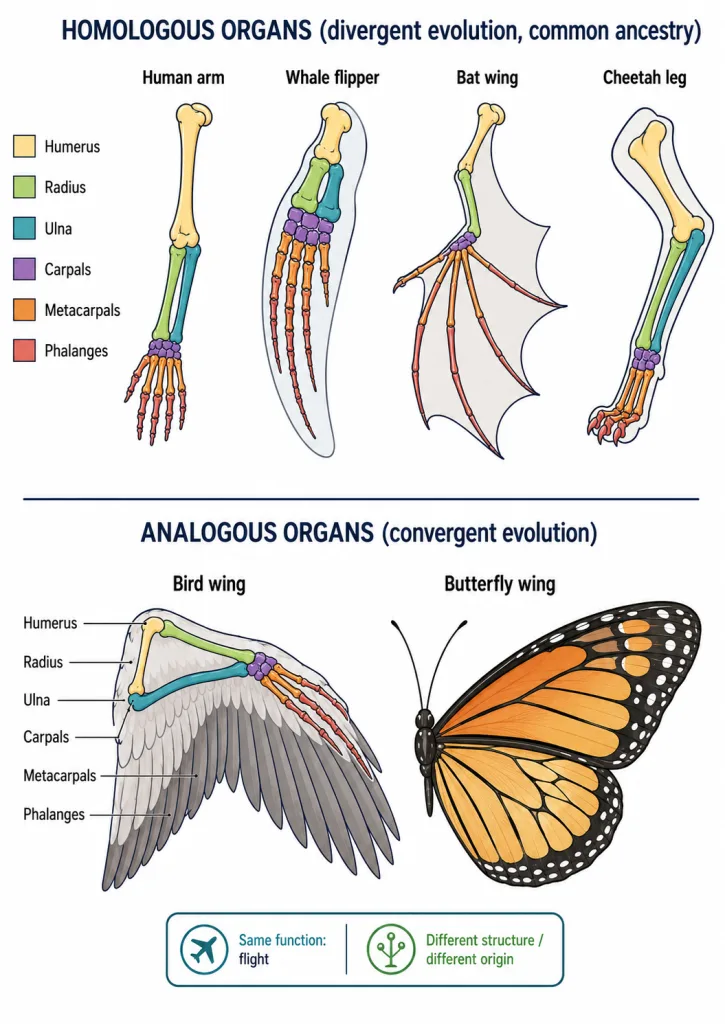
Compare the forelimbs of a whale, a bat, a cheetah and a human. They do completely different jobs — swimming, flying, running, handling objects — yet underneath, they are built to the very same plan. Each contains a humerus, radius, ulna, carpals, metacarpals and phalanges, arranged in the same order.
When a single basic structure has been reshaped in different directions to suit different needs, we call the structures homologous. They arise by divergent evolution — one ancestral design diverging as descendants adapted to different ways of life. Because that shared design points back to a shared origin, homology indicates common ancestry.
Plants show it too. The thorn of Bougainvillea and the tendril of Cucurbita look and act differently — one protects, the other clings — but both arise in the axillary position and are modifications of the same structure — homologous. Vertebrate hearts and brains are NCERT's other stock homology examples.
Different Blueprint, Same Job — Analogy
Analogy is the mirror image of homology. Here the structures are not built to the same plan, yet they perform the same function and end up looking or working alike.
Think of the wings of a butterfly and the wings of a bird. Both are used for flight and both are called wings, but anatomically they have nothing in common — one is a fold of insect body wall, the other a modified vertebrate forelimb. Such structures are analogous, and they come about by convergent evolution: unrelated groups, facing similar demands in similar habitats, independently evolve similar features for the same purpose.
Other good examples are the eye of the octopus and the eye of a mammal, the flippers of a penguin and of a dolphin, and, among plants, the sweet potato (a modified root) and the potato (a modified stem) — different structures pressed into the same service.
Evidence in the Molecules
The same argument works right down at the level of chemistry. Diverse organisms that carry out a given function often use very similar proteins and genes to do it. These biochemical, or molecular, similarities point to the same shared ancestry that structural similarities suggest — the more closely related two organisms are, the more alike their proteins and DNA tend to be. This is the molecular evidence for evolution, and it reinforces the story told by anatomy.
What Humans Themselves Have Shown
There is one more line of reasoning, drawn from what breeders have achieved. By artificial selection, humans have created an astonishing variety of forms — the many breeds of dogs, and countless varieties of crops — all from wild ancestors, and all within just a few hundred years.
The conclusion is hard to resist. If deliberate human selection can reshape living things so much in a few centuries, then nature, working through natural selection over millions of years, could plausibly have produced the full diversity of life. Artificial selection is, in effect, a small, fast demonstration of what natural selection can do given enough time.
Quick Recap
- Embryological evidence: proposed by Ernst Haeckel (vertebrate embryos, including human, show vestigial gill slits behind the head, functional only in fish); the strong version was disapproved by Karl Ernst von Baer — embryos never pass through the adult stages of other animals.
- Homology: same basic structure, different functions (forelimbs of whale, bat, cheetah, human — all with humerus, radius, ulna, carpals, metacarpals, phalanges); result of divergent evolution; indicates common ancestry. Plant example: thorn of Bougainvillea and tendril of Cucurbita.
- Analogy: different structures, same function (butterfly vs bird wing; octopus vs mammal eye; penguin vs dolphin flipper; sweet potato root vs potato stem); result of convergent evolution.
- Molecular evidence: similarities in proteins and genes point to common ancestry.
- Artificial selection: humans bred many breeds (dogs, crops) in a few hundred years — suggesting nature could do the same over millions of years.
Solved Examples — Section 5
Q1. What embryological observation did Ernst Haeckel use as evidence for evolution?
Answer: That the embryos of all vertebrates, including humans, develop a row of vestigial gill slits just behind the head — structures that are functional only in fish and absent in other adult vertebrates.
Q2. How did Karl Ernst von Baer modify Haeckel's embryological claim?
Answer: He showed on careful study that an embryo never passes through the adult stages of other animals. Embryos of related animals resemble one another, but development does not replay an ancestor's adult form.
Q3. Why are the forelimbs of a whale, bat, cheetah and human called homologous?
Answer: Because despite doing different jobs, they share the same basic bone plan — humerus, radius, ulna, carpals, metacarpals and phalanges. This shared design, arising by divergent evolution, indicates common ancestry.
Q4. Distinguish between homology and analogy with one example each.
Answer: Homologous organs share the same basic structure but differ in function (forelimbs of mammals) and result from divergent evolution. Analogous organs differ in structure but share a function (butterfly and bird wings) and result from convergent evolution.
Q5. Give one plant example each of homologous and analogous organs.
Answer: Homologous: the thorn of Bougainvillea and the tendril of Cucurbita. Analogous: the sweet potato (a modified root) and the potato (a modified stem).
Q6. How does artificial selection support evolution by natural selection?
Answer: Humans have produced many breeds of dogs and crop varieties in just a few hundred years by selective breeding. If such change is possible in centuries, nature could produce far greater diversity over millions of years.