
Reading the Record in the Rocks
That evolution has actually happened is not a matter of belief — it rests on evidence drawn from several fields. One of the most direct kinds of evidence is written into the rocks themselves, in the form of fossils.
A fossil is the preserved remains of the hard parts of an organism — bones, shells, teeth, woody tissue — found buried in rock. Soft parts usually decay, but hard parts can survive for millions of years, leaving behind a lasting trace of a life form that once existed.
Layers of Time in Sedimentary Rock
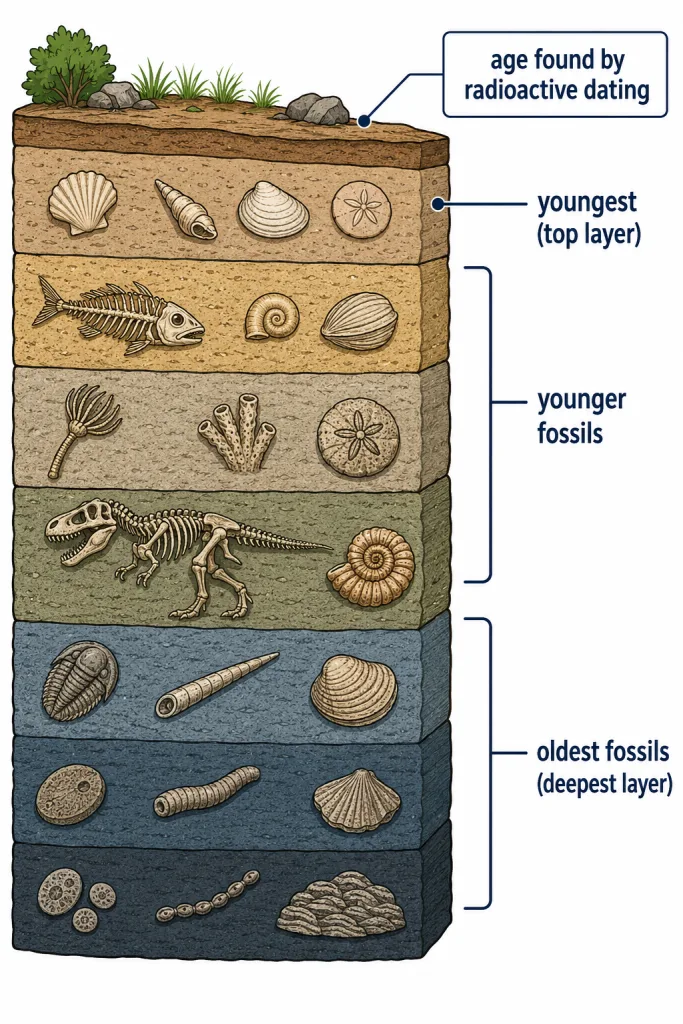
To understand how fossils tell a story, you have to understand how the rock that holds them forms. Over the long history of the earth, sediments — mud, sand, silt — settle and pile up in layers, one over the other, and slowly harden into rock. A cross-section of the earth's crust therefore shows these sediments stacked in layers, laid down at different times.
The order of these layers carries a clue about time. Sediments at the bottom were laid down first and those on top later, so as a rule the deeper the layer, the older it is. When an organism died and was buried while a particular layer was forming, its hard parts became a fossil locked into that layer. As a result, rock layers of different ages contain fossils of different life forms.
What the Fossils Reveal
When we compare fossils from different layers, a pattern emerges. Some fossils look much like organisms living today. Others belong to creatures that have completely vanished from the earth — extinct forms, the dinosaurs being the most famous example.
By studying which fossils occur in which sedimentary layer, we can work out the geological period in which each life form lived. Two things become clear from this. First, life forms have varied over time — the living world did not stay the same. Second, particular life forms are restricted to particular stretches of geological time, which means new forms of life arose at different times in the history of the earth. Because all of this comes from the study of fossils, it is called paleontological evidence.
Putting a Date on a Fossil
It is not enough to know that one layer is older than another; we would like to know how old, in actual years. This is done by radioactive dating. Certain elements in the rocks decay from one form into another at a fixed, steady rate. By measuring how much of the original element remains and how much has decayed, scientists can calculate the age of the rock — and so the age of the fossils it holds.
Put together, the picture from fossils is a powerful one: the earth is very old, life has changed continuously across vast spans of time, and countless forms have appeared and disappeared along the way. Fossils are, in a sense, the direct historical documents of evolution.
Quick Recap
- Fossils = preserved remains of the hard parts of organisms, found in rocks.
- Sediments settle in layers over time; deeper layers are older, so different-aged layers hold fossils of different life forms.
- Some fossils resemble living organisms; others are extinct (e.g., dinosaurs).
- Studying fossils across sedimentary layers gives the geological period they lived in — showing life forms varied over time and new forms arose at different times.
- This is paleontological evidence for evolution. Fossil ages are found by radioactive dating.
Solved Examples — Section 4
Q1. What exactly is a fossil?
Answer: A fossil is the preserved remains of the hard parts of a life form — such as bones, shells or teeth — found buried in rocks. Soft parts usually decay, but hard parts can survive for millions of years.
Q2. Why do deeper rock layers generally contain older fossils?
Answer: Sediments pile up in layers over time, the earliest at the bottom and later ones on top. So the deeper a layer, the earlier it was formed, and the older the fossils buried within it.
Q3. What does it mean when a fossil represents an extinct organism, and give an example.
Answer: It means the organism no longer exists anywhere on earth; it lived in the past and died out. Dinosaurs are a classic example of such extinct forms preserved only as fossils.
Q4. What is meant by paleontological evidence for evolution?
Answer: It is the evidence obtained by studying fossils in sedimentary layers. It shows that life forms varied over time and that new forms arose at different periods in the earth's history.
Q5. How do scientists find out the actual age of a fossil?
Answer: By radioactive dating. Radioactive elements in the rock decay at a fixed rate, so measuring how much has decayed reveals the age of the rock and hence of the fossils it contains.
Q6. What two broad conclusions about the history of life do fossils support?
Answer: That life forms have changed continuously over time rather than staying the same, and that new kinds of organisms appeared at different times in the earth's long history.