
When Natural Selection Really Began
Evolution by natural selection, in the true sense, would have begun once cellular forms of life with differences in their metabolic capabilities appeared on earth. Before that there was nothing much for nature to choose between. Once cells that differed in what they could do — what they could feed on, how they could survive — were around, some were bound to fare better than others under a given set of conditions, and selection had something to work with.
The heart of the Darwinian idea is just this: nature selects. Among the varying individuals in a population, those better suited to the conditions leave more offspring, and over time the population comes to be made up of their kind.
Life Span Sets the Pace
How quickly new forms appear is tied to the life span of the organism. Microbes that divide fast can multiply into millions of individuals within hours, so new variants can show up in a matter of days.
Take a colony of bacteria growing on a particular medium. It already carries built-in variation — some cells are better able to use a certain feed component than others. Change the composition of the medium and only that part of the population able to survive the new conditions will carry on. In time this surviving variant outgrows the rest and appears, in effect, as a new form. All of this can happen within days. For the same change to work its way through a fish or a fowl would take millions of years, because their life spans run into years. In each case nature has selected for fitness — but for microbes the clock simply runs faster.
Fitness Is Inherited
The fitness that matters here is not something an organism picks up during its life. It rests on characteristics that are inherited. An organism better able to survive in an otherwise hostile environment does so because of traits passed down to it, and so there must be a genetic basis for being selected. Adaptive ability is inherited; fitness is the end result of that inherited ability to adapt and be selected by nature.
This is an important point. Nature can only work on differences that can be handed on to the next generation. A change that helps an individual but cannot be inherited leaves no lasting mark on the population.
Industrial Melanism — Moths and Soot
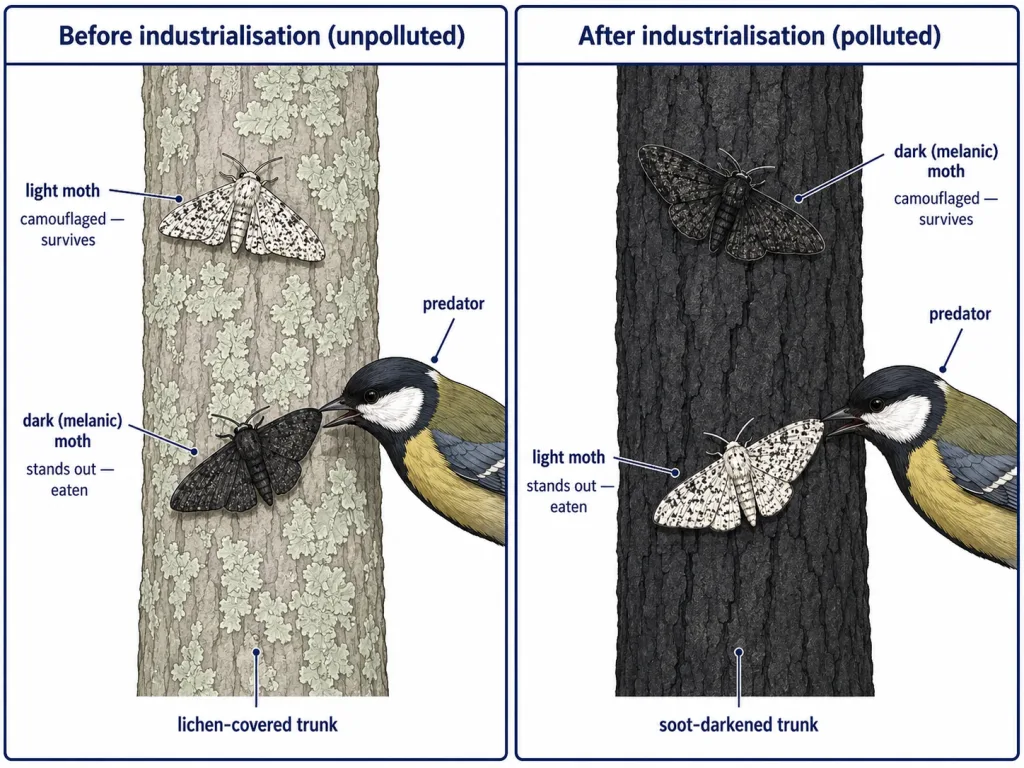
A striking case of natural selection at work comes from England. In a collection of moths made in the 1850s, before industrialisation, there were more white or light-winged moths than dark, melanised ones. But in a collection from the same area after industrialisation, around 1920, the dark moths were in the majority — the proportion had reversed.
The explanation is that predators spot a moth against a contrasting background. Before industrialisation, the tree trunks were covered with pale, almost white lichen; against this the light moths were hidden and the dark ones were picked off. After industrialisation, soot darkened the trunks; now the dark moths were camouflaged while the light ones stood out and were eaten. In rural, non-industrial areas the count of melanic moths stayed low. Those that could hide against their background survived and increased — and it is worth remembering that no variant was completely wiped out. (Incidentally, lichens serve as pollution indicators, since they do not grow where the air is polluted.)
Selection by Human Action, and the Role of Chance
We drive selection ourselves, often without meaning to. The heavy use of herbicides and pesticides has led to the selection of resistant varieties, and the same happens with microbes against which we use antibiotics or drugs. Resistant organisms appear on a time scale of months or years, not centuries. These are examples of evolution by anthropogenic action — evolution speeded up by what humans do.
All of this also tells us something about the nature of evolution. It is not a directed process in the sense of aiming at a goal. It is a stochastic process — one based on chance events in nature and chance mutations in organisms. There is no plan behind it; there is variation, and there is selection acting on that variation under whatever conditions happen to prevail.
Quick Recap
- Natural selection began in earnest when cellular life with metabolic differences arose.
- The rate of new forms depends on life span: fast-dividing microbes throw up new variants in days; a fish or fowl would take millions of years.
- A bacterial colony has built-in variation; changing the medium selects the surviving variant, which outgrows the rest.
- Nature selects for fitness, which is inherited (has a genetic basis).
- Industrial melanism (peppered moth): pale lichen-covered trunks hid light moths (1850s); soot-darkened trunks hid dark moths (1920). Predators spot moths against a contrasting background; no variant is completely wiped out.
- Anthropogenic action (herbicides, pesticides, antibiotics) selects resistant forms in months–years. Evolution is stochastic, not directed — driven by chance events and chance mutations.
Solved Examples — Section 7
Q1. When, in the true sense, did evolution by natural selection begin?
Answer: When cellular forms of life that differed in their metabolic capabilities appeared on earth, giving nature real differences to select between.
Q2. Why do new forms appear far faster in microbes than in a fish or fowl?
Answer: Microbes divide fast and have very short life spans, so new variants can appear within days; in animals with life spans of years, the same change would take millions of years.
Q3. How does changing the growth medium of a bacterial colony bring out a new variant?
Answer: The colony already has built-in variation. The new medium lets only the part of the population able to survive it carry on; that variant outgrows the rest and appears as a new form.
Q4. Why is the fitness that nature selects said to be inherited?
Answer: Because it rests on characteristics passed down to the next generation. There must be a genetic basis for being selected, so adaptive ability is inherited, not acquired during life.
Q5. Explain how industrial melanism in the peppered moth illustrates natural selection.
Answer: Predators spot moths against a contrasting background. On pale lichen-covered trunks (pre-industrial) the light moths were hidden and survived; on soot-darkened trunks (post-industrial) the dark moths were hidden and became the majority. The proportion reversed, though no variant was wiped out.
Q6. What does it mean to say evolution is stochastic rather than directed?
Answer: It is not aimed at a goal. It rests on chance events in nature and chance mutations in organisms, with selection acting on whatever variation happens to be present.