
The View That Ruled Before Science Stepped In
For centuries the accepted explanation for the living world came from religious literature — the theory of special creation. It carried three claims. First, that every kind of organism we see today was created exactly as it is now. Second, that this diversity has stayed the same since creation and will never change. Third, that the earth is only about four thousand years old.
Each of these ideas came under strong attack during the nineteenth century. Naturalists studying rocks, fossils and the distribution of living things kept finding evidence that pointed the other way — that life had changed over enormous spans of time, and that the earth was not thousands but billions of years old.
Lamarck and the Idea of Use and Disuse
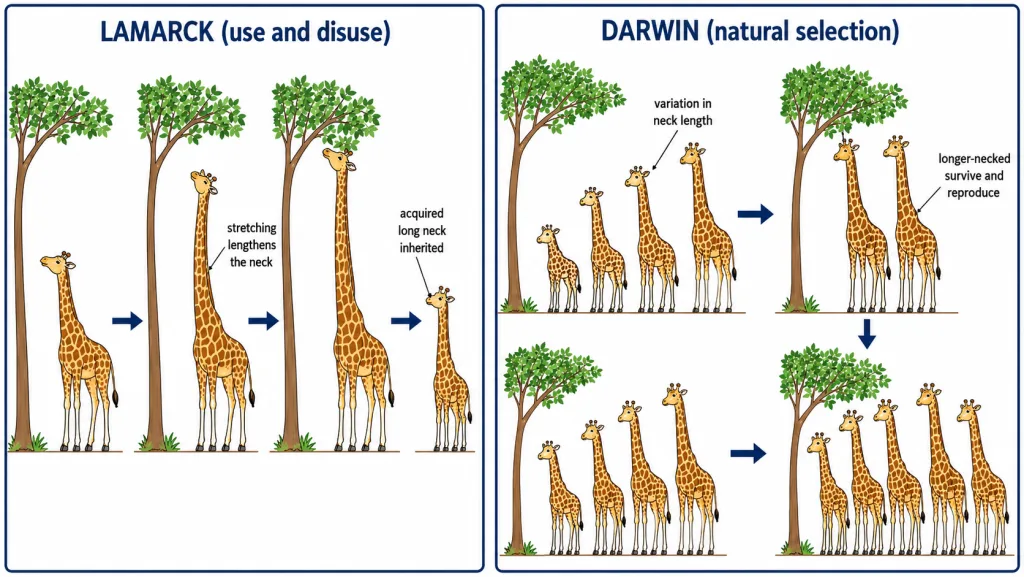
Even before Darwin, a French naturalist named Lamarck had argued that life forms do evolve, but he pinned the change on the use and disuse of organs. In his view, an organ that an animal uses heavily grows stronger and more developed, while one that is neglected shrinks — and these changes acquired during a lifetime are then handed down to the offspring. This second part is the crucial one: the inheritance of acquired characters.
His favourite illustration was the giraffe. Ancestors with ordinary necks stretched upward to reach leaves on tall trees; the constant stretching lengthened the neck a little, and this lengthened neck was passed on to the next generation. Repeated over many generations, Lamarck said, this is how the giraffe came by its long neck.
It is a neat story, but it does not hold up. Characters an organism acquires during its life — a stretched neck, a muscle built by exercise — are not written into its reproductive cells, so they are not inherited. Nobody accepts this conjecture any more.
Darwin and the Voyage of the Beagle
The turning point came with Charles Darwin. As a young man he sailed around the world on a survey ship, H.M.S. Beagle, and what he saw on that voyage shaped everything that followed. He noticed that living forms resemble one another to varying degrees — not only among themselves but also with forms that had lived millions of years earlier and were now extinct. Life, in other words, had a history: some kinds had died out while new kinds had appeared at different times.
Out of this came two ideas that sit at the heart of his theory: branching descent and natural selection. Branching descent means that today's species are the branched-off descendants of common ancestors that lived at different points in the past. Natural selection is the mechanism that drives the branching.
How Natural Selection Works
Darwin's reasoning begins with a simple observation: every population carries built-in variation. No two individuals are exactly alike, and much of this variation is heritable — it can be passed to the offspring.
Now, some of these variations happen to make an individual better suited to its surroundings — better at finding food, tolerating the climate, or escaping danger. Such individuals survive better and, more importantly, leave more offspring. Darwin called this advantage fitness, and he was careful about what he meant by it: fitness refers ultimately and only to reproductive fitness — the ability to leave more progeny than others.
Because the better-fit individuals leave more young, and because their advantageous traits are inherited, those traits become more common in the population generation after generation. Nature, in effect, keeps 'selecting' the better-fit. And since fitness rests on characters that are inherited, there must be a genetic basis underlying it — the adaptive ability that gets selected is passed down through the genes.
Malthus's Influence and Wallace's Parallel Insight
Darwin's thinking was sharpened by an essay on human populations written by Thomas Malthus. Malthus pointed out a tension: populations can in theory grow explosively, yet natural resources are limited and real populations stay more or less stable in size. If more individuals are born than the resources can support, there must be a struggle for existence — a competition in which only some survive.
Darwin's brilliant stroke was to join this to variation. If heritable variations let a few individuals use the limited resources better than the rest, then only those few will flourish and leave more progeny. Over many generations the make-up of the population shifts, and new forms appear to arise.
One more name belongs here. Alfred Wallace, a naturalist working in the Malay Archipelago, arrived at almost exactly the same conclusions at almost exactly the same time, quite independently of Darwin. That two people reached the idea separately is itself a sign of how strongly the evidence pointed toward it.
Quick Recap
- Special creation: all species made as they are, diversity unchanging, earth ~4000 years old — challenged through the 19th century.
- Lamarck: evolution by use and disuse of organs plus inheritance of acquired characters; giraffe stretched its neck and passed the longer neck on — now rejected (acquired traits are not inherited).
- Darwin (H.M.S. Beagle): two key ideas — branching descent and natural selection.
- Populations have heritable variation; the better-fit survive and leave more progeny. Fitness = reproductive fitness, and it has a genetic basis.
- Malthus (limited resources, stable populations, competition) influenced Darwin. Alfred Wallace (Malay Archipelago) reached the same conclusions independently at the same time.
Solved Examples — Section 3
Q1. What are the three claims of the theory of special creation?
Answer: That all present-day species were created as they are, that this diversity has never changed and never will, and that the earth is only about four thousand years old. All three were challenged in the nineteenth century.
Q2. State Lamarck's explanation for the long neck of the giraffe.
Answer: Ancestral giraffes stretched their necks to reach high leaves; the stretching lengthened the neck, and this acquired long neck was inherited by the offspring, growing longer over generations — by use and inheritance of acquired characters.
Q3. Why is Lamarck's theory of inheritance of acquired characters rejected?
Answer: Characters gained during an individual's lifetime are not carried in the reproductive cells, so they are not passed to the offspring. Hence acquired characters cannot drive evolution as Lamarck proposed.
Q4. What are the two key concepts of Darwin's theory?
Answer: Branching descent — today's species descend from common ancestors, branching over time — and natural selection, the mechanism by which the better-fit forms are favoured.
Q5. What did Darwin mean by 'fitness'?
Answer: Fitness refers ultimately and only to reproductive fitness — the ability of an individual to leave more progeny than others. Because it rests on inherited characters, fitness has a genetic basis.
Q6. How did Malthus's work influence Darwin, and who reached similar conclusions independently?
Answer: Malthus's essay noted that resources are limited while populations tend to grow, implying competition and struggle for existence — which fed Darwin's idea of natural selection. Alfred Wallace, working in the Malay Archipelago, reached the same conclusions independently around the same time.