
The Finches Darwin Found on the Galapagos
On his long sea voyage Darwin reached the Galapagos Islands, a cluster of volcanic islands far out in the Pacific, and there he came across an astonishing variety of creatures. What caught his attention most were some small black birds, later named Darwin's finches. He noticed that a single island held many varieties of these finches, differing chiefly in the size and shape of their beaks.
Darwin concluded that all these varieties had evolved on the islands themselves. Beginning from an original seed-eating form, birds with altered beaks had appeared over time — some suited to catching insects, others to feeding on plant matter — so that from one ancestral type came insectivorous and vegetarian finches, each adapted to a different way of feeding.
What Adaptive Radiation Means
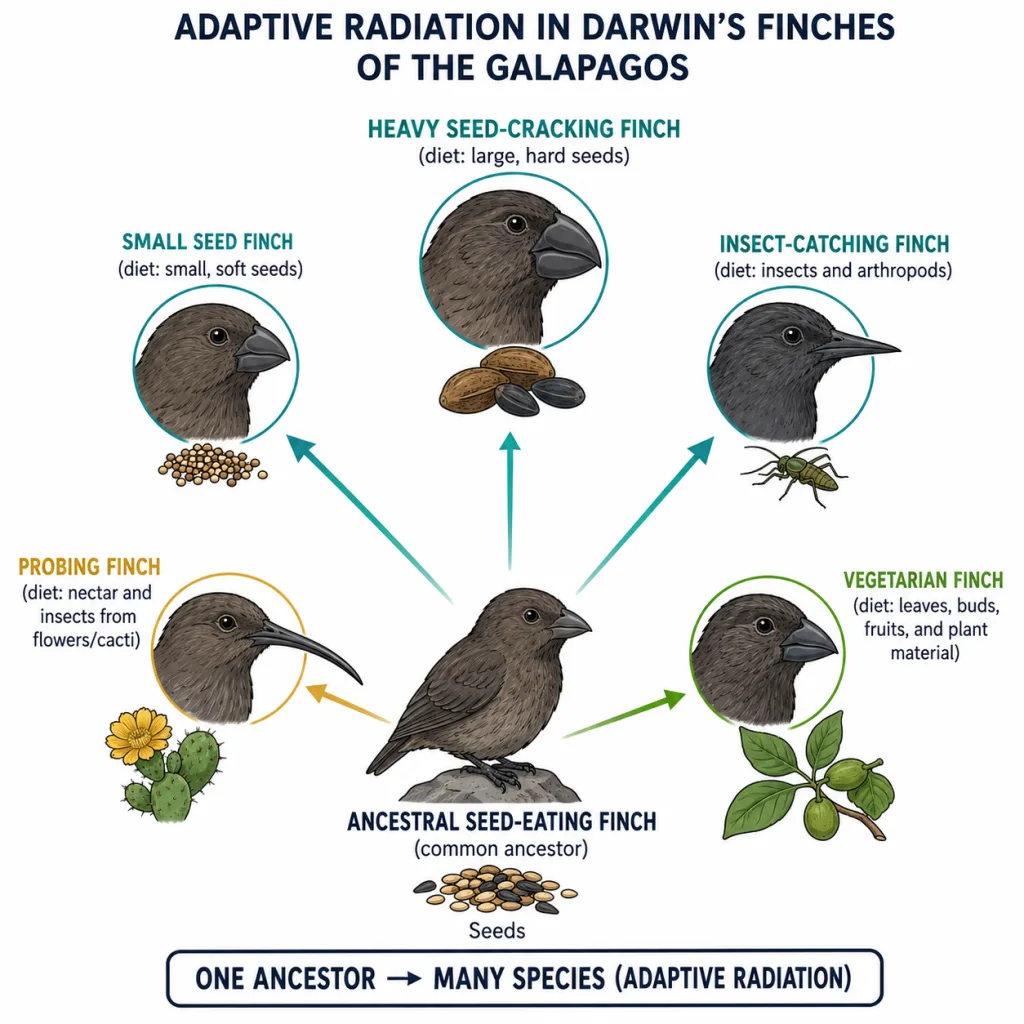
This is the process that gives us the term adaptive radiation. It describes the evolution of different species in a given geographical area, all starting from one point and literally radiating outward into other habitats. From a single ancestral stock, descendants spread into the various niches available and, in adapting to each, become distinct species.
Darwin's finches are one of the finest examples of this phenomenon. Each beak shape represents an adaptation to a particular food source, yet all trace back to that one seed-eating ancestor that first reached the islands.
The Australian Marsupials
A second classic example comes from Australia. A whole range of marsupials — pouched mammals, each quite different from the next — evolved there from a single ancestral stock, but all within the Australian island continent. Isolation played a large part: cut off from other landmasses, the marsupials had the continent's many habitats to themselves and radiated to fill them, giving rise to marsupial forms that graze, burrow, climb and hunt.
This is adaptive radiation on a continental scale, and it parallels what happened with the finches on a much smaller island setting. One starting stock, many habitats, and in time many species.
When Radiations Converge
Something interesting happens when more than one adaptive radiation takes place in the same isolated area, each set of animals spreading into similar habitats. The result can be convergent evolution — unrelated groups coming to resemble one another because they have adapted to the same kinds of life.
Australia illustrates this too. Alongside the marsupials, placental mammals in Australia also underwent their own radiation, evolving into varieties that look remarkably like the marsupials filling the same roles. A well-known pairing is the placental wolf and the Tasmanian wolf, which was a marsupial: two animals from entirely separate lineages that ended up looking and living alike because the same habitat selected the same kind of body and the same way of hunting.
Radiation and Convergence Compared
It helps to keep the two ideas side by side. Adaptive radiation is about one stock branching out into many forms to suit many habitats — a spreading, diverging pattern. Convergence is about separate stocks arriving at similar forms because they face the same habitat and the same demands — a coming-together in appearance despite different ancestry.
So Darwin's finches and the Australian marsupials show us radiation from a common origin, while the placental wolf and the marsupial Tasmanian wolf show us convergence toward a common form. Both patterns fall out naturally from natural selection working on the raw variation within populations.
Quick Recap
- On the Galapagos Islands, Darwin found many varieties of small black birds — Darwin's finches — differing mainly in beak shape.
- From an original seed-eating form arose insectivorous and vegetarian finches, all evolving on the islands themselves.
- Adaptive radiation = evolution of different species in a geographical area, starting from one point and radiating out to other habitats.
- Darwin's finches and the Australian marsupials (many marsupials from one ancestral stock, all within Australia) are the classic examples.
- When more than one radiation occurs in an isolated area, you get convergent evolution — e.g., the placental wolf resembling the Tasmanian wolf (a marsupial).
Solved Examples — Section 6
Q1. What did Darwin observe about the finches on the Galapagos Islands?
Answer: He found many varieties of small black birds on the same islands, differing chiefly in beak shape, and concluded they had all evolved there from a single ancestral form.
Q2. Define adaptive radiation.
Answer: It is the evolution of different species in a given geographical area, starting from one point and radiating out to occupy other habitats — one ancestral stock giving rise to many adapted forms.
Q3. How did the different beak types among Darwin's finches arise?
Answer: From an original seed-eating form, birds with altered beaks appeared, adapting to different foods — becoming insectivorous and vegetarian finches — all on the islands themselves.
Q4. Why are the Australian marsupials considered an example of adaptive radiation?
Answer: Many different marsupials evolved from a single ancestral stock, but all within the isolated Australian continent, each adapting to a different habitat.
Q5. What is convergent evolution, and how is it shown in Australia?
Answer: It is when separate lineages come to resemble one another by adapting to similar habitats. In Australia, placental mammals resemble the marsupials filling the same roles — for example, the placental wolf and the marsupial Tasmanian wolf.
Q6. How does convergent evolution differ from adaptive radiation?
Answer: Adaptive radiation is one stock diverging into many forms for many habitats; convergence is separate stocks arriving at similar forms because they face the same habitat and the same demands.