
Selection Reshapes the Whole Population
Natural selection does not act on one individual in isolation; it acts on the spread of a trait across an entire population. Picture almost any measurable character — body size, beak length, birth weight — plotted for every member of a population. Most of the time the plot comes out as a bell-shaped curve: a few individuals sit at the low extreme, a few at the high extreme, and the bulk cluster near the middle, the mean value.
When selection favours some values of the trait over others, it changes the shape of that curve. Depending on which part of the curve is favoured, the outcome takes one of three recognisable forms — stabilising, directional or disruptive selection. The easiest way to keep them apart is to ask a single question: which individuals end up leaving more offspring, the average ones, one extreme, or both extremes?
The Three Patterns at a Glance
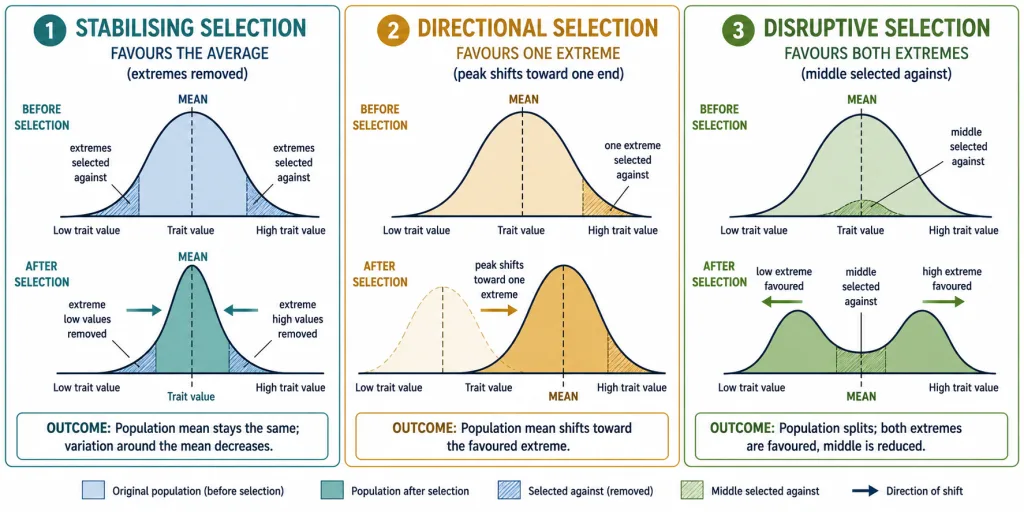
Each of the three types can be read straight off the bell-shaped distribution curve. In stabilising selection the middle of the curve is favoured, so more individuals come to hold the mean character value and the two extremes are trimmed away. In directional selection one end of the curve is favoured, so more individuals come to hold a value on one side of the mean, and the peak of the curve shifts in that direction. In disruptive selection both ends are favoured at the expense of the middle, so more individuals come to hold the peripheral values at the two extremes, and the single peak can split into two.
Notice what is really changing in each case: the average value of the trait, the amount of variation, or both. Keeping that in mind makes the three patterns hard to confuse.
Stabilising Selection — the Middle Wins
Stabilising selection favours the average and works against both extremes. More and more individuals come to acquire the mean character value, while those carrying unusually high or unusually low values are selected against and become rarer. The bell curve grows taller and narrower around the middle; the mean itself stays put, but the variation around it is reduced.
Human birth weight is the classic scenario. Babies of average weight tend to survive best. Very small babies and very large babies both face higher risks, so both extremes are selected against, and the population stays centred on a middle weight. Because it opposes change and preserves the existing average, stabilising selection is the pattern you expect in a stable, unchanging environment.
Directional Selection — the Curve Shifts
Directional selection favours one extreme of the trait rather than the middle. More individuals come to acquire a value on one side of the mean — a value other than the mean character value — so the peak of the curve moves steadily in that direction. Over generations the whole population drifts towards the favoured extreme.
The peppered moths of industrial England are the standard scenario. As tree trunks darkened with soot, dark-winged moths were better camouflaged and survived better than pale ones, so the population shifted towards the dark form. This is what selection tends to look like when the environment itself is changing in one consistent direction, pushing the average trait value along with it.
Disruptive Selection — Both Extremes Win
Disruptive selection is the odd one out: it favours both extremes at once and works against the average. More individuals come to acquire the peripheral character values at the two ends of the distribution curve, while intermediate individuals are selected against. The single bell curve is pulled apart into a two-peaked shape, and if the two groups keep diverging the population can eventually split into two.
Imagine a seed-eating bird population living where only very small soft seeds and very large hard seeds are available, with nothing in between. Birds with small beaks handle the small seeds well and birds with large beaks crack the big ones; medium-beaked birds are poorly suited to either and do worst. Selection then favours both beak extremes, and the population tends to divide. Because it splits one distribution into two, disruptive selection is the one most closely linked to the origin of new forms.
Quick Recap
- Natural selection acts on the whole bell-shaped distribution of a trait and can reshape it in three ways.
- Stabilising selection: favours the mean; more individuals acquire the mean value, both extremes are removed, variation is reduced (example: human birth weight).
- Directional selection: favours one extreme; more individuals acquire a value on one side of the mean and the peak shifts in that direction (example: dark peppered moths after industrialisation).
- Disruptive selection: favours both extremes; more individuals acquire the peripheral values at both ends, the curve becomes two-peaked and the population can split (example: small- vs large-beaked seed eaters).
- Quick test — ask who leaves more offspring: the average (stabilising), one extreme (directional) or both extremes (disruptive).
Solved Examples — Section 9
Q1. In stabilising selection, which individuals are favoured and what happens to variation?
Answer: The average individuals are favoured, so more of them acquire the mean character value; both extremes are selected against, and the overall variation in the population is reduced.
Q2. How does directional selection change the trait distribution curve?
Answer: It favours one extreme, so more individuals acquire a value on one side of the mean and the peak of the curve shifts in that direction, moving the whole population towards the favoured extreme.
Q3. Why can disruptive selection eventually split a population into two?
Answer: It favours both extremes and acts against the average, so individuals gather at the two peripheral values, turning the single-peaked curve into a two-peaked one; as the two groups keep diverging they may become separate forms.
Q4. Human birth weight is an example of which type of selection, and why?
Answer: Stabilising selection, because average-weight babies survive best while both very small and very large babies are selected against, keeping the population centred on the mean weight.
Q5. The shift from pale to dark peppered moths after industrialisation illustrates which type of selection?
Answer: Directional selection, because a changing environment favoured one extreme (the dark form), shifting the population's average colour towards that extreme.
Q6. In one line each, state which part of the bell curve is favoured in the three types of selection.
Answer: Stabilising favours the middle (mean); directional favours one end (one extreme); disruptive favours both ends (both extremes).