
What Breaks the Equilibrium
The Hardy–Weinberg principle describes an idealised population whose allele frequencies never budge. Real populations rarely behave so tidily, and that is the whole point — because when the frequencies do shift, evolution is happening. So the natural next question is: what actually disturbs the equilibrium and pushes allele frequencies off their steady values?
Five factors are known to do this. They are gene migration or gene flow, genetic drift, mutation, genetic recombination, and natural selection. Each one, in its own way, adds, removes or reshuffles alleles in a population and so nudges the frequencies away from the constant values that equilibrium would keep. It is worth taking them one at a time.
Gene Migration and Gene Flow
Populations are not always sealed off from one another. When a section of one population migrates and joins another, it carries its alleles with it. New alleles are added to the population it joins, and the very same alleles are subtracted from the population it left. Both populations therefore end up with altered allele frequencies — the movement changes the genetic make-up at both ends.
A single migration event does this once. If such gene migration happens again and again between the two populations, the steady exchange of alleles is called gene flow. Over time gene flow tends to make the populations more alike genetically, blurring differences that might otherwise have built up between them.
Genetic Drift — the Role of Chance
Sometimes allele frequencies change for no adaptive reason at all — simply by chance. This random change in allele frequency from one generation to the next is called genetic drift. Which individuals happen to survive, which happen to breed, and which alleles happen to be passed on can all be matters of luck, and that luck alone can shift the frequencies.
Drift matters far more in small populations than in large ones. In a huge population, chance fluctuations tend to cancel out; in a small one, a run of luck can swing an allele's frequency dramatically or even wipe it out entirely. Because drift is directionless and driven by chance rather than fitness, it can carry a small population's genetic make-up somewhere quite different from where selection alone would have taken it.
The Founder Effect and Bottlenecks
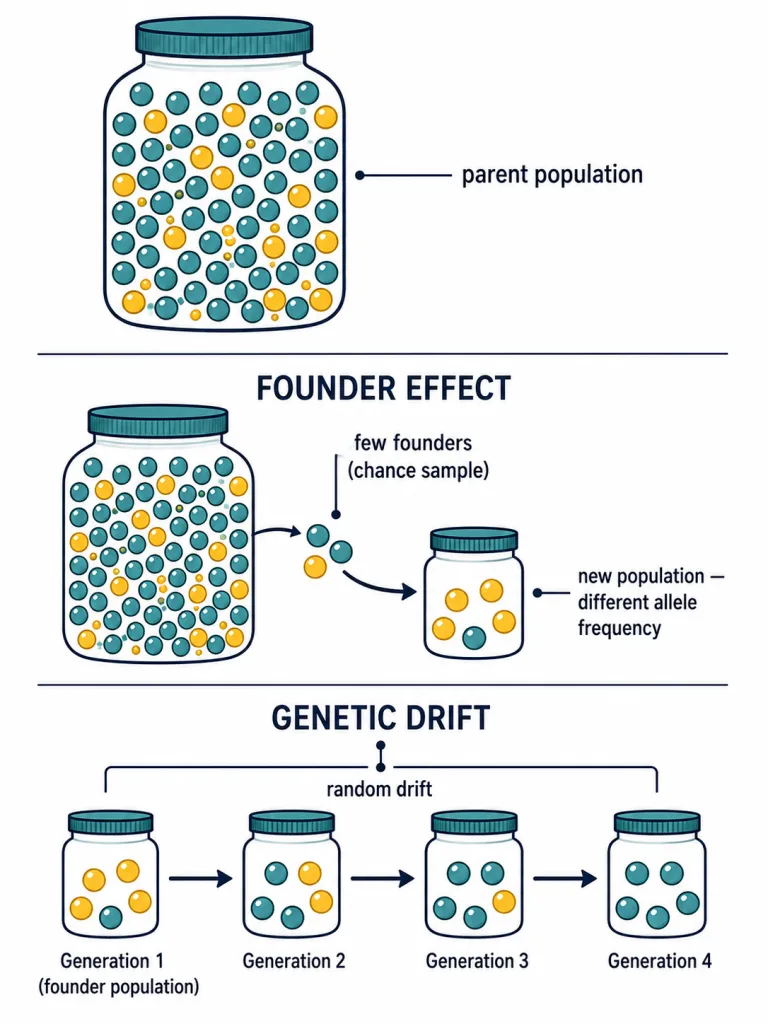
Drift shows its power most clearly when only a few individuals establish a brand-new population. Because that founding handful carries only a small, chance sample of the original population's alleles, the new population can start out with allele frequencies quite unlike the parent's. Drift can then push those frequencies so far that the new group becomes markedly different — different enough, sometimes, to be regarded as a separate species. This drifted founding group shows what is called the founder effect.
A related situation (beyond NCERT) is a bottleneck: a drastic, often sudden reduction in a population's size — from disease, disaster or over-hunting, say. The few survivors are again only a chance sample of what was there before, so their allele frequencies can differ sharply from the original, and drift acts strongly on the small survivor group.
Mutation, Recombination and Selection
The remaining three factors round out the list. Mutation is the ultimate source of new alleles — changes in the genetic material that introduce variants that simply did not exist before, giving selection and drift fresh material to work on. Genetic recombination, occurring during gametogenesis, reshuffles existing alleles into new combinations each generation, so offspring differ from their parents even without any new mutation.
Natural selection is the fifth factor, and the only non-random one: heritable variations that improve survival and reproduction lead their carriers to leave more progeny, steadily raising the frequency of the favoured alleles. Taken together, variation arising from mutation, from recombination during gametogenesis, from gene flow or from genetic drift changes the frequency of genes and alleles in later generations, and when this is coupled with the enhanced reproductive success that selection provides, the population can end up looking like a different population altogether.
Quick Recap
- Five factors disturb Hardy–Weinberg equilibrium: gene migration/gene flow, genetic drift, mutation, genetic recombination and natural selection.
- Gene flow: a section of a population migrates; alleles are added to the new population and lost from the old, changing frequencies in both. Repeated migration = gene flow.
- Genetic drift: random change in allele frequency by chance; strong in small populations.
- Founder effect: a few individuals found a new population; drift makes the new allele frequencies so different that the founders may become a different species.
- Bottleneck: a drastic reduction in population size also leaves a chance sample, driving strong drift.
- Mutation creates new alleles; recombination (during gametogenesis) reshuffles them; natural selection raises the frequency of alleles that improve reproductive success.
Solved Examples — Section 11
Q1. Name the five factors that are known to affect Hardy–Weinberg equilibrium.
Answer: Gene migration or gene flow, genetic drift, mutation, genetic recombination, and natural selection.
Q2. How does the migration of part of a population change allele frequencies?
Answer: The migrants carry alleles into the new population, adding them there, while the same alleles are lost from the old population; both populations therefore end up with changed allele frequencies. Repeated migration produces gene flow.
Q3. What is genetic drift, and why is it more important in small populations?
Answer: It is a random change in allele frequency that happens purely by chance. In small populations chance events do not average out, so drift can swing frequencies sharply or eliminate an allele, whereas in large populations such fluctuations tend to cancel.
Q4. Explain the founder effect.
Answer: When a few individuals establish a new population, they carry only a chance sample of the original alleles; drift can then make the new allele frequencies so different that the founding group may become a separate species. This drifted founding group shows the founder effect.
Q5. How do mutation and recombination each contribute variation?
Answer: Mutation introduces entirely new alleles that did not exist before, while genetic recombination during gametogenesis reshuffles existing alleles into new combinations, so offspring differ from their parents.
Q6. What is a population bottleneck, and how is it related to drift?
Answer: A bottleneck is a drastic reduction in population size; the few survivors are a chance sample of the original, so their allele frequencies can differ sharply from before, and drift acts strongly on the small survivor group.