
A Prediction Hidden in the Double Helix
When Watson and Crick described the double helix in 1953, they added one famously understated line — that the base pairing they had proposed "immediately suggests a possible copying mechanism for the genetic material."
Their idea was simple and elegant. The two strands of DNA are complementary, so each one already carries all the information needed to rebuild its partner. To copy the molecule, you just unzip the two strands and let each act as a template for building a fresh complementary strand.
The consequence is the key prediction: after copying, every daughter DNA molecule keeps one parental (old) strand and gains one newly made strand. Because each new molecule conserves half of the original, this scheme is called semiconservative replication.
Three Models That Had to Be Tested
(NCERT presents only the semiconservative scheme — but the rival models below are classic Board/NEET exam context.)
A prediction is only as good as the experiment that checks it. In principle DNA could have copied itself in any of three ways:
| Model | What each daughter molecule looks like |
|---|---|
| Conservative | One molecule fully old, the other fully new |
| Semiconservative | Each molecule has one old + one new strand |
| Dispersive | Old and new DNA scattered in patches along both strands |
Watson and Crick backed the semiconservative model. The challenge was to design an experiment that could tell these three apart — and that is exactly what Meselson and Stahl achieved.
The Meselson–Stahl Experiment (1958)
Matthew Meselson and Franklin Stahl found a clever way to "weigh" DNA. Their trick was to label the parental DNA with a heavy isotope of nitrogen, , and then watch the label dilute out as the DNA copied itself.
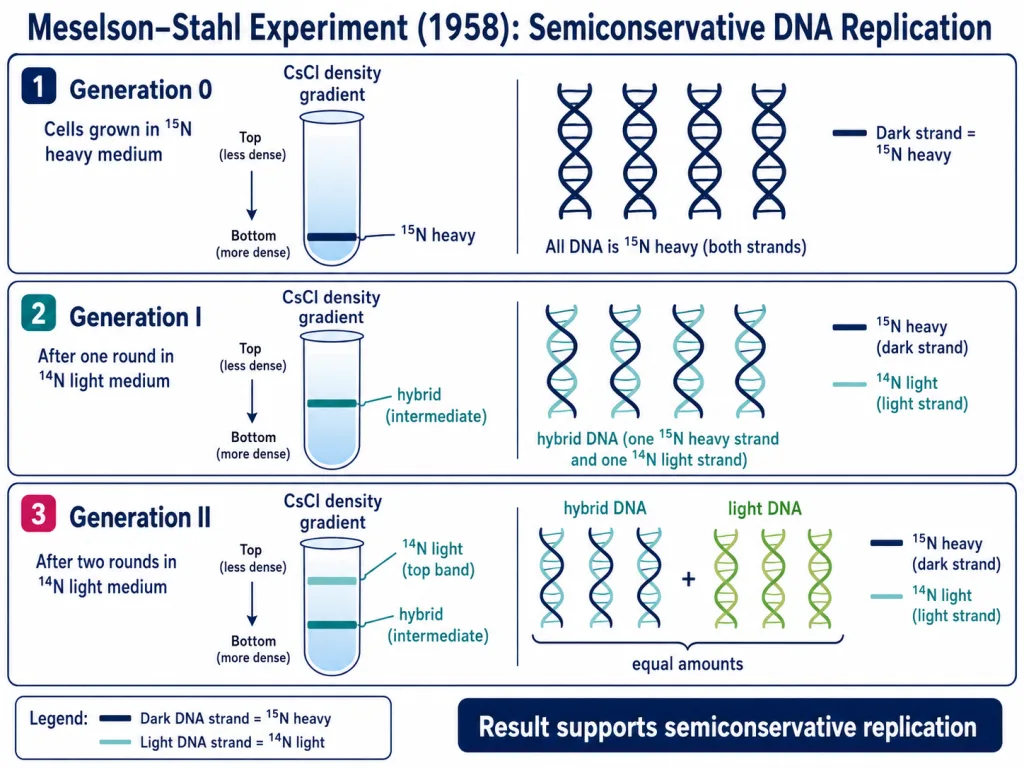
The steps were:
- They grew E. coli for many generations in a medium where the only nitrogen source was . This made all the DNA heavy (every base now contained ).
- They then shifted the cells to normal medium and let them keep dividing. From this point, every new strand would be built from light .
- At fixed time points (each generation), they extracted the DNA and spun it in a caesium chloride (CsCl) density-gradient centrifuge, which sorts molecules purely by density.
[NEET Tip] is not radioactive — it is simply heavier. It is separated from on the basis of density, not radioactivity. This is a favourite trap.
Reading the Density Bands
The beauty of the experiment is in the bands that appeared in the centrifuge tube.
- Generation 0 (start): all DNA is heavy () → a single heavy band.
- After ONE generation (~20 min, since E. coli divides every 20 minutes): all the DNA had an intermediate (hybrid) density — one heavy parental strand paired with one light new strand. A single hybrid band, and no heavy band left.
- After TWO generations (~40 min): the DNA was made of equal amounts of hybrid DNA and light DNA ().
That first result is decisive. A hybrid band after one round rules out conservative replication (which would have given a heavy band + a light band). The half-hybrid, half-light mix after two rounds rules out dispersive replication too. Only the semiconservative model fits — proving Watson and Crick right.
Quick check: at the third generation (~60 min) the hybrid stays constant while light DNA doubles — so the proportion of hybrid keeps falling (1/4 of molecules), even though hybrid never disappears entirely.
Confirmation in Chromosomes — Taylor's Experiment
Meselson and Stahl worked with the simple, naked DNA of a bacterium. But do the chromosomes of higher organisms — with their DNA wrapped around proteins — also replicate semiconservatively?
The answer came the very same year. Taylor and colleagues (1958) grew the root tips of Vicia faba (the faba bean) using radioactive (tritiated) thymidine to label newly made DNA. By tracking where the label ended up in the chromosomes across cell divisions, they showed that chromosomal DNA also replicates semiconservatively.
So the rule holds from bacteria to plants to humans: each daughter DNA carries one old strand and one new strand.
[Board] Keep the two proofs paired: Meselson & Stahl → E. coli (density label, ); Taylor et al. → Vicia faba (radioactive thymidine).
Memory Capsule — Section 6
- Watson & Crick (1953) predicted semiconservative replication: strands separate, each is a template; each daughter DNA = 1 old + 1 new strand.
- Three possible models: conservative, semiconservative, dispersive — only the second proved correct.
- Meselson & Stahl (1958) in E. coli: grew cells in heavy , shifted to , separated DNA by CsCl density-gradient centrifugation.
- After 1 generation → all hybrid (intermediate) DNA; after 2 generations → equal hybrid + light DNA. This rules out conservative and dispersive models.
- is heavy, not radioactive — separated by density.
- Taylor and colleagues (1958) confirmed it in chromosomes of Vicia faba using tritiated thymidine.
Solved Examples — Section 6
Q1. What does "semiconservative" mean in the context of DNA replication?
Answer: Each daughter DNA molecule retains one parental (old) strand and contains one newly synthesised strand. Half of the original molecule is conserved in each copy — hence "semi" conservative.
Q2. Why did Meselson and Stahl use rather than a radioactive label, and how were the DNA molecules separated?
Answer: is a heavy (non-radioactive) isotope that makes DNA denser without changing its chemistry. The DNA was separated by CsCl density-gradient centrifugation, which sorts molecules by density — heavy, hybrid and light DNA settle at different positions.
Q3. In the Meselson–Stahl experiment, what density of DNA was found after one generation in medium, and what does this rule out?
Answer: After one generation, all the DNA had intermediate (hybrid) density — one heavy strand plus one light strand. This rules out the conservative model, which would have produced a separate heavy band and a separate light band.
Q4. After two generations in medium, what did the DNA samples contain?
Answer: Equal amounts of hybrid DNA and light DNA. Half the molecules were hybrid () and half were fully light () — exactly the prediction of semiconservative replication.
Q5. If E. coli grows for 80 minutes (four generations) after the shift to , what fraction of the DNA molecules will still be hybrid?
Answer: 1/8. The two original heavy strands persist, so 2 of the 16 molecules () are hybrid. ; the remaining 14/16 are fully light.
Q6. Who confirmed semiconservative replication in chromosomes, in which organism, and using what label?
Answer: Taylor and colleagues (1958) confirmed it in the chromosomes of Vicia faba (faba bean) using radioactive (tritiated) thymidine to follow newly synthesised DNA.