
From "Factors" to Molecules
In the last chapter we saw how traits pass from parents to offspring through Mendel's "factors" — what we now call genes. But what are genes made of, physically? This chapter answers that: genes are stretches of DNA, and this chapter is the story of how DNA was identified as the genetic material and how the information in it is stored, copied and used.
Think of it as following one molecule — DNA — through its whole working life: its structure, how it is packed into a cell, how it copies itself (replication), and how its message is read out into proteins (transcription and translation).
DNA — A Long Polymer of Nucleotides
DNA (deoxyribonucleic acid) is a long chain (polymer) built from repeating units called deoxyribonucleotides. Each nucleotide has three parts — a nitrogenous base, a pentose sugar (deoxyribose), and a phosphate group (we look at this in detail in the next section).
The length of a DNA molecule is measured as the number of nucleotides, or as base pairs (bp) for double-stranded DNA — and this length is a characteristic of each organism:
| Organism | Genome size |
|---|---|
| Bacteriophage φX174 | 5386 nucleotides |
| Bacteriophage lambda (λ) | 48,502 bp |
| Escherichia coli | 4.6 × 10⁶ bp |
| Human (haploid) | 3.3 × 10⁹ bp |
So a human cell carries over 3 billion base pairs of DNA — an enormous amount of information stored in one kind of molecule.
Who First Found DNA?
DNA was first isolated in 1869 by Friedrich Meischer, who extracted an acidic substance from the nuclei of cells and called it 'Nuclein'. Because such a long, fragile polymer was hard to isolate intact, working out its actual structure took much longer — until 1953, when Watson and Crick proposed the double-helix model (the focus of the next section).
[NEET Tip] Two names to keep straight: Meischer (1869) discovered DNA (nuclein); Watson & Crick (1953) worked out its structure.
The Central Dogma — How Information Flows
Soon after the double helix was proposed, Francis Crick put forward the central dogma of molecular biology — the rule for how genetic information moves inside a cell:
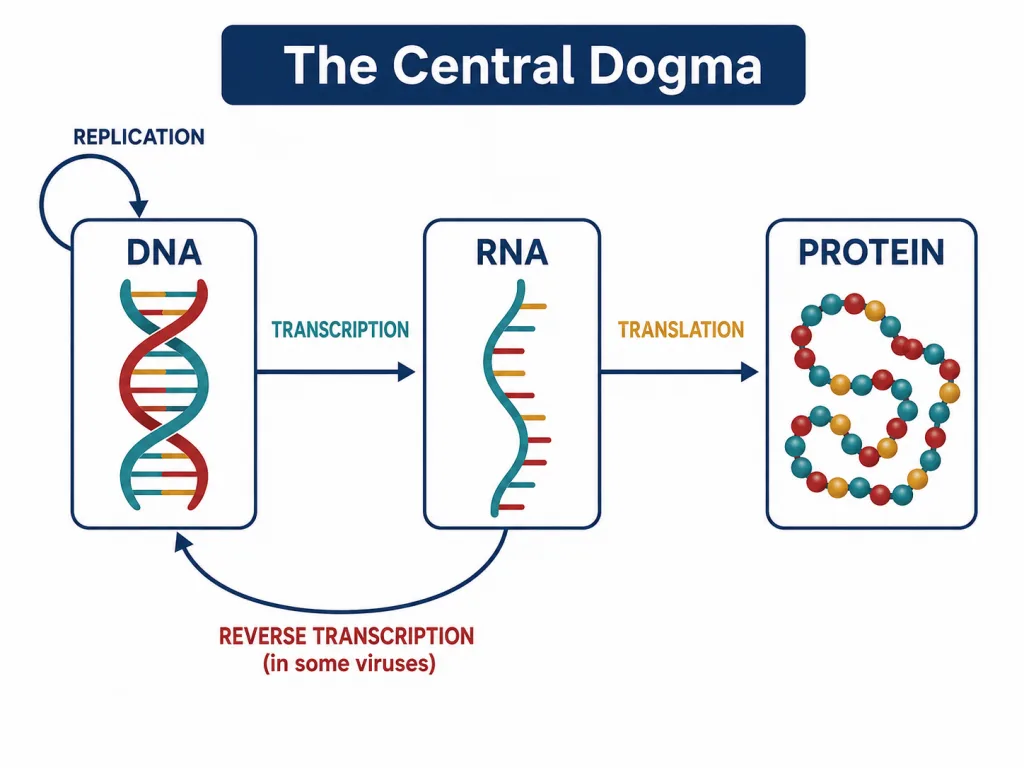
DNA is transcribed into RNA, and RNA is translated into protein. The protein then does the actual work in the cell.
In some viruses (the retroviruses, such as HIV) the flow runs in reverse — from RNA to DNA — a process called reverse transcription. This was the one well-known exception that extended Crick's original scheme.
DNA or RNA — Which is the Genetic Material?
In most organisms, DNA is the genetic material. In some viruses, RNA is the genetic material instead; in the rest of life, RNA mainly acts as a messenger and in other supporting roles rather than as the master copy.
Why is DNA preferred as the long-term store? Because it is more stable than RNA (RNA's extra –OH group makes it reactive and short-lived). We compare the two carefully in a later section — for now, just hold the headline: DNA = the stable archive; RNA = the working messenger.
Memory Capsule — Section 1
- DNA = polymer of deoxyribonucleotides; length measured in base pairs (bp).
- Genome sizes: φX174 5386 nt · λ 48,502 bp · E. coli 4.6 × 10⁶ bp · human 3.3 × 10⁹ bp.
- Meischer (1869) discovered DNA ('Nuclein'); Watson & Crick (1953) gave its structure.
- Central dogma: DNA → RNA → Protein; reverse (RNA → DNA) = reverse transcription (retroviruses).
- DNA = stable genetic material in most organisms; RNA = genetic material in some viruses, otherwise a messenger.
Solved Examples — Section 1
Q1. Arrange these by genome size, smallest first: E. coli, human (haploid), bacteriophage φX174, lambda phage.
Answer: φX174 (5386 nt) < λ (48,502 bp) < E. coli (4.6 × 10⁶ bp) < human (3.3 × 10⁹ bp). Genome size does not track "complexity" perfectly, but across these four it rises from a small virus to a bacterium to a human.
Q2. Who discovered DNA, in which year, and what name did he give it?
Answer: Friedrich Meischer, in 1869. He isolated an acidic material from cell nuclei and named it 'Nuclein'. Its double-helix structure came much later (Watson & Crick, 1953).
Q3. State the central dogma of molecular biology. Which enzyme-driven step is the exception?
Answer: Information flows DNA → RNA → Protein (transcription then translation). The exception is reverse transcription (RNA → DNA), seen in retroviruses, which led to the term "reverse" transcriptase.
Q4. Why is DNA, rather than RNA, the genetic material in most organisms?
Answer: DNA is chemically more stable — it lacks the reactive 2'-OH group that RNA has, so it is less easily degraded and better suited to long-term storage of information. RNA is more reactive and usually acts as a short-lived messenger.
Q5. A double-stranded DNA has 3.3 × 10⁹ base pairs. How many nucleotides does it contain in total?
Answer: 6.6 × 10⁹ nucleotides. Each base pair is made of two nucleotides (one on each strand), so the total number of nucleotides is twice the number of base pairs.
Q6. In which group of organisms is RNA the genetic material, and what role does RNA usually play elsewhere?
Answer: RNA is the genetic material in some viruses (e.g., many RNA viruses). In most other organisms RNA is not the master copy — it works mainly as a messenger (mRNA) and in related roles, while DNA stores the information.