
The Master Enzyme — DNA-dependent DNA Polymerase
Knowing that DNA copies itself semiconservatively is one thing; carrying out that copying inside a living cell needs a whole team of enzymes. The main enzyme is the DNA-dependent DNA polymerase. The name tells you its job: it reads a DNA template and uses it to polymerise deoxynucleotides into a new strand.
This enzyme has to be remarkably fast and remarkably accurate at the same time:
- Speed: in E. coli, the entire genome of about bp is copied in about 38 minutes — an average of nearly 2000 base pairs every second (4.6 million ÷ 2000 ≈ 2300 s).
- Accuracy: every mistake risks becoming a mutation, so the polymerase copies with extremely high fidelity.
[NEET Tip] Remember the full name — DNA-dependent DNA polymerase — because it is directed by a DNA template (distinguish it from the DNA-dependent RNA polymerase used in transcription).
Fuel and Building Blocks — dNTPs Do Double Duty
Replication is energetically expensive, and the cell pays for it using a clever shortcut: the substrates themselves carry the energy.
The raw materials are deoxyribonucleoside triphosphates (dNTPs) — that is, dATP, dGTP, dCTP and dTTP. These serve two purposes at once:
- Substrate: the nucleotide part is added to the growing DNA strand.
- Energy source: the two terminal phosphates are high-energy phosphate bonds (just like the terminal phosphates of ATP). Their removal during polymerisation releases the energy that drives the reaction forward.
So each building block arrives pre-charged with its own fuel — the cell does not need a separate energy molecule for every nucleotide added.
Key idea: dNTPs = substrate + energy. The two outer phosphates are high-energy, exactly as in ATP.
Where Copying Begins — The Origin of Replication
Replication does not start randomly anywhere along the DNA, and DNA polymerases cannot kick off the process on their own. Instead, copying begins at a specific site called the origin of replication (ori) — a defined region of the DNA sequence.
At the origin, the double helix is opened up. The cell does not unzip the entire molecule at once, because separating two very long strands along their whole length would cost far too much energy. Instead, a small opening forms — and synthesis proceeds from there.
This idea of an origin has a very practical pay-off in biotechnology. When a piece of DNA is to be multiplied during recombinant DNA work, it must be inserted into a vector, because it is the vector that provides an origin of replication — without an ori, the inserted DNA cannot be copied inside the host cell.
[Board] A DNA fragment can only be propagated in a host if it carries an origin of replication — that is precisely what a cloning vector supplies.
The Replication Fork & the 5'→3' Rule
The small opening in the helix where the two strands separate and copying happens is the replication fork — shaped like a Y.
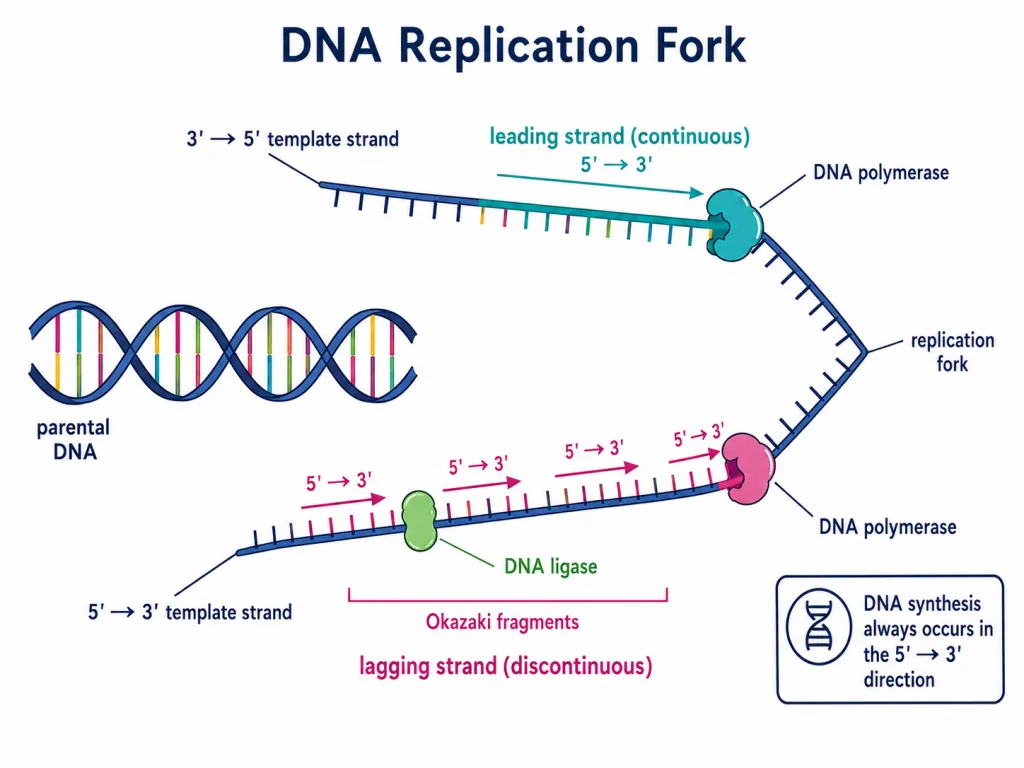
Here lies the key complication: DNA polymerase can build a new strand in only one direction — . But remember the two template strands are antiparallel, so they cannot both be read the same convenient way.
- On the template with polarity, the new strand can be made continuously, smoothly following the fork as it opens. This is the leading strand.
- On the template with polarity, the polymerase must work away from the fork, so the new strand is made in short pieces, discontinuously. This is the lagging strand.
Because one strand is continuous and the other discontinuous, replication is described as semi-discontinuous. (NCERT itself simply says one strand is copied continuously and the other discontinuously.)
Okazaki Fragments, DNA Ligase & the S Phase
The short pieces made on the lagging strand are called Okazaki fragments. On their own they would leave the new strand in broken bits, so a sealing enzyme is needed: DNA ligase joins the Okazaki fragments into one continuous strand.
Putting the cast of enzymes together for the lagging strand:
- DNA-dependent DNA polymerase synthesises each fragment ().
- DNA ligase stitches the fragments together.
Finally, when does all this happen? In eukaryotes, DNA replication takes place during the S phase of the cell cycle (the synthesis phase of interphase, between G1 and G2). Replication and cell division must be tightly coordinated — if a cell replicates its DNA but then fails to divide, the result is polyploidy (an abnormal extra set of chromosomes).
[NEET Tip] Tie the names together: short pieces = Okazaki fragments; the joiner = DNA ligase; the timing in eukaryotes = S phase.
Memory Capsule — Section 7
- Main enzyme = DNA-dependent DNA polymerase: uses a DNA template; very fast (~2000 bp/sec in E. coli, whole genome in ~38 min) and very accurate (errors → mutations).
- dNTPs (deoxyribonucleoside triphosphates) act as both substrate and energy source; the two terminal phosphates are high-energy, as in ATP.
- Replication begins at a specific origin of replication (ori); polymerases cannot start on their own. A cloning vector supplies the ori.
- Copying happens at a replication fork. Polymerase works only .
- Leading strand = continuous; lagging strand = discontinuous (short Okazaki fragments) → replication is semi-discontinuous.
- DNA ligase joins Okazaki fragments. In eukaryotes, replication occurs in the S phase of interphase.
Solved Examples — Section 7
Q1. Name the main enzyme of DNA replication and explain why it is called "DNA-dependent."
Answer: The main enzyme is DNA-dependent DNA polymerase. It is "DNA-dependent" because it requires a DNA template to direct the order in which deoxynucleotides are added to the new strand.
Q2. How do deoxyribonucleoside triphosphates (dNTPs) serve a "dual purpose" during replication?
Answer: They act both as substrates (the nucleotide is added to the growing strand) and as the energy source (their two terminal phosphates are high-energy bonds, like those of ATP, and their removal powers polymerisation).
Q3. Why can the two strands of a long DNA molecule not be separated along their entire length for replication?
Answer: Unwinding the whole molecule at once would require very high energy. Instead, the strands are opened only within a small region — the replication fork — and copying proceeds from there.
Q4. Why is one new strand made continuously and the other discontinuously?
Answer: DNA polymerase synthesises only in the direction. On the template the new strand runs toward the fork and is made continuously (leading strand). On the template the new strand must be made away from the fork, so it is built in short pieces — discontinuously (lagging strand).
Q5. What are Okazaki fragments and which enzyme joins them?
Answer: Okazaki fragments are the short stretches of DNA synthesised discontinuously on the lagging strand. They are joined into a continuous strand by the enzyme DNA ligase.
Q6. In which phase of the eukaryotic cell cycle does DNA replication occur, and what abnormality follows if division fails after replication?
Answer: Replication occurs in the S phase (synthesis phase of interphase). If a cell replicates its DNA but does not divide, it results in polyploidy — an abnormal extra set of chromosomes.