
A Quick Way to Tell People Apart
We just learnt that 99.9% of our DNA is identical across all humans. The remaining tiny fraction is what makes each of us unique. If we wanted to compare two people, sequencing all 3 × 10⁹ base pairs every time would be hopelessly slow and costly.
DNA fingerprinting is the clever shortcut: a very quick technique to compare the DNA of any two individuals by examining a few special regions instead of the whole genome. It looks at stretches of repetitive DNA, where a short sequence is repeated many times over.
The technique was developed by Alec Jeffreys, and in India it is closely associated with Lalji Singh and the Centre for Cellular and Molecular Biology (CCMB), Hyderabad.
Satellite DNA and Polymorphism
When genomic DNA is spun in a density gradient, the bulk DNA forms one major peak and small extra peaks appear alongside — these are called satellite DNA. Depending on base composition, segment length and number of repeat units, satellite DNA is grouped into micro-satellites, mini-satellites, and so on.
These sequences usually do not code for proteins, but they show a very high degree of polymorphism — variation from person to person — and this is the very foundation of DNA fingerprinting.
Polymorphism simply means variation at the genetic level, arising from mutations. An inheritable mutation observed in a population at high frequency is called a DNA polymorphism (conventionally, when the variant occurs at a frequency above 0.01). Because mutations in non-coding DNA rarely affect survival, they accumulate freely generation after generation — which is why these regions vary so much.
[NEET Tip] Remember the chain of logic: mutations → polymorphism → variation in repetitive DNA → DNA fingerprint. The variation lives mostly in non-coding satellite DNA.
VNTR — The Heart of the Technique
Alec Jeffreys used a special satellite DNA as a probe that shows very high polymorphism, called VNTR — Variable Number of Tandem Repeats.
Here is the key idea: a small DNA sequence is arranged in tandem (one after another) in many copies, and the number of copies varies hugely between individuals — and even between the two alleles (paternal and maternal) of one person. Because the copy number differs, the size of a VNTR ranges from about 0.1 to 20 kb.
VNTRs belong to the class of satellite DNA called mini-satellites. When DNA is cut and probed with VNTR, the differing copy numbers produce bands of different sizes — a pattern that is essentially unique to each person.
That banding pattern differs from individual to individual, with one striking exception: monozygotic (identical) twins, who share the same pattern.
Steps of DNA Fingerprinting
The classical technique uses Southern blot hybridisation with a radiolabelled VNTR probe, and runs through six steps:
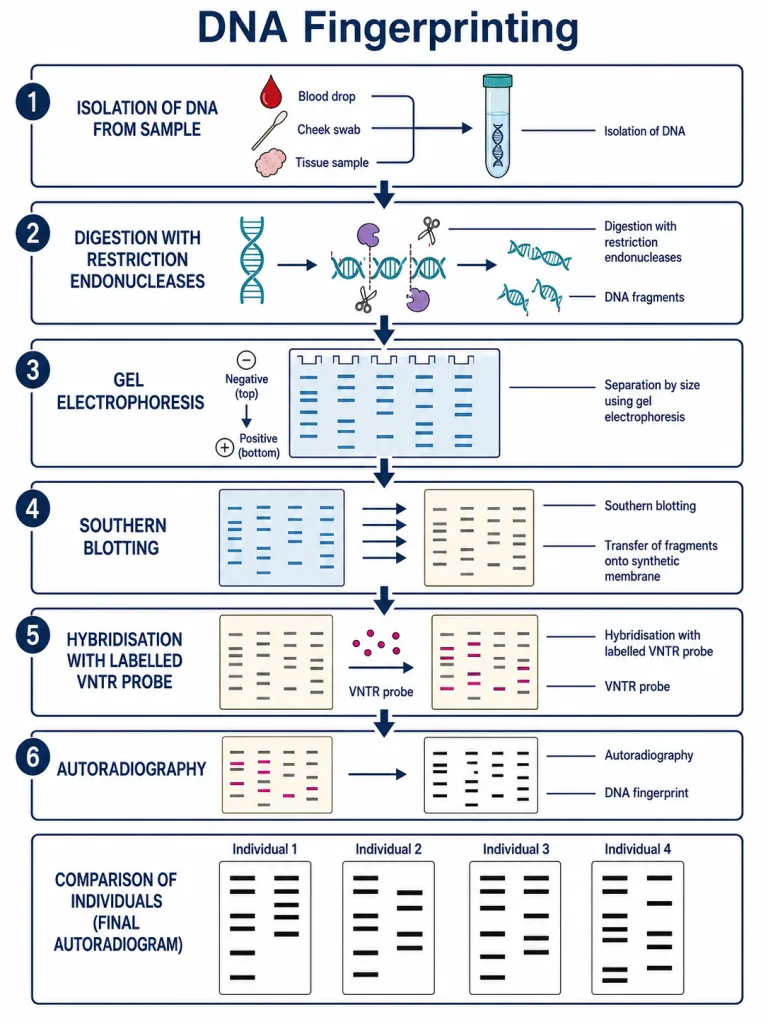
- Isolation of DNA from the sample.
- Digestion of the DNA using restriction endonucleases.
- Separation of the fragments by gel electrophoresis (by size).
- Blotting — transferring the separated fragments onto a synthetic membrane such as nitrocellulose or nylon (Southern blotting).
- Hybridisation of the membrane with a labelled VNTR probe.
- Detection of the bound (hybridised) fragments by autoradiography, giving the band pattern.
The sensitivity has since been boosted by the polymerase chain reaction (PCR), so that DNA from even a single cell is now enough for analysis.
Applications of DNA Fingerprinting
Because the band pattern is unique and is inherited from parents to children, DNA fingerprinting has powerful uses:
- Forensic science: matching DNA from a crime scene (blood, hair-follicle, skin, bone, saliva, sperm) to a suspect. DNA from any tissue of a person shows the same pattern, making it ideal for identification.
- Paternity and parentage disputes: since the pattern is inherited, a child's bands can be traced to the parents.
- Population and evolutionary studies: determining genetic diversity within and between populations.
In India, this technique is linked with Lalji Singh and the CCMB, Hyderabad. Today many different probes are used to generate DNA fingerprints.
Memory Capsule — Section 13
- DNA fingerprinting: quick way to find DNA differences between individuals; developed by Alec Jeffreys (India: Lalji Singh, CCMB Hyderabad).
- Based on polymorphism in repetitive (satellite) DNA, mostly non-coding.
- VNTR = Variable Number of Tandem Repeats — a mini-satellite; copy number varies, so size ranges 0.1–20 kb.
- Steps: isolate DNA → digest with restriction endonucleases → gel electrophoresis → blotting (Southern) onto nylon/nitrocellulose → hybridise with labelled VNTR probe → autoradiography.
- Uses: forensics, paternity disputes, population/evolution studies. Identical (monozygotic) twins share the same pattern; PCR lets a single cell suffice.
Solved Examples — Section 13
Q1. Who developed the technique of DNA fingerprinting, and what does VNTR stand for?
Answer: It was developed by Alec Jeffreys. VNTR stands for Variable Number of Tandem Repeats — a satellite DNA whose copy number varies greatly between people.
Q2. On what biological principle does DNA fingerprinting rest?
Answer: On polymorphism (variation) in repetitive, non-coding satellite DNA, particularly VNTRs. Because the number of tandem repeats differs between individuals, each person gives a distinctive band pattern.
Q3. List the six steps of the classical DNA fingerprinting technique in order.
Answer: (1) Isolation of DNA, (2) digestion with restriction endonucleases, (3) separation by gel electrophoresis, (4) blotting onto a synthetic membrane, (5) hybridisation with a labelled VNTR probe, (6) detection by autoradiography.
Q4. Why is DNA fingerprinting useful in forensic work even when only a small sample is available?
Answer: DNA from any tissue of a person (blood, hair, skin, bone, saliva, sperm) gives the same pattern, so even tiny traces can identify someone. With PCR to amplify the DNA, even a single cell is enough.
Q5. Two individuals show an identical DNA fingerprint pattern. What is the most likely explanation?
Answer: They are most likely monozygotic (identical) twins, who develop from one zygote and so share the same DNA. For all other individuals the banding pattern differs.
Q6. What kind of satellite DNA is a VNTR, and what size range does it span?
Answer: A VNTR is a mini-satellite. Because the copy number of its tandem repeat varies, the size of a VNTR ranges from about 0.1 to 20 kb, producing many bands of differing sizes on the autoradiogram.