
Why Genes Need Regulation
A cell does not make every protein all the time — that would waste energy. It switches genes on only when their products are needed. This switching is called regulation of gene expression, and in eukaryotes it can act at several levels (transcription, RNA processing, mRNA transport and translation).
In prokaryotes, regulation occurs mainly at the level of transcription — specifically, controlling whether transcription even starts. A neat real example: E. coli makes the enzyme beta-galactosidase only when lactose is around to be broken down. No lactose, no need for the enzyme — so the bacterium keeps that gene switched off.
[NEET Tip] In prokaryotes, the rate of transcriptional initiation is the main control point for gene expression.
The Operon — A Cluster of Genes
In bacteria, related genes are often grouped together and controlled as a single unit called an operon — a unit of several genes sharing a common promoter and regulatory machinery. Examples include the lac, trp, ara and his operons.
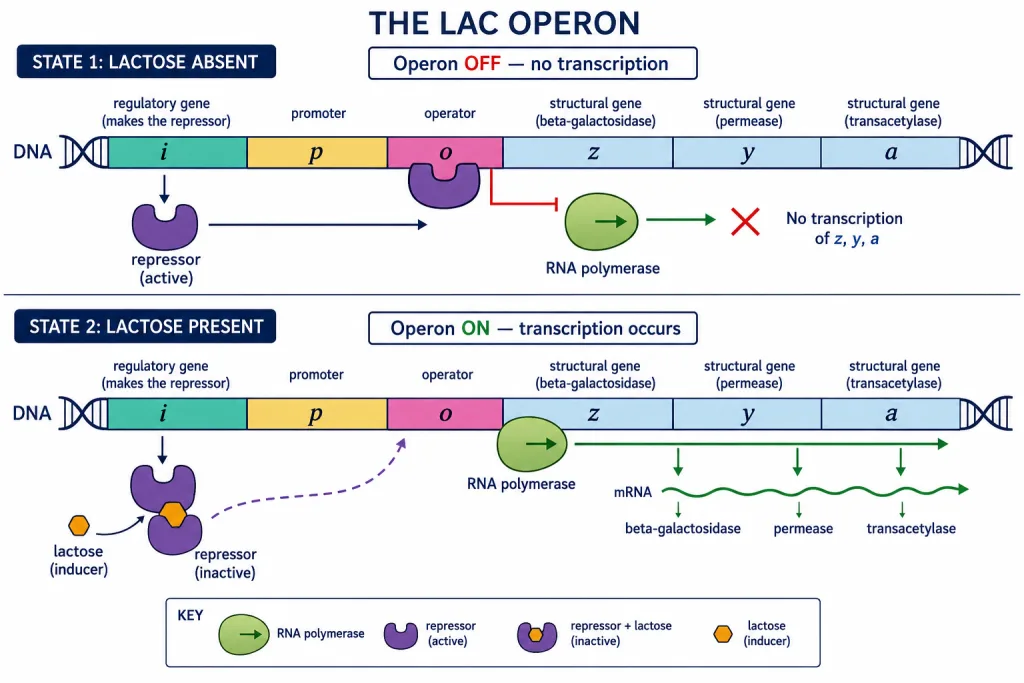
The lac operon (the model worked out by Francois Jacob and Jacque Monod, the first transcriptionally regulated system to be explained) has these parts:
- A regulatory gene (i) — codes for the repressor protein (here i comes from inhibitor, not inducer).
- A promoter (p) — the binding site for RNA polymerase.
- An operator (o) — the site where the repressor can bind.
- Three structural genes: z, y and a.
What the Three Structural Genes Do
The three structural genes of the lac operon each make an enzyme needed to handle lactose:
| Gene | Product | Job |
|---|---|---|
| z | beta-galactosidase | Breaks lactose into galactose + glucose |
| y | permease | Controls entry of lactose into the cell |
| a | transacetylase | A transacetylase enzyme |
All three products are needed for the metabolism of lactose, which is why it makes sense for the cell to control them together as one operon.
[NEET Tip] Remember the pairing: z → beta-galactosidase, y → permease, a → transacetylase. Beta-galactosidase splitting lactose into galactose and glucose is the most asked detail.
Lactose — The Inducer
Lactose is the inducer of the lac operon — it is the very substrate that switches the operon on and off. (Beyond NCERT: in the classic experiments, glucose or galactose cannot act as inducers of this operon.)
A tiny background level of the operon is always expressed, so that some permease exists to let the first lactose molecules into the cell. Once inside, lactose acts as the signal to turn the operon fully on. This is a beautiful case of enzyme synthesis being regulated by its own substrate.
[Board] The substrate lactose itself is the inducer that controls switching the operon on and off.
Operon ON or OFF — Negative Regulation
The repressor (from the i gene) is made all the time (constitutively). Whether the operon runs depends on lactose:
Without lactose — operon OFF: The repressor binds the operator and physically blocks RNA polymerase from transcribing the structural genes. No enzymes are made.
With lactose — operon ON: Lactose binds the repressor and inactivates it. The inactivated repressor can no longer hold the operator, so it leaves. Now RNA polymerase reaches the promoter and transcribes z, y and a, and the lactose-metabolising enzymes are produced.
Because the controlling protein is a repressor that blocks transcription, this is called negative regulation. (The lac operon also has a positive control, but that is beyond this level.)
One-line logic: No lactose → repressor ON operator → operon OFF. Lactose present → repressor inactivated → operon ON.
Memory Capsule — Section 11
- In prokaryotes, gene expression is regulated mainly at transcription (rate of initiation).
- An operon = several genes under one promoter; lac operon explained by Jacob & Monod.
- Parts: i (regulatory → repressor) · p (promoter) · o (operator) · structural genes z, y, a.
- z → beta-galactosidase (lactose → galactose + glucose) · y → permease (lactose entry) · a → transacetylase.
- Lactose = inducer (glucose/galactose cannot induce).
- No lactose: repressor binds operator → operon OFF. Lactose present: lactose inactivates repressor → operator free → operon ON — this is negative regulation.
Solved Examples — Section 11
Q1. At which level is gene expression mainly regulated in prokaryotes, and why?
Answer: Mainly at the level of transcription — specifically the rate of transcriptional initiation. Controlling whether transcription starts is the most economical way to decide which proteins a bacterium makes.
Q2. Name the parts of the lac operon and who first explained it.
Answer: The lac operon has a regulatory gene i (makes the repressor), a promoter (p), an operator (o), and three structural genes z, y and a. It was first explained by Francois Jacob and Jacque Monod.
Q3. State the product of each structural gene of the lac operon and its function.
Answer: z → beta-galactosidase, which breaks lactose into galactose and glucose; y → permease, which controls lactose entry into the cell; a → transacetylase.
Q4. Which molecule is the inducer of the lac operon? Can glucose act as the inducer?
Answer: Lactose is the inducer — it is the substrate that switches the operon on and off. Glucose cannot act as an inducer (nor can galactose).
Q5. Explain what happens to the lac operon in the absence of lactose.
Answer: The repressor made by the i gene binds the operator and blocks RNA polymerase, so the structural genes are not transcribed. The operon stays OFF and no lactose-metabolising enzymes are made.
Q6. How does lactose switch the operon on, and why is this called negative regulation?
Answer: Lactose binds and inactivates the repressor, which then leaves the operator. RNA polymerase can now transcribe z, y and a, turning the operon ON. It is called negative regulation because the controlling protein (the repressor) normally acts by blocking transcription.