
The Final Proof — Enter the Bacteriophage
Avery and his colleagues had strongly suggested DNA was the genetic material, but not everyone was convinced. The unequivocal proof came in 1952 from Alfred Hershey and Martha Chase, who used a clever experimental tool: the bacteriophage, a virus that infects bacteria.
A bacteriophage works in a simple way. It attaches to a bacterium and injects its genetic material inside. The bacterial cell then treats this viral material as its own and starts churning out new virus particles. So the question Hershey and Chase asked was sharp and answerable: when the phage infects the bacterium, does DNA enter the cell, or does protein enter? Whichever one goes in must be the genetic material.
Labelling DNA and Protein Differently
The genius of the experiment lay in radioactive labelling, exploiting one chemical difference between DNA and protein:
- DNA contains phosphorus but no sulphur.
- Protein contains sulphur but no phosphorus.
So Hershey and Chase grew two batches of phages:
| Radioactive label | What it tags | Why |
|---|---|---|
| P (radioactive phosphorus) | DNA | DNA has phosphorus; protein does not |
| S (radioactive sulphur) | Protein | Protein has sulphur; DNA does not |
This gave them two distinguishable phage populations — one with radioactive DNA (P) and one with radioactive protein (S). Now they could simply follow the radioactivity and see which molecule entered the bacteria.
[NEET Tip] Fix the pairing: P → DNA (phosphorus), S → protein (sulphur). Swapping these two is the most common mistake in this experiment.
The Blender, the Centrifuge and the Result
The labelled phages were allowed to attach to and infect E. coli. Then came two key steps:
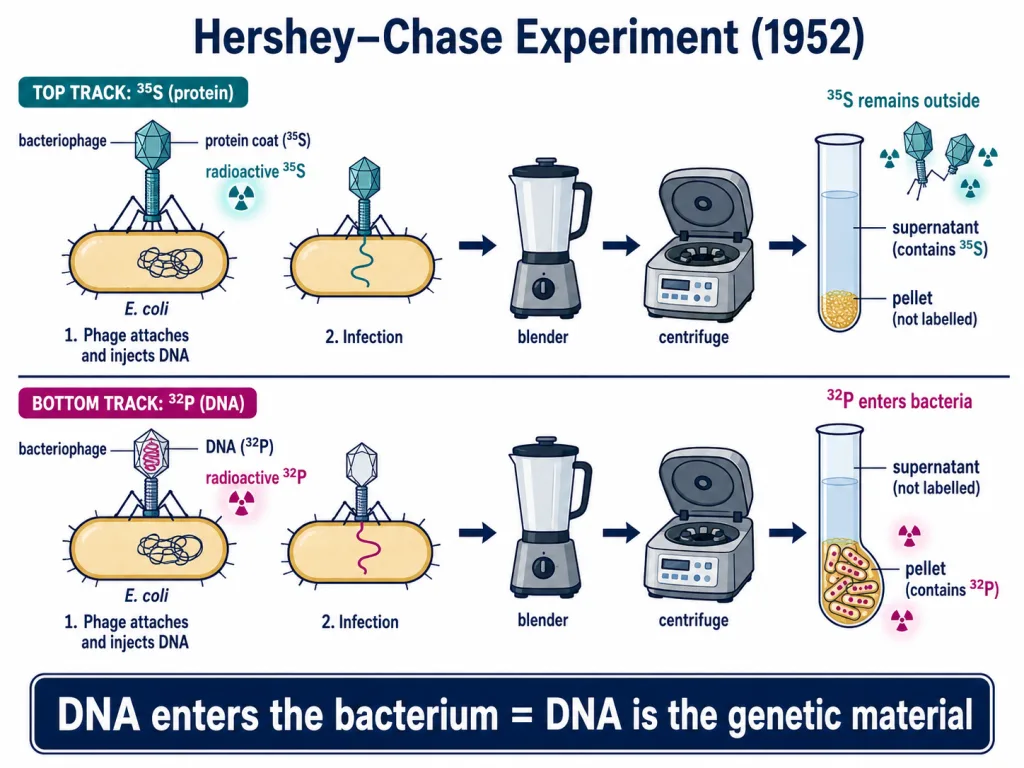
- Blender — the mixture was whirled in a blender, which shook the empty viral coats off the outside of the bacteria.
- Centrifuge — spinning then separated the heavier bacteria (pellet at the bottom) from the lighter viral coats (left in the liquid above).
The results were decisive:
- Bacteria infected by P-labelled phages were radioactive → the DNA had entered the bacteria.
- Bacteria infected by S-labelled phages were NOT radioactive → the protein coat stayed outside.
Since it was the DNA that passed from virus into bacterium (and went on to direct the making of new viruses), the conclusion was final: DNA is the genetic material.
[Board] The blender removes the coats; the centrifuge separates bacteria from coats; only P (DNA) is found inside the bacteria — that is the proof.
What Must a Genetic Material Do?
With DNA confirmed, we can ask a deeper question: what properties must any molecule have to serve as genetic material? Four criteria stand out:
- Replication — it must be able to generate a copy of itself. (Both DNA and RNA can, thanks to base pairing and complementarity; proteins fail at this very first hurdle.)
- Stability — it must be chemically and structurally stable, not changing with age, life-cycle stage or physiology. (Griffith's experiment already hinted at this: heating killed the bacteria but did not destroy the genetic material's information.)
- Scope for slow mutation — it must allow slow changes (mutations), which are the raw material for evolution.
- Expression — it must be able to express itself as the phenotype, i.e., as Mendelian characters.
Proteins fail criterion 1 outright. Among the nucleic acids, both DNA and RNA qualify — so we need to compare them to see why DNA became the preferred long-term store.
DNA vs RNA — Stability, Mutation and the RNA World
DNA and RNA both fulfil the criteria, but they are not equal. The deciding factor is stability.
RNA carries a reactive 2'-OH group on every nucleotide, which makes it labile and easily degraded. RNA is also catalytic, hence reactive. It also uses uracil, whereas DNA's thymine (and its double-stranded, complementary structure that allows repair) adds extra stability. The upshot:
- DNA is chemically less reactive and structurally more stable → the better store of genetic information.
- RNA is less stable, so it mutates faster. This is why RNA viruses mutate and evolve more rapidly (they also have short life spans).
- RNA can directly code for proteins, so it is excellent for the transmission and expression of information.
This brings us to the RNA World idea. The evidence suggests RNA was the first genetic material: it could act both as the genetic material and as a catalyst — biological catalysts made of RNA are called ribozymes. But because a catalytic RNA is reactive and unstable, DNA later evolved from RNA with chemical modifications that made it far more stable, taking over the job of long-term storage while RNA kept its dynamic roles.
[NEET Tip] Headline to remember: DNA = stable archive; RNA = reactive, mutable, and the first genetic material AND a catalyst (ribozyme).
Memory Capsule — Section 5
- Hershey & Chase (1952): used bacteriophages infecting E. coli; labelled P → DNA, S → protein.
- Blender shook off viral coats; centrifuge separated bacteria from coats.
- P (DNA) entered the bacteria; S (protein) stayed outside → DNA is the genetic material.
- A genetic material must: replicate, be chemically/structurally stable, allow slow mutations (for evolution), and express as phenotype (Mendelian characters).
- DNA more stable than RNA (RNA's 2'-OH and uracil make it reactive/mutable); RNA viruses mutate & evolve faster.
- RNA World: RNA was the first genetic material and also a catalyst (ribozyme); DNA evolved later because it is more stable.
Solved Examples — Section 5
Q1. Who provided the unequivocal proof that DNA is the genetic material, in which year, and using what organism?
Answer: Alfred Hershey and Martha Chase, in 1952, using bacteriophages (viruses that infect bacteria) that infected E. coli. Their experiment settled the protein-versus-DNA debate in favour of DNA.
Q2. Why was P used to label DNA and S to label protein, rather than the other way round?
Answer: DNA contains phosphorus but no sulphur, so P labels DNA. Protein contains sulphur but no phosphorus, so S labels protein. This chemical difference let the two molecules be tracked separately.
Q3. What was the role of the blender and the centrifuge in the experiment?
Answer: The blender agitated the mixture to shake the empty viral coats off the bacterial surface. The centrifuge then separated the heavier bacteria (pellet) from the lighter viral coats, so the location of each label could be checked.
Q4. In the Hershey–Chase result, which label was found inside the bacteria, and what did this prove?
Answer: P (the DNA label) was found inside the bacteria, while S (the protein label) remained outside. This proved that DNA, not protein, enters the bacterium — hence DNA is the genetic material.
Q5. List the properties a molecule must have to act as genetic material.
Answer: It must be able to replicate (make a copy of itself), be chemically and structurally stable, allow slow mutations required for evolution, and express itself as the phenotype (Mendelian characters).
Q6. Why is RNA thought to be the first genetic material, yet DNA became the preferred store of information?
Answer: RNA could act both as genetic material and as a catalyst (ribozyme), so it likely came first. But RNA's reactive 2'-OH group makes it unstable and easily mutated, so DNA evolved from RNA with modifications that made it more stable for long-term storage.