
A Question That Took a Century
Mendel proposed his 'factors' of inheritance, and at almost the same time DNA (nuclein) was first isolated — yet for a long time nobody knew which molecule actually carried heredity. By the 1920s, the work of Mendel, Walter Sutton, Thomas Hunt Morgan and others had narrowed the search down to the chromosomes inside the nucleus. But chromosomes are made of both protein and DNA, so the real question remained: which of these two is the genetic material?
For years, most biologists backed protein. Proteins are built from 20 different amino acids and seemed varied enough to encode the huge diversity of life, while DNA — with only four bases — looked too simple. This section follows the first great clue that began to overturn that assumption.
Griffith's Bacterium — Two Strains of Pneumococcus
In 1928, Frederick Griffith was working with Streptococcus pneumoniae (also called pneumococcus), the bacterium that causes pneumonia. He noticed that when grown on a culture plate, the bacteria came in two forms:
| Strain | Colony | Capsule | Virulence |
|---|---|---|---|
| S (smooth) | Smooth, shiny | Has a mucous polysaccharide capsule | Virulent — kills mice |
| R (rough) | Rough | No capsule | Non-virulent — harmless |
The difference in appearance comes down to that coat: S-strain bacteria are wrapped in a smooth polysaccharide capsule, while R-strain bacteria lack it. Crucially, mice injected with the virulent S strain die of pneumonia, whereas mice injected with the R strain stay healthy.
[NEET Tip] Lock in the link: S = Smooth = capsule = virulent (kills); R = Rough = no capsule = non-virulent (safe).
The Four Injections — Griffith's Experiment
Griffith could kill bacteria by heating them. He then ran a beautifully simple set of injections into mice:
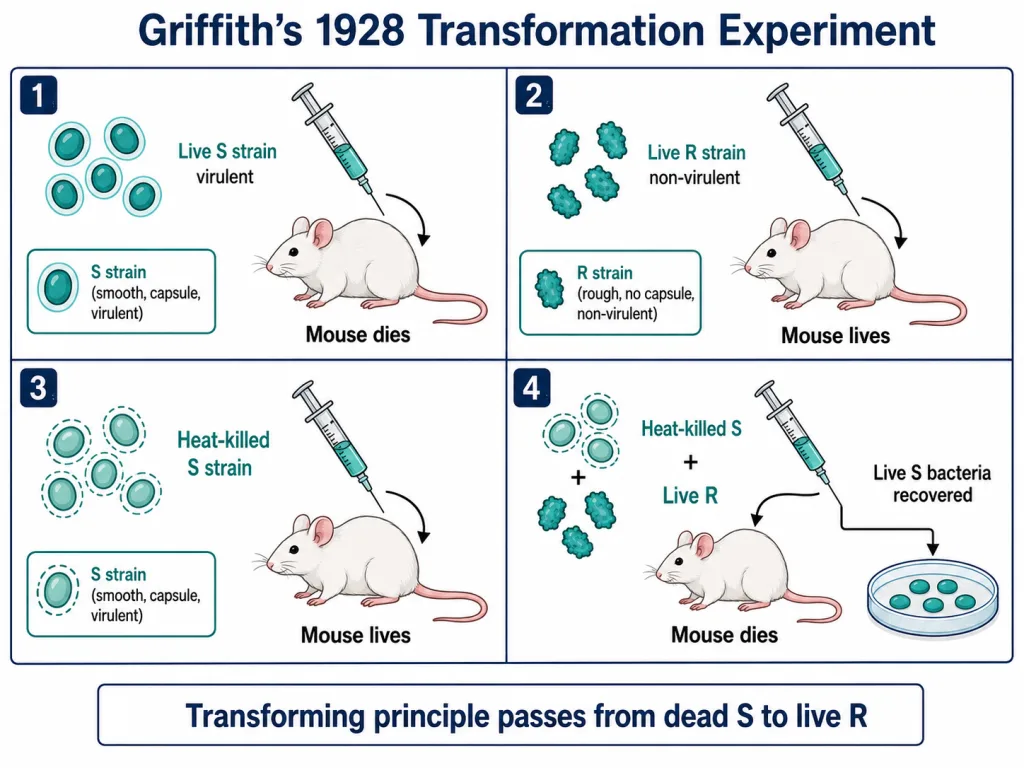
- Live S strain injected → mouse dies (S is virulent).
- Live R strain injected → mouse lives (R is harmless).
- Heat-killed S strain injected → mouse lives (dead bacteria cannot cause disease).
- Heat-killed S + live R injected together → mouse dies — and, astonishingly, live S bacteria are recovered from the dead mouse.
The fourth result is the shock. Neither heat-killed S (harmless on its own) nor live R (harmless on its own) should kill the mouse — yet together they did, and living, virulent S bacteria appeared where none had been injected alive.
The 'Transforming Principle'
Griffith reasoned that the harmless live R bacteria had been changed — transformed — into virulent S bacteria. Something had passed from the dead S cells into the living R cells, giving them the ability to build a smooth polysaccharide coat and become deadly.
He named this mysterious factor the 'transforming principle'. Because the change was inherited by the new S bacteria, this transforming principle had to be the genetic material itself, carried over from the heat-killed S strain.
There was, however, a clear limit to what Griffith could claim. His experiment proved that some heritable substance was transferred — but it did not reveal the biochemical nature of that substance. Was the transforming principle protein, RNA, or DNA? That question was left wide open.
[Board] State Griffith's conclusion exactly: a 'transforming principle' passed from heat-killed S to live R, transforming R into virulent S — but its chemical identity remained unknown.
Avery, MacLeod & McCarty — Naming the Molecule
Griffith left the chemistry unsolved, so Oswald Avery, Colin MacLeod and Maclyn McCarty (working through the 1930s and 40s) set out to identify the transforming principle. At the time, many still assumed it would turn out to be a protein.
Their strategy was elegant: from heat-killed S cells they purified the different biochemicals separately — proteins, DNA, RNA — and tested which one could transform live R cells into S cells. Then they destroyed each suspect with a specific enzyme:
- Protease (digests protein) → transformation still happened → so it is not protein.
- RNase (digests RNA) → transformation still happened → so it is not RNA.
- DNase (digests DNA) → transformation was abolished → so the transforming principle must be DNA.
Since destroying DNA — and only DNA — stopped the transformation, they concluded that DNA is the hereditary (genetic) material. Even so, not every biologist was convinced, which set the stage for the decisive experiment we meet in the next section.
[NEET Tip] The enzyme logic is the whole answer: DNase kills transformation (→ DNA is the genetic material); protease and RNase do not (→ rules out protein and RNA).
Memory Capsule — Section 4
- The search narrowed heredity to the chromosomes (protein + DNA); most scientists first suspected protein.
- Frederick Griffith (1928), Streptococcus pneumoniae: S = smooth, capsuled, virulent (kills mice); R = rough, no capsule, harmless.
- Heat-killed S alone = harmless; heat-killed S + live R → mouse dies, and live S recovered.
- Conclusion: a 'transforming principle' passed from dead S to live R — the genetic material — but its chemical nature was unknown.
- Avery, MacLeod & McCarty: purified biochemicals + enzymes showed DNase abolished transformation, while protease and RNase did not → the transforming principle is DNA.
Solved Examples — Section 4
Q1. Which scientist performed the transformation experiment, in which year, and with which bacterium?
Answer: Frederick Griffith, in 1928, using Streptococcus pneumoniae (pneumococcus), the bacterium that causes pneumonia. His work first revealed a 'transforming principle' passing between bacterial strains.
Q2. Compare the S and R strains of pneumococcus.
Answer: The S strain forms smooth colonies, has a polysaccharide capsule and is virulent (kills mice). The R strain forms rough colonies, has no capsule and is non-virulent (harmless). The capsule is the key difference.
Q3. Why did mice injected with heat-killed S strain survive, but mice injected with heat-killed S plus live R die?
Answer: Heat-killed S alone cannot cause disease, so the mouse lives. But when mixed with live R, a transforming principle from the dead S cells transforms the R cells into virulent S, which then kill the mouse.
Q4. What did Griffith recover from the dead mice in his key experiment, and what did it prove?
Answer: He recovered living, virulent S bacteria, even though only heat-killed S and live R had been injected. This proved that R had been transformed into S by some heritable factor passed from the dead S cells.
Q5. What was the main limitation of Griffith's experiment?
Answer: Griffith showed that a 'transforming principle' (genetic material) was transferred, but his experiment did not identify its biochemical nature — whether it was protein, RNA or DNA remained unknown.
Q6. How did Avery, MacLeod and McCarty show that the transforming principle is DNA?
Answer: They treated heat-killed S extracts with specific enzymes. Protease and RNase did not stop transformation, but DNase abolished it. Since destroying DNA alone prevented transformation, they concluded that DNA is the genetic material.