
Why a Code at All?
Replication and transcription were easy to picture — a nucleic acid copied into another nucleic acid, guided by complementarity. Translation is different. Here, information must pass from a polymer of nucleotides (RNA) to a polymer of amino acids (protein). But there is no complementarity between a nucleotide and an amino acid — none exists, and none can even be imagined. So how does the cell know which amino acid a piece of RNA stands for?
The answer is the genetic code — a set of rules that tells the cell which nucleotide sequence specifies which amino acid.
The puzzle was famously framed by the physicist George Gamow. There are only 4 bases but 20 amino acids to specify. A one-base code gives only 4 options; a two-base code gives — still not enough. Gamow argued the code must be a triplet: combinations, more than enough for 20 amino acids.
Proving the code was a triplet was tougher. Har Gobind Khorana chemically synthesised RNAs with defined base combinations; Marshall Nirenberg's cell-free system finally allowed the code to be cracked; and Severo Ochoa's enzyme (polynucleotide phosphorylase) helped make RNAs of known sequence. Together they built the famous codon table.
Codons — Reading the Table
A codon is a set of three adjacent nucleotides on the mRNA that specifies one amino acid. With 4 bases taken three at a time, there are exactly codons.
Of these 64:
- 61 codons code for amino acids.
- 3 codons code for no amino acid and act as stop (termination) codons: UAA, UAG, UGA.
One codon is special: AUG codes for the amino acid methionine and doubles as the start (initiator) codon.
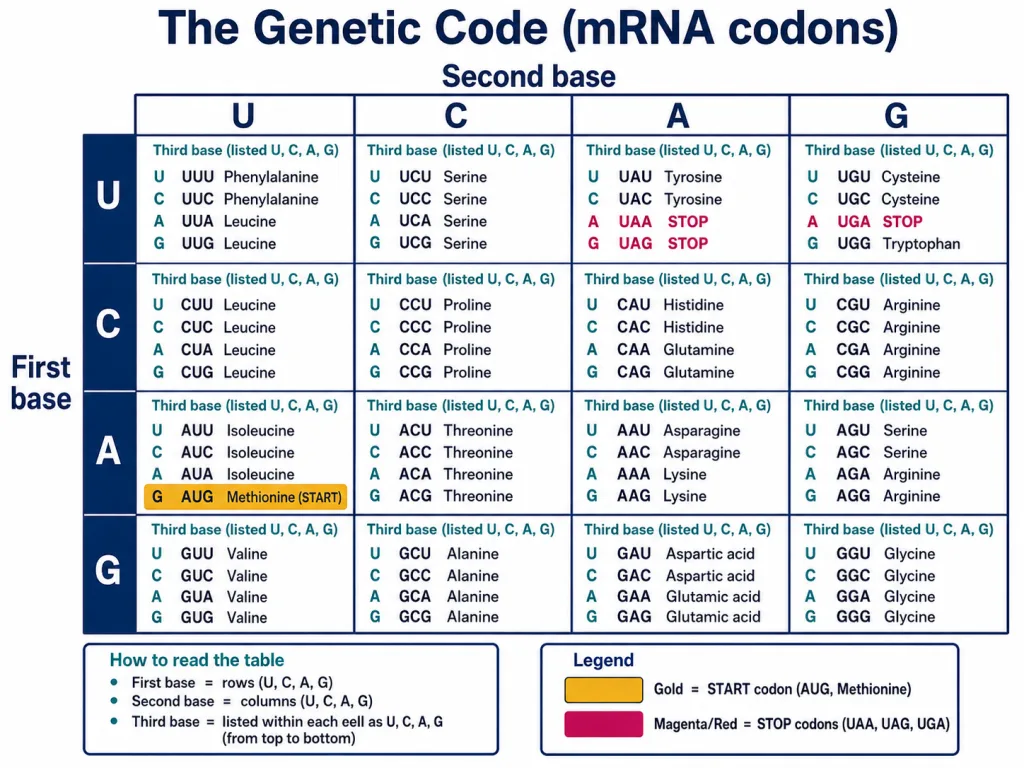
So, for example, the mRNA stretch AUG-UUU-UUC is read as: start/methionine — phenylalanine — phenylalanine. The reading always begins at AUG and runs codon by codon until a stop codon is reached.
[NEET Tip] Memorise the three stop codons with the phrase "U Are Annoying, U Are Gone, U Go Away" → UAA, UAG, UGA. And remember: AUG is both START and Methionine.
Salient Features of the Genetic Code
The genetic code has a set of defining features that examiners love:
- Triplet — three nucleotides code for one amino acid.
- Degenerate — most amino acids are coded by more than one codon (e.g., phenylalanine has UUU and UUC). The code has redundancy.
- Unambiguous & specific — one codon codes for one, and only one, amino acid. There is no confusion.
- Nearly universal — the same codon means the same amino acid from bacteria to humans (UUU = phenylalanine everywhere). A few exceptions exist, e.g. in mitochondrial codons and some protozoans.
- Comma-less — the code is read continuously, three bases at a time, with no punctuation between codons. (It is also non-overlapping — a related but separate general property.)
- AUG is the initiator — it both starts translation and codes for methionine.
[Board] Do not confuse degenerate with ambiguous. Degenerate = one amino acid may have several codons. Unambiguous = one codon never codes for two different amino acids. Both are true at the same time.
tRNA — the Adapter Molecule
Right after the code was proposed, Francis Crick realised there had to be a go-between. Amino acids have no chemical feature that lets them "read" a codon directly. So Crick postulated an adapter molecule — something that could read the code on one side and hold the matching amino acid on the other.
That adapter turned out to be tRNA (transfer RNA), which was already known at the time as sRNA (soluble RNA); only later was its adapter role recognised.
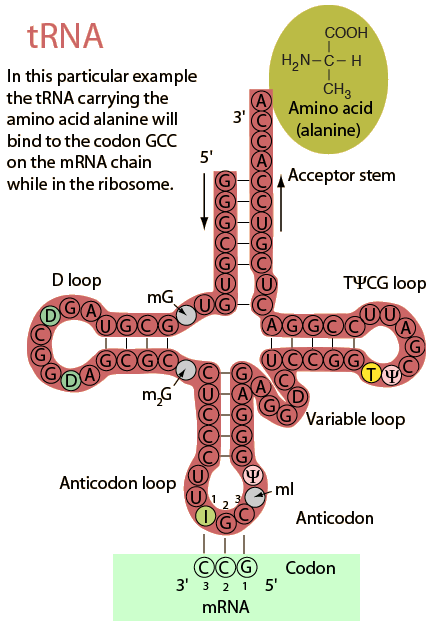
A tRNA has two business ends:
- An anticodon loop with bases complementary to the codon on the mRNA — this is how it "reads" the code.
- An amino-acid acceptor end to which the specific amino acid is attached.
tRNAs are specific for each amino acid. There is also a special initiator tRNA for starting translation, and crucially there are no tRNAs for the stop codons — which is why a stop codon ends the chain.
[NEET Tip] Codon (mRNA) and anticodon (tRNA) are complementary and antiparallel — pair them like any two nucleic acid strands.
Structure of tRNA & Mutations of the Reading Frame
The secondary structure of tRNA looks like a clover-leaf, while its actual three-dimensional shape is a compact inverted-L. The clover-leaf clearly shows the anticodon loop at one end and the amino-acid acceptor arm at the other.
The genetic code is also illuminated by mutations. Because the code is read in fixed triplets with no punctuation, inserting or deleting one or two bases shifts the entire reading frame from that point onward — a frameshift mutation — scrambling every codon downstream. But inserting or deleting three bases (or a multiple of three) only adds or removes whole codons and leaves the rest of the reading frame intact.
Think of the sentence of three-letter words: RAM HAS RED CAP. Insert one letter and rearrange — RAM HAS BRE DCA P — and everything after the insertion turns to nonsense. Add three letters together — RAM HAS BIG RED CAP — and the rest still reads fine.
A single-base change can also matter: in sickle-cell anaemia, one base change in the beta-globin gene swaps glutamate for valine.
Memory Capsule — Section 9
- Codon = 3 adjacent nucleotides → 1 amino acid; total codons.
- 61 code for amino acids; 3 stop codons = UAA, UAG, UGA.
- AUG = methionine and start/initiator codon.
- Features: triplet · degenerate · unambiguous/specific · nearly universal · comma-less · AUG initiator.
- Crick postulated the adapter = tRNA (earlier called sRNA).
- tRNA has an anticodon loop (complementary to codon) and an amino-acid acceptor end; clover-leaf secondary structure.
- Special initiator tRNA; no tRNAs for stop codons.
Solved Examples — Section 9
Q1. Why must the genetic code be a triplet code rather than a singlet or doublet?
Answer: There are only 4 bases but 20 amino acids. A singlet codes for 4, a doublet for — both too few. A triplet gives combinations, enough to specify all 20 amino acids (with codons to spare). George Gamow first argued for this.
Q2. How many of the 64 codons code for amino acids, and what do the rest do?
Answer: 61 codons code for amino acids; the remaining 3 (UAA, UAG, UGA) are stop/termination codons and code for no amino acid.
Q3. What is meant by saying the genetic code is "degenerate" but "unambiguous"?
Answer: Degenerate means most amino acids are coded by more than one codon (the code is redundant). Unambiguous means one codon specifies one, and only one, amino acid — it never codes for two. Both statements are true simultaneously.
Q4. State the two functions of the codon AUG.
Answer: AUG codes for the amino acid methionine, and it also serves as the start (initiator) codon that signals where translation begins.
Q5. Who postulated the adapter molecule, and what features let tRNA play this role?
Answer: Francis Crick postulated the adapter. tRNA fits the role because it has an anticodon loop (bases complementary to the codon, so it reads the code) and an amino-acid acceptor end (which binds the specific amino acid) — linking nucleotide language to amino-acid language.
Q6. Why does a stop codon end protein synthesis?
Answer: There are no tRNAs for stop codons (UAA, UAG, UGA). With no tRNA able to read them, no amino acid can be added; instead a release factor recognises the stop codon and translation terminates, releasing the polypeptide.