
The Building Block — A Nucleotide
A single nucleotide is built from three parts:
- A nitrogenous base
- A pentose sugar — deoxyribose in DNA, ribose in RNA
- A phosphate group
The nitrogenous bases come in two families:
- Purines (double-ring): Adenine (A) and Guanine (G)
- Pyrimidines (single-ring): Cytosine (C), Thymine (T) and Uracil (U)
Cytosine is found in both DNA and RNA. Thymine occurs in DNA, while Uracil replaces thymine in RNA (thymine is simply 5-methyl uracil).
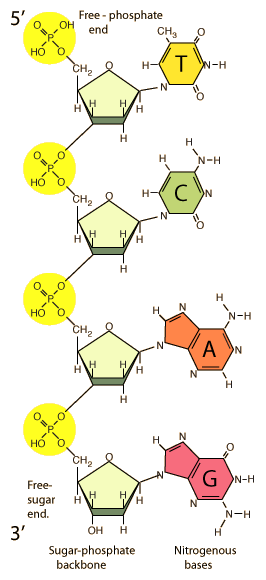
Putting the parts together:
- Base + sugar (joined at the 1' carbon by an N-glycosidic linkage) = a nucleoside (e.g., adenosine, deoxyadenosine).
- Nucleoside + phosphate (joined at the 5' carbon by a phosphoester linkage) = a nucleotide.
[NEET Tip] Base + sugar = nucleoside; add phosphate and you get a nucleotide. Mixing these two up is a classic trap.
Linking Nucleotides — The Sugar–Phosphate Backbone
Two nucleotides join through a 3'–5' phosphodiester linkage (a phosphate bridges the 3' carbon of one sugar and the 5' carbon of the next). Repeating this builds a long polynucleotide chain.
The chain has direction (polarity):
- At one end the sugar carries a free phosphate on the 5' carbon — the 5'-end.
- At the other end the sugar has a free –OH on the 3' carbon — the 3'-end.
The backbone is made only of sugars and phosphates; the nitrogenous bases project from this backbone. It is the sequence of these bases that carries the genetic information.
DNA vs RNA — Two Chemical Differences
RNA differs from DNA in just two small but important ways:
| Feature | DNA | RNA |
|---|---|---|
| Pentose sugar | Deoxyribose (no –OH at 2') | Ribose (extra –OH at the 2' position) |
| Pyrimidine base | Thymine | Uracil (thymine is 5-methyl uracil) |
That extra 2'-OH makes RNA more reactive and less stable than DNA — one reason DNA is the better long-term store of information.
The Double Helix — Watson & Crick (1953)
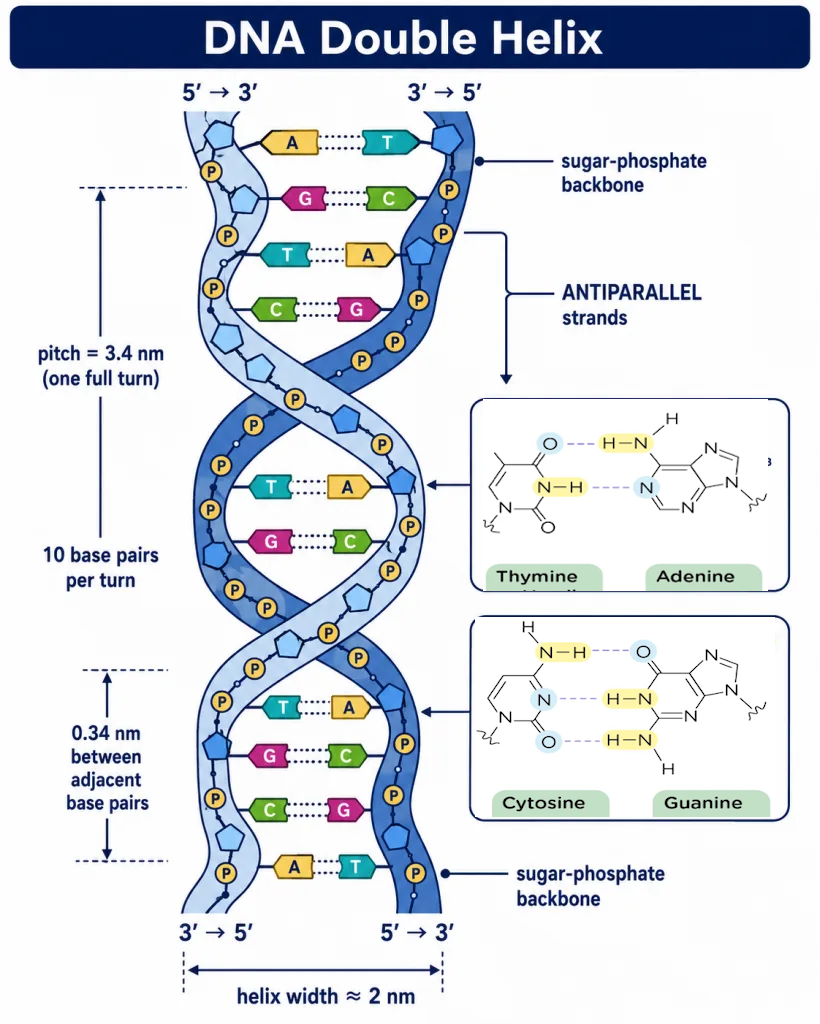
In 1953, James Watson and Francis Crick proposed the famous double-helix model of DNA. They built it using the X-ray diffraction data of Maurice Wilkins and Rosalind Franklin, together with a crucial clue from Erwin Chargaff.
Chargaff's rule: in any double-stranded DNA, the amount of Adenine equals Thymine and Guanine equals Cytosine — so the ratios A/T and G/C are each equal to 1 (and total purines = total pyrimidines). This equality is exactly what you'd expect if A always pairs with T and G always pairs with C.
Because the two strands pair in this fixed way, they are complementary — knowing the sequence of one strand lets you predict the other. This is also what makes faithful copying (replication) possible.
Salient Features of the Double Helix
Watson and Crick's model has five key features worth memorising:
- Two polynucleotide chains with a sugar–phosphate backbone on the outside and the bases facing inward.
- The two chains are antiparallel — one runs 5'→3', the other 3'→5'.
- The bases pair through hydrogen bonds: A=T with 2 H-bonds, G≡C with 3 H-bonds. A purine always pairs with a pyrimidine, keeping the helix a uniform width.
- The chains are coiled right-handed, with a pitch of 3.4 nm, about 10 base pairs per turn, so adjacent base pairs sit 0.34 nm apart.
- The flat base pairs stack on one another; this base stacking, along with the H-bonds, stabilises the helix.
Key numbers: pitch 3.4 nm · 10 bp/turn · 0.34 nm between base pairs · A=T 2 bonds · G≡C 3 bonds.
Memory Capsule — Section 2
- Nucleoside = base + sugar; nucleotide = nucleoside + phosphate.
- Purines: A, G (double ring). Pyrimidines: C, T, U (single ring).
- Nucleotides join by 3'–5' phosphodiester bonds; chain runs 5'-end → 3'-end.
- RNA vs DNA: ribose has a 2'-OH; uracil replaces thymine.
- Chargaff: A = T, G = C (A/T = G/C = 1).
- Double helix: antiparallel · right-handed · A=T 2 H-bonds, G≡C 3 H-bonds · pitch 3.4 nm · 10 bp/turn · 0.34 nm/bp.
Solved Examples — Section 2
Q1. What is the difference between a nucleoside and a nucleotide?
Answer: A nucleoside is a nitrogenous base joined to a sugar (e.g., adenosine). A nucleotide is a nucleoside plus a phosphate group. In short: nucleotide = nucleoside + phosphate.
Q2. Classify the five nitrogenous bases as purines or pyrimidines, and state which is unique to DNA and which to RNA.
Answer: Purines: adenine and guanine. Pyrimidines: cytosine, thymine and uracil. Thymine is unique to DNA; uracil is unique to RNA (it replaces thymine).
Q3. A double-stranded DNA contains 30% adenine. What percentage of guanine does it have?
Answer: 20%. By Chargaff's rule A = T = 30%, so A + T = 60%, leaving 40% for G + C. Since G = C, each is 20%.
Q4. Why does a purine always pair with a pyrimidine in the double helix?
Answer: Pairing a double-ring purine with a single-ring pyrimidine keeps the distance between the two backbones constant (about 2 nm), giving the helix a uniform width. Two purines would be too wide and two pyrimidines too narrow.
Q5. How many hydrogen bonds form between A–T and between G–C? Which base pair makes DNA harder to separate?
Answer: A=T has 2 hydrogen bonds; G≡C has 3. DNA rich in G–C pairs is harder to separate (denature) because each G–C pair holds with an extra hydrogen bond.
Q6. The two strands of DNA are described as "antiparallel." What does this mean?
Answer: The two strands run in opposite directions — if one strand goes 5'→3', the partner strand alongside it goes 3'→5'. They are not simply parallel copies; they are oriented head-to-tail relative to each other.