
What Transcription Means
Transcription is the process of copying genetic information from one strand of DNA into RNA. It is the first step of the central dogma — turning the DNA archive into a working RNA message.
The same rule that guided replication — complementary base pairing — also governs transcription, with one twist: since RNA has no thymine, adenine on the DNA template pairs with uracil (U) in the new RNA strand instead of thymine.
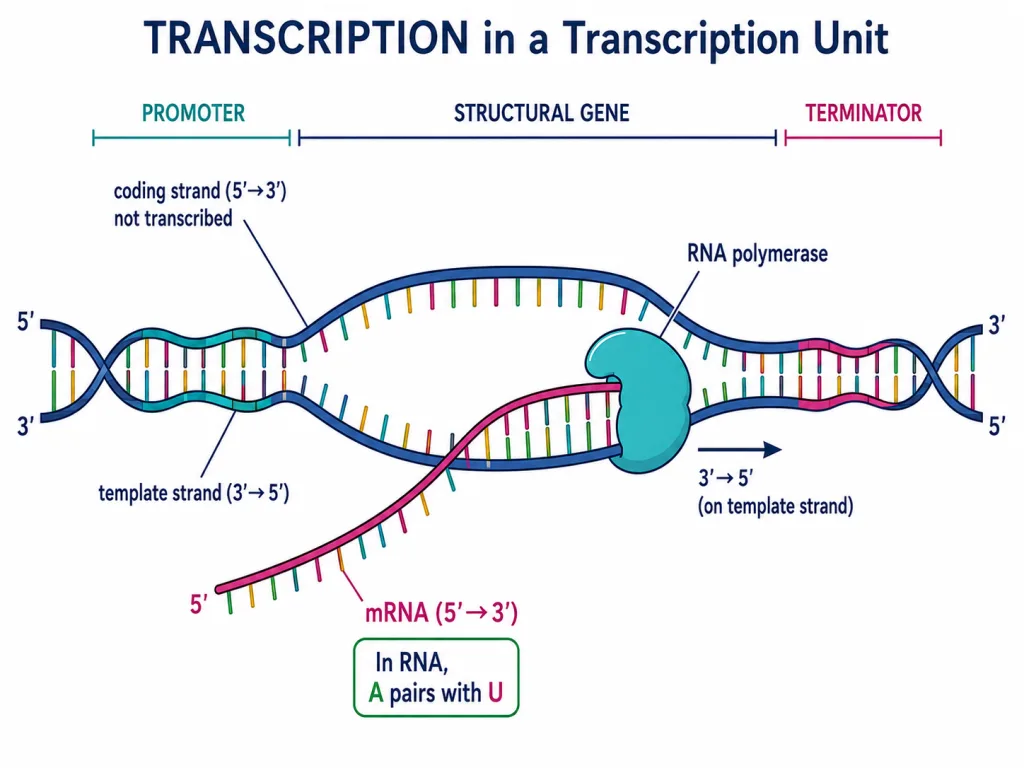
Two big differences set transcription apart from replication:
- In replication, the entire DNA of the cell is duplicated. In transcription, only a small segment of DNA is copied.
- In replication, both strands are copied. In transcription, only one strand is used as the template.
Because only a part is copied, the cell needs clear signposts marking where to start, where to stop, and which strand to read. That is exactly what a transcription unit provides.
The Transcription Unit — Three Parts
A transcription unit is defined by three regions on the DNA:
- A Promoter
- The Structural gene
- A Terminator
The promoter and terminator flank the structural gene. By convention, all positions are described with respect to the coding strand:
- The promoter lies towards the 5'-end (upstream) of the structural gene. It is a DNA sequence that provides the binding site for RNA polymerase, and its position is what decides which strand is template and which is coding.
- The terminator lies towards the 3'-end (downstream) and usually marks where transcription stops.
A neat consequence: if you swapped the positions of promoter and terminator, the definitions of coding and template strand would flip — so the promoter effectively defines the two strands.
[Board] Remember the order along the coding strand (5'→3'): Promoter → Structural gene → Terminator.
Template Strand vs Coding Strand
The enzyme DNA-dependent RNA polymerase can build RNA in only one direction, 5'→3'. So it must read its template in the 3'→5' direction.
- The strand with 3'→5' polarity is read by the enzyme — this is the template strand.
- The other strand has 5'→3' polarity and a sequence identical to the RNA made (except T appears where the RNA has U). This strand is displaced and not transcribed, yet — somewhat oddly — it is called the coding strand.
A worked example with a hypothetical sequence:
3'-ATGCATGCATGCATGC-5'   Template Strand
5'-TACGTACGTACGTACG-3'   Coding Strand
The RNA is made complementary to the template (A→U), so it reads 5'-UACGUACGUACGUACG-3' — the same as the coding strand but with U replacing T.
[NEET Tip] The RNA sequence always matches the coding strand (swap T for U). The strand actually copied is the template strand.
The Gene, Split Genes & RNA Polymerases
A gene is the functional unit of inheritance. A segment of DNA coding for one polypeptide is a cistron, so a structural gene may be monocistronic (mostly eukaryotes) or polycistronic (mostly bacteria).
In eukaryotes, genes are split: the coding exons (which appear in the mature RNA) are interrupted by non-coding introns (intervening sequences that do not appear in the mature RNA).
RNA polymerases — who makes the RNA?
- In bacteria, a single DNA-dependent RNA polymerase makes all three types of RNA. It binds the promoter (initiation), elongates, and releases the RNA at the terminator (termination). It associates with an initiation factor (sigma) to start and a termination factor (rho) to stop.
- In eukaryotes, there are three RNA polymerases with a division of labour:
| Enzyme | Transcribes |
|---|---|
| RNA polymerase I | rRNAs (28S, 18S, 5.8S) |
| RNA polymerase II | hnRNA (precursor of mRNA) |
| RNA polymerase III | tRNA, 5S rRNA, snRNAs |
Processing of hnRNA & the Three RNA Types
In bacteria the mRNA needs no processing — and since there is no nucleus, transcription and translation happen in the same compartment and can even be coupled (translation begins before transcription finishes).
In eukaryotes the primary transcript (hnRNA, heterogeneous nuclear RNA) contains both exons and introns and is non-functional. It is matured in three steps:
- Splicing — introns are removed and exons are joined in order.
- Capping — an unusual nucleotide, methyl guanosine triphosphate, is added to the 5'-end.
- Tailing — a poly-A tail (about 200–300 adenylate residues) is added to the 3'-end, in a template-independent way.
The fully processed hnRNA — now called mRNA — is exported from the nucleus for translation.
The three RNA types and their jobs:
- mRNA — provides the template / message.
- tRNA — the adapter; brings amino acids and reads the code.
- rRNA — structural and catalytic during translation.
Memory Capsule — Section 8
- Transcription = DNA → RNA; only one strand, only a segment is copied. A pairs with U in RNA.
- Transcription unit = Promoter + Structural gene + Terminator (order along coding strand).
- Template strand = 3'→5', the one read by RNA polymerase. Coding strand = 5'→3', same sequence as RNA (T for U), not transcribed.
- Enzyme = DNA-dependent RNA polymerase; works 5'→3'. Bacteria: one polymerase (sigma initiates, rho terminates).
- Eukaryotes: RNA pol I = rRNA · RNA pol II = hnRNA (mRNA precursor) · RNA pol III = tRNA, 5S rRNA, snRNA.
- Eukaryotic genes are split (exons + introns). hnRNA → mRNA via splicing + capping (5') + tailing (3', poly-A).
- RNA types: mRNA (message) · tRNA (adapter) · rRNA (structural/catalytic).
Solved Examples — Section 8
Q1. Name the three regions of a transcription unit in their correct order along the coding strand.
Answer: Promoter → Structural gene → Terminator. The promoter lies upstream (towards the 5'-end of the coding strand) and the terminator downstream (towards the 3'-end).
Q2. A template strand reads 3'-TACGGT-5'. Write the sequence of the RNA transcribed from it.
Answer: 5'-AUGCCA-3'. Pair each template base with its complement, using U opposite A (A→U, T→A, C→G, G→C), and write the RNA 5'→3'.
Q3. Why is the strand that is not transcribed called the "coding" strand?
Answer: Its sequence is identical to the RNA that is made (with thymine in place of uracil). So even though it is displaced and not copied, it reads like the coding message — hence the name. The strand actually copied is the template strand.
Q4. How does transcription in bacteria differ from that in eukaryotes in terms of the polymerase used?
Answer: Bacteria use a single RNA polymerase for all RNA types. Eukaryotes have three: RNA pol I (rRNAs), RNA pol II (hnRNA, the mRNA precursor) and RNA pol III (tRNA, 5S rRNA, snRNAs).
Q5. List the three processing events that convert hnRNA into mature mRNA in eukaryotes.
Answer: (1) Splicing — introns removed, exons joined; (2) Capping — methyl guanosine triphosphate added at the 5'-end; (3) Tailing — a poly-A tail added at the 3'-end.
Q6. Why are both strands of DNA not transcribed at the same time?
Answer: If both were copied they would give two RNAs of different sequences (one segment coding for two proteins, complicating information transfer), and these complementary RNAs would pair into a double-stranded RNA that could not be translated. So only one strand is used.