
What Translation Means
We have seen DNA copied into RNA during transcription. Now comes the final step of the central dogma — turning that RNA message into a protein. Translation is the process of polymerising amino acids into a polypeptide, and the crucial point is this: the order and sequence of amino acids is dictated by the base sequence in the mRNA.
Think of mRNA as a written instruction and the polypeptide as the product built by reading those instructions three letters (one codon) at a time. The amino acids in the growing chain are joined to one another by peptide bonds, and forming each peptide bond costs energy.
First Step — Charging the tRNA
Because forming a peptide bond needs energy, the cell prepares its amino acids in advance. In the very first phase, each amino acid is activated using ATP and then attached to its specific (cognate) tRNA.
This loading step has two names you should know:
- Charging of tRNA, or more precisely,
- Aminoacylation of tRNA.
Once two such charged tRNAs are brought close together on the mRNA, the formation of a peptide bond between their amino acids becomes energetically favourable. A catalyst then speeds the reaction up.
[NEET Tip] "Charging" and "aminoacylation" mean the same thing — activating an amino acid and joining it to its tRNA. This is the energy-investing step before the ribosome ever gets involved.
The Ribosome — The Protein Factory
The ribosome is the site of protein synthesis — the cellular factory where amino acids are stitched together. It is built from structural rRNAs and about 80 different proteins, and in its inactive state it exists as two subunits: a large one and a small one.
When the small subunit meets an mRNA, translation begins. The large subunit carries two sites that hold incoming amino-acid–tRNA complexes close enough for a peptide bond to form.
Most remarkably, the ribosome is also a catalyst: in bacteria the 23S rRNA acts as the enzyme — a ribozyme — that actually forms the peptide bond. So an RNA, not a protein, does the chemistry of joining amino acids.
The Three Stages — Initiation, Elongation, Termination
Translation proceeds in three neat stages:
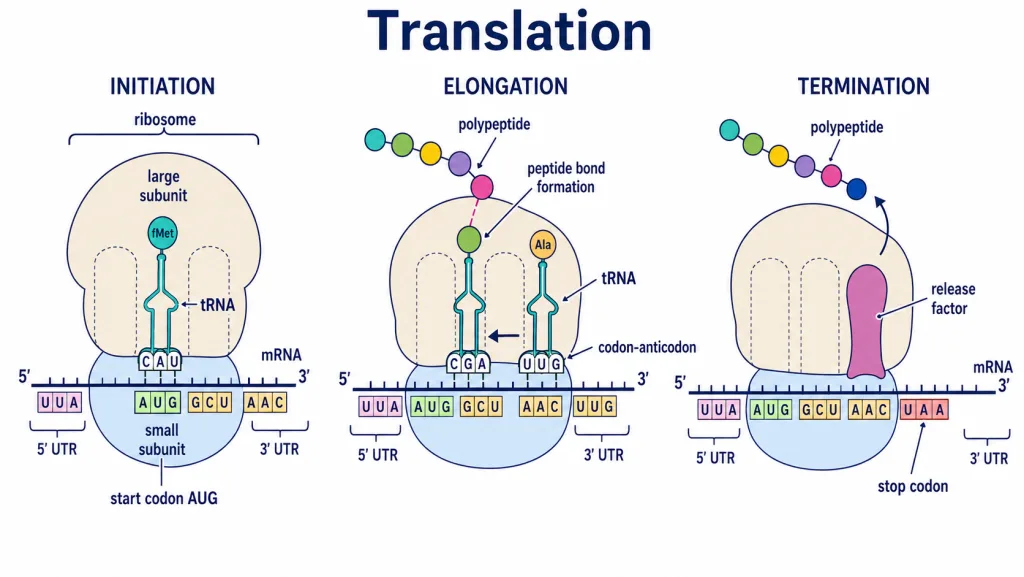
1. Initiation — The small ribosomal subunit binds the mRNA at the start codon AUG, which is recognised only by the special initiator tRNA. The large subunit then joins, assembling the complete ribosome at the start.
2. Elongation — Charged tRNAs arrive one by one. Each tRNA's anticodon base-pairs with the matching codon on the mRNA, the ribosome moves codon by codon, and amino acids are added one at a time, linked by peptide bonds. The polypeptide grows in the order dictated by the mRNA.
3. Termination — When the ribosome reaches a stop codon, a release factor binds there. This ends translation and releases the completed polypeptide from the ribosome.
The mRNA Has More Than Just Code
A translational unit in mRNA is the stretch flanked by the start codon (AUG) and the stop codon — this is the part that actually codes for the polypeptide.
But the mRNA carries extra sequences that are not translated, called untranslated regions (UTRs):
- A 5' UTR lies before the start codon.
- A 3' UTR lies after the stop codon.
These UTRs do not become part of the protein, yet they are not useless — they are required for efficient translation. So an mRNA reads, in order: 5' UTR → start codon → coding region → stop codon → 3' UTR.
[Board] UTRs are present at both the 5' and 3' ends and help translation run efficiently, even though they are never decoded into amino acids.
Memory Capsule — Section 10
- Translation = polymerising amino acids into a polypeptide; the mRNA base sequence dictates the amino-acid order.
- Amino acids join by peptide bonds (energy-requiring); first they are activated by ATP and loaded onto tRNA — charging / aminoacylation.
- Ribosome = site of protein synthesis; two subunits; the rRNA acts as a ribozyme (23S in bacteria) that forms the peptide bond.
- Initiation (small subunit + mRNA + initiator tRNA at AUG) → Elongation (codon-by-codon addition) → Termination (release factor at a stop codon frees the polypeptide).
- UTRs at 5' (before start) and 3' (after stop) ends are untranslated but aid efficient translation.
Solved Examples — Section 10
Q1. Define translation and state what decides the order of amino acids in the polypeptide.
Answer: Translation is the polymerisation of amino acids into a polypeptide. The order and sequence of amino acids is dictated by the sequence of bases in the mRNA.
Q2. What is meant by "charging" of tRNA, and why is it needed before peptide-bond formation?
Answer: Charging (also called aminoacylation) is the activation of an amino acid using ATP and its attachment to the cognate tRNA. It supplies the energy and pairs each amino acid with the right tRNA, so that when two charged tRNAs come close, a peptide bond can form readily.
Q3. Which molecule is the site of protein synthesis, and what catalyses peptide-bond formation?
Answer: The ribosome is the site of protein synthesis. The rRNA itself acts as a ribozyme (the 23S rRNA in bacteria) and catalyses the formation of the peptide bond.
Q4. Name the three stages of translation and the signal that begins and ends the process.
Answer: Initiation, elongation and termination. Translation begins at the start codon AUG (read by the initiator tRNA) and ends at a stop codon, where a release factor frees the polypeptide.
Q5. What are UTRs, where are they found, and what is their role?
Answer: Untranslated regions are mRNA sequences that are not translated. They lie at both the 5' end (before the start codon) and the 3' end (after the stop codon) and are required for efficient translation.
Q6. During elongation, how does the ribosome pick the correct amino acid for each codon?
Answer: Each charged tRNA brings a specific amino acid, and its anticodon base-pairs with the complementary codon on the mRNA. The ribosome moves codon by codon, adding amino acids one at a time in the sequence the mRNA specifies.